Hotels in Courchevel

4 villages stacked on a slope in the world's largest ski area

Courchevel

LanguageEnglish
CurrencyEUR
TimezoneGMT+1
Temperature8-25 °C
Dial Code+33
Population68.2M
Area640,679 km²
SocketsType C / Type E
Tap waterDrinkable

Discover Courchevel

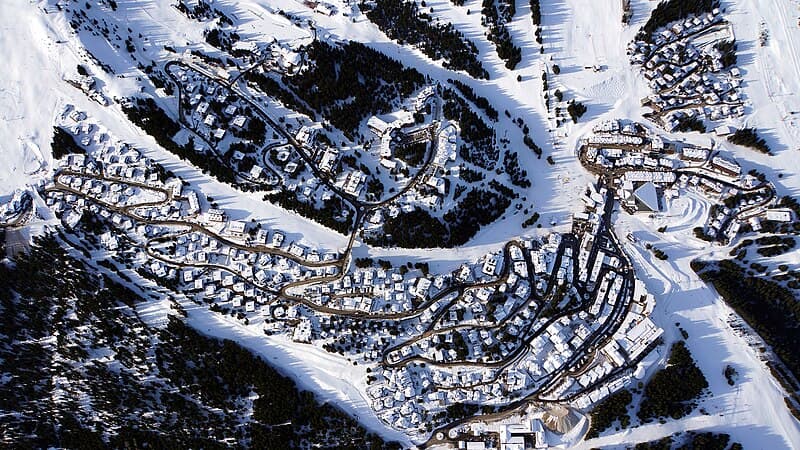
Courchevel isn't one village but 4 settlements built one above the other on the slope of the Tarentaise valley, and the difference between them is crucial for both price and the shape of your holiday. Lowest down is Le Praz at 1,300 metres, still with original Savoyard cottages; above it are Village and Moriond; and at the top is Courchevel 1850, the highest, most expensive, and home to more 5-star hotels than any other Alpine resort. It was built from scratch after the Second World War as the first French resort planned on an untouched slope, and it shows in how it was designed: the pistes run straight into the village, and you can ski almost everywhere. Courchevel is part of the Three Valleys, the largest linked ski area in the world, with 600 km of pistes on a single lift pass. In the middle of the village is a runway for small aircraft, where planes land uphill.

What to see

The places worth your time in Courchevel, and what to expect at each

Saulire

Saulire

above Courchevel 1850

A peak at 2,738 metres, reached from Courchevel by cable car, from where you can cross over into neighbouring Méribel. It's the main crossroads of the Three Valleys, and from the summit platform you can see Mont Blanc, the Vanoise and La Grande Casse.

Tip: You can go up even without skis — the cable car runs in both winter and the summer season, and a pedestrian ticket costs a fraction of the ski pass. The morning ride up to Saulire around 9am is the only way to avoid the queue that forms around 11am. It's windy up top and typically 8 degrees colder than in the village.

Admission:
pedestrian ticket from €22
Time needed:
half a day
Three Valleys

Three Valleys

the whole area

A linked area covering Courchevel, Méribel, Les Menuires, Val Thorens and Orelle, with 600 km of pistes and 160 lifts on a single pass — the largest in the world. From Courchevel you can ski all the way to Val Thorens at 2,300 metres and back in a single day.

Tip: The round trip to Val Thorens and back takes a whole day, and you need to set off before 9am to catch the last lift back around 4:30pm. Anyone who misses it pays around €150 for a taxi across the valley. The route back via Méribel is longer but safer than the descent into Mottaret.

Admission:
Three Valleys ski pass from €72
Time needed:
a full day
Courchevel 1850 and La Croisette

Courchevel 1850 and La Croisette

Courchevel 1850

The highest of the settlements, home to most of the luxury hotels, designer shops and the main lift terminal at La Croisette. The pistes run right between the buildings and the streets light up in the evening; it has the best access to the whole area, but also the highest prices in the Alps.

Tip: Restaurant prices on La Croisette are half as much again as in Moriond, 200 metres below, which has a free lift and ski bus. At the Sherpa supermarket up top, goods cost more than in Le Praz. Anyone wanting an expensive dinner should do it at lunch instead, when the set menu is usually half the price.

Admission:
free
Time needed:
2 h
The Altiport

The Altiport

above Courchevel 1850

A runway 537 metres long, set directly into the slope above the village, with an 18.5% gradient — planes land uphill and take off downhill. It's among the most demanding airports in the world, and pilots need special qualifications to use it. It appeared in the opening scene of a James Bond film.

Tip: A piste and footpath run alongside the runway, from where you can watch landings up close for free; most flights come on Saturday mornings during the changeover. Scenic flights over Mont Blanc from here cost from €200 per person and last half an hour.

Admission:
free, scenic flight from €200
Time needed:
1 h
Le Praz and the ski jumps

Le Praz and the ski jumps

Courchevel Le Praz

The lowest and oldest settlement, at 1,300 metres, with original Savoyard cottages of stone and wood, a small lake and forest around it. It's home to the ski jumps built for the 1992 Albertville Olympics, still in use today and covered in synthetic matting in summer.

Tip: It's the cheapest place to stay in Courchevel, yet a cable car still runs up to La Croisette in 8 minutes. Restaurants here have normal French prices. You can walk to the ski jumps, and the take-off tower offers a view over the whole valley.

Admission:
free
Time needed:
2 h
Méribel and Mottaret

Méribel and Mottaret

the neighbouring valley

A neighbouring resort over the Saulire ridge, which differs from Courchevel in its architecture: buildings must be built only from wood and stone with shingle roofs, a rule set by its British founder in 1938. The valley sits in the middle of the Three Valleys, making it the closest point to both sides.

Tip: The crossing from Courchevel takes 20 minutes on skis and is included in the Three Valleys pass. Restaurants on the slopes in Méribel are a third cheaper than in Courchevel 1850. In summer there's a bus here from Courchevel, and it's also a starting point for routes into the Vanoise National Park.

Admission:
included in the ski pass
Time needed:
a full day
Val Thorens

Val Thorens

the far end of the Three Valleys

Europe's highest resort, at 2,300 metres, at the far end of the Three Valleys. Snow is reliable here from November to May, and above it rises the Péclet glacier, with a cable car up to 3,200 metres. Cars aren't allowed into the village, which is entirely pedestrian.

Tip: From Courchevel it's a full day's expedition on skis, and you need to watch the time for the last lifts back, which run around 4:30pm. The pistes here sit above the treeline, so visibility is worse than in Courchevel in fog and snowfall — don't come here in that kind of weather.

Admission:
included in the ski pass
Time needed:
a full day
Vanoise National Park

Vanoise National Park

south of the resort

France's first national park, founded in 1963 to protect the ibex, of which only a few dozen remained at the time and there are now 2,000. It borders Italy's Gran Paradiso park, and together they form the largest protected area in Western Europe. 500 km of marked trails run through it.

Tip: The nearest entrance from Courchevel is via Pralognan or from Méribel, and it's a full-day trip. Ibex graze above 2,000 metres early in the morning and in the evening, resting in the shade of the rocks around midday. Camping, picking plants and bringing dogs, even on a lead, are all banned in the park.

Admission:
free
Time needed:
a full day
Bozel and the valley below the resort

Bozel and the valley below the resort

12 km below the resort

A village at 900 metres at the bottom of the valley, through which you drive up to Courchevel. It has a lake for swimming, a market, everyday shops, and gives a sense of what the Tarentaise looked like before skiing arrived. Paths lead out to the villages of Champagny and Pralognan.

Tip: Prices here for everything are half those in the resort, which applies to the supermarket, the rental shop and restaurants alike — anyone arriving by car should shop here, not up top. The lake has pleasant water for swimming in summer and is free. A bus runs up to Courchevel several times a day.

Admission:
free
Time needed:
half a day

Photos: Saulire — Florian Pépellin (CC BY-SA 4.0) · Three Valleys — DimiTalen (CC0) · Courchevel 1850 and La Croisette — Nikgrech (CC BY-SA 3.0) · The Altiport — Hugues Mitton (hugovoyages) (CC BY-SA 2.5) · Le Praz and the ski jumps — Ruth Hartnup from Vancouver, Canada (CC BY 2.0) · Méribel and Mottaret — Jean-Maurice Gouédard (CC BY 3.0) · Val Thorens — DimiTalen (CC0) · Vanoise National Park — Ibex73 (CC BY-SA 4.0) · Bozel and the valley below the resort — JC CARRE (CC BY-SA 3.0)

Where to stay

Areas and districts, matched to the kind of trip you are taking

Courchevel 1850

Best for: the best access to the slopes and luxury

The highest settlement, with most of the hotels, shops and the main lift terminal. You can ski right to the door, and it has the resort's only real nightlife in the evening. In exchange, prices are the highest in the whole Alps, for both accommodation and food.

Moriond and Village

Best for: a compromise between price and location

2 mid-level settlements at 1,300 and 1,500 metres, linked to the top by both lifts and the ski bus. Accommodation costs roughly a third less than up top, and the slopes are still right from the door. Moriond also faces south and gets the most sun in the whole resort.

Le Praz

Best for: the lowest prices and an original village

The lowest and oldest settlement, at 1,300 metres, with stone cottages, forest and the Olympic ski jumps. Restaurants here have normal French prices, and the cable car up takes 8 minutes. The downside is the lower altitude, where snow may not lie at the start and end of the season.

La Tania and Bozel

Best for: families and the cheapest accommodation

A small resort in the forest below Courchevel, and a village at the bottom of the valley. Accommodation is the cheapest in the area, and La Tania is linked to the ski area by a lift straight from its centre. Bozel is an ordinary town with shops at normal prices, but getting around from there without a car is inconvenient.

Getting around

From the airport

The nearest major airport is Geneva, 150 km and 2.5 hours away by car; direct buses and shared transfers run in season. A cheaper option is the train: the TGV from Paris or Geneva runs to Moûtiers, a station 24 km below the resort, from where a bus runs up in 45 minutes. On Saturdays, when guests change over, the road up gets jammed and the journey from Moûtiers can take up to 2 hours. Tolls apply on French motorways, and winter tyres or snow chains are compulsory in mountain departments from November to March.

Geneva (GVA) · 150 km

  • Shared transfer· 2 h 30 min· €60
  • Altibus coach· 3 h 30 min· €45
  • Car hire· 2 h 30 min

Lyon Saint-Exupéry (LYS) · 190 km

  • Altibus coach· 3 h 30 min· €50
  • Car hire· 2 h 45 min

Chambéry (CMF) · 110 km

  • Bus via Moûtiers· 2 h 30 min· €40
  • Car hire· 1 h 50 min

Around town

Free ski buses run within the resort between all 4 levels, every 10–15 minutes, and in season until 1am. Alongside them are free lifts and escalators linking the levels of the village — without them there's a 50-metre difference in altitude between La Croisette and the lower streets. You can ski right to the door of most hotels, which is the main reason cars aren't used here; parking is also chargeable, costing up to €25 a day in 1850. Local buses run several times a day for trips outside the area, to Bozel, Pralognan and the national park.

Ski busesFree between Le Praz, Village, Moriond and 1850, running until 1am in winter. Tend to be full between 8am and 9am in peak season. · free
Cable cars and lifts160 lifts on the Three Valleys ski pass, more than 20 of them leaving from Courchevel. A pedestrian ticket for a single cable car costs a fraction of the daily ski pass. · ski pass from €72 per day
Bus from MoûtiersThe connection to the railway station, taking 45 minutes, and up to 2 hours on Saturdays because of traffic. Better to buy the ticket online in advance. · €18 one way
TaxiBetween levels of the resort from €15, to Moûtiers around €80. Worth it in the evening, when ski buses run less often, and for crossing from another valley. · €15–80
CarUnnecessary and expensive within the resort — parking in 1850 costs up to €25 a day. Only useful for shopping in Bozel and trips outside the Three Valleys. · parking €15–25 per day

Useful apps: Google Maps, Les 3 Vallées, Altibus, Météo France Montagne

When to go

The winter season runs from mid-December to mid-April. The most reliable snow is in January and February, but these are also the most expensive weeks — around Christmas, during the French February half-term and at Easter, apartment prices double. The best value is early December and the second half of March, when the snow is good, the days are longer and prices are significantly lower. The summer season is short, from mid-July to the end of August, when some cable cars run and you can walk marked trails. The rest of the year — April to June and September to November — the resort is closed, including the shops.

Best time

January and February for reliable snow, the second half of March for value

What to avoid

the French February half-term, because of prices and queues

MonthJanFebMarAprMayJunJulAugSepOctNovDec
Day1°2°6°9°14°18°21°20°16°12°6°2°
Night-7°-7°-4°-1°3°7°9°9°6°2°-3°-6°
Rainy days88891110998999

Food & drink

Savoyard cuisine is built on cheese, potatoes and smoked meat — tartiflette, fondue and raclette are 3 variations on the same base, and every restaurant in the resort has them on the menu. The price difference between Courchevel's levels is dramatic: the same dish costs twice as much in 1850 as in Le Praz or Bozel. Restaurants on the slopes charge for their location, but those in Méribel are a third cheaper than in Courchevel. The cheapest way to eat is to shop for yourself — the supermarket in Bozel down in the valley has normal French prices, unlike the shop up top.

What to try

Tartiflette

Baked potatoes with bacon, onion and a whole reblochon cheese on top. The recipe was invented in the 1980s by the reblochon producers' association to sell more cheese — and it worked.

Fondue savoyarde

3 cheeses — beaufort, comté and emmental — melted in Savoie white wine. Ordered from 2 people upwards, and served with white wine or tea, not cold water.

Raclette

Cheese melted under a grill and scraped onto potatoes with pickled vegetables and dried meat. In resorts it's also done on a tabletop grill, where everyone melts their own portion.

Diots au vin blanc

Savoyard smoked sausages braised in white wine with onion, served with potatoes or polenta. The cheapest traditional dish on the menu, and often the daily special in mountain restaurants.

Croûte au fromage

Bread soaked in wine and baked with cheese and egg. A mountain-hut lunch dish that looks like a starter but fills you up like a main course.

Génépi

A herbal liqueur made from high-altitude wormwood that grows above 2,000 metres. Drunk after meals, and many mountain huts have their own homemade version you won't find on the menu.

Beaufort and Tomme de Savoie

A hard cheese from cows grazed in the Tarentaise valley, and a softer tomme from the surrounding valleys. Buy them at cheese shops in the villages below the resort for noticeably lower prices than up top.

Vin de Savoie

Light white wines made from the jacquère and roussette grape varieties from the valleys below the mountains. Ordered by the carafe, they're cheaper and better suited to cheese dishes than imported wines.

What it costs

Espresso

€2.50–4

Lunch at a mountain restaurant on the piste

€25–40

Dinner at a restaurant in Le Praz

€30–45 per person

Dinner in Courchevel 1850

€70–150 per person

Three Valleys ski pass, per day

€72–80

Courchevel-only ski pass, per day

€62–68

Ski hire for a day

€25–45

Night in an apartment for 4

€200–500

Indicative prices that change over time — treat them as a guide, not a price list.

Practical information

SocketsCEuroplug, two round pinsEFrench, with earth pin
Voltage230V / 50Hz
Tap waterTap water is drinkable — Tap water is drinkable everywhere in France, and you're entitled to it free in restaurants — order it as "une carafe d'eau", and they must bring it even if you haven't ordered anything else. Anyone who just says "de l'eau" will get charged bottled water, at €4–6. A sign reading "eau non potable" by a fountain means it isn't drinkable.
TippingService is included in the price by law in France, and the bill usually carries a note saying "service compris". Tipping is therefore optional and small: in a café, the change is left behind; in a restaurant, 5% for good service. Card terminals rarely offer a tip option, so it's left in cash on the table. In a taxi, you just round up.
Driving on theright
SafetyThe French Riviera is safe, but has a high rate of pickpocketing — in crowds on the promenade, at markets and on suburban trains. The most common loss in the region, though, is a break-in to a parked car: at car parks by beaches and viewpoints, windows get smashed over a bag left on a seat. Leave your car empty and carry your documents with you. The emergency number is 112, the sea rescue number is 196.
Opening hoursIn French mountain resorts, opening hours follow the season, not the calendar. In winter, shops and rental outlets open from 8am to 7pm, including Sundays; Saturday is changeover day for apartments, and the streets are chaotic all day. Mountain restaurants serve only lunch, roughly from noon to 2:30pm, and dinner isn't served until 7pm. Outside the season — that is, from mid-April to the end of June and from September to November — most hotels, shops and cable cars are closed, and you can't even buy bread in the resort.
Customs & etiquette"Bonjour" is said on entering a shop, a bakery or a doctor's office, and skipping it reads as rude — in France it matters more than the rest of the conversation. Using the informal "tu" with a stranger isn't done. Food is ordered course by course, and the bill isn't brought until you ask for it. Walking around town in swimwear isn't done, and on the Riviera it's fined by local bylaw. Bread is broken by hand and placed directly on the tablecloth, not on the plate.
A few local wordsHello — BonjourThank you — MerciPlease — S'il vous plaîtThe bill, please — L'addition, s'il vous plaîtCheers — SantéGoodbye — Au revoir

How to plan your days

1 day

A day in Courchevel

  1. 1Morning: cable car up from Le Praz to La Croisette.
  2. 2Cable car up to Saulire, while it's still clear and the queue is short.
  3. 3Ski back down to Courchevel and lunch at a mountain restaurant outside the main rush.
  4. 4Afternoon: the pistes above Moriond, which get the most sun.
  5. 5Evening: a walk along La Croisette and dinner lower down in Le Praz.

2 days

2 days with Méribel

  1. 1Day 1: follow the plan above.
  2. 2Morning: cross via Saulire to the other side into Méribel.
  3. 3Lunch in Mottaret, where prices are a third lower.
  4. 4Afternoon: back over the ridge, catching the last lift around 4:30pm.
  5. 5Evening: watch planes landing at the altiport.

3 days

3 days with Val Thorens

  1. 1Days 1–2: follow the plan above.
  2. 2Set off before 9am, crossing via Méribel to Val Thorens.
  3. 3Lunch in Val Thorens and a trip up to the Péclet glacier.
  4. 4Head back with a 2-hour margin for the last lifts.
  5. 5On a 4th day, walk or cross-country ski to Pralognan and the national park.

Day trips

Pralognan-la-Vanoise

30 km · 50 min by car

A village on the edge of the Vanoise National Park that has stayed a small resort with a single cable car — the total opposite of Courchevel. It offers the nearest access to the park, where ibex graze, and in winter you can snowshoe and climb frozen waterfalls here. Prices are roughly half those in Courchevel.

Moûtiers and the Tarentaise

24 km · 45 min by bus

A town at the bottom of the valley with a 13th-century Cathedral of St Peter and a beaufort cheese museum at the cooperative dairy, which is open to the public. It's the main railway hub for the whole valley, and also where you can shop at normal prices rather than mountain ones.

Annecy

110 km · 2 h by car

A town on the shore of Europe's cleanest lake, threaded with canals, with an old castle and a lakeside promenade. In summer people swim and sail here, and a flat 42 km cycle path runs around the lake. It's the best full-day trip from the mountains down to the water, and the route passes Albertville, host of the Winter Olympics.

Frequently asked questions

Which Courchevel should I choose?+

Courchevel 1850 has the best access to the slopes and the highest prices in the Alps; Moriond and Village are about a third cheaper and still right on the slopes; Le Praz is the cheapest and prettiest, but sits at 1,300 metres, where there may be no snow at the start and end of the season. A free ski bus runs between all of them.

How do I get to Courchevel without a car?+

By TGV train to Moûtiers and then by bus up the hill in 45 minutes. From Geneva, direct buses and shared transfers run in season, taking 2.5 hours. On Saturdays, when guests change over, the road up gets jammed and the journey can take twice as long.

Is a ski pass for the whole Three Valleys worth it?+

Only if you genuinely want to ski across to Méribel and Val Thorens. Courchevel alone has 150 km of slopes, and its own ski pass costs roughly €10 less per day. Anyone skiing with children, or only in the mornings, gets by fine with it; anyone wanting to explore the whole area needs the big one.

Is Courchevel suitable for beginners?+

Yes, it's among the best in France: above Courchevel 1850 and in Moriond there are extensive gentle slopes, magic carpets are free, and ski schools teach in English. At the same time there's plenty of challenging terrain, so a mixed-ability group won't need to split up.

When is Courchevel cheapest?+

Early December and the second half of March, when the snow is already or still good and apartment prices are significantly lower. The most expensive periods are Christmas, the French February half-term and Easter, when prices double and queues form at the lifts.

Can you save money in Courchevel?+

Yes, mainly on location and food. A night's stay in Le Praz or La Tania costs roughly half of 1850, and dinner around €30 there instead of €80. Grocery shopping is done at the supermarket in Bozel down in the valley, where prices are normal French prices, not mountain ones.

Does Courchevel operate in summer?+

Only briefly, from mid-July to the end of August, when some cable cars run and a minority of hotels and restaurants stay open. You can walk marked trails, mountain bike, and the Vanoise National Park is nearby. Outside that period the resort is closed from April to June and from September to November.

What's special about the altiport?+

The runway measures 537 metres and has an 18.5% gradient, so planes land uphill and take off downhill; pilots need special qualifications for it. You can watch landings for free from the piste, and most flights come on Saturday mornings.

Visa Requirements

Check the latest visa requirements for entering this country. Some nationalities may need to apply for a visa or e-visa before travel.

Check visa requirements

Emergency Numbers

Language

French

Currency

EUR

Timezone

GMT+1

Dial Code

+33

Population

68.2M

Area

640,679 km²

Voltage

230V / 50Hz

Driving Side

Right

Top Hotels in Courchevel

Live prices from 500+ properties

Loading hotels...

Planning a trip to Courchevel?

Compare hundreds of hotels, find the best price, and book with free cancellation on TravelManiac.