Hotels in Nice

The capital of the French Riviera

Nice

LanguageEnglish
CurrencyEUR
TimezoneGMT+1
Temperature8-25 °C
Dial Code+33
Population68.2M
Area640,679 km²
SocketsType C / Type E
Tap waterDrinkable

Discover Nice

Nice is France's fifth-largest city and the only place on the Riviera that runs year-round — it has a university, a harbour, France's second-busiest airport and three hundred fifty thousand residents, so it doesn't shut down in November the way neighbouring resorts do. Until 1860 it belonged to Savoy, and for centuries before that to Italy, which still shows in the ochre façades of the old town, can still be heard in the local dialect, and can still be tasted in a cuisine that's closer to Genoa than to France. Along the sea runs the seven-kilometre Promenade des Anglais, paid for in the nineteenth century by British winter visitors who wanted somewhere to walk. The beaches are pebble, not sand — the most common surprise for first-time visitors — and water shoes are standard here. The city also makes the best base for the whole coast: Monaco is twenty minutes by train, Cannes half an hour, and Èze or Villefranche even closer.

What to see

The places worth your time in Nice, and what to expect at each

Promenade des Anglais

Promenade des Anglais

seafront

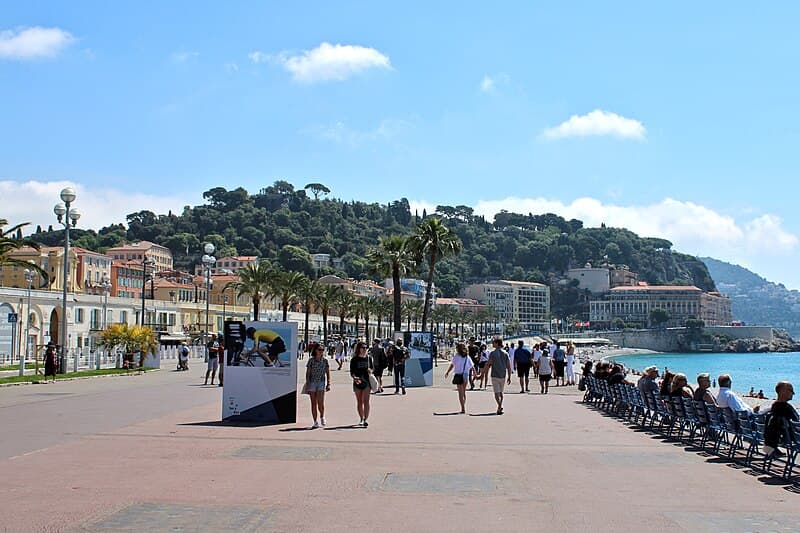
A seven-kilometre-long waterfront along the Baie des Anges, with two lanes for pedestrians and cyclists, blue chairs facing the sea, and belle époque hotels behind. It was built in 1820 for British winter visitors who needed somewhere for an afternoon stroll, and locals gave it its name.

Tip: The blue chairs are free and can be moved around — it's the only place on the Riviera where you can sit by the sea without spending anything. Before eight in the morning the promenade is empty and belongs to runners; between six and eight in the evening the light is best and the crowds are largest.

Admission:
free
Time needed:
2 h
Old Town and Cours Saleya

Old Town and Cours Saleya

Vieux Nice

Vieux Nice is a tangle of narrow lanes with ochre and red façades, washing lines overhead, and baroque churches unlike anything else in France. At its centre is Cours Saleya, where flowers and vegetables are sold six days a week, replaced by antiques on Mondays.

Tip: The market winds down around half past one, after which the stalls fold up and the square turns into restaurant terraces with a noticeably worse price-to-quality ratio. Shop and eat here in the morning. The lanes of Vieux Nice fill with cruise-ship crowds around midday and are empty before ten.

Admission:
free
Time needed:
half a day
Castle Hill

Castle Hill

Colline du Château

between Vieux Nice and the harbour

A ninety-metre hill between the old town and the harbour, once the site of a medieval castle until Louis XIV had it razed in 1706. What remains is a park with an artificial waterfall, a cemetery, and the best view over the whole bay and the orange rooftops of Vieux Nice.

Tip: A free lift goes up from the seafront end of the old town next to Ponchettes beach — most people don't know about it and climb three hundred steps instead. The waterfall at the top is the coolest spot in the city at midday heat, and the park closes at sunset.

Admission:
free
Time needed:
2 h
Matisse Museum

Matisse Museum

Musée Matisse

Cimiez

A collection housed in a seventeenth-century Genoese villa on the hill of Cimiez, where Matisse spent the last thirty-seven years of his life. It holds over six hundred of his works, mainly drawings, late-period paper cut-outs, and personal items he bequeathed to the city.

Tip: The museum sits in an olive grove that hosts a jazz festival in July, right next to Roman excavations and a monastery with Matisse's grave — easy to combine into one afternoon. Bus number 5 gets here from the centre in fifteen minutes; on foot it's a steep climb.

Admission:
from €10
Time needed:
2 h
Marc Chagall National Museum

Marc Chagall National Museum

Cimiez

A museum built in 1973 specifically to house Chagall's Biblical Message cycle — seventeen large-format canvases the painter donated to the state, plus stained glass and a mosaic reflected in a pool in the garden. Chagall himself attended the opening and approved the layout of the rooms.

Tip: This is the best-curated museum in the city and takes just an hour and a half — there are only three rooms. It sits between the centre and Cimiez, a fifteen-minute uphill walk from the station. On the first Sunday of the month, entry to state museums is free, and it gets busy accordingly.

Admission:
from €10
Time needed:
1.5 h
Place Masséna

Place Masséna

centre

The main square, with red Genoese-style façades, a checkerboard pavement, and seven illuminated statues seated on columns that change colour at night. A tram line runs through it, and it forms a natural divide between the old town and the nineteenth-century new district.

Tip: It connects to Promenade du Paillon, a green strip running over what was once a covered river, with a mirror-like water feature and jets — in hot weather children run through it all day, and it's free. In December a Christmas market sets up here, and in February the carnival floats pass through.

Admission:
free
Time needed:
1 h
Saint Nicholas Russian Orthodox Cathedral

Saint Nicholas Russian Orthodox Cathedral

near the station

The largest Orthodox cathedral outside Russia, completed in 1912 on the spot where Tsarevich Nicholas Alexandrovich died. It was built by Tsar Nicholas II for the Russian community that wintered in Nice, and has six onion domes covered in coloured tiles and an iconostasis of silver and enamel.

Tip: Photography isn't allowed inside and this is enforced; shoulders and knees must be covered. It's a twenty-minute walk west of the station, off the tourist trails, so it stays quiet even in August. The Russian cemetery with émigré graves is a bit further, in Caucade.

Admission:
from €5
Time needed:
1 h
Cimiez and the Roman Excavations

Cimiez and the Roman Excavations

Cimiez

A hill above the city where the Roman town of Cemenelum once stood — baths, an amphitheatre for five thousand spectators, and an archaeological museum survive. Next door is a Franciscan monastery with paintings by Ludovico Brea, a rose garden with valley views, and a cemetery where Matisse and Dufy are both buried.

Tip: The excavations are free to enter through the museum garden and are nearly empty at midday. The monastery garden is the best spot in Nice for sunset, since it sits high and opens to the west, and stays open until around eight in summer.

Admission:
museum from €10, garden free
Time needed:
2–3 h
Mont Boron and Coco Beach

Mont Boron and Coco Beach

east of the harbour

A wooded hill east of the harbour with trails between pines and agaves, the sixteenth-century Fort du Mont Alban at the summit, and views of Nice on one side and Villefranche on the other. Below it lies Coco Beach, a rocky swimming spot with neither sand nor pebbles.

Tip: Coco Beach is a way into the sea straight off rocks and concrete platforms, with no sunbeds and no services — locals come here for the cleanest water in the city. Bus number 14 goes up the hill, the ridge loop takes an hour and a half, and it's best done early in the morning since there's no shade.

Admission:
free
Time needed:
3 h

Photos: Promenade des Anglais — 3602kiva (CC0) · Old Town and Cours Saleya — Mike is Michi (CC BY-SA 4.0) · Castle Hill — Wikimedia Commons (CC BY-SA 3.0) · Matisse Museum — Tubantia (CC BY-SA 3.0) · Marc Chagall National Museum — Europe22 (CC BY-SA 3.0) · Place Masséna — Magali M from Nice, France (CC BY-SA 2.0) · Saint Nicholas Russian Orthodox Cathedral — Amin (CC BY-SA 4.0) · Cimiez and the Roman Excavations — HenrikKbh (CC BY-SA 3.0) · Mont Boron and Coco Beach — Rijksmuseum (CC0)

Where to stay

Areas and districts, matched to the kind of trip you are taking

Vieux Nice

Best for: a first visit and nightlife

The old town, with the market on Cours Saleya, baroque churches and the densest concentration of restaurants and bars in the city. The sea and Place Masséna are five minutes away on foot. Accommodation is in apartments in old buildings, often without a lift and noisy until two in the morning in summer — not the place for sleep.

Carré d'Or and the Promenade

Best for: a seaside stay and shopping

The blocks between the promenade and Rue Jean Médecin, with belle époque hotels, designer shops and the shortest route to the beach. The most expensive accommodation in Nice, and the quietest of all the central neighbourhoods. Good for anyone who wants to walk straight from the hotel onto the pebbles without moving around.

The Harbour and Riquier

Best for: better prices and a local feel

The eastern part of the city, behind Castle Hill, around the Lympia harbour where ferries to Corsica dock. Restaurants around the harbour are about a third cheaper than in the old town and draw a local crowd. It's a fifteen-minute walk to the centre, or a ride on tram line 2, and this is the closest base to Mont Boron.

Libération and Gambetta

Best for: a longer stay and the best market in the city

Residential districts north and west of the station, where Nice's own residents live. The market on Avenue Malausséna is bigger and cheaper than Cours Saleya and draws housewives rather than tourists. Accommodation here is the cheapest in the city centre, and it's a ten-minute tram ride to the sea.

Getting around

From the airport

Nice Côte d'Azur Airport is the second-busiest in France and sits seven kilometres west of the centre, right on the sea. Direct flights from Prague run year-round, several times a week in summer. From the airport, tram line 2 runs into the centre and ends at the harbour; a ticket costs just under ten euros including luggage. By train, Nice connects to the whole Riviera and to Paris by TGV high-speed rail in six hours. By car, it's roughly one thousand four hundred kilometres from Prague and fourteen hours; French motorways charge tolls, and the stretch along the coast is among the most expensive.

Nice Côte d'Azur (NCE) · 7 km

  • Tram line 2 to the centre and harbour· 25 min· €10
  • Taxi to the centre· 20 min· €35
  • Bus to Monaco and Cannes· 45–60 min· €22

Marseille Provence (MRS) · 200 km

  • TER train via Marseille to Nice· 3 h· €40
  • Rental car via the A8 motorway· 2 h 15 min

Around town

Nice has three tram lines and a dense bus network under a single fare, where one ride including transfers costs around one euro fifty and a day pass costs five euros — the cheapest transport on the whole Riviera. Tram line 2 runs from the airport through the centre to the harbour, and line 1 climbs to Cimiez. Along the coast, though, the train is the best option: twenty minutes to Monaco, half an hour to Cannes, six minutes to Villefranche, with services running two to three times an hour. A car in the city is a burden — parking is expensive, garages cost over twenty euros a day, and break-ins into parked cars are the most common tourist loss in the region.

Lignes d'Azur tram and busThree tram lines and buses across the whole city, a single fare with transfers valid for seventy minutes. · €1.70 per ride, €5 per day
Coastal trainThe regional TER stops in Villefranche, Monaco, Menton, Antibes and Cannes. The fastest and cheapest way to take day trips along the Riviera. · €2.50–8
Vélo Bleu bike shareA city bike-share scheme with docking stations all along the promenade, registered via an app. A continuous cycle path runs along the sea. · €1.50 per day plus ride fee
Castle Hill liftFree, next to Ponchettes beach at the eastern end of the old town. Saves climbing three hundred steps. · free
Taxi and ride-hailing appsTaxis in Nice are expensive and add luggage surcharges; Uber and Bolt work here and are cheaper. · €15 per ride in the centre

Useful apps: Google Maps, Lignes d'Azur, SNCF Connect, Vélo Bleu

When to go

Nice has three hundred sunny days a year and never really closes, so it's worth visiting outside summer too. The sea is swimmable from June to October, and it's warmest in August at around twenty-five degrees. July and August are the busiest and most expensive months, with the promenade and beaches packed and hotel prices doubled. May, June and September are the best combination: warm weather, a swimmable sea and manageable prices. Winter is mild, around thirteen degrees, museums stay open, and February brings a two-week carnival, the biggest event of the year. The most rain falls in October and November, in short, sharp storms.

Best time

May, June and September

What to avoid

mid-July to mid-August, and the week of the Cannes Film Festival, when prices spike along the whole Riviera

MonthJanFebMarAprMayJunJulAugSepOctNovDec
Day13°13°15°17°21°25°28°28°25°21°17°14°
Night5°5°7°9°13°17°20°20°17°13°9°6°
Rainy days655764235776
Sea14°13°14°15°18°21°24°25°24°21°18°15°

Food & drink

The cuisine in Nice isn't French in the butter-and-cream sense — it's cuisine niçoise: olive oil, anchovies, chickpeas and vegetables, much closer to Genoa than to Paris. The cheapest and best food is street food: socca from a stall for a few euros, stuffed vegetables at the market, pissaladière from the bakery. Old-town restaurants with a menu posted in four languages are a trap; locals eat around the harbour and in Libération. A genuine salade niçoise has no cooked vegetables or potatoes — if the menu lists them that way, the kitchen is cooking for tourists.

What to try

Socca

A thin chickpea-flour and olive-oil pancake baked in a giant pan in a wood-fired oven, served hot with pepper on paper. It costs around three euros and must be eaten right away — cold, it's no good. The best stalls are on Cours Saleya and in Rue Pairolière.

Salade niçoise

Tomatoes, anchovies or tuna, egg, olives, green beans and olive oil. By local orthodoxy, no cooked vegetables or potatoes belong in it — anyone who adds them is cooking for tourists.

Pan bagnat

A round roll soaked in olive oil and filled with the ingredients of salade niçoise, pressed together and left to rest a while. Sold in bakeries for five euros, it's the best lunch to take to the beach.

Petits farcis

Courgettes, tomatoes, peppers and onions stuffed with meat and breadcrumbs and baked. Served lukewarm, this is a dish that developed in Nice as a way to use up unsold market vegetables.

Pissaladière

A flatbread topped with caramelised onions, anchovies and black olives, with no tomato and no cheese. Sold by weight in bakeries, and unlike pizza, it tastes good cold too.

Daube niçoise

Beef braised in red wine with orange peel, served with wide pasta or ravioli. A winter dish that in summer only appears on menus at places cooking for locals.

Tourte de blettes

A sweet chard pie with raisins, pine nuts and apples, dusted with icing sugar. It sounds odd and tastes like apple strudel — it's the most typical dessert in Nice.

Rosé from Bellet

Wine from the only wine appellation that lies within the city limits, on the slopes above the Var valley. Little of it is made and it's rarely found in shops, but several restaurants in Nice pour it.

What it costs

Espresso at the counter

€1.50–2.50

Socca from a stall

€3–4

Pan bagnat from a bakery

€5–7

Lunch at a bistro

€18–25

Dinner at a restaurant

€40–60 per person

Day pass for tram and bus

€5

Sunbed on a paid beach

€20–30

Night in a 3-star hotel

€110–200 for a double

Indicative prices that change over time — treat them as a guide, not a price list.

Practical information

SocketsCEuroplug, two round pinsEFrench, with earth pin
Voltage230V / 50Hz
Tap waterTap water is drinkable — Tap water is drinkable everywhere in France, and in a restaurant you're entitled to it for free — ask for ‘une carafe d'eau’ and they must bring it, even if you haven't ordered anything else. Anyone who just says ‘de l'eau’ will get a paid bottle for four to six euros. A sign reading ‘eau non potable’ by a fountain means the water isn't drinkable.
TippingService is included by law in France, and the bill usually notes ‘service compris.’ A tip is therefore optional and small: loose change at a café, five percent at a restaurant for good service. Card terminals rarely offer a tip option, so it's left in cash on the table. In a taxi, you just round up.
Driving on theright
SafetyThe French Riviera is safe, but it has a high rate of pickpocketing — in crowds on the promenade, at the market and on suburban trains. The most common loss in the region, though, is a break-in to a parked car: at beach and viewpoint car parks, windows get smashed for a bag left on a seat. Leave the car empty and carry your documents with you. The emergency number is 112, and the sea rescue service is 196.
Opening hoursShops are generally open from about nine to seven, with smaller shops and bakeries closing for a midday break from half past twelve to half past three. On Sundays most shops are closed except bakeries and tourist-centre exceptions. Restaurants serve lunch from noon to two and dinner from seven to half past ten; in between you'll only get coffee and a sandwich. Museums close on Monday or Tuesday.
Customs & etiquette‘Bonjour’ is said on entering a shop, a bakery or a doctor's office, and skipping it reads as rude — in France it matters more than the rest of the conversation. Strangers are not addressed informally. Food is ordered course by course, and the bill isn't brought until you ask for it. Walking around town in swimwear isn't done, and on the Riviera it's fined by municipal ordinance. Bread is broken by hand and set directly on the tablecloth, not on the plate.
A few local wordsHello — BonjourThank you — MerciPlease — S'il vous plaîtThe bill, please — L'addition, s'il vous plaîtCheers — SantéGoodbye — Au revoir

How to plan your days

1 day

One Day in Nice

  1. 1Morning at the market on Cours Saleya, while the flower stalls are still up.
  2. 2Through the lanes of Vieux Nice, with socca from a stall for lunch.
  3. 3Take the lift up Castle Hill for a view over the whole bay.
  4. 4Afternoon swim off the pebbles and the blue chairs on the promenade.
  5. 5Dinner around the Lympia harbour, where it's cheaper than in the old town.

2 days

Two Days with the Museums

  1. 1Day one as above.
  2. 2Morning at the Chagall Museum with the Biblical Message.
  3. 3Bus number 5 up to Cimiez, the Matisse Museum and the Roman baths.
  4. 4Lunch in the monastery garden or in Cimiez.
  5. 5Early evening at Place Masséna, the park's water feature and the illuminated statues.

3 days

Three Days with the Riviera

  1. 1The first two days as above.
  2. 2Six minutes by train to Villefranche-sur-Mer for the sandy beach and old quarter.
  3. 3Bus 82 up to Èze, a walk through the village and the cactus garden.
  4. 4Afternoon train to Monaco, the Prince's Palace and Monte Carlo.
  5. 5Back to Nice for dinner; the whole loop fits on a single day pass.

Day trips

Monaco

20 km · 20 min by train

The world's second-smallest state, packed into two square kilometres. The Prince's Palace has a changing of the guard at 11:55, the Oceanographic Museum sits on a cliff with aquariums dating from the early twentieth century, there's the casino in Monte Carlo, and a Formula 1 circuit that runs along ordinary streets. Trains from Nice run twice an hour and cost around five euros.

Èze and Villefranche-sur-Mer

12 km · 25 min by bus

Èze is a medieval village perched on a rock four hundred metres above the sea, topped with a cactus garden overlooking the entire coastline. Villefranche below it has a deep bay where cruise ships anchor, one of the few sandy beaches in the area, and Rue Obscure, a lane that runs beneath the houses.

Cannes

33 km · 30 min by train

The city of the film festival, with the La Croisette promenade, sandy beaches and the old Le Suquet quarter on a hill above the harbour. Boats leave the harbour for the Lérins Islands, where the fortress once held the Man in the Iron Mask. The train from Nice runs along the coast and is cheaper than the bus.

Frequently asked questions

Are the beaches in Nice sandy?+

No, the entire coastline in Nice is pebble, and the stones are fist-sized. Getting into the water is uncomfortable, and water shoes are commonly sold and worn here. The nearest sandy beaches are in Villefranche, six minutes by train, and in Antibes or Cannes, half an hour away.

How do I get from the airport to the centre?+

By tram line 2, which runs from both terminals through the city to the harbour in twenty-five minutes. A ticket costs just under ten euros and covers luggage too. A taxi costs about thirty-five euros and, in rush hour, takes no less time than the tram.

Do I need a car in Nice?+

No, a car is more of a hindrance than a help. The tram and buses run for one euro seventy, and along the coast there's a train to Monaco, Cannes and Menton. Parking in the centre costs over twenty euros a day, and break-ins into parked cars are the most common tourist misfortune on the Riviera. A car is only useful for trips inland.

How many days are enough for Nice?+

Two days for the city itself, five to seven if you're using Nice as a base for the Riviera. Monaco, Èze, Villefranche, Antibes and Cannes are all within half an hour by train or bus and work well as day trips without changing hotels.

Is Nice expensive?+

Accommodation and restaurants, yes; transport and market food, no. A day pass for the tram and bus costs five euros, socca from a stall costs three, and a pan bagnat from a bakery costs six. Anyone who lunches at the market and dines near the harbour instead of the old town will find Nice cheaper than most French cities.

When is the sea warm enough in Nice?+

From June, when it's twenty-one degrees, through October, when it's still around twenty-one. It's warmest in August, around twenty-five degrees. In May the sea is eighteen degrees and only the hardy swim in it, even though the air is already over twenty.

What's free in Nice?+

The Castle Hill, including the free lift up, the blue chairs on the promenade, the monastery garden in Cimiez, the Roman excavations across from the museum garden, and the water feature in the park on Place Masséna. On the first Sunday of the month, entry to state museums is free, including the Chagall and Matisse museums.

Is English spoken in Nice?+

Yes, in hotels, museums and tourist restaurants. In bakeries, at the market and in ordinary shops it's not a given, and saying ‘bonjour’ on entering matters here more than the rest of the conversation — skipping it reads as rude and shapes how you're treated.

Visa Requirements

Check the latest visa requirements for entering this country. Some nationalities may need to apply for a visa or e-visa before travel.

Check visa requirements

Emergency Numbers

Language

French

Currency

EUR

Timezone

GMT+1

Dial Code

+33

Population

68.2M

Area

640,679 km²

Voltage

230V / 50Hz

Driving Side

Right

Top Hotels in Nice

Live prices from 500+ properties

Loading hotels...

Planning a trip to Nice?

Compare hundreds of hotels, find the best price, and book with free cancellation on TravelManiac.