Hotels in Geneva

Home to the UN and half the world's diplomats, yet you can still swim in the lake at lunchtime

Geneva

LanguageEnglish
CurrencyCHF
TimezoneGMT+1
Temperature-2-25 °C
Dial Code+41
Population8.8M
Area41,285 km²
SocketsType C / Type J
Tap waterDrinkable

Discover Geneva

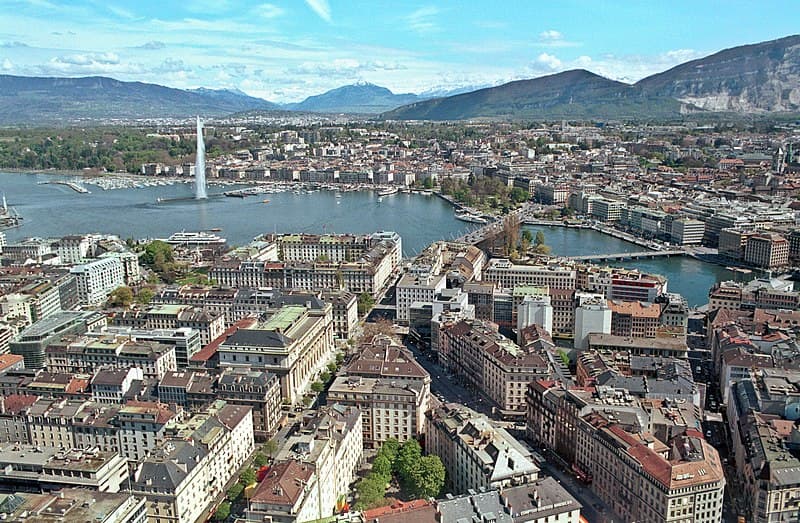
Geneva sits in the westernmost corner of Switzerland, surrounded on 3 sides by France and linked to the rest of the country only by a narrow corridor along the lake. It's a city of 2 faces: within its old walls lies the Protestant seat of John Calvin, once called the Protestant Rome and a refuge for reformist Europe across the 16th century; beside it stands the international quarter, home to the UN's European headquarters, the Red Cross, the World Health Organization and 200 other institutions, where 1 in 5 residents holds a diplomatic passport. Add watchmaking, banking and the highest concentration of international conferences in the world, and you get a city of 200,000 people that behaves like a metropolis. Visitors here will find fewer picture-postcard scenes than in Lucerne, but instead the Jet d'Eau shooting water 140 metres into the air, an old town with the best cafés in French-speaking Switzerland, a tour of the accelerator at CERN, and a lake you can dive straight into from the jetties along the waterfront in summer. And because France is 10 minutes away by tram, you can save a considerable amount even in one of the most expensive countries on earth.

What to see

The places worth your time in Geneva, and what to expect at each

Jet d'Eau

Jet d'Eau

Harbour / Eaux-Vives

A water fountain at the end of the pier in Geneva's harbour, shooting 500 litres of water a second 140 metres into the air at 200 km/h. It began in 1886 as a pressure-relief valve for the waterworks and only later became the city's symbol. At any given moment, 7 tonnes of water are in the air.

Tip: You can walk out along the pier right up to the jet and get soaked — bring a windbreaker, since a westerly wind sprays the whole pier. The best photo is from the right bank near Bains des Pâquis, not up close. It's lit up after dark from spring to autumn and only runs in mild weather in winter; it's switched off in strong wind or frost, so check ahead.

Admission:
free
Time needed:
30–45 min
St Pierre Cathedral

St Pierre Cathedral

Vieille Ville

A Romanesque-Gothic cathedral at the highest point of the old town, from which John Calvin preached between 1536 and 1564, turning Geneva into the centre of the Reformation — his wooden chair still stands inside. The Reformation stripped away all decoration, so the interior is deliberately bare. Beneath the cathedral lies the largest archaeological site of its kind in Europe, with excavated layers reaching back to the 4th century.

Tip: The north tower has 157 steps and offers the best view of the lake, the old town and, on a clear day, Mont Blanc — 5 francs, and usually empty. The archaeological crypt is a separate ticket and more interesting than the church itself: you can see 4 churches built one on top of another beneath your feet. Entry to the cathedral itself is free.

Admission:
church free, tower CHF 7, crypt CHF 12
Time needed:
1.5 h
Old Town and Place du Bourg-de-Four

Old Town and Place du Bourg-de-Four

Vieille Ville

The city's oldest square, on the site of a Roman marketplace, today ringed by café terraces and 18th-century houses. Around it winds a maze of steep lanes with antique shops and galleries, including Grand-Rue, where number 40 was the birthplace of Jean-Jacques Rousseau. On the Promenade de la Treille stands the longest wooden bench in the world, 200 metres long.

Tip: The terraces on Bourg-de-Four are the most pleasant place for coffee in the city, but you pay for the location — two streets up, the same coffee costs 2 francs less. On the Promenade de la Treille stands a chestnut tree whose first leaf each spring officially marks the start of spring, recorded in a logbook since 1818. On Sundays the lanes are empty, the nicest time for a stroll.

Admission:
free
Time needed:
1.5–2 h
Palace of Nations

Palace of Nations

Nations

The UN's European headquarters and its second-largest premises after New York, built in the 1930s for the League of Nations. The Human Rights Room has a ceiling by Miquel Barceló with stalactites in every colour; the Council Chamber displays original 1936 wall murals. Out front stands Broken Chair, a 12-metre wooden chair with a shattered leg, a protest against landmines.

Tip: Tours are guided only and must be booked online a few days ahead; a passport is essential, and without one you won't be let in even with a booking — an ID card isn't enough. The chambers shown vary depending on which delegations are meeting, so no two tours are ever quite the same. Ariana Park around the palace is open freely, and you can walk among the peacocks.

Admission:
CHF 22, booking required
Time needed:
1.5 h
CERN and Science Gateway

CERN and Science Gateway

Meyrin, 8 km from the centre

The European Organization for Nuclear Research on the border with France, home to the 27-km underground LHC accelerator, where the Higgs boson was discovered in 2012. The Science Gateway visitor centre, designed by Renzo Piano and opened in 2023, is free and features a section of the original Synchrocyclotron accelerator among other exhibits, plus exhibition halls shaped like two tubes spanning the road.

Tip: Science Gateway is free and needs no booking, but guided tours with a scientist are booked online around 3 weeks ahead and sell out within hours. Ordinary visitors can't get into the LHC tunnel itself, since it's live — tunnel tours only happen during shutdowns once every few years. Tram 18 gets you there from the centre in 20 minutes, and the web was invented here before Wi-Fi even existed, by Tim Berners-Lee in 1989.

Admission:
free
Time needed:
2–3 h
Bains des Pâquis

Bains des Pâquis

Pâquis

A concrete pier from 1932 jutting into the lake on the right bank, serving as a public lido, sauna, restaurant and, in winter, bathhouse — an institution Geneva residents saved from demolition in a referendum. Entry costs 2 francs. From the pier you get the best view of the Jet d'Eau with Mont Blanc behind it.

Tip: At 2 francs, it's the cheapest thing in Geneva that's genuinely worth doing. In winter there's a sauna with a view where you can jump straight into the lake; in summer half the office swims here at lunchtime. The "aubes musicales" morning concerts in July and August start at 6am at sunrise and are free. The fondue at the on-site canteen is one of the cheapest in the city.

Admission:
CHF 2
Time needed:
2 h
Reformation Wall and Bastions Park

Reformation Wall and Bastions Park

Bastions / Plainpalais

A 100-metre stone wall in the park beneath the old town, with 4 five-metre statues of the reformers Calvin, Farel, Beza and Knox, and reliefs depicting scenes from the Reformation across Europe. It was built in 1909 for the 400th anniversary of Calvin's birth, set into the wall of the city's former fortifications. A giant outdoor chessboard stands in the surrounding park.

Tip: Bastions Park is the most pleasant spot in the centre for a shop-bought lunch, and giant chess with metre-tall pieces is played all day for free — players will happily take on strangers. Look out for Oliver Cromwell and the Mayflower pilgrims on the wall too — the reliefs on the right trace where Calvinism spread. The light is best in the afternoon.

Admission:
free
Time needed:
45 min
Musée d'Art et d'Histoire

Musée d'Art et d'Histoire

Vieille Ville — south

Geneva's largest museum and one of the largest in Switzerland, with a collection spanning Egyptian and Greek antiquities, medieval armouries and European painting. The key work is The Miraculous Draught of Fishes by Konrad Witz from 1444 — the first painting in the history of European art to depict a specific, recognisable landscape, namely Lake Geneva with Mont Blanc in the background.

Tip: Entry to the permanent collection is free year-round, with a charge only for temporary exhibitions — it's the best refuge when it's raining in Geneva. The Witz painting hangs in the old masters' room and is worth heading straight to; you'll recognise the shoreline you walked along that morning. The museum also holds a watch collection that complements the dedicated Patek Philippe watch museum.

Admission:
permanent collection free
Time needed:
2 h
Carouge

Carouge

Carouge

A district across the Arve river on the city's southern edge, founded in the 18th century by the Kings of Sardinia as a rival seat facing Calvinist Geneva — hence its grid-plan Italian layout, low houses with inner courtyards, and a mood quite different from the rest of the city. Today it's a district of craft workshops, independent shops and the densest cluster of bars in Geneva.

Tip: Come in the evening or at weekends, when the centre is dead — Carouge is the one place in Geneva that's still lively at 11pm. The market on Place du Marché runs Wednesday and Saturday mornings and is cheaper than the market in the centre. Tram 12 or 18 gets you there from the centre in 10 minutes, and the inner courtyards behind the archways are open to the public, even though they don't look it.

Admission:
free
Time needed:
2–3 h

Photos: Jet d'Eau — Wikibusters (CC BY-SA 4.0) · St Pierre Cathedral — Torbjorn Toby Jorgensen (CC BY-SA 2.0) · Old Town and Place du Bourg-de-Four — Traumrune (CC BY 3.0) · Palace of Nations — Credits to Mourad Ben Abdallah / Wikimedia Commons (CC BY-SA 3.0) · CERN and Science Gateway — Brücke-Osteuropa (CC0) · Bains des Pâquis — Betchphoto (CC BY-SA 4.0) · Reformation Wall and Bastions Park — Roland Zumbühl - www.picswiss.ch. (CC BY-SA 3.0) · Musée d'Art et d'Histoire — Lpalli (CC BY-SA 3.0) · Carouge — HJPD (CC BY 3.0)

Where to stay

Areas and districts, matched to the kind of trip you are taking

Vieille Ville

Best for: first-time visitors, sights and cafés

The historic core on a hill above the left bank, with the cathedral, Bourg-de-Four and the steepest lanes in the city. It's the prettiest and quietest part of Geneva, since few people actually live here and it's empty on Sundays. Accommodation is pricey and hotels scarce, but everything except the UN district is within walking distance. Restaurants are geared towards business lunches, and things close early in the evening.

Pâquis

Best for: cheaper accommodation and food from around the world

A district on the right bank between the station and the lake, the most densely populated and ethnically diverse part of Geneva. You can eat here for 15–20 francs, unthinkable elsewhere in the centre, and it has the most budget-friendly hotels. It's also the district with the nightlife and street prostitution, and it's busy in the evening. Bains des Pâquis and the waterfront are a 5-minute walk away.

Nations

Best for: the UN, conferences and a quiet stay surrounded by greenery

The northern district with the Palace of Nations, the Red Cross and hundreds of international organisations, surrounded by parks and residential villas. Hotels here are geared towards delegates, meaning very high prices on weekdays during conferences and surprising discounts at weekends. It's a 15-minute tram ride to the centre. Restaurants close on Friday evenings and at weekends, as the district empties out.

Carouge and Plainpalais

Best for: evening life, markets and a younger crowd

The southern part of the city across the Arve river, home to the university, Switzerland's largest flea market on Plaine de Plainpalais, and the Sardinian-built district of Carouge. It's the only place in Geneva with nightlife past 11pm, and food and beer prices are around a quarter lower than by the lake. It's a 10-minute tram ride to the centre, and accommodation here is the cheapest in the whole city.

Getting around

From the airport

Direct flights to Geneva run from many European cities, served by Swiss and, seasonally, low-cost carriers. By train, journeys typically route via Zurich or Basel. By car, count on a long drive along motorways; a Swiss motorway vignette costing 40 francs is mandatory, and French motorways charge tolls. Geneva Airport, Cointrin, sits 4 km from the centre, a 6-minute train ride away — and the arrivals hall has a machine issuing every passenger a free 80-minute public transport ticket, so the trip into town costs nothing. The airport has two exits, Swiss and French, which is handy if you're heading on to Chamonix.

Geneva Cointrin (GVA) · 4 km

  • Train to Genève-Cornavin· 6 min· free with the ticket from the hall machine
  • Bus 10 into the centre· 20 min· free with the ticket from the machine
  • Taxi· 15–20 min· CHF 35
  • Direct bus to Chamonix· 1 h 30 min· €35

Lyon Saint-Exupéry (alternative) (LYS) · 150 km

  • Flixbus to Geneva· 2 h 30 min· €20

Around town

Geneva has one thing almost no other city offers: anyone staying at a hotel, hostel or campsite gets a Geneva Transport Card at check-in, letting them ride trams, buses and city trains free for the whole stay. On the same principle, the machine in the airport arrivals hall issues a free 80-minute ticket into the centre. So anyone staying overnight pays nothing for transport in Geneva — and yet plenty of people still buy tickets. Without the card, an hourly ticket costs 3 francs, a day pass 10. The city is small, and the left and right banks are linked by a 20-minute walk. Yellow Mouettes water taxis, small boats criss-crossing the harbour, are also included in the transport card. Genève Roule shared bikes are free for the first 4 hours.

Geneva Transport CardFree for anyone staying overnight at accommodation in the city — collect it from reception on arrival. Valid on trams, buses, city trains and the Mouettes boats for the whole stay. Don't forget to ask for it, as it isn't handed over everywhere automatically. · free for guests
TPG trams and buses6 tram lines and a dense bus network, running every 5–10 minutes. Line 18 goes to CERN, line 15 to the Palace of Nations. Without the transport card, an hourly ticket costs CHF 3. · CHF 3/1 h
Mouettes boatsYellow water taxis crossing the harbour between the left and right banks, 4 routes running every 10 minutes. Part of the public transport network and free with the transport card — the cheapest way to cruise with a view of the Jet d'Eau. · included with the card
Genève Roule shared bikesFree for the first 4 hours after a deposit, then 2 francs an hour. Flat along the lake with a continuous cycle path; steep climbing into the old town. · CHF 0 for the first 4 h
Train into FranceA train runs from Cornavin to Annemasse in 20 minutes, and a bus to Ferney-Voltaire; food and shopping across the border cost around 40% less. An ID card is enough for the trip. · from CHF 3

Useful apps: TPG, SBB Mobile, Google Maps, Genève Roule

When to go

Geneva is best from May to September, when the lake is warm, the lidos are open and evenings are spent outdoors. July and August are the warmest, around 28°C, and the only time the lake is genuinely good for swimming, at around 21°C. It's also the only period when hotels are cheaper, since international organisations go on holiday and conferences stop; on weekdays in spring and autumn, prices spike because of delegates. December brings the Escalade festival, with a procession in period costume around the 11th, the most quintessentially Geneva event of the year. November to February are grey, with fog hanging over the lake, though accommodation is cheapest then. The bise wind blows from the northeast and can knock the perceived temperature down by 10°C in winter.

Best time

May to September, with cheaper hotels in summer thanks to the UN holidays

What to avoid

weekdays during major conferences in spring and autumn, when accommodation prices can double

MonthJanFebMarAprMayJunJulAugSepOctNovDec
Day5°7°12°16°21°25°28°27°22°16°10°6°
Night-1°0°3°6°10°14°16°15°12°8°3°0°
Rainy days109910119898101011

Food & drink

Geneva is expensive even by Swiss standards, and a main course at a decent restaurant costs 35–50 francs. There are 3 ways around it, though. The first is the lunchtime "plat du jour", which even upmarket places offer for 22–30 francs — the same dish costs double in the evening. The second is France: the border is 10 minutes away by tram, and shopping or lunch in Annemasse or Ferney-Voltaire is around 40% cheaper, which half of Geneva takes advantage of every Saturday. The third is the Bains des Pâquis canteen, or the canteens of international organisations, which are open to the public. Local cuisine is French with lake fish: filets de perche are the signature dish, longeole the Geneva sausage, and cardon a winter vegetable found nowhere else. In November and December, marmite de l'Escalade, a chocolate cauldron filled with marzipan vegetables, is sold everywhere.

What to try

Papet vaudois and filets de perche

Papet is leeks and potatoes stewed with saucisson sausage, a dish from the French-speaking part of the country. Filets de perche are fried perch fillets from Lake Geneva served with tartar sauce and lemon — be aware most restaurants ship theirs in from Poland; a menu reading "perche du lac" means genuinely local, and it costs twice as much.

Longeole and cardon

Longeole is Geneva's pork sausage with fennel seed, simmered for hours and served with potatoes. Cardon, the Geneva cardoon, is a winter vegetable baked with cheese — both are protected local specialities, found mainly from November to February.

Cheese fondue

Melted gruyère and vacherin with white wine, into which bread is dipped on a fork. Drink white wine or black tea with it, not cold water; a portion for two runs 25–35 francs per person.

Raclette

Half a wheel of cheese heated under a grill and scraped onto potatoes with gherkins and pickled onions. Ordered by the number of scrapes, and eaten until the guest calls a halt.

Rösti

A pan-fried cake of grated potato, originally a Bernese farmers' breakfast. Served with egg, cheese or bacon, and the cheapest main course on most mountain-hut menus.

Bündnerfleisch

Beef air-dried in the mountain air, sliced paper-thin. A Bündnerteller plate of dried beef, raw ham and mountain cheese can stand in for a whole meal in a mountain hut.

Chocolate and Rivella

A bar of Swiss chocolate from a Coop or Migros supermarket costs a fraction of the price in a tourist shop and is the same brand. Rivella is the national soft drink, made from whey, tasting somewhere between apple and milk.

Marmite de l'Escalade

A chocolate cauldron filled with marzipan vegetables, sold only around 11 December to mark the anniversary of the repelled Savoyard attack of 1602. It's smashed while saying "Ainsi périrent les ennemis de la République", and it's about the most Geneva thing you can buy.

What it costs

Coffee at a café

CHF 4.50–6

Half-litre of beer

CHF 7–9

Lunchtime plat du jour

CHF 22–30

Filets de perche in the evening

CHF 38–52

Entry to Bains des Pâquis

CHF 2

Public transport for guests

free

Palace of Nations tour

CHF 22

Night at a 3-star hotel for 2

CHF 170–280

Indicative prices that change over time — treat them as a guide, not a price list.

Practical information

SocketsCEuroplug, two round pinsJSwiss
Voltage230V / 50Hz
Tap waterTap water is drinkable — Tap water in Switzerland is drinkable without exception and is 80% groundwater or spring water — in the mountains it flows continuously into public fountains, which are fine for drinking or filling a bottle. A sign reading "kein Trinkwasser" means not drinkable, and is rare. A litre of bottled water costs around a franc in a shop, 6–8 in a restaurant, so a refillable bottle saves more money than almost anything else.
TippingService is included by law and tipping isn't expected. It's customary to round up, typically to the nearest franc or to five. When paying by card, you state the amount you'd like the receipt rounded to — terminals usually have no tip field. In mountain huts, you pay at the counter in advance and no tip is given at all.
Driving on theright
SafetySwitzerland is among the safest countries in the world, and crime barely touches tourists; pickpocketing is concentrated on trains along main routes and in station halls. The real risk is in the mountains: weather can change within the hour, snowfields linger on north-facing slopes into July, and the avalanche situation shifts daily in winter. The emergency number is 112, the Rega mountain rescue service 1414. A Rega rescue is expensive without insurance; Rega patronage membership, for under 4 francs a month, covers it.
Opening hoursShops in Swiss cities open from 9am to 8pm and until 6pm on Saturdays; on Sundays, almost everything is closed except shops at the main station and the airport, which stay open until 9pm on Sundays too and are the only place a Sunday visitor can shop. Restaurants serve lunch from 11:30am to 2pm and dinner from 6pm to 10pm; outside those hours, expect at most a cold plate. Museums close on Mondays and often stay open until 8pm or 10pm on Thursdays. Banks close at 4:30pm.
Customs & etiquettePunctuality is a form of politeness in Switzerland — trains and buses leave on the announced minute, and a 7pm restaurant reservation means 7pm. The greeting "Grüezi" is said even to strangers on a mountain path, and it's a rule, not a courtesy. On Sundays and after 10pm, quiet hours apply: no mowing lawns, no drilling, no laundry in apartment blocks. Rubbish is sorted meticulously, and in some municipalities general waste must go in a special charged bag.
A few local wordsHello — BonjourThank you — MerciPlease — S'il vous plaîtThe bill, please — L'addition, s'il vous plaîtCheers — SantéGoodbye — Au revoir

How to plan your days

1 day

A day in Geneva

  1. 1Morning in the old town, Bourg-de-Four and St Pierre Cathedral with its tower.
  2. 2The archaeological crypt beneath the cathedral.
  3. 3Lunchtime plat du jour in the lanes above Bastions Park.
  4. 4Afternoon at the Reformation Wall, then a walk down to the lake and the Jet d'Eau.
  5. 5Early evening at Bains des Pâquis, for a swim or dinner on the pier.

2 days

2 days with the UN and CERN

  1. 1Day 1 as above.
  2. 2Morning: a booked tour of the Palace of Nations, passport in hand.
  3. 3Lunch in Ariana Park or in Nations.
  4. 4Afternoon: tram 18 to CERN and the free Science Gateway.
  5. 5Evening: bars in Carouge, still buzzing past 11pm.

3 days

3 days with a day trip

  1. 1Days 1–2 as above.
  2. 2Morning: bus to Chamonix beneath Mont Blanc, 1.5 hours.
  3. 3The cable car up to the Aiguille du Midi, or the rack railway to Montenvers.
  4. 4Return in the evening, dinner in Pâquis.
  5. 5Rainy-day alternative: Lausanne and the Lavaux vineyards by train.

Day trips

Chamonix and Mont Blanc

88 km · 1 h 30 min by bus

A French resort beneath the Alps' highest peak, reached from Geneva by direct buses and shared minibuses from the airport. A cable car up to the Aiguille du Midi climbs to 3,800 metres in 20 minutes, the biggest cable-car ascent in the world; at the top, the glass Pas dans le Vide box hangs over a thousand-metre drop. A rack railway to Montenvers leads to the Mer de Glace glacier. Bring warm clothing even in August — it can be below freezing up top. An ID card is enough for the trip into France.

Lausanne and the Lavaux vineyards

62 km · 40 min by train

The second-largest city on Lake Geneva, home to the International Olympic Committee and the only city under a million people in Europe with a metro. It has a Gothic cathedral where, to this day, a night watchman calls out the hours from the tower every night from 10pm to 2am. East of the city stretch the terraced Lavaux vineyards, a UNESCO World Heritage Site — 800-year-old terraces above the lake, linked by a signposted footpath from Lutry to Saint-Saphorin, with Chasselas wine to taste in every village.

Annecy

45 km · 1 h 15 min by bus

A French town on the shore of Europe's cleanest lake, nicknamed the Venice of the Alps for the canals running through its old town. In the middle of a canal stands the Palais de l'Isle, a former 12th-century prison and the most photographed building in Savoy. Food and accommodation cost roughly half what they do in Geneva, making Annecy a popular weekend escape. In summer people swim in the lake, and a flat cycle path along a former railway line runs around it. An ID card is enough for the trip.

Frequently asked questions

Is it true that public transport in Geneva is free?+

Yes, if you're staying overnight in Geneva. Every guest at a hotel, hostel or campsite receives a Geneva Transport Card at check-in, valid on trams, buses, city trains and the Mouettes boats for the whole stay. On top of that, a machine in the airport arrivals hall issues every passenger a free 80-minute ticket, so even the trip from the airport into town costs nothing. Ask for the card at reception, since it isn't always handed over automatically.

Can you visit CERN and see the accelerator?+

The Science Gateway visitor centre is free, needs no booking, and houses the original Synchrocyclotron accelerator along with numerous exhibits; tram 18 gets you there from the centre in 20 minutes. Ordinary visitors can't enter the LHC tunnel itself, since it's live during operation and only accessible during technical shutdowns once every few years. Guided tours with a scientist are booked online around 3 weeks ahead and sell out within hours.

What do I need for a Palace of Nations tour?+

Book online a few days ahead, and above all bring a valid passport — an ID card isn't enough, and security won't let you in without one even if you've paid. The tour lasts around an hour, costs 22 francs, and runs in English or French. The chambers you see vary depending on which delegations are meeting that day. Ariana Park around the palace, with its peacocks, is open freely, no booking or passport required.

Is it worth a shopping trip to France?+

Yes, and half of Geneva does it. The border is 10–20 minutes by tram or train — Annemasse, Ferney-Voltaire, Saint-Julien — and groceries, restaurants and fuel are around 40% cheaper there. An ID card is enough for the trip. Watch the limits on the way back into Switzerland: purchases over 300 francs are meant to be declared, and meat and alcohol have their own quantity limits. On Saturdays, French supermarkets near the border are packed and the queues long.

How many days do I need for Geneva?+

For the city alone, 2 days is enough — the first for the old town, the cathedral and the lake, the second for the Palace of Nations and CERN. But Geneva is best used as a base for day trips: Chamonix beneath Mont Blanc is 1.5 hours by bus, Lausanne with the Lavaux vineyards 40 minutes by train, and Annecy 1.25 hours away. So 3–4 days is more sensible than 2. For comparison, Zurich alone offers more, while Geneva's strength lies in its surroundings.

When does the Jet d'Eau run, and is it always visible?+

It runs year-round from morning until around 11pm, and is lit up after dark from spring to autumn. It doesn't always run, though: it's switched off in strong wind, since it would spray the whole harbour, and in frost, when the pier would ice over. In winter it often keeps shorter hours. When it's on, you can walk out along the pier right up to the jet, but in a westerly wind you'll get soaked — bring a windbreaker.

Is French spoken in Geneva, or does English work?+

The official language is French, but Geneva is Switzerland's most international city, and English gets you by almost everywhere — in hotels, restaurants and shops. German, on the other hand, often doesn't, which surprises people. A little French goes a long way: saying "bonjour" on entering a shop is a social requirement here, and skipping it is considered rude.

When is accommodation cheapest?+

Counter-intuitively, in summer and at weekends. Geneva's hotels rely on conferences held by international organisations, so prices climb on weekdays in spring and autumn and drop in July and August, when the UN is on holiday, and at weekends year-round. The difference between a Tuesday in May and a Saturday in August can be double. If you're on holiday, aim for a summer weekend; if you must travel on a weekday, book well ahead or stay just across the border in France.
Visa Requirements

Check the latest visa requirements for entering this country. Some nationalities may need to apply for a visa or e-visa before travel.

Check visa requirements

Language

German / French / Italian

Currency

CHF

Timezone

GMT+1

Dial Code

+41

Population

8.8M

Area

41,285 km²

Voltage

230V / 50Hz

Driving Side

Right

Top Hotels in Geneva

Live prices from 500+ properties

Loading hotels...

More destinations in Switzerland

Planning a trip to Geneva?

Compare hundreds of hotels, find the best price, and book with free cancellation on TravelManiac.