Hotels in St. Moritz

The birthplace of winter tourism, eighteen hundred metres up

St. Moritz

LanguageEnglish
CurrencyCHF
TimezoneGMT+1
Temperature-2-25 °C
Dial Code+41
Population8.8M
Area41,285 km²
SocketsType C / Type J
Tap waterDrinkable

Discover St. Moritz

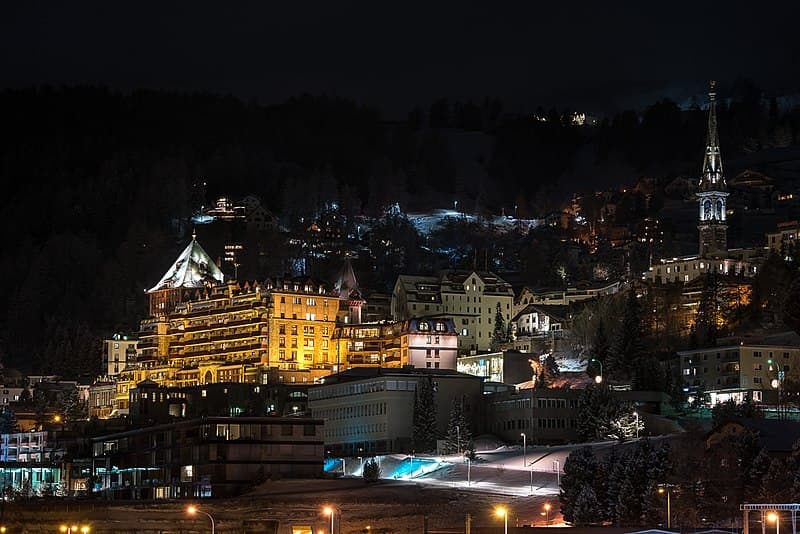
St. Moritz sits in the Upper Engadin, a wide valley at one thousand eight hundred and twenty-two metres with three hundred and twenty-two sunny days a year and the driest climate in the Alps. Winter tourism supposedly began here in 1864, when hotelier Johannes Badrutt bet his British summer guests that if they came back in winter he'd make it so warm they'd sit on the terrace in shirtsleeves — and if he lost, he'd pay for their trip. He won, and winter in the Alps has been sold ever since. The Winter Olympics were held here twice, in 1928 and 1948, and the Cresta Run — an ice channel ridden head-first — still operates today. The valley is also a landscape of lakes: in summer people sail, run and cycle around all four of them. Prices match its status as Switzerland's most luxurious resort, but the sport itself is more accessible than you'd expect.

What to see

The places worth your time in St. Moritz, and what to expect at each

Corviglia and Piz Nair

Corviglia and Piz Nair

above St. Moritz

The main skiing area above town, reached by a funicular straight from the centre and then a cable car up to Piz Nair at three thousand fifty-seven metres. At Corviglia, at two thousand five hundred metres, stands a restaurant with an aluminium wall designed by architect Foster, with views across the whole Engadin.

Tip: Piz Nair has the best panorama in the area, and in summer you can go up even without skis for a few dozen francs — the cable car runs from June to October. Sit on the left side of the cabin for the view down the valley. It's windy up top and typically ten degrees colder than below.

Admission:
from 45 CHF return
Time needed:
half a day
Muottas Muragl

Muottas Muragl

Samedan, 6 km from St. Moritz

A viewpoint ridge at two thousand four hundred fifty metres, reached since 1907 by a funicular railway. From here you can see the entire chain of Upper Engadin lakes — four lakes in a single line — with the Bernina massif behind. The hotel at the top is Switzerland's first energy-self-sufficient mountain building.

Tip: This is the most photographed view in the Engadin, best an hour before sunset when the lakes turn gold. Instead of the cable car down, you can walk the philosophers' trail to Pontresina in two hours. In winter an eight-kilometre toboggan run starts here, with sledges for rent at the top.

Admission:
38 CHF return
Time needed:
half a day
Diavolezza

Diavolezza

Bernina, 20 km southeast

A cable car to a ridge at two thousand nine hundred eighty metres, directly opposite the Pers glacier and the four-thousand-metre Piz Bernina. It's the closest view of a major glacier available in the Engadin without climbing, and in winter a free-ride ski route drops from here across the glacier down to the valley.

Tip: In summer you can stay overnight at the mountain hotel and catch sunrise over the glacier the next morning — noticeably clearer than in the afternoon. Skiing down across the Morteratsch glacier is only possible with a mountain guide, since it crosses crevasses. The terrace pool is free for hotel guests.

Admission:
38 CHF return
Time needed:
half a day
Morteratsch Glacier

Morteratsch Glacier

Bernina, 17 km southeast

Switzerland's most accessible major glacier, reached by a flat path up the valley from the train stop. Marker posts along the way show where the glacier's edge stood in a given year — it has retreated more than two kilometres since 1900, and walking between the markers tells the story better than any graph.

Tip: From the Morteratsch stop it's an hour on the flat to the end of the glacier, manageable even with children. The train from St. Moritz takes twenty minutes. You shouldn't step onto the ice itself without equipment and a guide — the edge is boggy and crevasses are often hidden under gravel.

Admission:
free, train 12 CHF
Time needed:
half a day
Bernina Express and the Rhaetian Railway

Bernina Express and the Rhaetian Railway

south of St. Moritz

A UNESCO-listed railway over the Bernina Pass into the Italian town of Tirano. It climbs to two thousand two hundred fifty-three metres without a rack system, loops through a spiral viaduct at Brusio, and drops from glaciers to palm trees in Italy within two hours. Built in 1910.

Tip: The panoramic Bernina Express requires a reservation and a surcharge, but a regular regional train runs the same route for a fraction of the price, has windows that open, and stops more often. Sit on the right in the direction of Tirano. Tirano has a market on Tuesdays, and the return bus goes via Livigno.

Admission:
regional train from 32 CHF
Time needed:
full day
Lake St. Moritz and the Cresta Run

Lake St. Moritz and the Cresta Run

centre

A lake right below town that freezes solid enough from January to March for horse races, polo and snow cricket to be held on it. Above it runs the Cresta Run, a three-quarter-kilometre ice channel from 1885 where you ride head-first on a skeleton sled.

Tip: Walking on the frozen lake is free, and the loop measures five kilometres. The Cresta Run is a private club, but in season it also admits visitors for a ride for around six hundred francs including equipment and instruction — book ahead, and women were only first allowed in 2018.

Admission:
lake free
Time needed:
2 h
Lake Sils and Val Fex

Lake Sils and Val Fex

11 km southwest

The largest of the Engadin lakes, on whose shore Friedrich Nietzsche spent seven summer seasons and wrote Thus Spoke Zarathustra; his cottage is now a museum. Above the village opens Val Fex, a valley closed to cars and reached by horse-drawn carriage.

Tip: In summer, Europe's highest boat service runs across the lake and it's the cheapest boat trip in the area. A horse-drawn carriage takes you from Sils Maria into Val Fex for twenty-five francs, and at the top there's a small church with frescoes and a mountain hotel serving lunch. Wind picks up here in the afternoon, which is exactly why sailors come.

Admission:
museum 6 CHF, carriage 25 CHF
Time needed:
half a day
The Leaning Tower and the old Dorf quarter

The Leaning Tower and the old Dorf quarter

St. Moritz Dorf

The remains of the twelfth-century Church of St. Mauritius, which has tilted by five and a half degrees — more than the Tower of Pisa — and had to be stabilised in the 1980s. It stands above the upper Dorf quarter, with hotels, shops and a promenade overlooking the lake.

Tip: A short viewpoint path runs free from the church past the tower down to the lake, giving the classic view of the town with the water below. The upper Dorf and lower Bad districts are linked by footpath and bus; shops are up top, spa and cheaper restaurants down below.

Admission:
free
Time needed:
1 h
Val Roseg

Val Roseg

Pontresina, 8 km southeast

A side valley from Pontresina to the Roseg glacier, closed to cars. Seven kilometres of flat path follow a stream to a lake of glacial meltwater and a mountain hotel famous for its dessert buffet. Piz Roseg and Piz Sella rise in the background.

Tip: In both winter and summer a horse-drawn carriage runs here from Pontresina for thirty-five francs, the easiest way to bring along less able members of the family. On foot it's an hour and a half on flat ground. In winter a cross-country ski trail runs through the valley, one of the most beautiful in Switzerland.

Admission:
free, carriage 35 CHF
Time needed:
half a day

Photos: Corviglia and Piz Nair — Roland Zumbühl (CC BY-SA 3.0) · Muottas Muragl — Adrian Michael (CC BY-SA 3.0) · Diavolezza — Daniel Schwen (CC BY-SA 2.5) · Morteratsch Glacier — Günter Seggebäing (CC BY-SA 3.0) · Bernina Express and the Rhaetian Railway — Kabelleger / David Gubler (http://www.bahnbilder.ch) (CC BY-SA 3.0) · Lake St. Moritz and the Cresta Run — Snowdog (Public domain) · Lake Sils and Val Fex — Biovit (Public domain) · The Leaning Tower and the old Dorf quarter — Gottfried Ladner (Public domain) · Val Roseg — Poschi (CC BY-SA 3.0)

Where to stay

Areas and districts, matched to the kind of trip you are taking

St. Moritz Dorf

Best for: a first stay, shopping and the view

The upper part of town on the slope above the lake, with the big hotels, luxury shops, and the departure point for the Corviglia cable car. It has the best view and is close to everything, but it's the most expensive address in the valley and the busiest during the season.

St. Moritz Bad

Best for: lower prices and wellness

The lower district at the end of the lake, with a spa, a public pool and apartment blocks. Accommodation runs roughly a quarter cheaper than up top, restaurants are more normally priced, and it's a few minutes from the Signal cable car on the other side of the valley. A bus runs up every ten minutes.

Pontresina

Best for: hiking, cross-country skiing and families

A village six kilometres southeast, closer to the glaciers and to Diavolezza, with sgraffito-decorated Engadin houses. It's quieter, about a third cheaper, and has the best access to the mountains. Train and bus run to St. Moritz in fifteen minutes.

Celerina and Samedan

Best for: the best value for location

Two villages on the valley floor by the lake and the airfield, from where you can ski Corviglia from the back side without paying for parking in St. Moritz. Accommodation is the cheapest in the Upper Engadin, and train and bus run every half hour. Evenings here, though, are quiet rather than lively.

Getting around

From the airport

St. Moritz has no major airport of its own, and the usual route runs through Zurich: the train from there takes three hours fifteen minutes via Chur with one change, and the final stretch is the famous Rhaetian Railway route over the Landwasser Viaduct. The second option is flying to Milan and taking the train to Tirano and up on the Bernina Express, which takes four hours but is one of the most beautiful rail routes in the Alps. By car it's roughly nine hundred kilometres and nine hours from Prague; a Swiss motorway vignette is required, and winter tyres in the cold season. The high passes of Julier and Maloja can close temporarily after snowfall.

Zurich (ZRH) · 200 km

  • Train via Chur· 3 h 15 min· 75 CHF
  • Rental car via the Julier Pass· 3 h
  • Private transfer· 3 h· 600 CHF per vehicle

Milan Malpensa (MXP) · 210 km

  • Train to Tirano and the Bernina Express· 5 h· 60 €
  • Rental car via the Maloja Pass· 3 h 30 min

Friedrichshafen (FDH) · 190 km

  • Train via Chur· 4 h· 60 €
  • Rental car· 2 h 45 min

Around town

A car is of no use here, and parking in St. Moritz is among the most expensive in Switzerland. The valley is served by the Rhaetian Railway, whose trains connect Celerina, Samedan, Pontresina and St. Moritz every half hour, plus a dense network of postal buses running exactly on the minute. Most hotels give guests a card at check-in that makes public transport free across the whole Upper Engadin — ask for it on arrival, since it isn't offered automatically. In winter, ski buses also run up to the lifts. Hiking and cross-country trails in the valley are perfectly marked and link all the villages.

Rhaetian RailwayA narrow-gauge railway across the whole valley and on over the Bernina into Italy. Trains run every half hour, are punctual, and have room for skis and bikes. · 4–12 CHF within the valley
Postal busesYellow buses to the villages, the lakes and over the passes. Free with a seasonal hotel card, otherwise a few francs per ride. · 3–8 CHF
Cable carsCorviglia and Piz Nair from town, Diavolezza and Muottas Muragl further out. In summer a multi-day pass covering all Engadin lifts is worthwhile. · 38–45 CHF return
Bike and e-bikeA network of flat paths runs around the lakes, with harder routes over the passes. Rental shops are by the station, and bikes can be taken free on the train with the right ticket. · 40 CHF per day
CarUnnecessary and expensive. Parking in St. Moritz costs around thirty francs a day, and the centre only has covered garages. Useful only for trips over the passes off the bus routes. · parking from 25 CHF per day

Useful apps: SBB Mobile, Rhätische Bahn, Engadin, MeteoSwiss

When to go

The winter season runs from early December to early April, and thanks to the altitude the snow is reliable; Christmas, New Year and February are the most expensive periods. Summer runs from mid-June to mid-October, when the lifts, huts and the boat service on Lake Sils are all open and hiking above two and a half thousand metres is possible. The shoulder seasons here are more pronounced than elsewhere: from mid-April to mid-June and from mid-October to the end of November, most hotels, lifts and restaurants are closed and the valley is nearly deserted. The Engadin is the driest corner of the Alps, but nights sit around six degrees even in August.

Best time

mid-June to mid-October for hiking, January to March for skiing

What to avoid

mid-April to mid-June and November, when most businesses are closed

MonthJanFebMarAprMayJunJulAugSepOctNovDec
Day0°2°5°9°14°17°19°18°15°11°5°1°
Night-13°-12°-9°-4°1°4°6°6°3°0°-6°-11°
Rainy days5567101111118666

Food & drink

The Engadin cooks at the meeting point of three cultures — Romansh, German and Italian, since it's an hour over the Bernina to Italy. So alongside rösti and Bündnerfleisch, the menu also runs to pizzoccheri and an Italian-style coffee service. Prices are the highest in Switzerland, but the gap is real: mountain restaurants at cable car stations charge for the view, while Celerina and Samedan feed you for half. The cheapest option is shopping at Coop or Migros and having a picnic by a lake — there a sandwich costs six francs instead of twenty-five in a restaurant.

What to try

Capuns

Noodle dough with cured meat wrapped in a chard leaf and braised in milk with cheese. The most typical Graubünden dish, made a little differently in every village.

Pizokel

The Graubünden version of buckwheat dumplings, baked with cabbage, cheese and bacon. Filling, and cheaper than most mains on the menu.

Bündnerfleisch and Bündnerteller

Beef air-dried in the mountain air, sliced paper-thin. A plate of dried meat, raw ham and cheese can stand in for a whole lunch at a mountain hut.

Engadine walnut tart

A crisp pastry filled with caramel and walnuts, which keeps for weeks and was originally carried out to shepherds for that reason. Sold at every pastry shop and the best souvenir from the valley.

Cheese fondue and raclette

Melted cheese with bread, or scraped over potatoes. Drink white wine or tea with it, not cold water — a portion for two runs around thirty francs per person.

Pizzoccheri

Buckwheat noodles from Valtellina on the other side of the pass, with potatoes, cabbage and cheese. A reminder that the Italian border is fifty kilometres from here.

Valtellina red

Wine from the terraced vineyards of Valtellina, reached by the Bernina Express. Made from the nebbiolo grape and lighter than its Piedmontese cousin; local restaurants stock it everywhere.

Röteli

A liqueur of cherries and spices drunk in Graubünden on New Year's Day and for visits. Homemade versions are offered after meals at mountain inns.

What it costs

Espresso

4.50 CHF

Lunch at a mountain hut

25–35 CHF

Dinner at a restaurant in the village

60–110 CHF per person

Day ski pass

85–95 CHF

Piz Nair cable car, return

45 CHF

Regional train to Tirano

from 32 CHF

Ski rental per day

45–60 CHF

Night in a 3-star hotel for two

220–400 CHF

Indicative prices that change over time — treat them as a guide, not a price list.

Practical information

SocketsCEuroplug, two round pinsJSwiss
Voltage230V / 50Hz
Tap waterTap water is drinkable — Tap water in Switzerland is drinkable without exception, and eighty percent of it comes from groundwater or springs — in the mountains it runs continuously into public fountains, and you can drink straight from them or fill a bottle. A sign reading 'kein Trinkwasser' means not drinkable and is rare. A litre of bottled water costs around a franc in a shop and six to eight in a restaurant, so a refillable bottle saves more money than anything else.
TippingService is included by law and no tip is expected. It's customary to round up, typically to the nearest franc or five. When paying by card, you tell the server the amount to round the receipt to — the terminal usually has no tip field. At mountain huts you pay at the counter up front, and no tip is given at all.
Driving on theright
SafetySwitzerland is one of the safest countries in the world and crime barely touches tourists; pickpocketing is concentrated on trains on the main routes and in station halls. The real risk lies in the mountains: weather can change within the hour, snowfields linger on north-facing slopes into July, and the avalanche situation shifts daily in winter. The emergency number is 112, and the mountain rescue service Rega is reached on 1414. A Rega callout is expensive without insurance; a Rega patronage membership for under four francs a month covers it.
Opening hoursShops in mountain resorts open from eight to half past six, and in season even on Sundays; out of season, everything shuts on Sundays except station shops. Restaurants serve lunch from half past eleven to two and dinner from six to nine, and you won't find food in the mountains later than that. Mountain huts close shortly after the last lift, usually between four and five in the afternoon. The shoulder season in November and from April to June is when most hotels and lifts are closed.
Customs & etiquettePunctuality is a form of courtesy in Switzerland — trains and buses leave at the announced minute, and a seven o'clock restaurant reservation means seven o'clock. A 'Grüezi' greeting is used even with strangers passed on a mountain trail — it's a rule, not an optional courtesy. Quiet hours apply on Sundays and after ten at night: no mowing lawns, no drilling, no laundry in apartment buildings. Waste is sorted rigorously, and some municipalities charge for a special bag for general rubbish.
A few local wordsHello — GrüeziThank you — DankePlease — BitteThe bill, please — Zahlen, bitteCheers — ProstGoodbye — Uf Wiederluege

How to plan your days

1 day

A day in the Engadin

  1. 1Morning by cable car from the centre up to Corviglia and on to Piz Nair.
  2. 2Lunch at a mountain restaurant with a view down the valley.
  3. 3Afternoon loop around Lake St. Moritz, five flat kilometres.
  4. 4The Leaning Tower and the promenade in the upper Dorf quarter.
  5. 5Dinner down in Bad, where prices are lower.

2 days

Two days with a glacier

  1. 1Day one as above.
  2. 2Morning train to the Morteratsch stop and a walk to the glacier's edge.
  3. 3Cable car back up to Diavolezza, opposite Piz Bernina.
  4. 4Afternoon in Pontresina and its sgraffito-decorated houses.
  5. 5Sunset from Muottas Muragl in the evening.

3 days

Three days with the Bernina

  1. 1First two days as above.
  2. 2Regional train over the Bernina Pass to the Italian town of Tirano.
  3. 3Lunch in Tirano and a look at the pilgrimage church.
  4. 4Back by train through the spiral viaduct at Brusio.
  5. 5With a fourth day, head to Lake Sils and take the carriage into Val Fex.

Day trips

Tirano and Valtellina

60 km · 2 h 30 min by train

The Italian town at the end of the Bernina Express, where you drop from glaciers to vineyards within two hours. The 1505 pilgrimage church Madonna di Tirano stands right by the station, and Tuesday brings a large market to town. Food prices are roughly a third of the Engadin's, so it's worth having lunch here.

Maloja Pass and Val Bregaglia

35 km · 50 min by bus

Beyond Lake Sils the road drops five hundred metres over thirteen hairpin bends into the Italian-speaking Bregaglia valley. Sculptor Alberto Giacometti was born in Stampa, and in Soglio, a terraced village above the valley, stone houses sit beneath the three-thousand-metre Sciora peak. A bus runs from St. Moritz, and it's the most beautiful route in the area.

Scuol and the Lower Engadin

60 km · 1 h 20 min by train

A valley eight hundred metres lower, with villages of painted sgraffito houses — Guarda, Ftan and Ardez — and the Bogn Engiadina spa fed by twenty mineral springs. From here it's a short hop to the Swiss National Park, the country's only one, where you can't leave the path or pick a flower.

Frequently asked questions

How do I get to St. Moritz without a car?+

By train from Zurich via Chur — the journey takes three hours fifteen minutes and is one of the most scenic connections in Europe. From Milan you go via Tirano and the Bernina Express in five hours. Once in the valley, the Rhaetian Railway and postal buses run every half hour, so a car really isn't needed.

Is snow reliable in St. Moritz?+

Yes, thanks to the eighteen-hundred-metre altitude and pistes running up to three thousand metres. The season runs from early December to early April, with the most reliable snow in January and February. The Engadin is the driest corner of the Alps, though, so it gets less natural snowfall than elsewhere and the resort relies heavily on snowmaking.

Can you visit St. Moritz in summer too?+

Summer is a full season here, from mid-June to mid-October: the lifts run, the mountain huts are open, and a network of hiking and cycling trails loops around the four lakes. Daytime temperatures sit around eighteen degrees and nights around six, so a jacket belongs in the bag even in August.

How much does a week in St. Moritz cost?+

It's Switzerland's most expensive resort: a three-star room from two hundred twenty francs, a day ski pass eighty-five to ninety-five francs, lunch at a mountain hut around thirty. Staying in Celerina, Samedan or Pontresina cuts accommodation costs by about a third while keeping the same access to the mountains.

Do people pay in euros in Switzerland?+

The currency is the Swiss franc, and while most tourist businesses accept euros, they do so at a noticeably worse rate and give change in francs. Cards are accepted everywhere, including at mountain huts. ATMs offer a conversion to your home currency that isn't worth it — always choose to be charged in francs.

What is the Cresta Run?+

A three-quarter-kilometre ice channel dating from 1885, where you ride head-first on a skeleton sled and hit speeds of around eighty kilometres an hour. It's a private club, but in the winter season it also admits visitors for a fee of around six hundred francs, including equipment and instruction.

Is the Bernina Express worth it, or is the regular train enough?+

An ordinary regional train on the Rhaetian Railway runs the same route for a fraction of the price, needs no reservation, has windows that open, and stops more often. The panoramic Bernina Express offers a glass roof and a guide, but the view is the same on both trains.

When does the Engadin shut down?+

From mid-April to mid-June and from mid-October to the end of November. During those windows most hotels, lifts and mountain restaurants are closed and the valley is largely empty. Anyone arriving then won't find an open lift or hut.
Visa Requirements

Check the latest visa requirements for entering this country. Some nationalities may need to apply for a visa or e-visa before travel.

Check visa requirements

Language

German / French / Italian

Currency

CHF

Timezone

GMT+1

Dial Code

+41

Population

8.8M

Area

41,285 km²

Voltage

230V / 50Hz

Driving Side

Right

Top Hotels in St. Moritz

Live prices from 500+ properties

Loading hotels...

More destinations in Switzerland

Planning a trip to St. Moritz?

Compare hundreds of hotels, find the best price, and book with free cancellation on TravelManiac.