Hotels in Zurich

Europe's most expensive city, where you can swim in a river through the centre

Zurich

LanguageEnglish
CurrencyCHF
TimezoneGMT+1
Temperature-2-25 °C
Dial Code+41
Population8.8M
Area41,285 km²
SocketsType C / Type J
Tap waterDrinkable

Discover Zurich

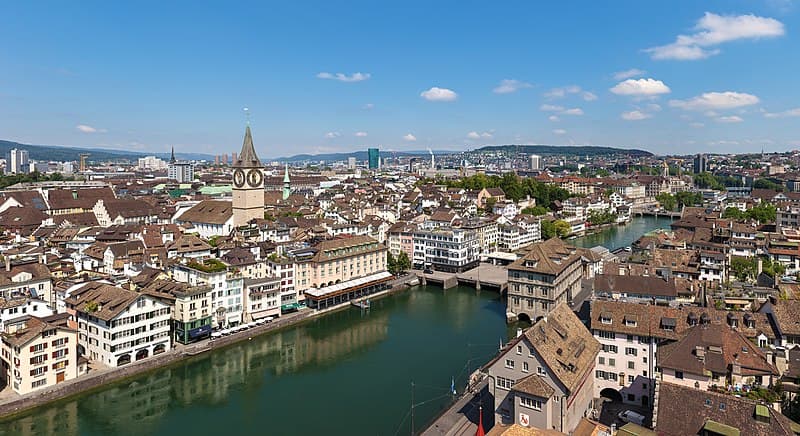
Zurich is Switzerland's largest city and one of the world's leading financial centres, but don't expect skyscrapers — it has four hundred thousand residents, an old town of cobbled lanes, and a lake the whole city swims in on the way home from work in summer. This is where Zwingli's Reformation began in 1519, stripping the Swiss church of organs, paintings and ornament, and shaping the Swiss character in the process: restraint, order and a distrust of display. The paradox is that a city with this history now holds gold reserves beneath Bahnhofstrasse and regularly ranks first or second on lists of the world's most expensive cities. For a visitor that means one thing: Zurich is beautiful and mercilessly expensive, so it pays to know in advance where the savings are. A large share of the best things are actually free — a walk along the Limmat, swimming in the river and the lake, the Lindenhof with its view, James Joyce's grave, churches with Chagall and Giacometti windows. What costs money is mainly food and lodging. Plan around that and you'll have two excellent days for reasonable money; skip the planning and you'll spend two hundred francs a day without knowing where it went.

What to see

The places worth your time in Zurich, and what to expect at each

Grossmünster

Grossmünster

Altstadt — right bank

A Romanesque church with twin towers, both the city's symbol and the birthplace of the Swiss Reformation — Huldrych Zwingli preached here and issued the order to strip churches of organs and paintings. The interior is bare and austere as a result, which is itself the point. The choir windows were designed by Augusto Giacometti, the bronze doors by Otto Münch, and an original statue of Charlemagne stands in the crypt.

Tip: A hundred and eighty-seven steps lead up the Karlsturm tower, giving the best view of the old town, the lake and the Alps for five francs — cheaper than any viewpoint in the city. Come after ten, when the tower opens; the church itself is free. On a clear day you can see as far as the Glarus Alps from the top.

Admission:
church free, tower 5 CHF
Time needed:
45 min–1 h
Fraumünster and the Chagall windows

Fraumünster and the Chagall windows

Altstadt — left bank

A former women's convent founded in 853, whose abbesses held the right to mint coins and levy tolls in the city for centuries. The main reason to visit is five stained-glass choir windows, designed in 1970 by an eighty-two-year-old Marc Chagall — each dominated by a different colour, together telling a biblical story from the prophets to Christ. The north transept adds a rose window by Augusto Giacometti.

Tip: Photography isn't allowed inside and it's strictly enforced, so take in the windows without your phone out. The best time is between ten and noon, when sunlight passes through the choir straight through the Chagall windows; in the afternoon they look dull. Admission is five francs and includes an audio guide plus the fresco-covered cloister courtyard.

Admission:
5 CHF
Time needed:
45 min
Bahnhofstrasse

Bahnhofstrasse

Centre

A boulevard a kilometre and a quarter long, running from the main station to the lake, built in 1867 over a filled-in moat, and today one of the most expensive shopping streets in the world. Beneath its southern end, near Paradeplatz, sit the vaults of the big banks holding a substantial share of Switzerland's gold reserves. Trams run along it; cars don't.

Tip: There's no point shopping here, but it's worth the walk for two reasons in particular: the Confiserie Sprüngli shop on Paradeplatz, where luxemburgerli are sold, and, in December, the Lucy Christmas lights — seven thousand suspended bulbs, the loveliest thing about a Zurich December. Buy chocolate at Coop or Migros a street over instead — same brand, a third of the price.

Admission:
free
Time needed:
45 min
Old Town and the Lindenhof

Old Town and the Lindenhof

Altstadt

A tangle of cobbled lanes on both banks of the Limmat, with the Lindenhof on the left bank — a raised terrace lined with lime trees on the site of a Roman customs post and a medieval imperial palace. From the terrace you can see the Grossmünster, the rooftops of Niederdorf and the river. The Augustinergasse and Schipfe lanes are among the oldest in the city, and Schipfe is the last corner still home to working craftspeople.

Tip: The Lindenhof is the best picnic spot in the city: buy bread, cheese and wine at Migros and you have dinner with a view for ten francs instead of eighty at a restaurant. Giant outdoor chess is played here, free to watch. The terrace stays open late into the night; the gate is never locked.

Admission:
free
Time needed:
1–1.5 h
Lake Zurich and the waterfront

Lake Zurich and the waterfront

Seefeld / Enge

A twenty-eight-kilometre glacial lake that begins right at the end of Bahnhofstrasse. Promenades run along both shores, excursion boats moor here, and on a clear day the Glarus Alps show above the water. The water is clean enough that people swim in it routinely from June to September, and it's drinkable after boiling.

Tip: The short boat loop takes ninety minutes and an ordinary ZVV day pass covers it — the best value-for-experience ratio in the city, since a standalone sightseeing cruise costs several times as much. Free swimming spots are Seebad Enge or Tiefenbrunnen, or Frauenbad and Männerbad right on the river Limmat. The water reaches around twenty-two degrees in August.

Admission:
free, boat covered by a ZVV pass
Time needed:
2–3 h
Kunsthaus Zürich

Kunsthaus Zürich

Hottingen

Switzerland's largest art collection, and, since a 2021 extension by David Chipperfield, the country's largest art museum overall. It holds the biggest Edvard Munch collection outside Norway, a strong Giacometti and Hodler presence, Monet including the large Water Lilies, and a whole floor of classical modernism. The controversial Bührle collection sits in the new building with accompanying context on its origins.

Tip: On Wednesdays admission to the permanent collection is free, and it's mostly locals rather than tourists who come — saving twenty-three francs. The new building has its own entrance, and the underground connecting corridor from the courtyard is easy to miss. Monet's Water Lilies hang in their own room in the original building and tend to be empty right after the ten o'clock opening.

Admission:
23 CHF, permanent collection free on Wednesdays
Time needed:
2–3 h
Uetliberg

Uetliberg

Uetliberg, 20 min by train

An eight-hundred-seventy-metre hill on the city's western edge, known to locals as 'Uetli' and treated as Zurich's home mountain. A viewing tower stands at the top, offering, on a clear day, the whole lake and the Alpine chain from Säntis to the Jungfrau. A ridge path leads on from here along a planetary trail to Felsenegg.

Tip: The S10 train from the main station takes twenty-one minutes and runs on an ordinary city ZVV ticket, no surcharge — many people buy a special ticket for it needlessly. Best to go up late afternoon, walk the ridge to Felsenegg for two hours, then take the cable car down into Adliswil. In winter you often look out over a sea of fog with the Alps poking through.

Admission:
covered by a ZVV ticket
Time needed:
half a day
Swiss National Museum

Swiss National Museum

next to Hauptbahnhof

A fairy-tale Neo-Renaissance building right next to the main station, home to the most complete account of Swiss history from prehistory to today. The collection runs from Celtic finds through Gothic altarpieces and armouries to the history of neutrality, banking and immigration. The 2016 extension is worth seeing in its own right.

Tip: It's the best way to understand, in two hours, why Switzerland functions the way it does — especially the sections on the founding of the confederation and the twentieth century. Admission to all federal museums is free under thirty-seven. The courtyard and park behind the building need no ticket, and there's a riverside bar there in summer.

Admission:
13 CHF, free under 16
Time needed:
2 h
Zürich West and the Viadukt

Zürich West and the Viadukt

Kreis 5

A former industrial district northwest of the centre, where shipyards and machine works have turned into clubs, galleries and bars. Its spine is a late-nineteenth-century railway viaduct, its stone arches now home to shops and the Im Viadukt market hall. Nearby stands the Freitag Tower, built from nine shipping containers, and the former shipbuilding hall Schiffbau.

Tip: This is where you'll save the most in Zurich's overall budget: a lunch set menu at Frau Gerolds Garten or the market hall runs fifteen to twenty francs instead of thirty-five in the centre. You can climb the outdoor staircase of the Freitag Tower for free, with a decent view over the district. Evenings here draw locals rather than tourists, and it's the best nightlife in the city.

Admission:
free
Time needed:
2–3 h

Photos: Grossmünster — Roland zh (CC BY-SA 3.0) · Fraumünster and the Chagall windows — CEphoto, Uwe Aranas (CC BY-SA 3.0) · Bahnhofstrasse — KeanoManu (CC BY-SA 4.0) · Old Town and the Lindenhof — Tschubby (CC BY-SA 3.0) · Lake Zurich and the waterfront — Roland zh (CC BY-SA 3.0) · Kunsthaus Zürich — Roland zh (CC BY-SA 3.0) · Uetliberg — roland zh (CC BY-SA 3.0) · Swiss National Museum — Matt Joseph (CC BY-SA 4.0) · Zürich West and the Viadukt — Hansueli Krapf This file was uploaded with Commonist. (CC BY-SA 3.0)

Where to stay

Areas and districts, matched to the kind of trip you are taking

Altstadt and Niederdorf

Best for: a first visit and an evening stroll

The historic core on both banks of the Limmat, with both main churches, the Lindenhof and the narrowest lanes in the city. Niederdorf on the right bank is the evening zone with pubs, the one place in Zurich still lively after eleven at night. Accommodation is the most expensive and the loudest here; the upside is that everything is within walking distance.

Kreis 5 — Zürich West

Best for: food, nightlife and better value

A former industrial district by the railway, today the liveliest part of the city, with meals and drinks considerably cheaper than in the centre. There's a market hall built into the viaduct, clubs in former machine-works halls, and the best value for lunch in town. It's ten minutes into the centre by tram or twenty on foot along the river, with accommodation about a quarter cheaper than the old town.

Seefeld and Enge

Best for: the lake, swimming and a calm stay

Residential, quiet and green districts along both shores of the lake south of the centre. Seefeld on the east bank has a promenade, bathhouses and the nicest morning run in the city; Enge on the west bank has a Chinese garden and boat moorings. Restaurants here are more neighbourhood than tourist-facing, and in summer it's the only place worth staying — you can jump in the water before breakfast.

Kreis 4 — Langstrasse

Best for: cheap food and an unpolished evening out

The most densely populated district in the city and, until recently, Zurich's red-light quarter, today a mix of bars, cheap restaurants from around the world, and flats. You can eat here for ten to fifteen francs, unheard of elsewhere in Zurich. It's also the one place in the city that gets loud at night and where it's worth keeping an eye on your belongings. Accommodation is the cheapest anywhere in Zurich.

Getting around

From the airport

Direct flights from Prague to Zurich take about an hour and a half, operated by Swiss; a fare booked ahead can run around two thousand crowns one-way, considerably more at the last minute. By train from Prague it's roughly twelve hours via Nuremberg or Munich with one change, including an overnight service; a ticket bought three months ahead is usually cheaper than a flight. By car it's nine hundred kilometres and nine hours; a Swiss motorway vignette costs forty francs and is valid for the calendar year, bought online or at the border. Zurich Kloten airport lies thirteen kilometres north, with a train into the centre every ten minutes taking ten minutes — one of the best airport connections in Europe.

Zurich Kloten (ZRH) · 13 km

  • S-Bahn / IC train to the Hauptbahnhof· 10–13 min· 7.20 CHF
  • Tram 10 into the centre· 35 min· 7.20 CHF
  • Taxi· 20–30 min· 60 CHF

Basel–Mulhouse (alternative for budget airlines) (BSL) · 95 km

  • Bus to Basel SBB station and train to Zurich· 1 h 30 min· 35 CHF

Around town

Zurich's ZVV transport network is dense, punctual and expensive: a single ticket for the central zone 110 costs 4.80 francs, a day pass 9.60. The day pass pays off from the third ride and, crucially, also covers the lake boats and the train up the Uetliberg, making it the best purchase in the city. Tickets are bought at a stop machine or through the ZVV app and need no validation — they're valid from the moment of purchase. Ticket inspectors are frequent and the fine is a hundred francs. Anyone staying in the centre can more or less do without transport at all: the old town is walkable, and it's fifteen minutes from the Hauptbahnhof to the lake. Shared Züri Velo bikes are free for the first thirty minutes, and the city is flat along the river but steep as you move away from it.

TramsThe backbone of the network, fifteen lines running every seven minutes. Lines 4 and 13 link the station to Zürich West, line 11 runs around the lake. The ticket also covers buses, S-Bahn trains and boats. · 4.80 CHF
ZVV 24-hour day pass9.60 CHF for zones 110, 29 CHF for the whole canton. Covers the lake boats and the train up the Uetliberg. Worth it from the third trip of the day and the best value in the city. · 9.60 CHF / 24 h
Lake boatsThe short loop takes 1.5 hours and is included in the day pass. Longer trips to Rapperswil need a ticket for more zones. Boats dock at Bürkliplatz, at the end of Bahnhofstrasse. · included with a day pass
S10 train up the UetlibergFrom the Hauptbahnhof to the summit in 21 minutes, on an ordinary ZVV ticket. Runs every half hour, more often in season. · included with a ticket
Shared bikes, Züri Velo and PublibikeFree for the first thirty minutes after registering, then two francs per half hour. Flat along the river and the lake, steep climbing into Kreis 6 and 7. · from 0 CHF for the first 30 min

Useful apps: ZVV, SBB Mobile, Google Maps, Züri Velo

When to go

Zurich is best from June to September, when you can swim in both the lake and the river and the whole city moves outdoors — river bathhouses on the Limmat, bars along the waterfront and evening swims are the city's best offering, and it's free. July and August are warm, around twenty-five degrees, but watch for Street Parade on the second weekend of August, when more than half a million people flood the city and accommodation becomes unavailable and overpriced. May and September have pleasant weather and fewer people. December is worth a visit for the Lucy light installation on Bahnhofstrasse and the Christmas markets, though it's damp and grey. November and January are the worst: fog sits over the lake for weeks, with sun only above it on the Uetliberg, not in the city itself. Winter accommodation prices, on the other hand, are the lowest of the year.

Best time

June to September for swimming, plus December for the lights

What to avoid

the Street Parade weekend in August and foggy November

MonthJanFebMarAprMayJunJulAugSepOctNovDec
Day3°5°10°15°19°23°25°24°20°14°8°4°
Night-2°-2°1°4°8°12°14°14°10°7°2°-1°
Rainy days10910111313121210101011

Food & drink

Eating in Zurich is the most expensive part of any trip, and it's worth planning around: a main course at an ordinary restaurant runs twenty-eight to forty-five francs, a pizza twenty-five, a half-litre of beer seven to nine. There are three ways to eat for half that. First is the set lunch, 'Mittagsmenü', offered even by pricier places for twenty-two to twenty-eight francs including soup — the same dish costs nearly double in the evening. Second is a canteen: the Migros Restaurant and Coop Restaurant chains, plus the ETH and university cafeterias, are open to the public, with a plate for around fifteen francs. Third is the supermarket — Migros and Coop sell ready meals, salads and bread for a fraction of the price, and a picnic at the Lindenhof or by the lake is both legal and common. Swiss specialities in the centre tend to be priced for tourists; fondue and Geschnetzeltes are worth seeking out in Kreis 4 or Kreis 5 instead.

What to try

Züri Geschnetzeltes

Strips of veal in a cream sauce with mushrooms and white wine, served with rösti. It's Zurich's signature dish, and the original version even includes veal kidney; restaurants charge around thirty to forty-five francs.

Rösti

Grated potatoes fried in a pan, originally a Bernese farmers' breakfast. Served with egg, cheese or bacon, and the cheapest main course on most mountain menus.

Cheese fondue

A melted blend of gruyère and vacherin with white wine, into which bread is dipped on a fork. Drink white wine or black tea with it, not cold water — a portion for two runs twenty-five to thirty-five francs per person.

Raclette

Half a wheel of cheese melted under a grill and scraped onto potatoes with gherkins and pickled onion. Ordered by the number of scrapes, and eaten until the guest calls it quits.

Bündnerfleisch

Beef air-dried in the mountain air, sliced paper-thin. A Bündnerteller plate of dried meat, raw ham and mountain cheese can stand in for a whole lunch at a mountain hut.

Chocolate and Rivella

A bar of Swiss chocolate from Coop or Migros costs a fraction of the price in a tourist shop and is the same brand. Rivella is the national soft drink, made from whey, tasting somewhere between apple and milk.

Luxemburgerli and Sprüngli

Miniature macarons from Zurich's Sprüngli patisserie, lighter and smaller than the French version. Sold by weight on Paradeplatz and good for two days; a hundred grams costs around twelve francs and it's the most typical gift to bring home from the city.

Sausage with bread and Kalte Ente

The cheapest hot meal in the city is a bratwurst from a street grill with a slice of bread for eight to ten francs, available even at Bellevue and by the station. Kalte Ente is a fruit-and-sparkling-wine drink, a common summer sip on the lakeside terraces.

What it costs

Coffee at a café

5–6.50 CHF

Half-litre of beer

7–9 CHF

Set lunch at a restaurant

22–28 CHF

Main course in the evening

32–48 CHF

Plate at a Migros Restaurant

14–18 CHF

ZVV day pass, zone 110

9.60 CHF

Kunsthaus admission

23 CHF, free on Wednesdays

Night in a 3-star hotel for two

180–260 CHF

Indicative prices that change over time — treat them as a guide, not a price list.

Practical information

SocketsCEuroplug, two round pinsJSwiss
Voltage230V / 50Hz
Tap waterTap water is drinkable — Tap water in Switzerland is drinkable without exception, and eighty percent of it comes from groundwater or springs — in the mountains it runs continuously into public fountains, and you can drink straight from them or fill a bottle. A sign reading 'kein Trinkwasser' means not drinkable and is rare. A litre of bottled water costs around a franc in a shop and six to eight in a restaurant, so a refillable bottle saves more money than anything else.
TippingService is included by law and no tip is expected. It's customary to round up, typically to the nearest franc or five. When paying by card, you tell the server the amount to round the receipt to — the terminal usually has no tip field. At mountain huts you pay at the counter up front, and no tip is given at all.
Driving on theright
SafetySwitzerland is one of the safest countries in the world and crime barely touches tourists; pickpocketing is concentrated on trains on the main routes and in station halls. The real risk lies in the mountains: weather can change within the hour, snowfields linger on north-facing slopes into July, and the avalanche situation shifts daily in winter. The emergency number is 112, and the mountain rescue service Rega is reached on 1414. A Rega callout is expensive without insurance; a Rega patronage membership for under four francs a month covers it.
Opening hoursShops in Swiss cities open from nine to eight, and until six on Saturdays; on Sundays almost everything is closed except shops at the main station and the airport, which stay open until nine and are the only place a Sunday-arriving tourist can buy anything. Restaurants serve lunch from half past eleven to two and dinner from six to ten; outside those hours you'll find at most a cold plate. Museums close on Mondays, and Thursday evenings often extend to eight or ten. Banks close at half past four.
Customs & etiquettePunctuality is a form of courtesy in Switzerland — trains and buses leave at the announced minute, and a seven o'clock restaurant reservation means seven o'clock. A 'Grüezi' greeting is used even with strangers passed on a mountain trail — it's a rule, not an optional courtesy. Quiet hours apply on Sundays and after ten at night: no mowing lawns, no drilling, no laundry in apartment buildings. Waste is sorted rigorously, and some municipalities charge for a special bag for general rubbish.
A few local wordsHello — GrüeziThank you — DankePlease — BitteThe bill, please — Zahlen, bitteCheers — ProstGoodbye — Uf Wiederluege

How to plan your days

1 day

A day in Zurich

  1. 1Morning at the Lindenhof and the Schipfe lanes on the left bank.
  2. 2Fraumünster for the Chagall windows, while sunlight still reaches the choir.
  3. 3Across the Münsterbrücke to the Grossmünster and up the tower.
  4. 4Set lunch in Niederdorf, afternoon walk down Bahnhofstrasse to the lake.
  5. 5Evening boat trip on a day pass, dinner in Zürich West.

2 days

Two days with the Uetliberg

  1. 1Day one as above.
  2. 2Morning S10 train up the Uetliberg for the Alpine view.
  3. 3Ridge walk to Felsenegg, then cable car down into Adliswil.
  4. 4Afternoon at the Kunsthaus or the Swiss National Museum.
  5. 5Evening swim at Seebad Enge and dinner on the waterfront.

3 days

Three days with a day trip

  1. 1First two days as above.
  2. 2Train to Lucerne or the Rhine Falls, both under an hour away.
  3. 3Lunch outside Zurich, where prices run a quarter lower.
  4. 4Return in the afternoon, market hall Im Viadukt in Zürich West.
  5. 5Evening bars in Kreis 4 or Frau Gerolds Garten.

Day trips

Rhine Falls near Schaffhausen

50 km · 55 min by train

The largest waterfall in Europe by water volume — a hundred and fifty metres wide, with up to six hundred cubic metres a second flowing over it in summer. The train runs from the Hauptbahnhof with one change to Neuhausen Rheinfall, five minutes' walk from the water. Viewing platforms on the south bank by Laufen Castle charge five francs; the north bank is free and offers nearly the same view. Boats ferry visitors to a rock in the middle of the current that you can climb.

Lucerne and Lake Lucerne

52 km · 45 min by train

Switzerland's most photogenic city: the covered wooden Kapellbrücke bridge from 1333, with painted panels under its roof, ramparts and towers above the town, and a lake ringed by mountains. Trains run twice an hour from Zurich and take forty-five minutes. From Lucerne you can continue by boat and cog railway up the Rigi, or by cable car up Pilatus — both a full-day trip costing around seventy francs. The town itself takes three hours to explore.

Bern

95 km · 1 h by train

Switzerland's capital and the only one whose entire old town is UNESCO-listed — six kilometres of arcades you can walk under in the rain and stay dry, eleven Renaissance fountains, and the Zytglogge clock tower with its figurine astronomical clock. The Aare river loops around the centre, and in summer locals drift down it with the current. Trains run every half hour and take an hour. Anyone wanting to see more than Zurich alone should come here.

Frequently asked questions

How much money should I budget per day in Zurich?+

Without accommodation, budget around ninety francs for a modest day: a supermarket breakfast, a set lunch for twenty-five, a day travel pass for nine-sixty, one admission fee and dinner at a canteen-style restaurant. With restaurants for both meals, expect a hundred fifty to a hundred eighty. A night in a three-star hotel for two runs a hundred eighty to two hundred sixty francs. Zurich ranks among the three most expensive cities in the world, and budgeting the way you would in Prague or Vienna simply doesn't work.

How can you save money in Zurich?+

Three things. Have your main meal at lunch — the same dish costs almost double in the evening. Shop at Migros and Coop and picnic at the Lindenhof or by the lake, which is completely normal and legal. And buy a nine-sixty ZVV day pass, since it also covers the lake boats and the train up the Uetliberg, which would otherwise cost extra. The Kunsthaus is free on Wednesdays, and churches, the Lindenhof and swimming in the river cost nothing at all.

Do you pay in francs or euros in Zurich?+

Francs. Euros are accepted at tourist-facing businesses, but at a rate that costs you ten to fifteen percent, and you get change back in francs. Paying by card works almost everywhere, including at ticket machines, and it's the best option — just always decline the terminal's offer to convert to your home currency or to euros, and let it charge you in francs. Cash is only needed for small market purchases.

Can you really swim in a river in the middle of the city?+

Yes, and it's the most typically Zurich summer activity there is. The Limmat flows out of the lake and is clean; historic bathhouses, Frauenbad and Männerbad, sit right on the river, with admission around eight francs. A popular activity called 'Limmatschwimmen' has people floating downstream with the current from the Flussbad Oberer Letten — you get in upstream and climb out about a kilometre down. The water reaches around twenty-two degrees in August, similar in the lake, and the season runs roughly from June to mid-September.

Is the Swiss Travel Pass worth it?+

Not for Zurich itself — a nine-sixty ZVV day pass covers the city. The Swiss Travel Pass pays off when you're taking day trips from Zurich to Lucerne, the Rhine Falls, Bern or the mountains: a three-day pass costs around two hundred thirty francs and covers all transport in the country plus admission to most museums. Simple rule: under two longer train trips a day, it's not worth it; over two, it is.

How many days do I need in Zurich?+

Two days are enough for the city itself — the first for the old town, both churches and the lake, the second for the Uetliberg and one museum. Three days make sense if you want to add a day trip to Lucerne or the Rhine Falls, both easy from Zurich and the best use of a third day. A longer stay in the city alone runs dry, but Zurich is an excellent base for the whole of northern Switzerland.

Will I get by in English?+

No problem at all. Zurich is an international financial centre with a high share of foreign residents, and you'll manage in English at hotels, restaurants, shops and the station. The local language is Swiss German, different enough from standard German that even Germans often struggle with it — but locals automatically switch to standard German or English for foreigners. The greeting 'Grüezi' is used with strangers too, including when entering a shop.

When is the best time to visit?+

From June to September, because that's when you can swim in the lake and the river, the city's biggest asset. Avoid the second weekend of August, when Street Parade brings over half a million people to town — accommodation becomes unavailable and prices double. December is worth a weekend for the Lucy light installation on Bahnhofstrasse. November is the worst month, with fog sitting over the lake for weeks while the sun only reaches the Uetliberg above it.
Visa Requirements

Check the latest visa requirements for entering this country. Some nationalities may need to apply for a visa or e-visa before travel.

Check visa requirements

Language

German / French / Italian

Currency

CHF

Timezone

GMT+1

Dial Code

+41

Population

8.8M

Area

41,285 km²

Voltage

230V / 50Hz

Driving Side

Right

Top Hotels in Zurich

Live prices from 500+ properties

Loading hotels...

More destinations in Switzerland

Planning a trip to Zurich?

Compare hundreds of hotels, find the best price, and book with free cancellation on TravelManiac.