Hotels in Gstaad

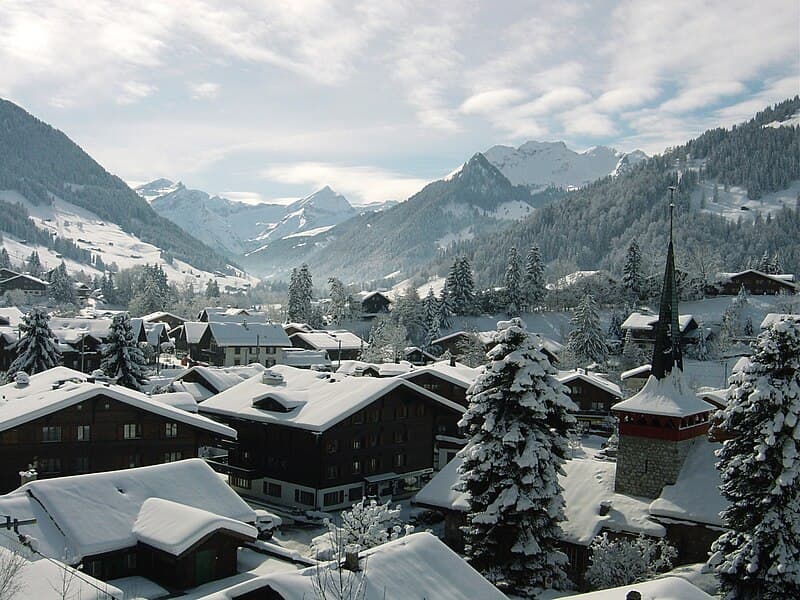
The village of wooden chalets that chose luxury over skyscrapers

Gstaad

LanguageEnglish
CurrencyCHF
TimezoneGMT+1
Temperature-2-25 °C
Dial Code+41
Population8.8M
Area41,285 km²
SocketsType C / Type J
Tap waterDrinkable

Discover Gstaad

Gstaad is a village of under 3,000 residents in the Bernese Saanenland, at 1,050 metres, where local building regulations allow nothing but shingle roofs and timber façades. That's exactly why, even after a century as a resort, it still looks like a mountain village rather than a ski town: the country's most expensive hotel stands in a chalet. Julie Andrews and Roger Moore lived here, children from around the world attend its boarding schools, and it hosts a tennis tournament with an international name in January and a showjumping event in December. The ski area is spread across nine hills on two sides of the valley, sharing a single lift pass, but mostly not linked to one another by runs — getting between them means a ski bus or train. The slopes are mostly gentle and blue, making Gstaad a good destination for families and a poor one for anyone chasing steep terrain.

What to see

The places worth your time in Gstaad, and what to expect at each

Glacier 3000 and Peak Walk

Glacier 3000 and Peak Walk

Col du Pillon, 20 km south-west

A glacier area on the Diablerets, reached by cable car from the Col du Pillon pass up to 3,000 metres. Strung between two summits is the 107-metre Peak Walk suspension bridge — the only one in the world connecting two peaks — with views of the Matterhorn, Mont Blanc and the Eiger.

Tip: It's around freezing at the top even in August, and windy, so a jacket and hat aren't optional. Take the first cable car around 9am, as mornings tend to be clear and afternoons cloud over. In summer, a toboggan run and dog-sledding operate on the glacier; you can visit the summit restaurant without paying for the attractions.

Admission:
from CHF 89 return
Time needed:
full day
Gstaad promenade

Gstaad promenade

centre

The village's main pedestrian street, lined with timber chalets, watchmakers and boutiques of brands you'd otherwise find on Zurich's Bahnhofstrasse. The contrast between farmhouse architecture and designer window displays is the whole joke of Gstaad. At the end of the street stands a church, and above it the towered Hotel Palace, visible from across the valley.

Tip: Prices in the shops along the promenade are Zurich-level, but coffee at the bakery a few doors down costs a normal 5 francs. The best time for a stroll is late afternoon, when skiers head back. The Hotel Palace has a bar open to the public, the cheapest way to see inside.

Admission:
free
Time needed:
1–2 h
Lauenensee

Lauenensee

Lauenen, 10 km south

A mountain lake at 1,380 metres in an enclosed valley beneath the walls of the Wildhorn, surrounded by a protected bog reserve. At the southern end, the Geltenschuss waterfall drops into the valley, and a flat loop around the shore measures under 2 kilometres.

Tip: You can drive here, with parking costing around 8 francs, but in summer a postbus from Gstaad also runs all the way to the lake. The water sits around 17 degrees even in August, which is borderline for swimming. It's loveliest early in the morning, when the mountains are reflected on the surface and the bus hasn't brought anyone yet.

Admission:
free, parking CHF 8
Time needed:
half a day
Saanen

Saanen

2 km north-west

The historic centre of the whole valley, 2 kilometres from Gstaad, older and less polished. St Mauritius Church, from 1444, has Gothic frescoes depicting the legend of St Nicholas, and the village has a row of 16th-century chalets with carved inscriptions above their doors.

Tip: Accommodation and food in Saanen cost roughly a third less than in Gstaad, and it's 5 minutes away by train. There's also a small-aircraft airfield, and in summer concerts from the Yehudi Menuhin Festival are held here, whose tent is pitched right by Saanen.

Admission:
free
Time needed:
2 h
Höhi Wispile

Höhi Wispile

above Gstaad

A hill right above Gstaad, reached by cable car from the edge of the village up to 1,900 metres. At the top is a mountain farm with a dairy, a children's playground and the start of a ridge trail to Lauenensee. The view takes in all of Saanenland and the glaciers to the south.

Tip: The nicest half-day hike in the area runs from here along the ridge down to Lauenensee, taking 3 hours and mostly downhill — head back by bus. The farm up top sells its own cheese and yoghurt, and you can even sleep in the hay. In winter, a toboggan run starts from here.

Admission:
CHF 32 return
Time needed:
half a day
Rougemont

Rougemont

5 km south-west

The first village across the language border, 3 kilometres from Saanen, where German gives way to French. It has an 11th-century Cluniac priory church and a castle with towers dating from 1580. The chalet architecture matches Gstaad's, but the signs above the doors are in French.

Tip: This is the clearest place to cross between Switzerland's two language worlds within a single train stop. The cable car up to Videmanette climbs to 2,100 metres, with a view of Gstaad from the other side. Restaurants here have French-side prices, meaning lower than in Gstaad.

Admission:
free
Time needed:
2–3 h
Saanenmöser and Schönried

Saanenmöser and Schönried

6 km north-east

Two settlements on the northern side of the valley at 1,300 metres, where Gstaad's largest connected ski area begins, linked all the way to Zweisimmen. In summer, a cable car runs from here to the Horneggli and Rellerli, the starting point for the area's best family trails.

Tip: Snow lies longer and more reliably here than in Gstaad itself, 250 metres lower, so skiing shifts here at the start and end of the season. The Gstaad–Saanenmöser train takes 10 minutes and is free with a hotel guest card, making it worth basing yourself here too.

Admission:
cable cars from CHF 35
Time needed:
half a day
Le Rubli and Videmanette

Le Rubli and Videmanette

above Rougemont

A distinctive rocky dome above Rougemont, nicknamed the Rüeblihorn, meaning carrot horn, for its shape. The cable car from Rougemont ends beneath it at Videmanette, at 2,100 metres, where a ridge trail begins and, in winter, the area's steepest slopes.

Tip: These are the only slopes in Saanenland that can be called demanding — the rest of the area is gentle. In summer, a loop from here to Gstaad via Videmanette and Eggli can be walked in 4 hours, with one descent by cable car.

Admission:
cable car CHF 34 return
Time needed:
half a day
Col du Pillon and the Simmental

Col du Pillon and the Simmental

passes around the valley

A pass at 1,515 metres on the route from the valley to Ormont and Lake Geneva, where the lower station of the Glacier 3000 cable car stands. North of Gstaad, by contrast, opens the Simmental, the valley that gave its name to the Simmental cattle breed and the Berner Alpkäse cheese.

Tip: The two routes can be combined into a full-day loop by car: to the glacier via Col du Pillon and back via Zweisimmen and the Simmental. In the Simmental, mountain dairies sell cheese straight from the producer for half the shop price, and are often open on Sundays too.

Admission:
free
Time needed:
half a day

Photos: Glacier 3000 and Peak Walk — Cable1 (Public domain) · Gstaad promenade — GstaadTourismus (CC BY-SA 3.0) · Lauenensee — Zumbo (CC BY-SA 3.0) · Saanen — Wikimedia Commons (CC BY-SA 3.0) · Höhi Wispile — Zacharie Grossen (CC BY-SA 3.0) · Rougemont — Roland Zumbühl, Arlesheim (CC BY-SA 3.0) · Saanenmöser and Schönried — Fred (CC BY-SA 3.0) · Le Rubli and Videmanette — Zacharie Grossen (CC BY-SA 3.0) · Col du Pillon and the Simmental — Fred (CC BY-SA 3.0)

Where to stay

Areas and districts, matched to the kind of trip you are taking

Gstaad

Best for: the promenade, shopping and evening life

The centre of the action, with the pedestrian street, the big hotels and the Eggli and Wispile cable cars within reach. Accommodation here is the most expensive in the valley, booked months ahead in season. In return, you never need to travel anywhere, and the train and ski bus stop right in the centre.

Saanen

Best for: lower prices with the same convenience

The valley's historic centre, 2 kilometres from Gstaad, with a Gothic church and 16th-century chalets. Accommodation and food cost roughly a third less, and the train to Gstaad takes 5 minutes. Evenings here are quiet, not lively.

Schönried and Saanenmöser

Best for: skiing and more reliable snow

Two settlements 250 metres higher on the northern side of the valley, where the largest connected ski area begins. Snow lasts longer here than in Gstaad, and the lift is a short walk from the hotel. The train down runs every half hour and is free with a hotel guest card.

Rougemont and the French side

Best for: peace and quiet and cheaper restaurants

A village across the language border where French is spoken and prices are lower than on the German side. It has its own cable car up to Videmanette, with the area's steepest slopes. It's 5 minutes by train to Saanen and 10 to Gstaad.

Getting around

From the airport

The most common route runs via Geneva: the train goes via Montreux and then climbs on the narrow-gauge GoldenPass line through the vineyards above Lake Geneva and over the pass into Saanenland; from the airport, it's about 3 hours with one change. From Zurich, it takes 3.5 hours via Bern and Zweisimmen. The GoldenPass line is an attraction in itself, and in the panoramic carriages you sit up front behind the driver. By road from Central Europe, allow around 10 hours via Germany and Bern; Switzerland requires a motorway vignette, and winter tyres in season, though the valley itself is reached without crossing any high passes.

Geneva (GVA) · 150 km

  • Train via Montreux on the GoldenPass line· 3 h· CHF 70
  • Rental car· 2 h 15 min
  • Private transfer· 2 h 15 min· CHF 450 per vehicle

Zurich (ZRH) · 210 km

  • Train via Bern and Zweisimmen· 3 h 30 min· CHF 85
  • Rental car· 2 h 45 min

Bern (BRN) · 90 km

  • Train via Zweisimmen· 1 h 45 min· CHF 40
  • Rental car· 1 h 30 min

Around town

The narrow-gauge MOB railway runs the length of the valley from Zweisimmen via Saanenmöser, Schönried, Gstaad and Saanen to Rougemont and on to Montreux; trains run every half hour, linking every place you could stay. Postbuses connect to the side valleys, to Lauenensee and to the glacier cable car. Most hotels give guests a card that makes transport free throughout the region — ask for one on arrival. In winter, ski buses to the individual hills are also free, which matters since the areas aren't linked by runs. A car is only useful for a trip to the glacier or the Simmental.

MOB railwayThe backbone of valley transport between Zweisimmen and Rougemont, every half hour. GoldenPass panoramic carriages run the same line for a supplement. · CHF 4–10 within the valley
PostbusesTo Lauenen, Turbach and Col du Pillon. They run exactly on time, but only a few times a day outside the season. · CHF 4–12
Ski busesConnect the individual ski hills, which aren't linked by runs. Free with a ski pass or hotel guest card. · free with a ski pass
Cable carsEggli and Wispile from Gstaad, Horneggli from Schönried, Videmanette from Rougemont, and the cabin lift to Glacier 3000. A multi-day pass covering all of them is worthwhile in summer. · CHF 32–89 return
CarUnnecessary for daily life in the valley; only useful for Col du Pillon and the Simmental. Hotel parking is often included, while central Gstaad charges for it. · parking from CHF 15 per day

Useful apps: SBB Mobile, Gstaad, MOB GoldenPass, MeteoSwiss

When to go

The winter season runs from mid-December to early April; Gstaad sits lower than St. Moritz, so snow is most reliable on the hills above Schönried and Saanenmöser and on the Glacier 3000, where skiing continues into November. Christmas and February are the most expensive periods. The summer season, from mid-June to mid-October, is quieter and cheaper, with huts and cable cars open and a network of 300 kilometres of marked trails. The shoulder seasons — mid-April to June and November — mean most hotels, cable cars and restaurants are closed. A music festival takes place here in July and pushes prices up for weeks.

Best time

mid-June to mid-October for hiking, January and February for skiing

What to avoid

mid-April to June and November, when most businesses are closed

MonthJanFebMarAprMayJunJulAugSepOctNovDec
Day3°5°9°13°18°21°23°22°18°14°8°4°
Night-5°-4°-1°3°7°10°12°12°9°5°0°-4°
Rainy days87910121212129899

Food & drink

Saanenland is dairy-farming country, and the food follows suit: hard mountain cheeses, dried meat, rösti and, in winter, fondue. The area's own protected cheese is called Berner Alpkäse, matured at mountain dairies above the valley and sold directly from producers and in mountain huts. In Gstaad itself, prices are the highest in the region, and a hotel restaurant dinner easily tops CHF 100, but mountain huts on the Wispile and Rellerli serve honest lunches for a third of that. The cheapest option is shopping at the Coop in Saanen and having a picnic by the lake. Prices are noticeably lower on the French side, in Rougemont.

What to try

Berner Alpkäse

A hard mountain cheese matured at dairies above the valley, with protected designation of origin. Bought directly at the dairies for half the shop price, with the flavour varying depending on where the cows grazed.

Berner Platte

A plate of smoked meat, sausages, smoked tongue and bacon with sauerkraut and beans. A winter dish meant for 2 people on one plate, and the heartiest item on the Bernese menu.

Rösti

A pan-fried cake of grated potato, originally a farmer's breakfast. With egg, cheese or bacon, it's the cheapest main course on most mountain menus.

Cheese fondue and raclette

A melted mix of gruyère and vacherin, or cheese scraped onto potatoes. Drink white wine or tea with it, not cold water, and a portion for 2 comes to around CHF 30 a head.

Meringue with double cream

A crisp meringue with thick Gruyère double cream, scooped up by the spoonful like butter. The region's classic dessert and, at mountain huts, the best calorie-to-price ratio around.

Dried meat from the Bernese Alps

Beef air-dried in the mountain air, sliced thin. Served on a wooden board with cheese and pickled vegetables, and enough to replace a whole lunch at a mountain hut.

Gstaad beef and Saanenland lamb

Meat from animals grazed on the meadows around the valley, which restaurants list by the farm's name. It costs more than imported meat, but it's the one local ingredient you'll find even in the smartest places.

Herbal mountain tea and Rivella

A herbal tea from mountain herbs gathered above the valley, and the national whey-based soft drink. Both are cheaper than beer at mountain huts, and the herbal tea is often the house's own blend.

What it costs

Espresso

CHF 4.50

Lunch at a mountain hut

CHF 22–32

Dinner at a restaurant in Gstaad

CHF 55–100 per person

Gstaad day ski pass

CHF 72–80

Glacier 3000 return

from CHF 89

Wispile cable car return

CHF 32

Ski rental per day

CHF 40–55

Night at a 3-star hotel, for 2

CHF 190–350

Indicative prices that change over time — treat them as a guide, not a price list.

Practical information

SocketsCEuroplug, two round pinsJSwiss
Voltage230V / 50Hz
Tap waterTap water is drinkable — Tap water is safe to drink everywhere in Switzerland without exception, and 80% of it comes from groundwater or springs — in the mountains it flows continuously into public fountains, safe to drink or fill a bottle from. A sign reading "kein Trinkwasser" means not drinkable, and it's rare. A litre of bottled water costs around 1 franc in a shop and 6–8 in a restaurant, so a refillable bottle saves more money than almost anything else.
TippingService is included by law, and tipping isn't expected. It's customary to round up, typically to the nearest franc or five. When paying by card, tell staff the amount you'd like the bill rounded to — terminals usually don't have a tip field. At mountain huts, you pay at the counter in advance, and no tip is given at all.
Driving on theright
SafetySwitzerland is one of the safest countries in the world, and crime barely touches tourists; pickpocketing is concentrated on trains along the main routes and in station halls. The real risk is in the mountains: weather can change within an hour, snowfields can linger on north-facing slopes into July, and avalanche conditions shift daily in winter. The emergency number is 112, and the Rega mountain rescue service is 1414. A Rega rescue is expensive without insurance, but a Rega patron membership for under 4 francs a month covers it.
Opening hoursShops in mountain resorts are usually open from 8am to 6:30pm, including Sundays in season; outside the season, everything except station shops closes on Sundays. Restaurants serve lunch from 11:30am to 2pm and dinner from 6pm to 9pm; you won't find food in the mountains later than that. Mountain huts close shortly after the last cable car run, usually between 4pm and 5pm. The shoulder season in November and from April to June sees most hotels and cable cars closed.
Customs & etiquettePunctuality is a form of politeness in Switzerland — trains and buses leave at the stated minute, and a 7pm restaurant reservation means 7pm. The greeting "Grüezi" is said to strangers on a mountain trail too, which is a rule, not a courtesy. On Sundays and after 10pm, quiet hours apply: no mowing lawns, drilling, or using washing machines in apartment buildings. Waste is sorted rigorously, and some municipalities charge for general waste bags specifically.
A few local wordsHello — GrüeziThank you — DankePlease — BitteThe bill, please — Zahlen, bitteCheers — ProstGoodbye — Uf Wiederluege

How to plan your days

1 day

A day in Saanenland

  1. 1Morning cable car to Höhi Wispile above the village.
  2. 2Ridge walk and lunch at the mountain farm dairy.
  3. 3Descend on foot or by cable car and stroll the Gstaad promenade.
  4. 4Afternoon train to Saanen for the Gothic church.
  5. 5Dinner in Saanen, where prices are lower than in Gstaad.

2 days

2 days with the glacier

  1. 1Day 1 as above.
  2. 2Morning bus to Col du Pillon and cable car up to Glacier 3000.
  3. 3Peak Walk between the two summits and lunch at the ridge restaurant.
  4. 4Afternoon back over the pass, with one stop at a viewpoint.
  5. 5Evening stroll through Gstaad and buy cheese to take home.

3 days

3 days with the lake and the French side

  1. 1First 2 days as above.
  2. 2Morning bus to Lauenensee and a loop around the shore.
  3. 3Return and lunch in Lauenen.
  4. 4Afternoon train to Rougemont, across the language border.
  5. 5With a fourth day, take the GoldenPass line to Montreux on Lake Geneva.

Day trips

Montreux and Chillon

60 km · 1 h 30 min by GoldenPass train

The railway descends from Saanenland through the Lavaux vineyards, a UNESCO World Heritage site, down to Lake Geneva. In Montreux stands 13th-century Chillon Castle on a rock in the lake, once written about by Byron, and on the promenade a statue of Freddie Mercury, who had a recording studio here. The temperature gap between the valley and the lake often runs to 10 degrees.

Gruyères

45 km · 1 h 15 min by train via Montbovon

A medieval hilltop town with a single street and a castle, beneath which sits a cheese dairy where gruyère is made, with the whole process visible through glass. In the same village is the museum of artist H.R. Giger, who designed Alien, and a bar decorated with his artwork — a combination that exists nowhere else.

Zweisimmen and the Simmental

20 km · 25 min by train

A valley north of Saanenland, home of the Simmental cattle breed and the Berner Alpkäse mountain cheese. Villages have painted timber houses with carved inscriptions, and mountain dairies sell cheese straight from the producer. From Zweisimmen, a cable car climbs to the Rinderberg, with views over the whole Bernese Alps.

Frequently asked questions

How do I get to Gstaad without a car?+

By train from Geneva via Montreux on the GoldenPass line in around 3 hours, or from Zurich via Bern and Zweisimmen in 3.5 hours. Within the valley, MOB trains run every half hour, and postbuses serve the side valleys. A car is of little use here, and a hotel guest card often covers local transport for free.

Is snow guaranteed in Gstaad?+

The village sits at 1,050 metres, so snow isn't guaranteed down there, but the slopes above Schönried and Saanenmöser are 250 metres higher, and the Glacier 3000 is open even in November. January and February are the most reliable months. Early and late in the season, skiing shifts to the higher peaks.

Who is Gstaad best suited to for skiing?+

For families and average skiers — most runs are gentle and blue. Anyone after steep terrain will only find it on the Videmanette above Rougemont and on the glacier. The ski areas also aren't linked by runs to one another; getting between them means a ski bus or train, which takes time.

How much does Glacier 3000 cost?+

A return cable car from Col du Pillon starts at CHF 89 and is the single priciest item in the area. The Peak Walk, the bridge between the two summits, is included in the ticket. The toboggan run and dog-sledding on the glacier are extra. With a regional ski pass, the cable car is often included.

Is Gstaad more expensive than St. Moritz?+

No, it's roughly a tenth cheaper: a day ski pass costs around CHF 75 versus 90, and a 3-star night from CHF 190. But the gap between Gstaad and neighbouring Saanen or Rougemont is bigger than the gap between the resorts themselves — in Saanen you'll pay about a third less.

Can you visit Gstaad in summer?+

Yes, summer is a fully-fledged season, from mid-June to mid-October. Cable cars and mountain huts operate, and the area has 300 kilometres of marked trails, mostly gentle. Daytime temperatures hover around 22 degrees and nights around 10, so a jacket belongs in the backpack even in August.

Why does the next village speak French?+

The language border between German- and French-speaking Switzerland runs exactly between Saanen and Rougemont. Chalet architecture is identical on both sides, but shop signs, menus and prices change within a single train stop. Restaurants tend to be cheaper on the French side.

When does Saanenland shut down?+

From mid-April to June, and in November. Most hotels, cable cars and mountain restaurants close during these periods, and only a fraction of businesses in the valley stay open. Visit then and you'll find the scenery, but not the services.

Visa Requirements

Check the latest visa requirements for entering this country. Some nationalities may need to apply for a visa or e-visa before travel.

Check visa requirements

Language

German / French / Italian

Currency

CHF

Timezone

GMT+1

Dial Code

+41

Population

8.8M

Area

41,285 km²

Voltage

230V / 50Hz

Driving Side

Right

Top Hotels in Gstaad

Live prices from 500+ properties

Loading hotels...

More destinations in Switzerland

Planning a trip to Gstaad?

Compare hundreds of hotels, find the best price, and book with free cancellation on TravelManiac.