Hotels in Santorini

White villages on the rim of a sunken crater

Santorini

LanguageGreek
CurrencyEUR
TimezoneEurope/Athens
Temperature12-33 °C
Dial Code+30
Population10.4M
Area131,957 km²
SocketsType C / Type F
Tap waterBottled advised

Discover Santorini

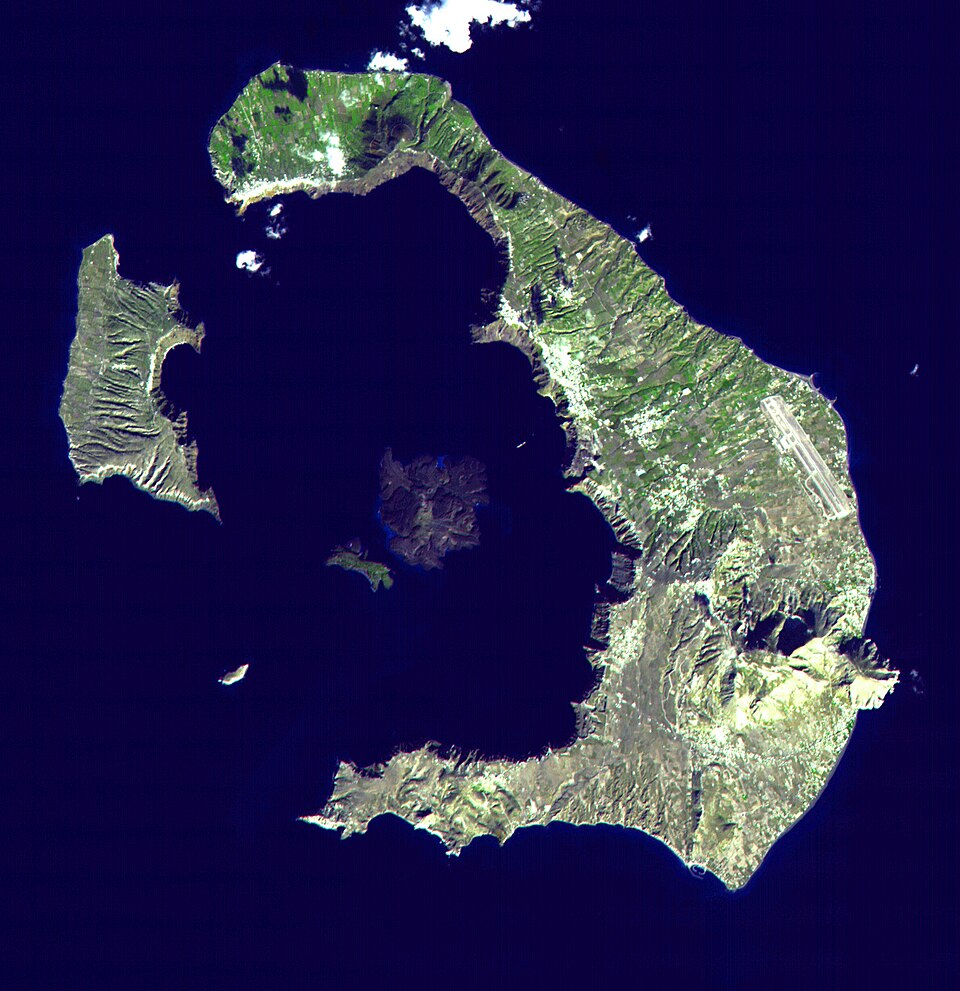
Santorini is what remains of a volcano that erupted around 1600 BC with such force that its centre collapsed into the sea. What was left is a crescent whose inner side drops a sheer three hundred metres into the caldera, and it is on the edge of that cliff that the white villages of Fira, Imerovigli and Oia stand — the reason people come here. The outer side is the opposite: low and gently sloping, with beaches of black and red volcanic sand and vineyards where the vines are coiled into baskets on the ground to protect them from the wind. The island is small — eighteen kilometres from end to end — but overloaded in summer: several cruise ships a day can anchor off the port, and thousands gather in Oia for the sunset. Plan your mornings and evenings differently from the crowds and you will see Santorini at peace. The season runs from April to October, and rooms with a caldera view are among the most expensive in Greece.

What to see

The places worth your time in Santorini, and what to expect at each

Oia

Oia

12 km north of Fira

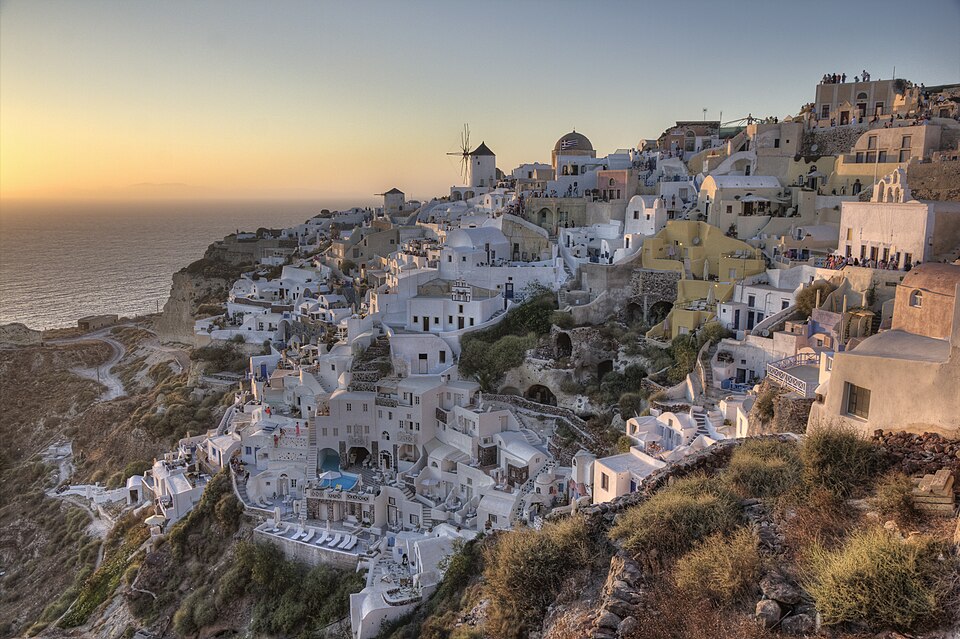
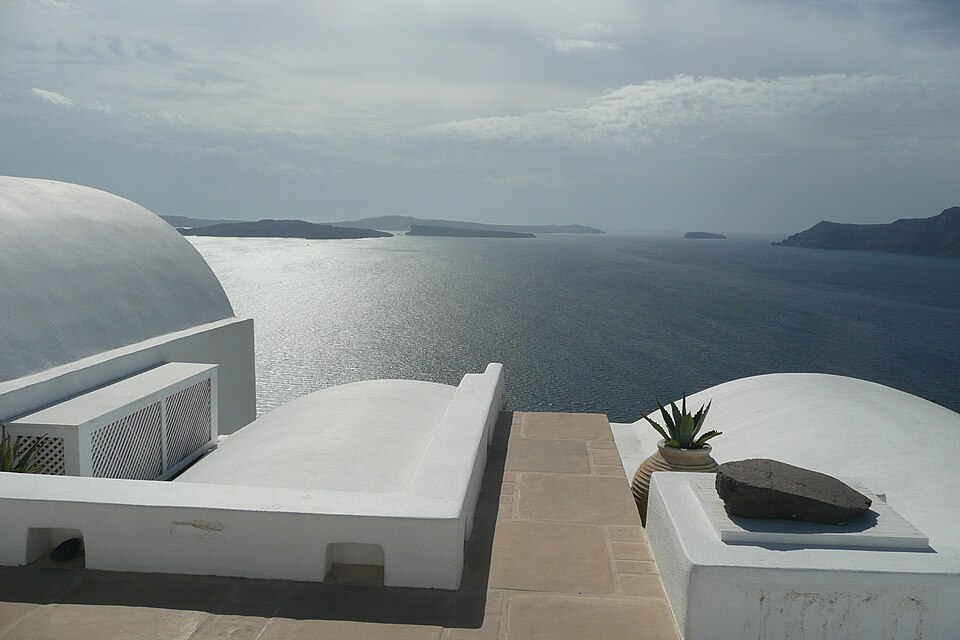
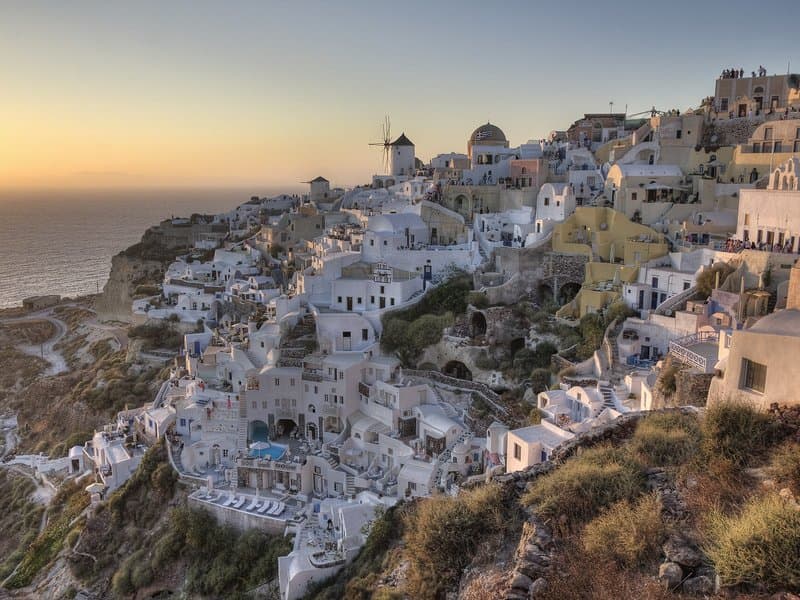
A village on the northern tip of the island with white houses and blue domes set into the cliff, the most photographed place in Greece. A single main marble street runs between the houses; below it are cave houses carved into the rock by former sea captains, and at the very bottom the small harbour of Ammoudi with its fish tavernas.

Tip: Skip the castle at sunset, where hundreds of people cram in — you get the same view from the windmills at the northern end of the village or from Ammoudi harbour, 300 steps below.

Admission:
free
Time needed:
half a day
Fira and the Old Port

Fira and the Old Port

centre of the island

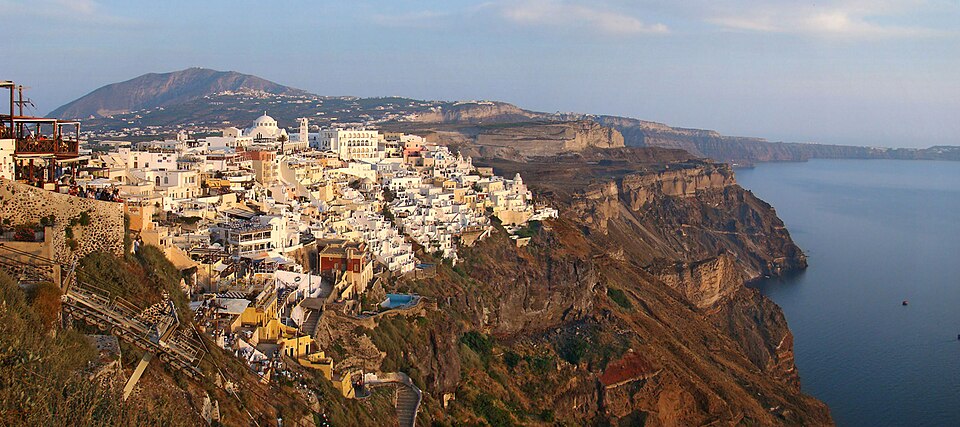
The island's capital, spread along the rim of the caldera, with the cathedral, shops and the largest choice of tavernas. From the centre a zigzag staircase of 587 steps and a cable car lead down to the Old Port, where boats leave for the volcano and cruise passengers come ashore.

Tip: When three or more cruise ships are in the bay, the queue for the cable car back up is over an hour — check the ship schedule on the port website and go down only after they have left.

Admission:
cable car €10 one way
Time needed:
3 h
Akrotiri

Akrotiri

13 km south-west of Fira

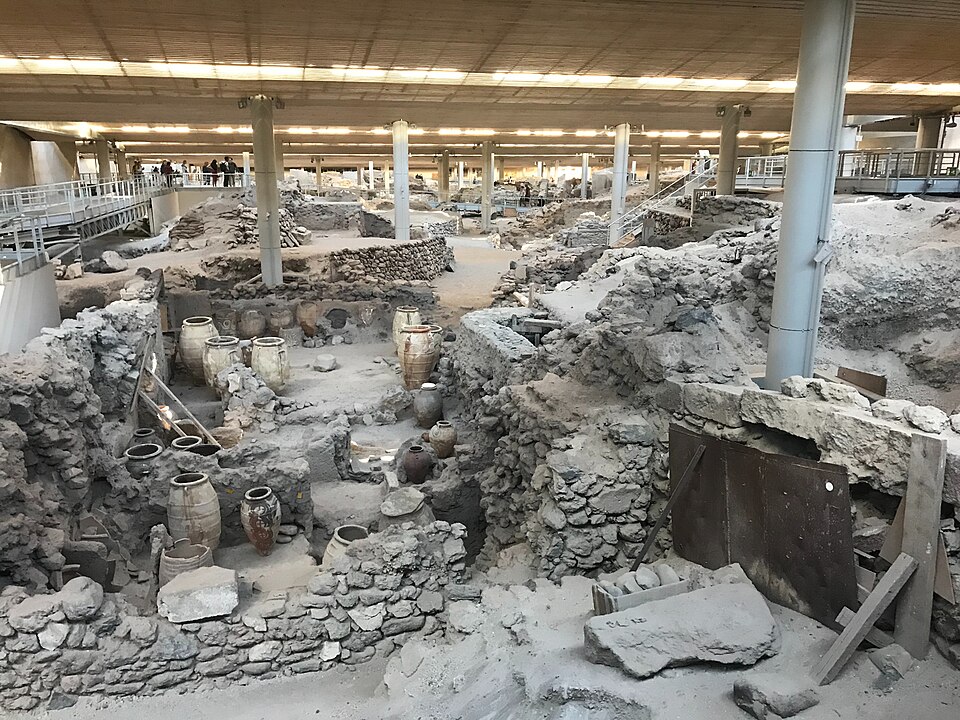
A Bronze Age town buried in ash by the eruption and preserved down to its two-storey houses, staircases, storerooms full of pithoi and drainage system. Unlike Pompeii, no victims were found here; the inhabitants apparently had time to escape. The whole site sits under a huge roof, so it is pleasant even at midday.

Tip: The wall paintings found here are not on site but in the Museum of Prehistoric Thera in Fira — visit the museum after Akrotiri, when they make sense, and you will usually share it with only a few dozen people.

Admission:
€20 (November–March €10)
Time needed:
1.5 h
Nea Kameni and the hot springs

Nea Kameni and the hot springs

the caldera, 20 min by boat

An uninhabited islet in the middle of the caldera and the youngest part of the volcano, which last erupted in 1950. A path crosses black lava fields to the crater, where steam escapes from the rocks. Boat trips usually also stop at neighbouring Palea Kameni, where you swim to an iron-rich spring with rust-coloured water.

Tip: The spring at Palea Kameni is only about thirty degrees and warmest right by the shore — bring an old swimsuit, as the iron-laden mud is hard to wash out of fabric.

Admission:
boat tour from €30
Time needed:
half a day
Ancient Thera

Ancient Thera

Kamari, 10 km south-east

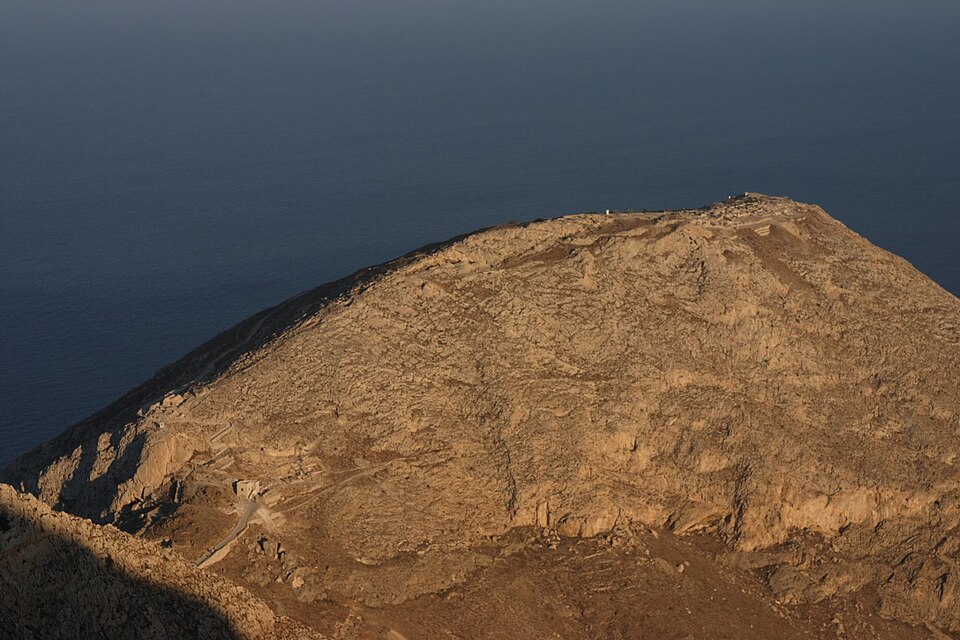
The remains of an ancient city on the ridge of Mesa Vouno mountain, 360 metres up between Kamari and Perissa beaches. The theatre, agora, temples and houses from the Hellenistic and Roman periods survive. From the ridge you can see both sides of the island and the open sea.

Tip: A switchback road climbs up from Kamari, doable by car or in an hour on foot; the car park at the top has only a few spaces, so arrive at opening time while the hill is still in shade.

Admission:
€10
Time needed:
2 h
Pyrgos

Pyrgos

7 km south of Fira

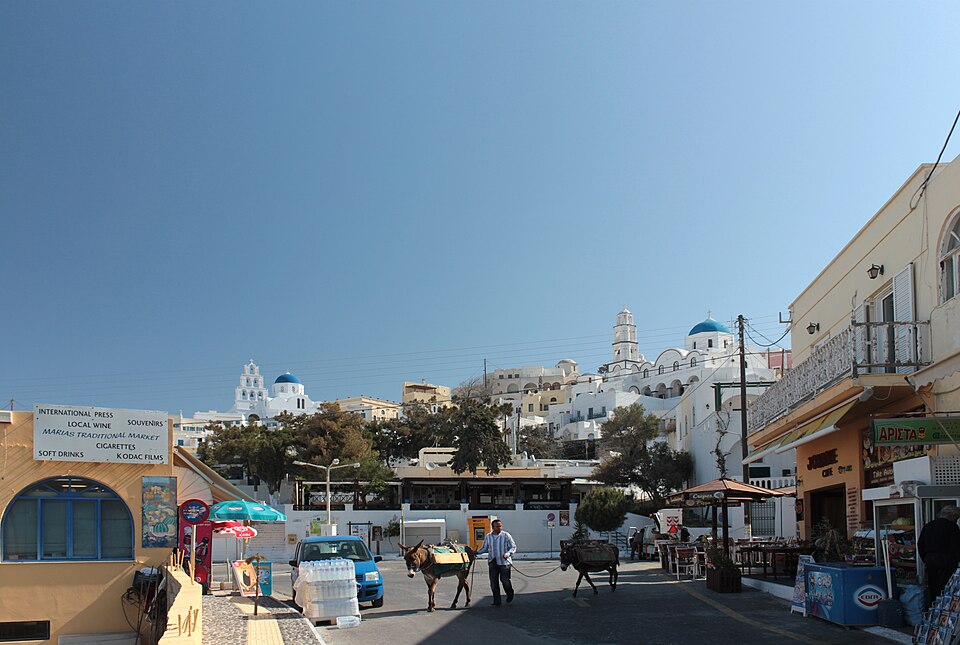
A medieval village on the highest hill inland, its houses huddled around the remains of a Venetian castle. Narrow lanes climb to a church at the top with views over the whole caldera and both coasts. It has a calm you will not find in Fira or Oia.

Tip: The sunset over the caldera is just as good here as from Oia, only without the crowds — but book a taverna on the walls in the morning, as the terraces have only a handful of tables.

Admission:
free
Time needed:
2 h
Caldera trail from Fira to Oia

Caldera trail from Fira to Oia

Fira – Oia

A ten-kilometre path along the cliff edge through Firostefani and Imerovigli, past Skaros rock with the ruins of a medieval castle, then along an undeveloped ridge to Oia. The caldera, the volcano and the island of Therasia stay in view the whole way.

Tip: Set off from Fira at seven in the morning — beyond Imerovigli there is no shade and no water, so two bottles per person is the minimum; a bus runs back from Oia every half hour.

Admission:
free
Time needed:
3–4 h
Skaros

Skaros

Imerovigli, 2 km north of Fira

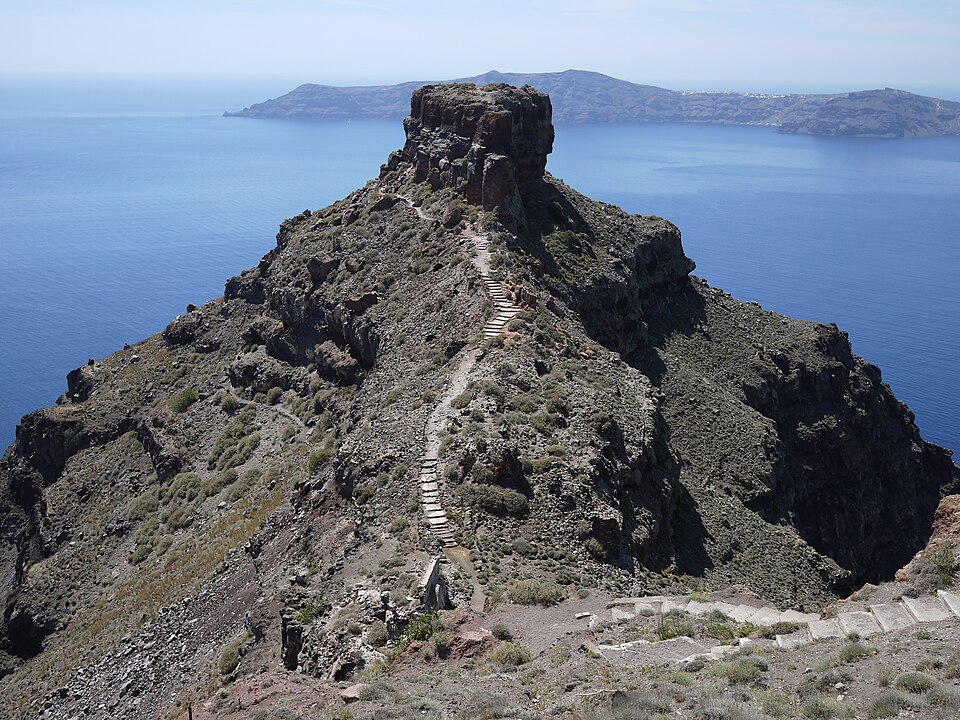
A rocky headland below Imerovigli that once held a Venetian castle surrounded by up to two hundred houses, the island's main settlement until the 18th century. Earthquakes destroyed the castle, leaving walls and the small Theoskepasti chapel at the foot of the cliff. A path runs along a narrow isthmus onto the rock.

Tip: The last stretch to the chapel is narrow and has no railing; avoid midday, as the way back to Imerovigli is 250 steps uphill in full sun.

Admission:
free
Time needed:
1.5 h
Black beaches of Perissa and Kamari

Black beaches of Perissa and Kamari

10–13 km south-east

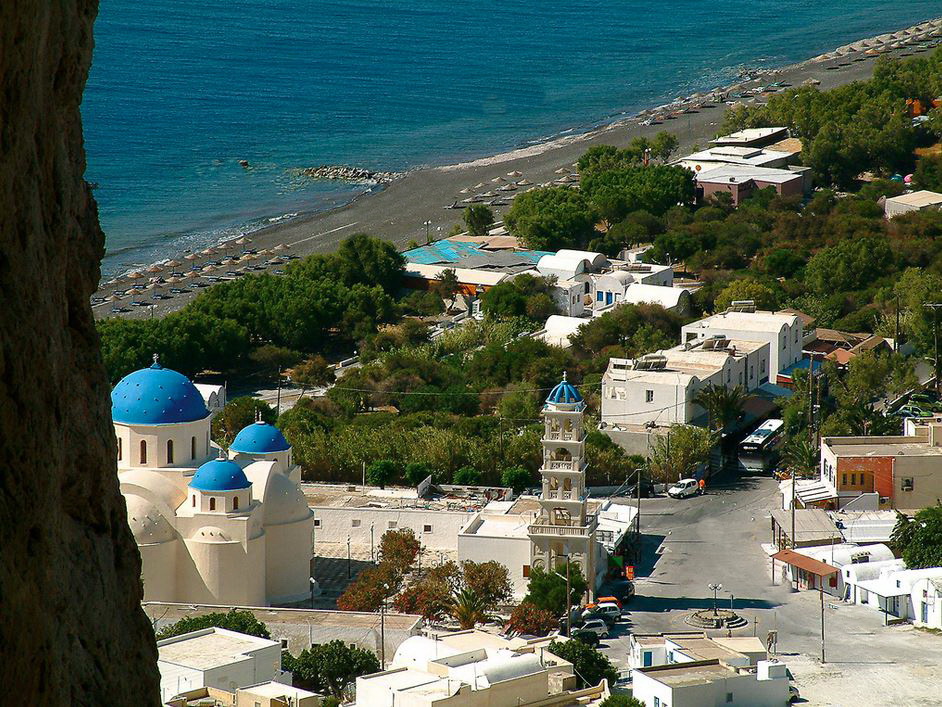
Two long beaches of black volcanic sand and pebbles on the south-east coast, separated by Mesa Vouno mountain. Kamari has a promenade with tavernas and an open-air cinema; Perissa, which runs on into Perivolos, is longer and quieter, with beach bars and water sports.

Tip: In July the black sand gets so hot you cannot walk on it barefoot — wear flip-flops even into the water, and a sunbed is worth more than a towel.

Admission:
free, sunbeds from €15
Time needed:
half a day

Photos: Oia — TomasEE (CC BY 3.0) · Fira and the Old Port — Tango7174 (CC BY-SA 4.0) · Akrotiri — Rt44 (CC BY-SA 4.0) · Nea Kameni and the hot springs — NASA (Public domain) · Ancient Thera — Hartmut Inerle (CC BY-SA 3.0) · Pyrgos — Edal Anton Lefterov (CC BY-SA 3.0) · Caldera trail from Fira to Oia — Paul Stephenson from London (CC BY 2.0) · Skaros — Christopher Down (CC BY 4.0) · Black beaches of Perissa and Kamari — SANTORINI2017 (CC BY-SA 4.0)

Where to stay

Areas and districts, matched to the kind of trip you are taking

Fira and Firostefani

Best for: a first visit without a car

The island's bus hub, with services to the airport, the port and every beach. The most restaurants, caldera views and prices a little lower than in Oia. Firostefani is five minutes' walk away and quieter at night.

Oia and Imerovigli

Best for: honeymoons and hotels with a pool above the caldera

The island's most expensive rooms, in cave houses carved into the cliff, often with a private hot tub. Oia is packed in the evening and completely empty in the morning. Mind the steps — at many hotels your luggage is carried down a hundred steps or more.

Kamari

Best for: families and a beach holiday

A resort by the black beach on the east coast, five minutes from the airport. A promenade with tavernas, shops and an open-air cinema, and accommodation at roughly half the price of the caldera. Buses to Fira run every twenty minutes.

Perissa and Perivolos

Best for: young travellers and tight budgets

The cheapest part of the island, with the longest beach, hostels, apartments and beach bars playing music in the evening. Fira is over half an hour away by bus, so the caldera becomes a day trip. The best choice for swimming.

Getting around

From the airport

Santorini has an international airport on the east coast, six kilometres from Fira. In season there are charter flights and direct scheduled services from dozens of European cities, and year-round flights from Athens take forty-five minutes. The other way in is by ferry: from Piraeus near Athens the slow boat takes eight hours and the fast one about five, while a fast boat from Mykonos or Naxos takes two hours. Ferries dock at the new port of Athinios below the cliffs, ten kilometres from Fira, where buses are timed to meet the arrivals.

Santorini (Thira) (JTR) · 6 km

  • KTEL bus to Fira· 20 min· €2.50
  • Taxi to Fira· 15 min· €25
  • Taxi to Oia· 30 min· €45
  • Hotel transfer· 10–40 min· included in your package

Around town

Every KTEL bus route starts from the bus station in Fira, so getting from Oia to Kamari always means changing in Fira. In season, buses to Oia, Kamari and Perissa run every twenty to thirty minutes until midnight. The island has only about forty taxis, and in the evening you can wait an hour for one. A car or scooter is handy for the south of the island and the wineries, but in summer parking in Oia and Fira is almost impossible. Quad bikes are popular, but they are the most common cause of tourist accidents.

KTEL busAll routes go via Fira; pay the driver or conductor in cash. · €2.50
Hire carA small car is enough, as the roads are narrow; in Oia, park in the large car park at the entrance to the village. · €45 / day
Scooter or quad bikeYou need an A or B category licence depending on engine size, otherwise the insurance is void. · €25 / day
Fira cable carLinks Fira with the Old Port every twenty minutes, in summer from seven in the morning to ten at night. · €10

Useful apps: KTEL Santorini, Ferryhopper, Google Maps

When to go

The most pleasant months are May, June and September to mid-October: around twenty-five degrees by day, the sea at twenty-two or more and fewer cruise ships than in August. July and August are the busiest and most expensive, though it barely ever rains. The meltemi wind blows often, cooling the days, but evenings on the cliff above the caldera can be chilly even in summer — bring a sweater. From November to March most hotels in Oia are closed and boat connections are thinner.

Best time

May, June and September

What to avoid

August for the crowds and prices; November to March for the closed hotels

MonthJanFebMarAprMayJunJulAugSepOctNovDec
Day14°14°16°19°23°27°29°29°26°23°19°16°
Night9°9°10°13°16°20°22°22°20°17°14°11°
Rainy days10974210014710
Sea16°15°15°16°19°22°24°25°24°22°19°17°

Food & drink

Santorini has its own cuisine grown almost without water: crops live off the morning dew, so they are small and intensely flavoured. The cherry tomatoes, white aubergine and fava pulse all carry protected designation of origin. The island's wineries are among the oldest in Europe, and the main grape, assyrtiko, makes dry, mineral wines that go with everything. On the caldera you pay for the view; the same food costs a third as much in Pyrgos, Megalochori or by the beaches.

What to try

Fava

A purée of the local yellow pulse with olive oil, onion and capers, served as a starter. Santorini fava is thicker and sweeter than elsewhere in Greece and you can buy it in packets to take home.

Domatokeftedes

Fritters of local cherry tomatoes, onion, mint and basil. Because the tomatoes are small and dry, the fritters hold their shape instead of falling apart — a standard starter in every taverna on the island.

Chloro

A fresh, soft goat's cheese with a tangy flavour, made only on Santorini and in small quantities. It is served on salads in place of feta or on its own with honey.

White aubergine

A pale aubergine variety with no bitterness and hardly any seeds, baked, grilled or turned into melitzanosalata. It grows only in the island's volcanic soil.

Assyrtiko

A white wine from vines trained into basket-shaped coils on the ground: dry, high in acidity, with a salty mineral edge. Winery tastings cost from €20 for three to six samples.

Vinsanto

A sweet dessert wine from sun-dried grapes, aged for years in barrels, deep amber with notes of raisins and honey. It is drunk after a meal or with biscuits, and shops sell it in small bottles too.

Grilled octopus

Dried in the sun and then grilled over charcoal, served with olive oil and vinegar. You can spot a good place by the octopus hanging on a line in plain view; frozen octopus from the freezer turns rubbery.

Souvlaki and gyros pita

Grilled meat from a skewer or a spit in pitta with tomato, onion, tzatziki and chips inside. The cheapest full meal in the country; 'kalamaki' is a skewer without the pitta.

What it costs

Freddo espresso on the caldera

€5–7

Gyros pita

€4.50–6

Taverna dinner away from the caldera

€25–35 per person

Dinner with a caldera view

€60–100 per person

Winery tasting

€20–45

Boat tour to the volcano and springs

from €30

Sunset catamaran cruise

from €110 per person

Night in a caldera-view hotel

€250–600

Indicative prices that change over time — treat them as a guide, not a price list.

Practical information

SocketsCEuroplug, two round pinsFSchuko
Voltage230V / 50Hz
Tap waterTap water is treated, bottled is common — Do not drink the tap water on Santorini. The island has no rivers or springs; water comes from desalination plants, the pipes are old and the mineral content is high. Buy bottled water — a litre and a half costs under a euro in a supermarket and up to three times that at a kiosk on the caldera. Hotels usually provide drinking water from a dispenser or bottles in the room.
TippingTipping in Greece means rounding up or leaving five to ten per cent, in cash on the table — card terminals usually have no tip option. The bill often arrives on a small plate with a few pieces of fruit or a free glass of spirit; that is hospitality, not an item to pay for. In tavernas you often pay at the till. A cover charge (bread) may only be added if it is listed on the menu.
Driving on theright
SafetySantorini is safe; the risks are mostly down to the terrain. The caldera edge is not railed everywhere, and the marble paving on paths and steps down to the harbours is slippery. Red Beach is officially closed because of falling rocks and there are warning signs on the cliff — people still go, but at their own risk. In February 2025 the island was hit by a swarm of earthquakes; hotels display instructions on what to do during a tremor. The emergency number is 112.
Opening hoursIn season, shops and tavernas in Fira and Oia open daily from morning until midnight. From April to October, Akrotiri and Ancient Thera open from eight to eight, and Ancient Thera is closed on Tuesdays. Wineries take visitors from eleven to seven, and evening tastings need booking. Out of season only a handful of places open in Oia.
Customs & etiquetteThe roofs and terraces of Oia's houses are private property, even when they have the best view — owners call the police on people climbing onto roofs or church domes, and flying drones over the village can bring a fine. Don't ride the donkeys to the Old Port; the animals suffer from overloading and local animal welfare groups campaign against it. Cover your shoulders in churches. Toilet paper goes in the bin.
A few local wordsGood morning / hello — KaliméraThank you — EfcharistóPlease / you're welcome — ParakalóThe bill, please — To logariasmó, parakalóCheers — Jamas

How to plan your days

1 day

One day from cliff to sea

  1. 1Morning: Akrotiri right at opening time, then Red Beach from the viewpoint above the cove.
  2. 2Lunch in Megalochori or Pyrgos, then an afternoon tasting at a winery in the south of the island.
  3. 3Late afternoon in Fira and the Museum of Prehistoric Thera.
  4. 4Sunset from the walls of Pyrgos or from Imerovigli, dinner in Fira.

2 days

Two days with the caldera and the volcano

  1. 1Day one as above.
  2. 2Day two: morning boat from the Old Port to Nea Kameni and the hot springs.
  3. 3Afternoon swim at the black beach in Kamari.
  4. 4Evening bus to Oia, sunset from the windmills and dinner in Ammoudi.

3 days

Three days including the caldera trail

  1. 1The first two days as above.
  2. 2Day three: set off on foot at seven along the caldera from Fira to Oia via Skaros.
  3. 3Breakfast in Oia while it is still empty, then back by bus.
  4. 4Afternoon at Ancient Thera and a swim in Perissa.
  5. 5Last evening: dinner in Kamari or the open-air cinema.

Day trips

Therasia

5 km · 20 min by boat from Ammoudi

The second, inhabited fragment of the original volcano, opposite Oia, home to barely three hundred people. The village of Manolas sits on the caldera rim just like Oia, only without the shops and crowds, and the harbour of Korfos has three fish tavernas. Boats run from Ammoudi several times a day.

Ios

40 km · 35–60 min by ferry

The neighbouring island is known as a party destination for the young, but beyond the main village of Chora it has long sandy beaches such as Mylopotas and Manganari, which Santorini lacks. For a day trip, take the morning fast boat and come back on the evening service.

Crete

130 km · 2 h by fast ferry to Heraklion

In season, fast boats run from Santorini to Heraklion twice a day, so you can fit in the palace of Knossos and the archaeological museum with original frescoes from Minoan Crete, related to those from Akrotiri. It is a long and pricier trip, better spread over two days.

Frequently asked questions

Where can I watch the sunset on Santorini without the crowds?+

Instead of the castle in Oia, try Imerovigli, the walls of Pyrgos, Akrotiri lighthouse on the south-western tip or the windmills at the northern edge of Oia. The sun sets over the caldera from all of them and there is a fraction of the people. The most memorable view is from a boat at sea.

Is a caldera-view room worth it?+

For a honeymoon or a short stay, yes — morning coffee above the caldera is the reason people come here. For a week by the sea, Kamari or Perissa at half the price make more sense, taking the bus to the caldera in the evenings.

Can you swim on Santorini?+

Yes, but the beaches are black volcanic sand and pebbles and shelve faster than on sandy islands. The best are Kamari, Perissa and Perivolos on the east coast. Below the caldera cliffs you can only swim from boats or from the rocks at Ammoudi.

Do I need a car on Santorini?+

Not necessarily. KTEL buses run from Fira to all the main villages and beaches every twenty to thirty minutes. A car is useful for the south of the island, the wineries and Akrotiri lighthouse. In summer, parking in Oia and Fira is a real problem.

Is Santorini safe after the 2025 earthquakes?+

Yes. The seismic activity of February 2025 has died down and the island is running normally, with hotels and sights open. Santorini lies in an active zone, small tremors are common and the volcano is continuously monitored. Follow the authorities' guidance when you travel.

How much does a holiday on Santorini cost?+

Santorini is one of the most expensive Greek islands. Dinner with a caldera view costs sixty to a hundred euros per person, and a night in a clifftop hotel starts at two hundred and fifty euros. Away from the caldera and outside August, prices come close to the rest of the Cyclades.

How do I get from Santorini to Mykonos?+

Fast ferries run several times a day in season and the crossing takes two to three hours depending on stops at Ios, Naxos and Paros. Buy tickets online through the Ferryhopper app or from the operators; in August book ahead.

How many days do I need on Santorini?+

Three days are enough for Oia, Fira, Akrotiri, the volcano and the caldera trail. For beach time and wineries, add another two or three days, or combine Santorini with another Cycladic island such as Naxos or Milos.

Visa Requirements

Check the latest visa requirements for entering this country. Some nationalities may need to apply for a visa or e-visa before travel.

Check visa requirements

Language

Greek

Currency

EUR

Timezone

Europe/Athens

Dial Code

+30

Population

10.4M

Area

131,957 km²

Voltage

230V / 50Hz

Driving Side

Right

Top Hotels in Santorini

Live prices from 500+ properties

Loading hotels...

Planning a trip to Santorini?

Compare hundreds of hotels, find the best price, and book with free cancellation on TravelManiac.