Hotels in Thessaloniki

Greece's second city, where Byzantine churches sit among waterfront cafés

Thessaloniki

LanguageGreek
CurrencyEUR
TimezoneEurope/Athens
Temperature12-33 °C
Dial Code+30
Population10.4M
Area131,957 km²
SocketsType C / Type F
Tap waterBottled advised

Discover Thessaloniki

Thessaloniki is Greece's second-largest city and holds a special place in Slavic history: it was from here that the brothers Cyril and Methodius set out in 863 on their mission to Great Moravia, and the alphabet they devised grew out of the Slavic dialects spoken around the city. Today it is a university city of a million people, one in ten of them a student, and that shapes everything — prices, nightlife and the fact that waterfront cafés are packed even on a Tuesday afternoon. Unlike Athens, antiquity is not the core here. Thessaloniki is above all Byzantine: fifteen early Christian and Byzantine monuments are UNESCO-listed and stand freely among apartment blocks, often a few metres from a bus stop. Alongside them are traces of Ottoman Salonica, which until 1912 was largely made up of Sephardic Jews, and a modern centre rebuilt after the great fire of 1917 to a plan by a French architect. There are no beaches in the city itself and the water in the bay is not suitable for swimming. For swimming, people head to Halkidiki, an hour's drive south. Thessaloniki therefore works both as a standalone city break of three or four days and as the start of a trip to the coast or to Mount Olympus.

What to see

The places worth your time in Thessaloniki, and what to expect at each

White Tower

White Tower

Lefkos Pyrgos

Nea Paralia waterfront

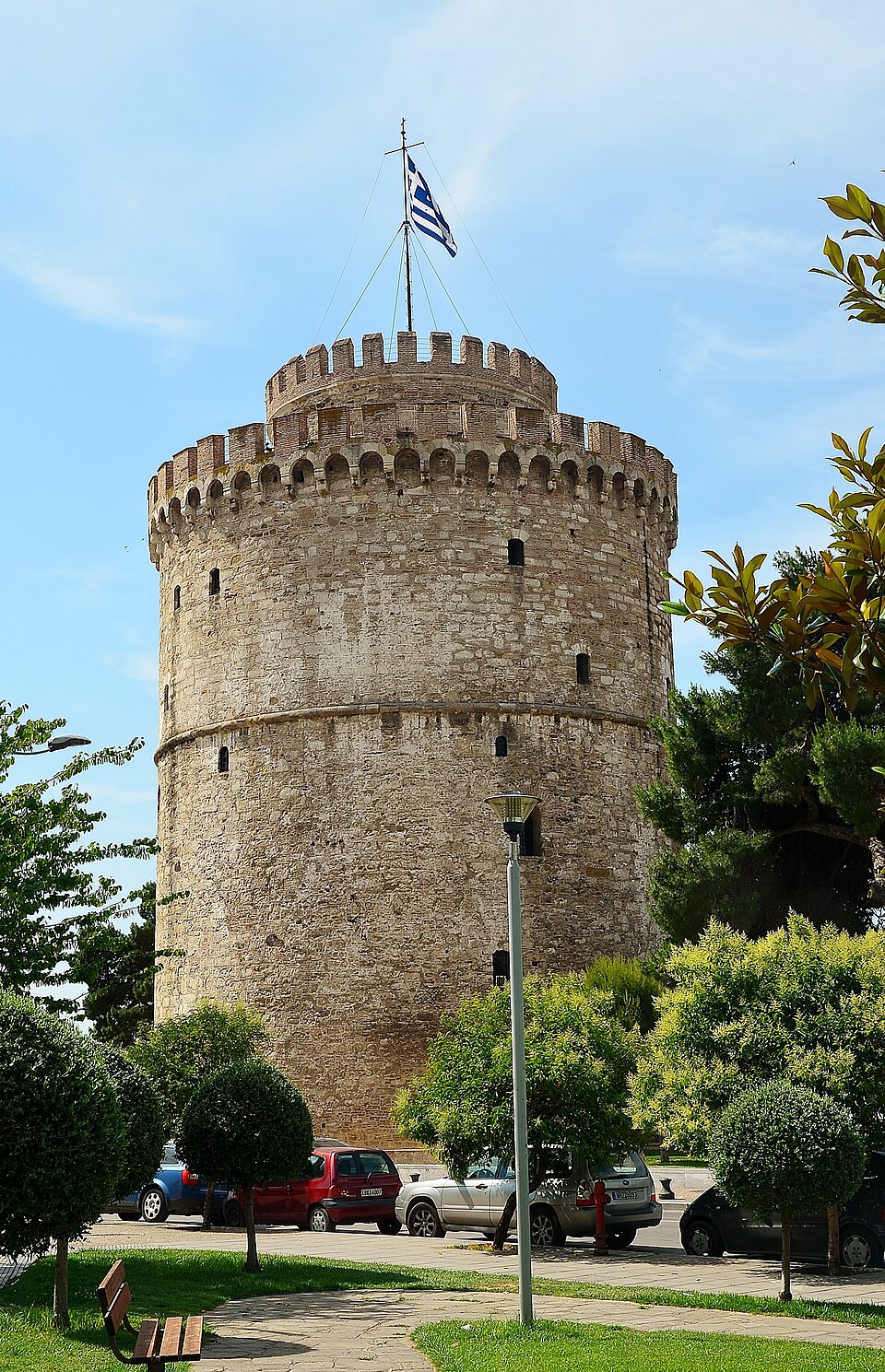
A round fifteenth-century artillery tower on the waterfront, the city's symbol and a surviving piece of the demolished walls. Under the Ottomans it served as a prison where executions took place, hence its nickname the Tower of Blood, and it was whitewashed after 1890 to shake off that reputation. Inside is a six-floor exhibition on the history of Thessaloniki and at the top a walkway with views over the bay and towards Mount Olympus.

Tip: The exhibition itself is mainly for children; you are really paying for the roof. Go up in the last forty minutes before closing, when the light over the waterfront is best and there is no queue at the ticket desk. Olympus is only visible from the top in dry weather after the northerly Vardaris wind; in summer haze usually hides it. There is no lift inside and the staircase spirals around the walls.

Admission:
around €6
Time needed:
1 h
Nea Paralia waterfront and the Umbrellas

Nea Paralia waterfront and the Umbrellas

Waterfront

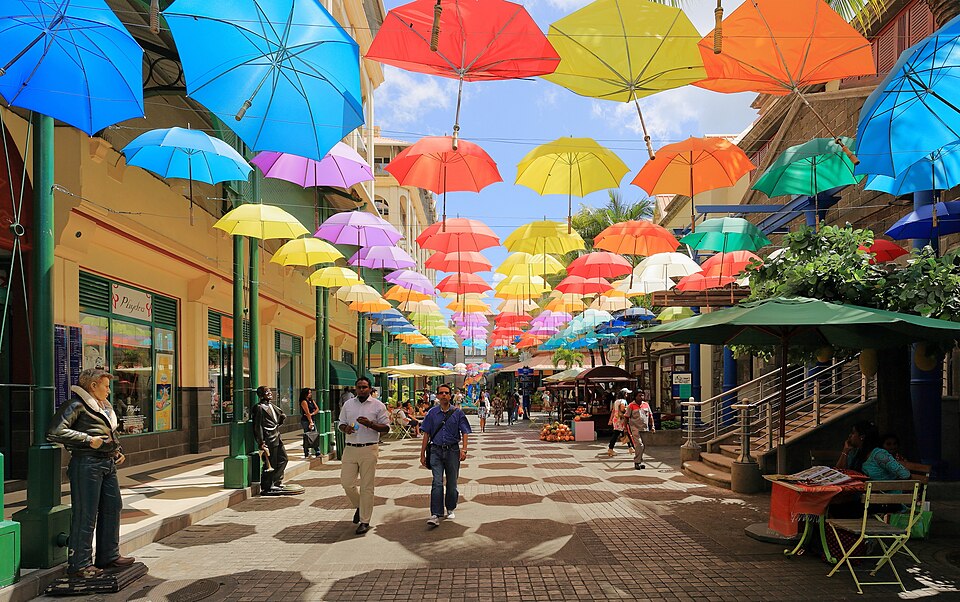
A five-kilometre promenade running south-east from the White Tower to the Megaron concert hall, divided into themed gardens with benches, a skate park and a cycle path. At its end stands The Umbrellas, a thirteen-metre steel sculpture by George Zongolopoulos. It is the city's main public space, where from spring to autumn people stroll in the evening and sit on the sea wall with a beer.

Tip: It is best done by bike: there are bike-share stations along the whole promenade and the stretch to the Umbrellas is flat. On foot it takes an hour and a half there and back. People come to the Umbrellas for sunset, but on windless days the smell from the port lingers over the bay, so when the air feels heavy, sit closer to the White Tower instead.

Admission:
free
Time needed:
1.5–2 h
Arch of Galerius and the Rotunda

Arch of Galerius and the Rotunda

Kamara

Kamara

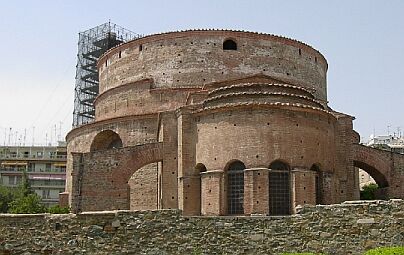
The remains of the palace complex of the Roman emperor Galerius from around AD 300. The arch, with reliefs of his campaign against the Persians, stands in the middle of Egnatia Street and is where locals arrange to meet — 'see you at Kamara'. Two hundred metres to the north is the Rotunda, a massive circular building that has been a mausoleum, a church and a mosque, and the only one in the city to keep its minaret.

Tip: The arch is free and can be walked around at any time; the Rotunda charges admission, and inside are fourth-century mosaics in the dome thirty metres up, so bring small binoculars or use your phone's zoom. The palace the arch belonged to is five minutes further south on Navarinou Square — the excavated area lies just below street level and can be seen from the pavement for free.

Admission:
arch free, Rotunda around €6
Time needed:
1 h
Church of Saint Demetrius

Church of Saint Demetrius

Agios Dimitrios

Centre, above Aristotelous

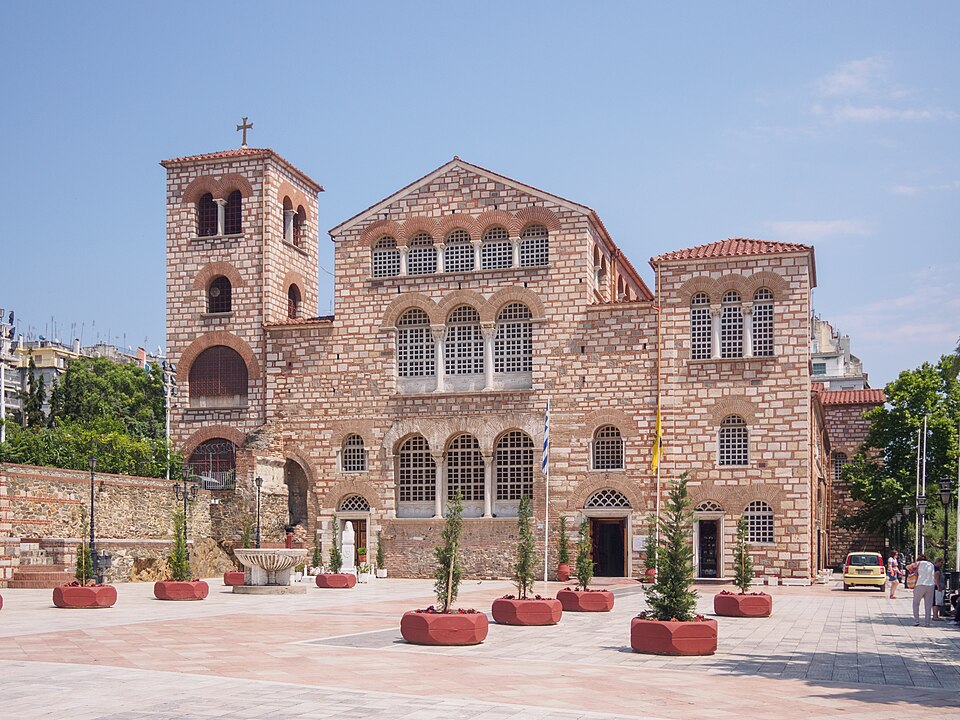
A five-aisled basilica dedicated to the city's patron saint, a Roman soldier martyred under Galerius. The original fifth-century church burned down in 1917 and was rebuilt, but seventh-century mosaics survive on the piers near the altar. Beneath the church is a crypt in the remains of Roman baths where, according to tradition, the saint died.

Tip: The entrance to the crypt is to the right of the altar and easy to miss; it is free and has different opening hours from the church, usually mornings only. Around 26 October, the feast of Saint Demetrius, the church is packed with pilgrims and a fair takes place outside — if you want quiet, come another time; if you want to see living Orthodox Thessaloniki, come then.

Admission:
free
Time needed:
45 min
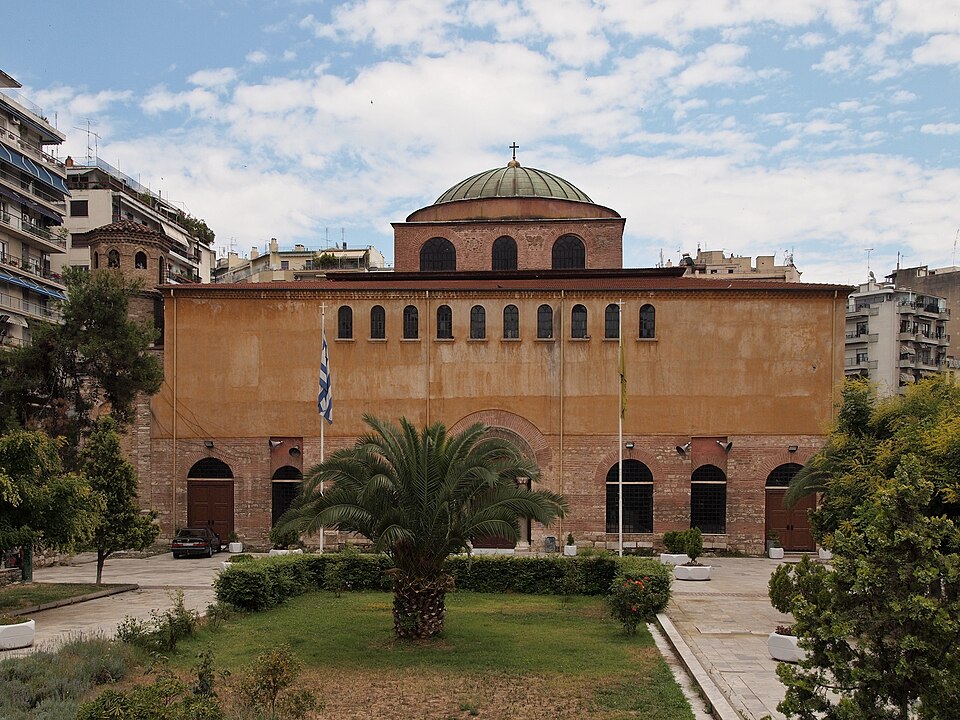
Hagia Sophia

Hagia Sophia

Agia Sofia

Centre

An eighth-century church modelled on its namesake in Constantinople, only on a smaller scale. The dome holds a mosaic of the Ascension with the apostles among olive trees, and the apse shows the Virgin and Child, beneath which traces of earlier iconoclast decoration with a plain cross are visible. It stands in a park on the avenue of the same name, two minutes from the sea.

Tip: Leave it for the end of a walk from Aristotelous, because since 2024 there has been an Agia Sofia metro station beneath it with finds from the excavation on display, which you can walk through for free without a ticket. The dome mosaic is best seen in the morning, when light falls through the windows directly onto it; in the afternoon the church is dim.

Admission:
free
Time needed:
30 min
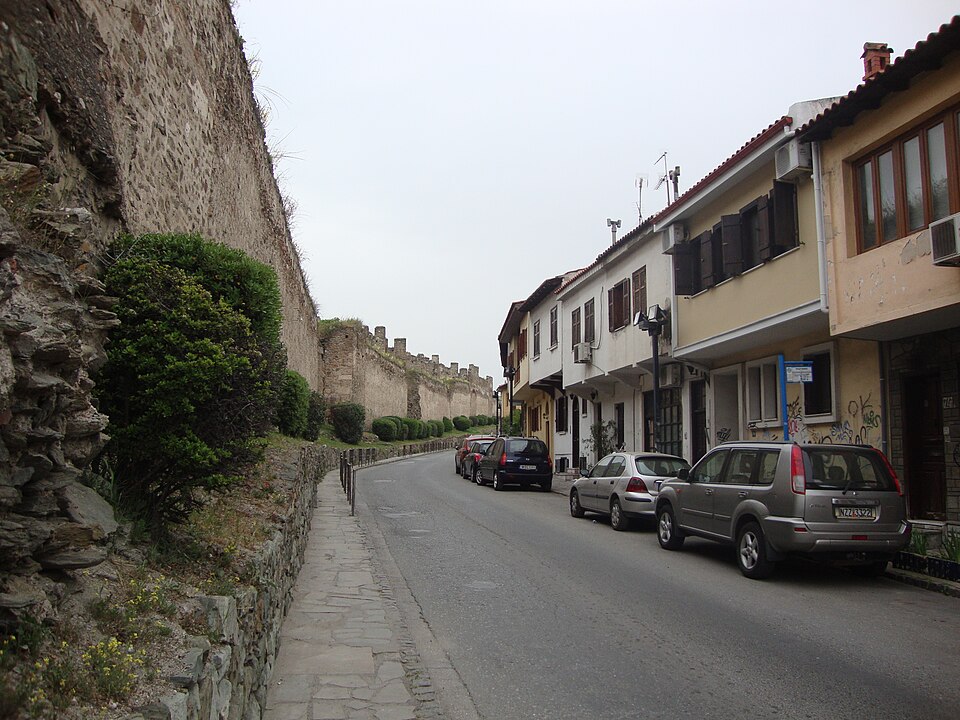
Ano Poli and the Heptapyrgion

Ano Poli and the Heptapyrgion

Άνω Πόλη

Ano Poli

The Upper Town on the slope above the centre is the only district that escaped the fire of 1917. Winding lanes of Ottoman houses with projecting bay windows climb to the Byzantine walls and the Heptapyrgion fortress, which served as a prison until 1989. The walls offer the best view over the whole city and the bay.

Tip: Don't walk up from the sea — it is a hundred and sixty metres of climbing, mostly on steps. Take bus 23 from Eleftherias Square up to the walls and walk down past the Vlatadon and Osios David monasteries. Vlatadon has peacocks at the entrance and a free viewpoint; Osios David is a small church with a fifth-century mosaic, opened by a caretaker, usually until two in the afternoon.

Admission:
free
Time needed:
2–3 h
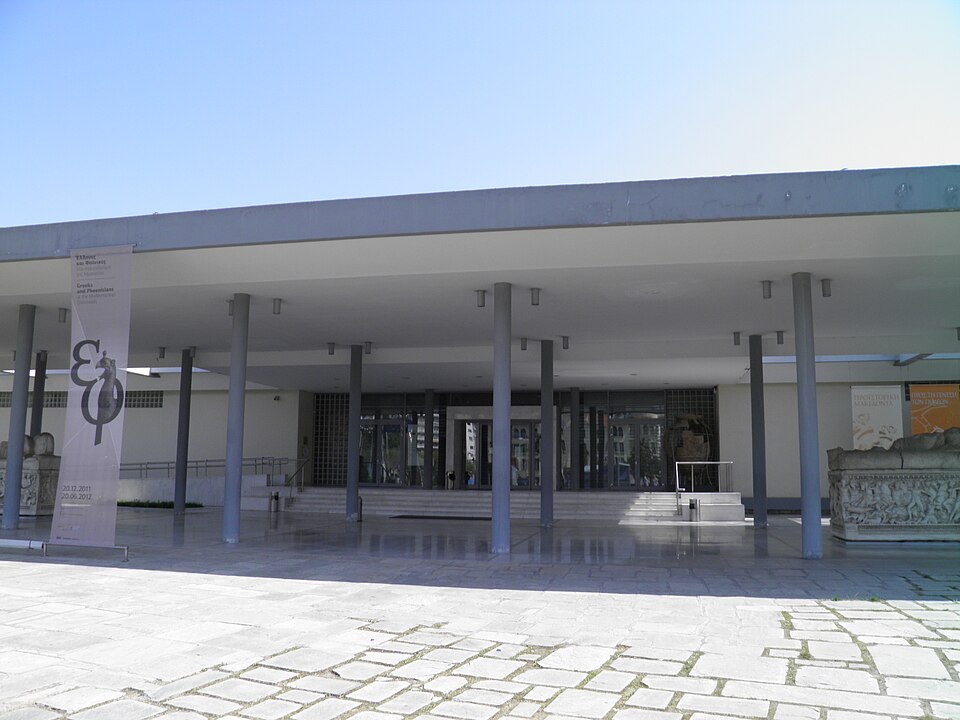
Archaeological Museum of Thessaloniki

Archaeological Museum of Thessaloniki

University district

The largest museum in northern Greece, with finds from ancient Macedonia. The highlight is the gallery of gold from the tombs at Derveni and Sindos — wreaths of golden oak and myrtle leaves, jewellery and the bronze Derveni Krater, decorated with a Dionysian procession and made from an alloy that looks like gold. The museum stands at the southern edge of the university district, ten minutes from the White Tower.

Tip: The Derveni Krater has its own display case in the gold gallery and is worth walking all the way around, as the reliefs continue on the back. A combined ticket for this museum and the Museum of Byzantine Culture next door costs less than two separate ones and is valid for several days. Admission is lower in winter, and on the first Sunday of the month from November to March entry is free.

Admission:
from €8
Time needed:
2 h
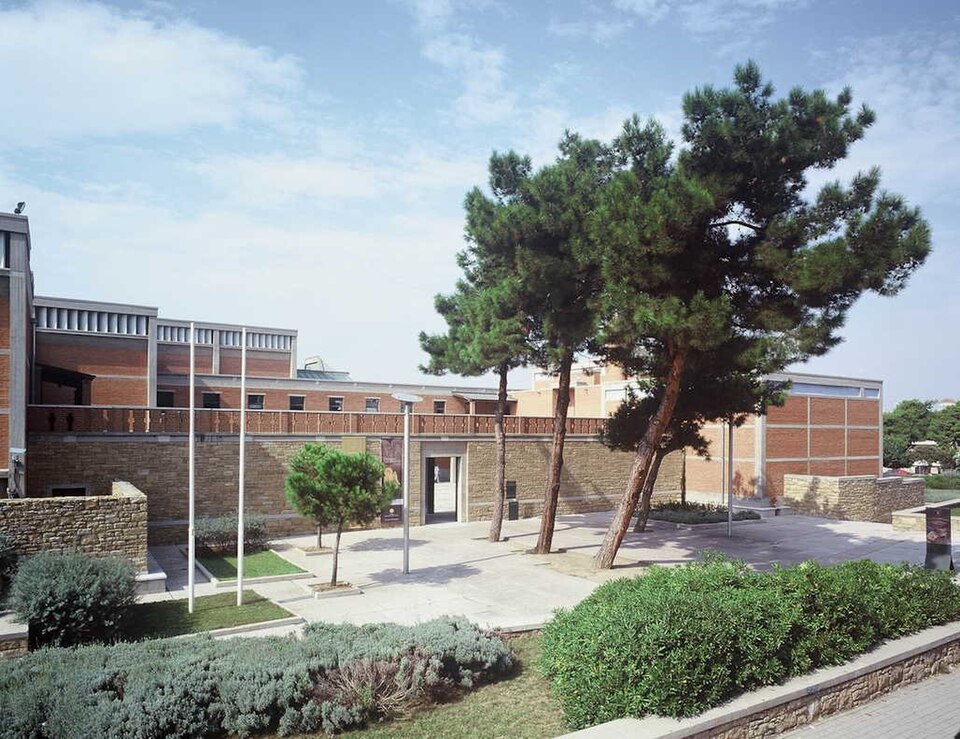
Museum of Byzantine Culture

Museum of Byzantine Culture

University district

A modern museum opened in 1994 that explains the Byzantine world through everyday life: what a house looked like, what people ate, how the dead were buried. On display are frescoes from tombs, a collection of icons, textiles and ceramics. It is a good companion to the churches in the city — after visiting it you look at the mosaics in the Rotunda and Hagia Sophia differently.

Tip: If you are doing both the museum and the churches, do the museum first, ideally right at opening at eight, when it is usually empty. The building is air-conditioned and at noon in August it is the best place to sit out the heat. The café in the garden between the two museums is cheap and free of tourists; it is mostly used by staff.

Admission:
from €8
Time needed:
1.5–2 h
Modiano and Kapani markets

Modiano and Kapani markets

Centre

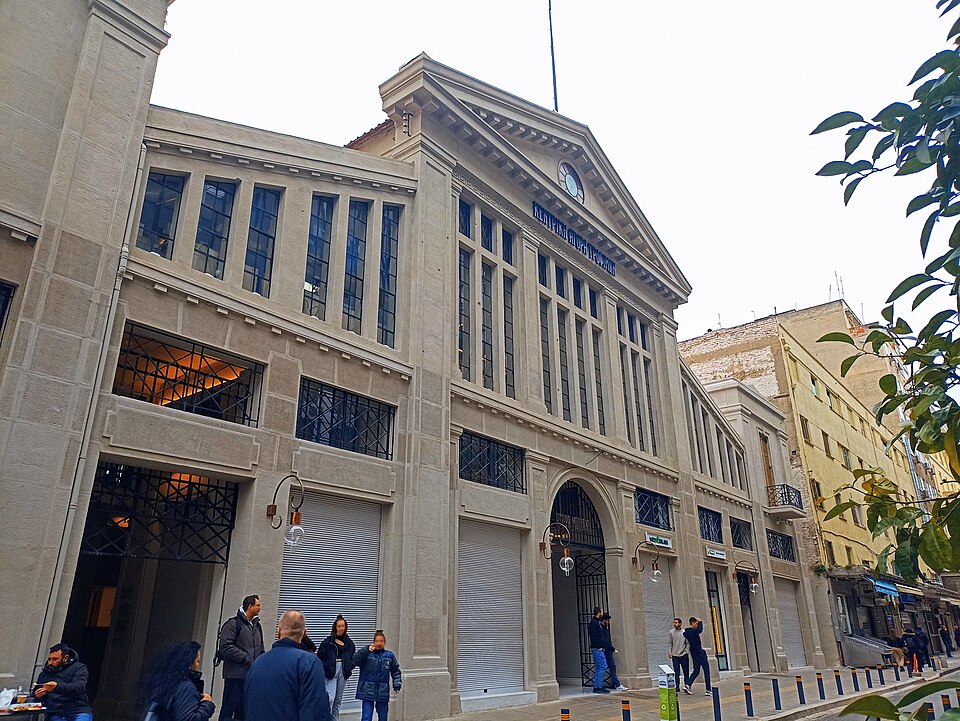
Two neighbouring covered and semi-covered markets in the centre between Aristotelous and Venizelou. Modiano is an Art Nouveau hall from 1930, named after the Jewish architect who designed it, which after restoration houses fish stalls and restaurants. Kapani is the older, noisier Ottoman bazaar in the lanes above it, with stalls selling olives, spices, cured meats and mussels from the bay.

Tip: Go in the morning between nine and eleven, when the market is at its liveliest and the fish is fresh; after three in the afternoon everything is shut. Olive stalls let you taste before you buy. Have lunch at one of the small ouzeries in the Kapani lanes, where mussels and sardines come with wine from a tin jug for a fraction of waterfront prices.

Admission:
free
Time needed:
1–1.5 h

Photos: White Tower — CeeGee (CC BY-SA 4.0) · Nea Paralia waterfront and the Umbrellas — Martin Falbisoner (CC BY-SA 4.0) · Arch of Galerius and the Rotunda — Adam Carr (CC BY-SA 3.0) · Church of Saint Demetrius — C messier (CC BY-SA 4.0) · Hagia Sophia — Andrew Zorin (CC BY-SA 3.0) · Ano Poli and the Heptapyrgion — XeresNelro (CC BY-SA 4.0) · Archaeological Museum of Thessaloniki — Carole Raddato from FRANKFURT, Germany (CC BY-SA 2.0) · Museum of Byzantine Culture — Prof. Vlasis Vlasidis (CC BY-SA 3.0) · Modiano and Kapani markets — Gerakishow (CC BY-SA 4.0)

Where to stay

Areas and districts, matched to the kind of trip you are taking

Centre between Aristotelous and Kamara

Best for: first visit, everything within walking distance

A grid of streets built after the fire of 1917 between Aristotelous Square, the Church of Saint Demetrius and the Arch of Galerius. Everything is within twenty minutes' walk from here, the metro stations are at Venizelou and Agia Sofia, and this is where most hotels are. The downside is traffic noise from Egnatia Street, so it pays to ask for a room facing the courtyard.

Ladadika and Valaoritou

Best for: nightlife, bars and tavernas

The former olive-oil warehouse district by the port, with restored nineteenth-century buildings now densely packed with tavernas and bars. A few streets away, on Valaoritou and Syngrou, are club bars where people head after midnight. Sleeping right in Ladadika is noisy until four in the morning at weekends — ideal for evenings, less so for sleep.

Ano Poli

Best for: atmosphere, views, quiet stays

The Upper Town on the hill below the walls, with Ottoman cottages, cats on the steps and small tavernas with views. There are several smaller guesthouses and apartments here that are quieter than the centre. It is fifteen minutes' walk downhill to the centre and buses 22 or 23 go back up; with a suitcase it is impractical without a taxi.

Kalamaria

Best for: families, longer stays, quiet by the sea

A residential district south-east of the waterfront, founded by refugees from Asia Minor in 1922. It is quieter and cheaper, with its own cafés and a harbour lined with fish tavernas where locals go for Sunday lunch. The centre is twenty to thirty minutes away by bus or by bike along the waterfront. For the first few days it is too far out; for a week it is a pleasant choice.

Getting around

From the airport

Thessaloniki has an international airport, Makedonia, fifteen kilometres south-east of the centre. It is served by direct flights from many European cities, including a number of low-cost routes, some of them seasonal only, and there is a connection from Athens roughly every hour with a flight time of fifty minutes. Overland, Thessaloniki can be reached by car through Serbia and North Macedonia. From Athens the train takes six hours, the fastest services four.

Makedonia (SKG) · 15 km

  • Bus 01X / 01N at night to the centre and the bus station· 40–60 min· €1.80
  • Taxi to the centre (night surcharge applies)· 25 min· €25

Around town

Thessaloniki's historic centre is small and walkable: from the White Tower to Aristotelous Square is fifteen minutes along the waterfront, and Ano Poli is half an hour uphill. Public transport relies on OASTH buses and the first metro line, which since November 2024 has run from the railway station below the centre eastwards to Nea Elvetia. Tickets are sold from machines at stops, at kiosks or by contactless card on the bus itself, and are valid on both buses and the metro. Because of traffic jams, buses in the centre are slow and packed at rush hour, so short trips are often quicker on foot. Taxis are blue and white, have meters and cost six to ten euros across town.

MetroOne line with thirteen stations from the New Railway Station via Venizelou, Agia Sofia and the university eastwards. Fast and air-conditioned, with archaeological finds from the excavations on display in the stations. It does not yet reach the airport. Tickets from machines in the stations.
OASTH busesA dense network including routes to Ano Poli (22, 23) and the airport (01X). Slow at rush hour because of traffic. Tickets are time-based and can be paid contactless at the validator. · €1.20
Bike shareStations along the entire waterfront; ideal for the ride to the Umbrellas and Kalamaria on the flat cycle path. Away from the waterfront, cycling in the centre is unpleasant. · from €1
TaxiBlue and white cars with meters that can also be booked through an app. Across the centre €6–10, with a higher rate from midnight to five. There is no fixed airport fare; the meter applies. · €4
KTEL intercity busesFrom the main Makedonia bus station on the west side of the city, buses run to Veria (Vergina), Katerini and Litochoro below Olympus. Buses to Halkidiki leave from a different terminal on the east side of the city — watch out for that. · from €7

Useful apps: OASTH Telematics, FreeNow, Google Maps, Efood

When to go

Thessaloniki has the climate of northern Greece: winter is noticeably colder than in Athens, nights in January drop below freezing and several times each winter the cold northerly Vardaris wind knocks ten degrees off the temperature. Summer is hot and humid, around thirty-two degrees by day in July and August, and the city empties at weekends because everyone heads for Halkidiki. Spring and autumn are best: in April, May, September and October it is twenty to twenty-seven degrees and you can sit on terraces late into the night. The International Fair takes place in September and the film festival in November, when hotels are more expensive.

Best time

April to June and September to October

What to avoid

January and February because of the Vardaris, mid-August because of the heat and closed businesses

MonthJanFebMarAprMayJunJulAugSepOctNovDec
Day10°12°15°20°25°30°32°32°27°21°16°11°
Night2°3°5°9°14°18°21°21°17°12°8°4°
Rainy days778775334688
Sea14°13°13°15°19°23°25°26°24°21°18°15°

Food & drink

Among Greeks, Thessaloniki has a reputation as the city where you eat best, largely thanks to refugees from Asia Minor and Pontus who brought the spiced cooking of Smyrna and Constantinople here in the 1920s. The typical place is an ouzeri or tsipouradiko, where small plates for sharing are ordered alongside a small carafe of spirit. The day starts with bougatsa, gyros is eaten during the day and dinner begins after ten. Thanks to the students, prices are noticeably lower than in Athens and a third lower than on the islands.

What to try

Bougatsa

Thin filo filled with semolina custard and dusted with sugar and cinnamon, or a savoury version with cheese or meat. Thessaloniki's number one breakfast, baked from five in the morning and best warm before ten. It is ordered by weight; a portion is about two hundred grams.

Koulouri Thessalonikis

A ring of yeast dough coated in sesame, sold by street vendors from carts at every bus stop. It costs under a euro and is the cheapest breakfast in town. They are fresh until noon; by the afternoon they are drying out.

Trigona Panoramatos

Triangular cones of filo pastry soaked in syrup and filled with vanilla cream, originally from the suburb of Panorama. Eat them straight away, as the pastry softens within an hour. One piece is as filling as a whole dessert.

Mussels from the bay

Most Greek mussels are farmed in the Thermaic Gulf near Chalastra. Ouzeries serve them steamed, fried in batter or as saganaki with feta and tomatoes. They are cheap and in season from spring to autumn; in winter they are smaller.

Soutzoukakia smyrneika

Oblong meatballs with cumin and garlic baked in tomato sauce, a recipe brought by refugees from Smyrna. They are served with rice or chips and are one of the most typical dishes of cheap mageiria, canteens serving ready-cooked food.

Souvlaki and gyros pita

Grilled meat from a skewer or a spit in pitta with tomato, onion, tzatziki and chips inside. The cheapest full meal in the country; 'kalamaki' is a skewer without the pitta.

Frappé

The iced whipped coffee was invented in Thessaloniki at the International Fair in 1957, when a Nestlé representative had no hot water to hand. Younger locals now prefer freddo espresso, but you can still get frappé in every café. Order it sketos, metrios or glykos depending on how much sugar you want.

Ouzo and tsipouro

An anise spirit that turns milky white when water is added. It is sipped slowly with meze, never downed in one and never on an empty stomach. Tsipouro is a grape spirit, in the north often made without anise.

What it costs

Freddo espresso in a café

€2.50–3.50

Bougatsa for breakfast

€2.50–3.50

Gyros pita

€3.50–4.50

Carafe of tsipouro with meze for two

€15–25

Dinner in a taverna per person

€15–25

Public transport ticket

€1.20

Museum admission

€6–8

Night in a 3* hotel for two

€70–120

Indicative prices that change over time — treat them as a guide, not a price list.

Practical information

SocketsCEuroplug, two round pinsFSchuko
Voltage230V / 50Hz
Tap waterTap water is treated, bottled is common — Tap water in Thessaloniki is drinkable; it comes from the Aliakmonas river and from wells on the plain west of the city, and locals drink it routinely. It is harder and more chlorinated than in Athens, so some people filter it. Tavernas bring bottled water to the table anyway; half a litre costs around fifty cents in a shop. On Halkidiki and in the mountains around Olympus the water comes from springs and is often excellent.
TippingTipping in Greece means rounding up or leaving five to ten per cent, in cash on the table — card terminals usually have no tip option. The bill often arrives on a small plate with a few pieces of fruit or a free glass of spirit; that is hospitality, not an item to pay for. In tavernas you often pay at the till. A cover charge (bread) may only be added if it is listed on the menu.
Driving on theright
SafetyThessaloniki is a safe city, and tourists encounter crime at most in the form of pickpockets on crowded 01X and 31 buses and around the Kapani market. People stroll along the waterfront even at two in the morning and it is full of families. After dark there is no reason to go around the old railway station and the western port beyond Vardaris. Demonstrations and public transport strikes are common, announced in advance, and on strike days only taxis run. In summer, watch out for the heat: the paved Aristotelous Square and the waterfront radiate over forty degrees around noon. The emergency number is 112, tourist police 1571.
Opening hoursShops in the centre open on Tuesday, Thursday and Friday from nine to two and from half past five to nine in the evening, and on Monday, Wednesday and Saturday in the morning only. The Kapani and Modiano markets open at seven in the morning and close around three in the afternoon; they are shut on Sunday. Byzantine churches are open for free roughly from eight to one and again in the afternoon; during services a visit is not appropriate. State museums close on Tuesday morning or all day. Locals have dinner after ten and ouzeries are full until one in the morning, even on weekdays.
Customs & etiquetteIn Greece, tilting the head up with a click of the tongue means 'no', not agreement. An open palm pushed towards someone (the mountza) is an insult, so wave with your fingers together. In a taverna, dishes are ordered for the middle of the table and shared; people don't order individual plates. Churches and monasteries are not entered in shorts or with bare shoulders; shawls are often lent at the entrance. Stiletto heels are banned at historic sites to protect the marble. In older buildings toilet paper must not be flushed, as the plumbing cannot cope with it.
A few local wordsGood morning / hello — KaliméraThank you — EfcharistóPlease / you're welcome — ParakalóThe bill, please — To logariasmó, parakalóCheers — Jamas

How to plan your days

1 day

Thessaloniki in one day

  1. 1Bougatsa in the morning, then the White Tower as soon as it opens.
  2. 2The Arch of Galerius, the Rotunda and the palace remains on Navarinou Square.
  3. 3Midday at the Kapani market and lunch in an ouzeri in the lanes.
  4. 4In the afternoon, the Church of Saint Demetrius with its crypt, and Hagia Sophia.
  5. 5In the evening, a walk along the waterfront to the Umbrellas and dinner in Ladadika.

2 days

Two days: Byzantine and Ottoman Thessaloniki

  1. 1Day one as in the one-day plan.
  2. 2Day two: the Museum of Byzantine Culture and the Archaeological Museum right at opening.
  3. 3Lunch among the students in the university district.
  4. 4Bus 23 up to Ano Poli, the walls, the Heptapyrgion and the view.
  5. 5Walk down past Vlatadon and Osios David, dinner at a taverna on the hillside.

3 days

Three days: add Vergina or the sea

  1. 1The first two days as in the previous plan.
  2. 2Day three: KTEL bus to Veria in the morning and a local bus to Vergina.
  3. 3The royal tombs of Philip II and the museum inside the burial mound.
  4. 4Back in Thessaloniki in the afternoon; in the evening Kalamaria and a fish taverna in the harbour.
  5. 5Summer alternative: a full day on the beaches of Kassandra in Halkidiki.

Day trips

Vergina (ancient Aigai)

75 km · 1 h 15 min by car, 1 h 45 min by bus with a change in Veria

The first capital of the Kingdom of Macedon, where Philip II, father of Alexander the Great, was assassinated in 336 BC. His tomb was discovered in 1977 beneath a twelve-metre burial mound, and the museum is built right inside the mound — you walk through the darkness past the intact façades of the tombs and display cases holding the golden ossuary and the royal wreath. It is the most powerful archaeological experience in northern Greece and is UNESCO-listed. Photography is not allowed inside. Since 2024 the restored palace above the village has also reopened; allow half a day.

Mount Olympus and Dion

90 km · 1 h 15 min by car to Litochoro

Greece's highest mountain stands ninety kilometres from Thessaloniki and on a clear day can be seen from the waterfront. The base is the mountain town of Litochoro, from where you drive up to the Prionia car park at 1,100 metres. For a day trip, the Enipeas gorge trail from Litochoro to Prionia suits well: eight kilometres along the river with rock pools. Climbing the summit, Mytikas, takes two days with a night in a mountain hut. On the way back, ancient Dion below the mountain is worth a stop — the sacred city of the Macedonians, with mosaics and a sanctuary of Isis where water stands in the temple and reeds grow in it.

Halkidiki

70 km · 1 h by car to Kassandra

A three-pronged peninsula south of Thessaloniki with the best beaches in northern Greece and the summer destination of every local. For a day trip the nearest prong is Kassandra — the beaches near Kallithea and Sani have clear water and are an hour's drive away, and KTEL buses leave from the eastern terminal. The second prong, Sithonia, is wilder and prettier but too far for a single day. The third prong, Athos with its monasteries, is open only to men with a special permit. In July and August the road is one long queue on Friday afternoon heading out and on Sunday evening heading back.

Frequently asked questions

Why is Thessaloniki linked with Cyril and Methodius?+

The two brothers were born in Thessaloniki and in 863 set out from here on their mission to Great Moravia in Central Europe. The Old Church Slavonic language they created for the mission was based on the Slavic dialects spoken around the city, so Thessaloniki is in a sense the birthplace of the first Slavic literary language. That is also why the city has its own Slavic name, Solun, still used in several Slavic languages.

How many days do I need in Thessaloniki?+

Two full days are enough for the main sights, the waterfront and the markets. A third day is worth spending on a trip to Vergina or Mount Olympus, because the best archaeology in the region lies outside the city. If you are travelling in summer and want to swim, combine two days in Thessaloniki with a week in Halkidiki, an hour's drive from the airport.

Can you swim in the sea in Thessaloniki?+

Not in the city. The water in the bay along the waterfront is unsuitable for swimming because of the port and river mouths, and there are no beaches here. The nearest swimming is at Perea and Agia Triada, half an hour south by bus, but the really good beaches start in Halkidiki, an hour away by car. Locals head there at summer weekends.

How do I get from the airport to the city centre?+

Take bus 01X, or 01N at night, which runs from the terminal through the centre to the Makedonia bus station and costs €1.80; it runs every twenty to thirty minutes and takes forty to sixty minutes to reach the centre depending on traffic. A taxi costs twenty-five to thirty euros and takes twenty-five minutes. The metro does not yet go to the airport.

Are the Byzantine churches free?+

Yes, the active churches — Hagios Demetrios, Hagia Sophia, Acheiropoietos, Panagia Chalkeon and others — are free to enter because services are still held in them. You only pay for the Rotunda and the museums. Dress with covered shoulders and knees and don't go in during the liturgy, typically on Sunday mornings.

What remains of Thessaloniki's Jewish history?+

Until 1912 Sephardic Jews expelled from Spain formed the largest group in the city, which was called the Jerusalem of the Balkans. In 1943 more than fifty thousand of them were deported to Auschwitz. This history is remembered at the Jewish Museum on Agiou Mina Street, the Monastirioton Synagogue, the Modiano market named after a Jewish architect and the Holocaust memorial on Eleftherias Square.

Where is Atatürk's birthplace?+

Mustafa Kemal, founder of modern Turkey, was born in Thessaloniki in 1881 and his birthplace stands on Apostolou Pavlou Street next to the Turkish Consulate General, below Ano Poli. It is a small museum with period furnishings and entry is free, but you go through the consulate's security check and need to bring a passport or ID card.

When is the weather best in Thessaloniki?+

For sightseeing, April to June and September to October are best, with daytime temperatures of twenty to twenty-seven degrees. July and August are hot at over thirty degrees, and in mid-August, around the 15 August holiday, many businesses are closed. Winter is colder than you might expect: nights in January drop below freezing and the cold Vardaris wind can blow for several days on end.

Visa Requirements

Check the latest visa requirements for entering this country. Some nationalities may need to apply for a visa or e-visa before travel.

Check visa requirements

Language

Greek

Currency

EUR

Timezone

Europe/Athens

Dial Code

+30

Population

10.4M

Area

131,957 km²

Voltage

230V / 50Hz

Driving Side

Right

Top Hotels in Thessaloniki

Live prices from 500+ properties

Loading hotels...

Planning a trip to Thessaloniki?

Compare hundreds of hotels, find the best price, and book with free cancellation on TravelManiac.