Hotels in Florence

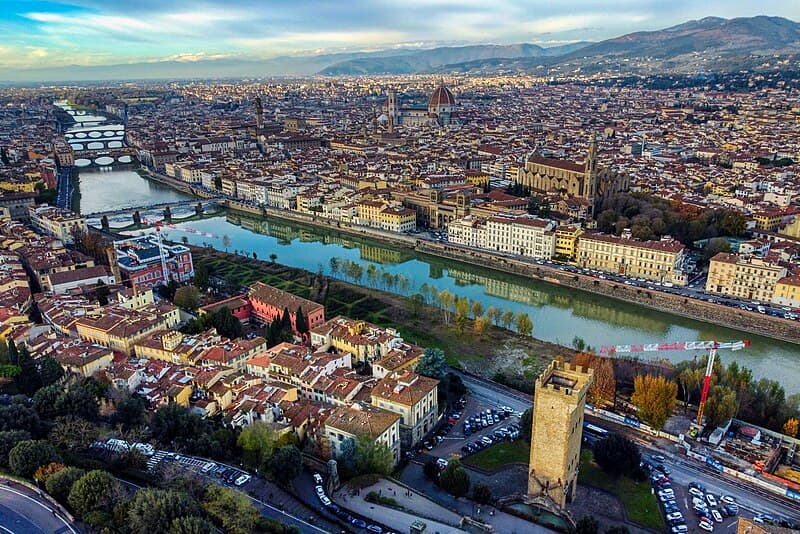
A city you can cross in an hour and spend a week seeing

Florence

IdiomaEnglish
MonedaEUR
Huso horarioGMT+1
Temperatura10-30 °C
Prefijo+39
Población59M
Área301,340 km²
EnchufesTipo C / Tipo F / Tipo L
Agua del grifoPotable

Descubra Florence

Florence is the densest concentration of art in the world, and at the same time a surprisingly small city — the historic centre is 2 km across and can be crossed on foot in 20 minutes. In the 14th and 15th centuries it was the banking centre of Europe, and Medici money paid for what we now call the Renaissance: Brunelleschi's dome, which no one knew how to build and which still stands today without internal support, along with Donatello, Botticelli, Michelangelo and Leonardo. The Uffizi began life as an office building for civil servants and is now one of the most visited galleries in the world. The downside is that everyone knows this: in July people queue in the sun outside the cathedral, and the lanes around the Ponte Vecchio move at a crawl. Book tickets in advance, get up early and allow 3 days for the city, and you'll come away with an experience that has no equal in Europe. Turn up in August without reservations and you'll spend the day in queues.

What to see

The places worth your time in Florence, and what to expect at each

Cathedral and Brunelleschi's Dome

Cathedral and Brunelleschi's Dome

Duomo

Santa Maria del Fiore, with its marble facade in white, green and pink and its brick dome, which Filippo Brunelleschi built between 1420 and 1436 from the inside without scaffolding and without an internal supporting frame. It remains the largest masonry dome in the world. 463 steps lead up between the dome's 2 shells, passing close by the frescoes of the Last Judgement. Beside it stand Giotto's Bell Tower and the octagonal baptistery with its bronze Gates of Paradise.

Tip: Entry to the church is free, but the dome, bell tower, baptistery and museum require a combined ticket with a timed dome slot, which sells out up to a week ahead. If you don't want to be squeezed into the narrow passage between the dome's shells — and anyone claustrophobic shouldn't go there at all — climb Giotto's Bell Tower instead: it has almost as many steps, has a window, and crucially gives you a view of the dome itself.

Admission:
church free, combined ticket from €30
Time needed:
2–3 h for everything
Uffizi Gallery

Uffizi Gallery

Piazza della Signoria

Once the offices of Tuscan civil servants, turned by the Medici into a collection and opened to the public in 1765 as one of the world's first museums. A chronological walk from Gothic to Baroque: Giotto's Madonna, Botticelli's Birth of Venus and Primavera, Leonardo's Adoration of the Magi, Michelangelo's Doni Tondo, Caravaggio's Medusa. The corridor on the second floor gives a famous view over the Ponte Vecchio and the River Arno.

Tip: Book a timed ticket online, and in season it's worth buying it 3 weeks ahead; without one, waits of up to 2 hours are common. Go for the first slot at 8:15am, or after 4pm, when the gallery empties out and the Botticelli room is no longer packed. The visit can be done in 2 hours if you head straight to rooms 8 to 15 and walk through the rest.

Admission:
from €25 in season
Time needed:
2–3 h
Ponte Vecchio

Ponte Vecchio

Oltrarno / centre

The only Florentine bridge the retreating Germans didn't blow up in 1944, and the oldest bridge in the city — its current form dates from 1345. It carries two rows of shops that have belonged exclusively to goldsmiths since the 16th century; before that they were butchers, evicted by the Medici because of the smell. Above the shops runs the covered Vasari Corridor, which the duke used to walk from the palace to the Uffizi without setting foot on the street.

Tip: Take your photo of the bridge from the neighbouring Ponte Santa Trinita, not from the bridge itself — from there you get the whole silhouette above the water. The best light is an hour before sunset. During the day the bridge is a slow shuffle and has the highest concentration of pickpockets in the city; after 9pm it's half empty and street musicians play.

Admission:
free
Time needed:
30 min
Galleria dell'Accademia

Galleria dell'Accademia

San Marco

A one-sculpture museum: home to Michelangelo's David, 5.17 m tall, carved from a single block of marble that 2 other sculptors had already given up on. It stood on the square from 1504 and was moved here in 1873 to protect it from the weather. Besides David there are Michelangelo's 4 unfinished Prisoners, which show how the sculptor worked, and a collection of historical musical instruments including a Stradivarius.

Tip: A copy of David stands for free on the Piazza della Signoria and another on the Piazzale Michelangelo — if you just want the silhouette, you don't need to pay. For the original, book online, since the queue without a booking can run to 2 hours for a piece of marble you'll view in 20 minutes. Entry is free on the first Sunday of the month, but the queue matches.

Admission:
from €16
Time needed:
1–1.5 h
Palazzo Vecchio

Palazzo Vecchio

Piazza della Signoria

A fortress-like 13th-century town hall with a 94-metre tower, still the seat of Florence's city government today. Inside is the Hall of the Five Hundred with battle frescoes and a ceiling so heavy the roof had to be raised, Francesco I's secret study reached through a hidden door, and the apartments of Eleonora of Toledo. The tower gives the closest view of the cathedral dome over the city's rooftops.

Tip: Entry to the courtyard with its frescoes is free and open to anyone. Only the museum and the tower cost money, and they're sold separately — if you just want the view, take the tower alone, the cheapest big viewpoint in Florence. Larger backpacks aren't allowed on the tower, and it closes in the rain. The secret passages tour is guided only and must be booked in advance.

Admission:
museum from €12.50, tower €12.50
Time needed:
1.5–2 h
Pitti Palace

Pitti Palace

Oltrarno

A vast Renaissance palace across the river, built for the banker Luca Pitti, and bought by the Medici after his bankruptcy to become their main residence. It now houses 5 museums at once: the Palatine Gallery, with Raphael's Madonnas hung salon-style as in the 18th century, the royal apartments, a costume museum, a modern art collection and the treasury.

Tip: The Palatine Gallery is the least crowded major collection in Florence and holds more Raphaels than anywhere else in the world. A combined ticket with Boboli and the Uffizi is valid for 5 days and pays off if you spread your visits out. Go in right at opening and start in the Palatine Gallery; save the Boboli Gardens for the afternoon, when there's shade up top.

Admission:
from €16
Time needed:
2 h
Boboli Gardens

Boboli Gardens

Oltrarno

45 hectares of Italian garden behind the Pitti Palace, a model for both Versailles and Schönbrunn. Paths climb the slope past avenues of cypresses, an amphitheatre with an Egyptian obelisk, the Neptune Fountain, and the Buontalenti Grotto, an artificial cave with dripstone where copies of Michelangelo's Prisoners stand. The highest point, by the Porcelain Museum, has views over the Tuscan hills.

Tip: This is the only large area of shade in the centre and in summer the only place bearable at midday — bring water, as there are only 2 drinking fountains. Entering from the palace means an immediate climb uphill; for level ground, go in through the Annalena gate. The neighbouring Bardini Garden uses the same ticket and has a better view of the dome, while staying half empty.

Admission:
from €10, included with Pitti
Time needed:
2 h
Basilica of Santa Croce

Basilica of Santa Croce

Santa Croce

The largest Franciscan church in the world and Florence's pantheon: 300 notable figures are buried beneath its floor and walls, including Michelangelo, Galileo, Machiavelli and Rossini. Dante has only an empty tomb here, since he's actually buried in Ravenna, which refuses to give up his remains. The chapel holds Giotto frescoes, and the courtyard has Brunelleschi's Pazzi Chapel, a textbook Renaissance building.

Tip: The square in front of the basilica is one of the few large open spaces in the centre and hosts calcio storico in June, a rough mix of football and wrestling played in Renaissance costume. Inside is a leather school where you can buy leather straight from the makers; the shops around the square sell the same goods for more. The church closes at 5:30pm, with last entry half an hour before.

Admission:
from €8
Time needed:
1–1.5 h
Piazzale Michelangelo

Piazzale Michelangelo

south bank

A terrace on the hill above the south bank of the Arno, giving the classic view of Florence: the dome, the bell tower, the town hall tower and the bridges over the river all in one shot. A bronze copy of David stands at its centre. Just above the terrace is the Romanesque church of San Miniato al Monte, with its marble facade and a cemetery that gives the same view without the crowds.

Tip: People come here for sunset, and in season several hundred stand here at that hour — arrive an hour early, or instead come in the morning, when the terrace is empty and the light falls on the city from the front. Bus 12 or 13 runs up here from the station; on foot it's a 20-minute climb up steps from the Ponte Vecchio. At San Miniato, monks sing Gregorian vespers around 5:30pm.

Admission:
free
Time needed:
1 h

Photos: Cathedral and Brunelleschi's Dome — Gary Campbell-Hall (CC BY 2.0) · Uffizi Gallery — Arek N. (CC BY-SA 3.0) · Ponte Vecchio — Ingo Mehling (CC BY-SA 4.0) · Galleria dell'Accademia — Rhododendrites (CC BY-SA 4.0) · Palazzo Vecchio — Francesco Bini (CC BY-SA 4.0) · Pitti Palace — Almaak (CC BY-SA 3.0) · Boboli Gardens — Diego Delso (CC BY-SA 4.0) · Basilica of Santa Croce — Rhododendrites (CC BY-SA 4.0) · Piazzale Michelangelo — Diego Delso (CC BY-SA 4.0)

Where to stay

Areas and districts, matched to the kind of trip you are taking

Duomo and centro storico

Best for: a first visit

The historic core around the cathedral and Piazza della Signoria, where most of the main sights are within sight of each other. It's the most expensive place to stay and the most crowded by day; but after 9pm the centre empties out and is surprisingly quiet. Cars are banned, since the whole core is a restricted traffic zone, and anyone driving in gets a fine by post.

Oltrarno and Santo Spirito

Best for: crafts and dinner

The district across the river, home to bookbinders, goldsmiths and restorers who have worked here for centuries, where bar prices reflect the fact that locals drink here. In the evening people sit on the church steps on Piazza Santo Spirito with a beer, the liveliest spot in the city. It's 5 minutes across the Ponte Vecchio to the centre.

Santa Croce

Best for: restaurants and nightlife

The eastern part of the core around the basilica, with bars, leather workshops and the Sant'Ambrogio market, where locals shop. Accommodation is a third cheaper than near the cathedral, and everything is still walkable. Around Borgo degli Albizi you'll find the most places with prices aimed at Florentines. It's louder in the evening, since students come here.

San Lorenzo and Mercato Centrale

Best for: food and shopping

The district around the Medici church of San Lorenzo, with a covered market whose upper floor is entirely food stalls and stays open until midnight. Around the church is a street market selling leather, where haggling is expected and quality varies. It's 3 minutes from Santa Maria Novella, the main station, making it convenient for a short stay, though the area around the station is the least attractive part of the centre.

Getting around

From the airport

Direct flights to Florence are limited from many cities, so travellers often fly into Bologna, Pisa or Milan and continue by train. From Bologna, the Frecciarossa high-speed train reaches Florence in 37 minutes and costs from €15; from Pisa, a regional train takes an hour for €10. Florence's own airport, Amerigo Vespucci, lies 5 km from the centre, and tram T2 runs directly from it to Santa Maria Novella, the main station, in 20 minutes for €1.50 — the simplest airport arrival of any Italian city. By car you can only reach a car park on the outskirts: the whole historic centre is a no-drive zone monitored by cameras, and fines arrive by post even 6 months later.

Florence Amerigo Vespucci (FLR) · 5 km

  • Tram T2 to Santa Maria Novella· 20 min· €1.50
  • Taxi to the centre (fixed fare)· 15 min· €22

Pisa Galileo Galilei (PSA) · 85 km

  • Train from Pisa Centrale· 1 h· €9.50

Bologna Marconi (BLQ) · 105 km

  • Frecciarossa high-speed train from Bologna Centrale· 37 min· €15

Around town

Florence is a walking city, and you need nothing else in the centre — it's 10 minutes from the station to the cathedral, another 10 from the cathedral to the Ponte Vecchio. The historic core is a no-drive zone, so even buses don't run there except small electric ones. Public transport is useful for just 3 things: the tram from the airport, bus 12 or 13 to Piazzale Michelangelo, and buses to nearby villages from the station. A ticket costs €1.70, bought at a tabaccheria or via an app, and validated on board. Siena, Pisa and San Gimignano are reached by train or bus from the terminal beside the station; a car only makes sense for a drive through Chianti, and even then it's parked outside the walls. The pavement is uneven and there are steps everywhere, so wheeled suitcases and heels aren't practical here.

On footThe main and fastest way to get around. The centre is 2 km across, and all the main sights are within 20 minutes' walk of the cathedral. The pavement is uneven, so wear sturdy shoes. · free
ATAF busesA €1.70 ticket is valid for 90 minutes, bought at a tobacconist, a machine or an app, and validated on board. Practically useless in the centre, but handy for Piazzale Michelangelo and Fiesole. · €1.70
Tram3 lines, of which only T2 from the airport to the main station matters to visitors. It runs every 5 minutes from 5am to half past midnight and is the cheapest airport transfer in Italy. · €1.50
Trains from Santa Maria NovellaThe main station is 10 minutes from the cathedral. An hour to Pisa, an hour and a half to Siena, 37 minutes to Bologna on the high-speed train. Regional trains don't need booking and a ticket is valid for 4 hours. · from €9
TaxiCan't be hailed on the street; call one or wait at a rank by the station or the cathedral. A ride across the centre costs €10–15, and the fixed fare from the airport is €22. Uber only operates here in its pricier Black tier. · from €10
Bikes and scootersShared e-bikes and scooters are around the city, but the centre is pedestrianised and the pavement uneven. Fine for a ride along the Arno or out to the Cascine park; in the old centre, walking is faster. · from €1 to unlock

When to go

The best months are April, May, September and October: a pleasant 20–25°C, gardens in bloom, and a schedule you can spend outdoors all day. July and August are genuinely hot in Florence's basin, typically over 33°C, and the queues are the longest of the year — you wait for shade just as you wait for a ticket. Winter is mild, around 10°C, with rain and overcast skies, but the museums are half empty and hotels cost half as much; if you're here for the art rather than sitting outside, January is the best deal. In mid-August, around the Ferragosto holiday, some places close as Italians themselves head to the coast.

Best time

April to June and September to October

What to avoid

July and August, because of the heat in the basin and the queues

MonthJanFebMarAprMayJunJulAugSepOctNovDec
Day10°12°16°20°25°29°33°32°27°21°15°11°
Night2°2°5°8°12°16°18°18°15°11°6°3°
Rainy days888986456898

Food & drink

Tuscan cuisine is rustic, built on bread, beans, olive oil and beef. Bread here has always been unsalted, which surprises people — supposedly the result of a historic dispute over the salt tax — and it's still baked that way today, which suits it to strongly flavoured cured meats and olive oil. There are 3 kinds of eatery: a trattoria is a home-style restaurant, an osteria originally served only wine and now serves food too, and a fiaschetteria or vinaio is a hole-in-the-wall counter for a glass of wine and a panino with roast pork. The cheapest decent lunch is a panino con lampredotto from a stall for €5, or the upper floor of the Mercato Centrale market. Avoid the places offering a menu turistico for €10 around the cathedral — what you get there is frozen, and the same dish 3 streets away in Oltrarno costs €2 more and is fresh.

What to try

Bistecca alla fiorentina

A T-bone steak from Chianina beef, 3 fingers thick and weighing a kilo or more, chargrilled and served exclusively rare — order it well done and you insult the chef. Charged by weight, around €55 per kilo, and ordered for 2. It isn't made for one.

Ribollita

A thick soup of black cabbage, beans and stale bread that, as the name suggests, is reboiled and tastes better the next day. Once winter food for the poor, now on menus all year round; served with a generous stream of olive oil on top.

Lampredotto

It isn't roast pork: it's beef stomach stewed in vegetable broth, sliced and packed into a bread roll dipped in the broth, with a piquant green sauce. Florence's number one street food, costing around €5 at carts called trippai. It sounds strange and tastes excellent.

Pappa al pomodoro

A mash of tomatoes, garlic, basil and stale bread, thick enough for a spoon to stand up in. Served warm or cold, and in summer it's the best light lunch on the menu, around €8.

Crostini di fegatini

A toasted round of bread with a chicken-liver pâté, capers and anchovies. A classic Tuscan starter that arrives first at the table and features in every family dinner.

Chianti Classico

A red wine made from sangiovese grapes from the hills between Florence and Siena, identified by the black rooster on the neck label. House wine by the carafe costs €5 for half a litre and is perfectly drinkable at a good trattoria; a bottle of Chianti Classico starts at €15.

Gelato

You can spot a genuine gelateria by the fact that the gelato isn't piled into sharp peaks and the pistachio is a dull brownish green, not bright green. The sign 'produzione propria' means it's made on the premises.

Cantucci and Vin Santo

Hard almond biscuits dipped into the sweet dessert wine Vin Santo. Served at the end of a meal instead of dessert, and in many trattorias the owner brings it over personally and doesn't charge for it.

What it costs

Espresso at the bar

€1.10–1.50

Panino con lampredotto from a stall

€4.50–6

Gelato, 2 scoops

€3–4.50

Lunch at a trattoria

€15–22

Bistecca alla fiorentina, per kilo

€50–60

Uffizi entry in season

from €25

Combined cathedral ticket

from €30

Night at a 3-star hotel, double

€100–170

Indicative prices that change over time — treat them as a guide, not a price list.

Practical information

SocketsCEuroplug, two round pinsFSchukoLItalian
Voltage230V / 50Hz
Tap waterTap water is drinkable — Tap water in Italy is safe to drink and more strictly monitored than bottled water, including the public drinking fountains found on squares — in Rome they're called nasoni, and every larger city has hundreds of them. A sign saying 'acqua non potabile' means the opposite, and appears only at fountains in old parks. Restaurants don't offer tap water; the waiter automatically brings bottled water and asks 'naturale, o frizzante?' — still or sparkling.
TippingTipping in Italy isn't calculated as a percentage the way it is in the US. Restaurant bills usually include a coperto, a cover charge for the table setting and bread, typically €2–3 per person — that stands in for a tip. If the service is excellent, round up the bill or leave a few euros on the table. At a café you leave nothing. Card terminals usually have no tip option.
Driving on theright
SafetyItaly is a safe country, and violent crime barely touches tourists. The real risks are pickpocketing in crowds, at metro exits and in the crush around monuments, and theft from cars — nothing visible should be left in a car parked on the street, not even an empty bag. In the south and in tourist centres, watch for bills with items you didn't order; the price list must be clearly displayed. The 112 emergency line works and operators speak English.
Opening hoursShops open around 9am, and many smaller ones close for a midday break from 1:30pm to 3:30pm, or as late as 5pm in the south. Supermarkets and chains in tourist centres stay open all day. Most shops are closed on Sundays, but restaurants and cafés aren't. Museums typically close on Mondays. Restaurants open for lunch from 12:30pm to 2:30pm and for dinner not before 7:30pm — arrive at 6pm and you'll find the kitchen closed.
Customs & etiquetteCappuccino is drunk only in the morning — ordering one after lunch is the clearest sign of a tourist; espresso is what's drunk after a meal. Coffee at the bar costs a fraction of what it costs at a table, and price lists usually show 2 columns. Don't enter churches in shorts above the knee or with bare shoulders; the big basilicas check for this at the entrance. Walking around town in swimwear isn't done, and seaside resorts can fine you for it. Keep your receipt — Italian law fines even the customer who leaves without one.
A few local wordsHello — BuongiornoThank you — GraziePlease — Per favoreThe bill, please — Il conto, per favoreCheers — SaluteGoodbye — Arrivederci

How to plan your days

1 day

A day in Florence

  1. 1Morning: the cathedral from outside, the baptistery and the climb up Giotto's Bell Tower.
  2. 2Piazza della Signoria and the free open-air statues in the Loggia.
  3. 3A booked morning slot at the Uffizi.
  4. 4Lunch at the Mercato Centrale, or a panino with lampredotto.
  5. 5Afternoon at the Ponte Vecchio, then up to Piazzale Michelangelo for sunset in the evening.

2 days

2 days with David and Oltrarno

  1. 1Day 1 as above.
  2. 2Morning: a booked slot at the Galleria dell'Accademia.
  3. 3The Basilica of Santa Croce, with the tombs of Michelangelo and Galileo.
  4. 4Afternoon across the river to Oltrarno, the Pitti Palace and the Boboli Gardens.
  5. 5Evening on Piazza Santo Spirito, then dinner at a trattoria across the river.

3 days

3 days including Tuscany

  1. 1The first 2 days as above.
  2. 2Morning: Palazzo Vecchio and the climb up the tower.
  3. 3Train or bus to Siena's Piazza del Campo.
  4. 4Afternoon at Siena's cathedral and a walk through the historic centre.
  5. 5Return in the evening for a last gelato and a stroll along the Arno.

Day trips

Siena

70 km · 1 h 15 min by bus

A medieval hill town, for centuries Florence's biggest rival, whose growth stopped in 1348 when the plague killed half its population and its half-built cathedral was left permanently unfinished. The Piazza del Campo is shell-shaped, sloping toward its centre, and twice a year hosts the Palio, a bareback horse race around the square. The cathedral has marble stripes and a mosaic floor that's uncovered for only a few weeks a year. The quickest way here is by direct bus from Florence's station; the train takes a roundabout route and terminates below the hill.

Pisa

85 km · 1 h by train

The Leaning Tower is the cathedral's bell tower, which began to lean during construction in the 12th century because it stands on alluvial soil; today it's stabilised and leans just under 4 degrees. Around it on the Square of Miracles stand the cathedral, a circular baptistery with exceptional acoustics, and the Camposanto cemetery, whose soil was brought from Golgotha. Climbing the tower is by timed slot in small groups and costs around €20. Trains run from Florence every half hour; if you fly into Pisa, you can stop here on the way from the airport.

San Gimignano and Chianti

55 km · 1 h 20 min by bus with a change

A hilltop town with 13 surviving defensive towers out of an original 72, built by rival families — whoever had the tallest tower had the upper hand. Everything inside the walls can be seen in 2 hours, and there's a gelateria here that has repeatedly won the world championship. The route runs through the Chianti wine country with its cypress-lined avenues. The bus involves a change at Poggibonsi; with a rental car you can stop in Greve and Castellina for a cellar tasting on the way.

Frequently asked questions

Do I need to book Uffizi tickets in advance?+

Yes, unless you want to queue for 2 hours. Tickets have a set time slot, are bought online on the official portal, and sell out up to 3 weeks ahead in season. The same applies to the Galleria dell'Accademia with David and to climbing the cathedral dome. Smaller museums like Palazzo Vecchio or Santa Croce you can just turn up to.

How many days are enough for Florence?+

2 days cover the cathedral, the Uffizi, David and the Ponte Vecchio, but it'll be tight. 3 days is reasonable: that also fits in the Pitti Palace with the Boboli Gardens and an evening above the city. Add Siena, Pisa or Chianti and allow 4 to 5 days — each trip takes a full day.

Is the Firenze Card worth it?+

Only in specific cases. It costs around €85, is valid for 72 hours and covers most museums with no extra bookings. It pays off if you manage 5 or more paid museums in 3 days, including the Uffizi and the Accademia. If you're planning 2 major museums and otherwise just walking the city, buy tickets separately and save money.

Can I climb the cathedral dome if I'm claustrophobic?+

No, and it's best not to try. The route runs up 463 steps in a narrow passage between the dome's 2 shells, in places you walk bent forward, and you can't turn back or retrace your steps, since you go up and down by different staircases. If you want a view without tight spaces, go to Giotto's Bell Tower next door or the tower at Palazzo Vecchio.

How do I get from the airport into the centre?+

Tram T2 runs directly from the terminal to Santa Maria Novella, the main train station. It takes 20 minutes, runs every 5 minutes from 5am to half past midnight, and a ticket costs €1.50. A taxi has a fixed fare of €22 into the centre. If you fly into Pisa or Bologna, it's an hour or 37 minutes by train respectively.

Can I drive into the centre?+

Practically no. The whole historic core is a restricted traffic zone monitored by cameras, and fines arrive by post at home even 6 months later, often several for a single trip. A hotel inside the zone can register your plate temporarily, but you have to give it to them in advance. The sensible option is to leave the car at a park-and-ride near the station or on the outskirts and take the tram.

When is the best time to visit?+

April to June and September to October, when it's 20–25°C and you can be outside all day. Summer is genuinely hot in the basin, typically 33°C and up, and the queues are longest. Winter is the cheapest time and museums are half empty, but expect rain and shorter opening hours for the gardens.

How much does bistecca alla fiorentina cost?+

It's charged by weight, typically €50–60 per kilo, and a single steak weighs a kilo to a kilo and a half, since it's cut 3 fingers thick. It's ordered for 2 or more people and served exclusively rare. With a side dish and wine, dinner for 2 comes to €80–100; for cheaper Tuscan beef, order peposo or tagliata instead.

Requisitos de visa

Verifique los requisitos de visa actuales para ingresar a este país.

Verificar requisitos de visa

Números de emergencia

Idioma

Italian

Moneda

EUR

Huso horario

GMT+1

Prefijo

+39

Población

59M

Área

301,340 km²

Voltaje

230V / 50Hz

Lado de conducción

Derecha

Mejores hoteles en Florence

Precios en vivo de 500+ propiedades

Cargando hoteles...

Planea un viaje a Florence?

Compare cientos de hoteles, encuentre el mejor precio y reserve con cancelación gratuita.