Hotels in London

Nine million people, thirty-three boroughs, and museums that never charge a penny

London

IdiomaEnglish
MonedaGBP
Huso horarioGMT+0
Temperatura6-22 °C
Prefijo+44
Población67.7M
Área243,610 km²
EnchufesTipo G
Agua del grifoPotable

Descubra London

London isn't really one city but thirty-three self-governing boroughs strung along the Thames, which together feel more like a chain of linked towns than a single metropolis. The Romans founded the port of Londinium here in AD 43, the Great Fire of 1666 wiped out the old timber City, and Second World War bombing did the same to the docklands in the east — which is why Gothic churches, Georgian terraces and 1990s glass often stand on the same street. One decision from 2001 matters most for visitors: the great national museums, including the British Museum, the National Gallery and the Natural History Museum, are free to enter, with charges only for temporary exhibitions. A three-day itinerary can be put together with almost no admission fees at all. What's expensive is accommodation, transport and eating out in the centre — not culture. English is spoken by only a minority of residents; more than three hundred languages are heard on London's streets.

What to see

The places worth your time in London, and what to expect at each

British Museum

British Museum

Bloomsbury

A collection of eight million objects from every continent, assembled since 1753. The best-known pieces are the Rosetta Stone, sculptures from the Athenian Parthenon, Assyrian reliefs from Nineveh and Egyptian mummies. The glass-roofed Great Court is the largest covered square in Europe and can be walked through free, even without visiting the collections.

Tip: Entry is free and unticketed, but the main entrance on Great Russell Street has a bag-check queue in the morning — the back entrance from Montague Place is usually empty. You can't see the whole museum in one visit; pick two wings. It stays open until 8:30pm on Fridays, and the Egyptian galleries are half-empty after six.

Admission:
free
Time needed:
3 h
Tower of London

Tower of London

Tower Hill

A Norman fortress begun by William the Conqueror in 1078, which served in turn as a royal residence, an armoury, a mint and a prison. Inside are the Crown Jewels, including a sceptre set with the largest cut diamond in the world, the armouries in the White Tower, and the site of executions on Tower Green.

Tip: Book online for the first morning slot at nine — you can walk straight to the Crown Jewels without a queue, while by noon the wait is half an hour. Yeoman Warder tours leave every thirty minutes from the entrance, last an hour and are included in the ticket; the guides are former non-commissioned officers and it's the best part of the visit.

Admission:
from £35 online
Time needed:
3 h
Westminster Abbey

Westminster Abbey

Westminster

The Gothic coronation church of English monarchs since 1066, also the venue for royal weddings and funerals. It holds over three thousand graves — Elizabeth I, Mary Queen of Scots, Isaac Newton, Charles Darwin and Stephen Hawking — plus Poets' Corner, with Chaucer, Dickens and Kipling.

Tip: The ticket includes an audio guide narrated by Jeremy Irons and a newer triforium gallery with views down into the nave that most visitors never reach. If you don't want to pay, come to the free evensong at five, held almost daily in the abbey. It's closed to tourists on Sundays.

Admission:
from £30
Time needed:
2 h
Palace of Westminster and Big Ben

Palace of Westminster and Big Ben

Westminster

The seat of the UK Parliament, built in neo-Gothic style after the 1834 fire. Big Ben is the name of the bell, not the tower — officially the Elizabeth Tower since 2012 — which, after a five-year restoration, again chimes every quarter hour. The Houses can be visited on a guided tour.

Tip: On Saturdays and during parliamentary recesses you can join a paid tour of both Houses; on weekdays the public gallery is free to visit while Parliament is sitting — just join the queue at Cromwell Green. Only British citizens can access the tower, and only via their MP. The best photo is from Westminster Bridge, shot from the opposite bank.

Admission:
free from outside, tour from £32
Time needed:
1–2 h
Tower Bridge

Tower Bridge

Tower Hill / Southwark

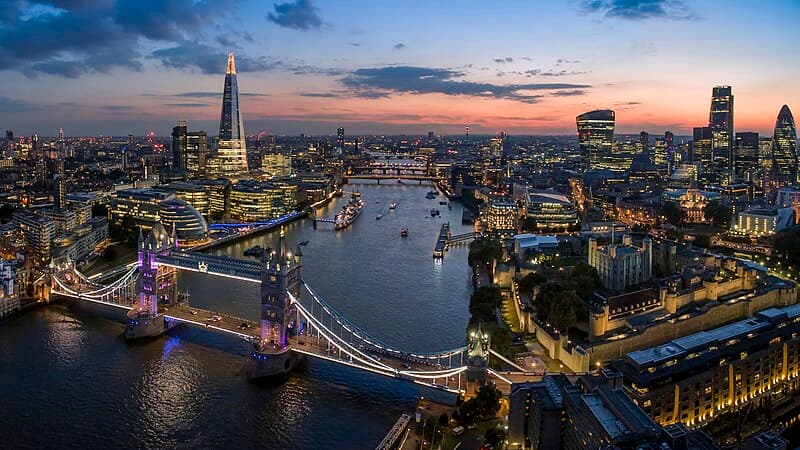
A bascule bridge from 1894 that still opens around eight hundred times a year for tall-masted ships. The walkway tour crosses the high-level walkways forty-five metres up, with a glass floor, and finishes in the engine rooms with the original steam engines that raised the bridge until 1976.

Tip: Bridge lift times are published in advance on the bridge's website — traffic stops a few minutes before, and it's free and more striking than paying to go up. The glass floor is at its best exactly when a double-decker bus passes underneath. The bridge itself can be crossed on foot free of charge at any time.

Admission:
from £13.40
Time needed:
1–2 h
St Paul's Cathedral

St Paul's Cathedral

City of London

Christopher Wren's baroque cathedral of 1710, built on the site of the church destroyed in the Great Fire. The dome is 111 metres high and contains the Whispering Gallery, where a word whispered against the wall can be heard thirty-two metres away. The crypt holds the tombs of Nelson, Wellington and Wren himself.

Tip: Five hundred and twenty-eight steps lead up into the dome, and the final stretch is a narrow spiral staircase with no lift — anyone with knee trouble or a fear of heights should stop at the Whispering Gallery. Tickets bought online are two pounds cheaper and also cover the free evensong at five, though for that you enter through a separate door without paying.

Admission:
from £25 online
Time needed:
2 h
Buckingham Palace

Buckingham Palace

St James's

The monarch's London residence, with seven hundred rooms, opens to the public in summer — visitors can see the State Rooms, hung with paintings by Rembrandt and Vermeer, and the garden. The Changing of the Guard, led by a military band, takes place in front of the palace railings and is free to watch.

Tip: The Changing of the Guard doesn't happen daily: in summer it usually runs Monday, Wednesday, Friday and Sunday at eleven, and every other day out of season — the schedule is on the Household Division website and changes in rain. Arrive by half past ten or you'll be three rows of heads back. A better view than the railings is from the Victoria Memorial or Wellington Barracks, where the detachment sets out from.

Admission:
free from outside, State Rooms from £35
Time needed:
1–3 h
Natural History Museum

Natural History Museum

South Kensington

A natural history museum in a Romanesque-style building from 1881, holding seventy million specimens. A twenty-five-metre blue whale skeleton hangs in the main hall, an animatronic T. rex greets visitors in the dinosaur gallery, and the Earth section includes a walk-through simulation of the Kobe department-store earthquake.

Tip: Admission is free, but it's the most-visited museum for families in the country, and weekend queues at the main entrance can run to an hour. Use the side entrance on Exhibition Road, which is nearly always empty, and arrive right at ten. An ice rink is set up outside over winter. The Science Museum and the V&A are next door, both also free.

Admission:
free
Time needed:
3 h
Borough Market

Borough Market

Southwark

A food market beneath the railway arches by London Bridge, recorded since 1276 and in its current form since 1851. British cheese, game, oysters, chorizo sandwiches and baked goods are sold here; about half the stalls serve hot food to eat on the go, and it's the best cheap lunch in the centre.

Tip: Thursday, Friday and Saturday it's open in full; Monday to Wednesday only some stalls trade. Come before noon or after two — in between it's an impossible crush. Cheese and oil tastings are free and taken seriously. Southwark Cathedral stands right next door, free to enter and usually empty.

Admission:
free
Time needed:
1–2 h

Photos: British Museum — Luke Massey & the Greater London National Park City Initiative (CC BY 2.0) · Tower of London — [Duncan] from Nottingham, UK (CC BY 2.0) · Westminster Abbey — Antiquary (CC BY 4.0) · Palace of Westminster and Big Ben — ThatsTheBoss (CC0) · Tower Bridge — Fuzzypiggy (CC BY-SA 3.0) · St Paul's Cathedral — Mark Fosh (CC BY 2.0) · Buckingham Palace — Julian Herzog (Website) (CC BY 4.0) · Natural History Museum — Daniel Lu (User:dllu) (CC BY-SA 4.0) · Borough Market — Øyvind Holmstad (CC BY-SA 4.0)

Where to stay

Areas and districts, matched to the kind of trip you are taking

Westminster and South Bank

Best for: first-time visitors and the main sights

The government district on the north bank, with Parliament, the Abbey and Downing Street, faces the pedestrian South Bank across the river, with the London Eye, Tate Modern and the Globe theatre. All of it can be covered on foot in a morning, and seven bridges link the two banks. Accommodation here is expensive, and the north bank empties out in the evening once the civil servants go home, while the south bank stays lively.

Soho and Covent Garden

Best for: restaurants, theatre and evening entertainment

The densest concentration of restaurants, bars and theatres in Europe, squeezed between Oxford Street and the Thames. Chinatown serves cheap, good food, some forty West End theatres line Shaftesbury Avenue, and street performers work licensed pitches in Covent Garden. It's noisy to stay in, but everything is within walking distance, and six Underground stations serve the area.

South Kensington and Chelsea

Best for: museums and a quieter family stay

A neighbourhood of white Victorian terraces with three major free museums side by side, Hyde Park to the north and Kensington Gardens beyond it. It's quiet, well supplied with good restaurants, and the best base for families, since a wet-weather itinerary is all within walking distance. Hotel prices are lower than in Westminster, and the Piccadilly line runs direct from Heathrow.

Shoreditch and the East End

Best for: street art, markets and the cheapest food

A former working-class and industrial district northeast of the City, now a hub for street art, independent bars and Sunday markets — Brick Lane with its Bangladeshi restaurants, Columbia Road for flowers, Spitalfields for design. Food here costs a fraction of the centre. The City is a fifteen-minute walk away, Westminster twenty minutes by Underground.

Getting around

From the airport

Flights from Prague to London run several times a day and take about two hours. It matters which of the five airports you land at — the difference in transfer time and cost is significant. Heathrow, in the west, is closest and has an Underground link; Gatwick, in the south, has an express train; Stansted and Luton, in the north, only a coach or a train with a change, taking an hour and a half. Low-cost carriers from the Czech Republic mostly fly to Stansted and Luton, scheduled carriers to Heathrow. Eurostar trains arrive from Paris and Brussels at St Pancras station. The cheapest connection from any airport is the National Express coach, the fastest is the express train.

Heathrow (LHR) · 24 km

  • Piccadilly line Underground· 50–60 min· £5.60
  • Elizabeth line to Paddington· 30 min· £12.80
  • Heathrow Express· 15 min· £25
  • Taxi / Uber· 45–75 min· £60

Gatwick (LGW) · 45 km

  • Gatwick Express to Victoria· 30 min· £20
  • Thameslink train· 35–45 min· £12
  • National Express coach· 1 h 30 min· £10

Stansted (STN) · 64 km

  • Stansted Express to Liverpool Street· 47 min· £17
  • National Express coach· 1 h 45 min· £9

Luton (LTN) · 56 km

  • DART shuttle and train· 45–60 min· £16
  • Green Line 757 coach· 1 h 30 min· £11

Around town

Get around London with a contactless bank card or phone — visitors no longer need an Oyster card, since an ordinary contactless card carries the same fares and the same daily cap. Tap in and out (on buses, tap in only), and the system automatically works out the cheapest combination and stops charging once you hit the daily cap. The key is to pay with the same card or phone for the whole day, or the cap won't apply. The Underground runs from five until midnight, with all-night service on five lines on Fridays and Saturdays. Buses run round the clock and are cheaper than the Underground, just slower. Don't bring a car into London: there's a congestion charge for entering the centre and an extra emissions charge for older vehicles.

Underground (the Tube)Eleven lines, densest in the centre. Fares depend on zone and time of day; the zone 1–2 daily cap is around eight and a half pounds. It gets stuffy at rush hour, and older lines have no air conditioning. · £2.80 single fare
BusesThe cheapest transport in the city: one fare of £1.75 regardless of distance, with free transfers within the hour. The daily cap is £5.25. The front seats upstairs are the cheapest sightseeing tour in London. · £1.75
Elizabeth line and suburban trainsA fast underground route across the city from Heathrow through the centre to Essex, on the same fares as the Underground. The Overground and Thameslink cover neighbourhoods the Tube doesn't reach. · £2.80
Santander CyclesA docked bike-hire scheme across the centre. The first thirty minutes cost £1.65, and you can reach almost anywhere in the centre on one. Traffic drives on the left, and cycle lanes are well marked. · £1.65 per 30 min
Uber Boat river busesCatamarans along the Thames from Westminster to Greenwich, paid for with the same contactless card. It's transport, not a sightseeing cruise, but the views are just as good and it's half the price. · from £5

Useful apps: Citymapper, Google Maps, TfL Go, Uber

When to go

London works year-round and weather isn't really a reason to plan around — it rains often but lightly, and showers tend to be short. May, June and September are the most pleasant, with long evening light and parks in bloom. July and August are the most expensive and crowded, and the Underground gets stuffy, but festivals and the Notting Hill Carnival make up for it. November and January bring the lowest flight and hotel prices, though it's dark by four in the afternoon. December belongs to the Christmas markets and the Regent Street lights, and prices climb again. Anyone visiting mainly for museums and theatre can travel in February for half the cost.

Best time

May, June and September for the light and the parks

What to avoid

the second half of December and early August, for prices and crowds

MonthJanFebMarAprMayJunJulAugSepOctNovDec
Day8°9°11°14°18°21°23°23°20°16°11°9°
Night3°3°4°6°9°12°14°14°12°9°6°4°
Rainy days1199998888101010

Food & drink

In practice, London's food is the food of the world: the best meals in the city are Indian, Bangladeshi, Caribbean, Vietnamese and Lebanese, while British classics survive in pubs and markets. Prices swing wildly — a lunch from a stall at Borough Market or Maltby Street costs eight to twelve pounds, the same dish in a Westminster restaurant thirty. The best cheap options are lunch set menus, supermarket 'meal deals' for a few pounds, and pubs that run a cheaper midday menu between noon and three on weekdays. Anyone who wants to eat well and cheaply travels a couple of stops out from the centre: in Whitechapel, Peckham and Southall you eat better for half the money.

What to try

Fish and chips

Cod or plaice in beer batter with chips, vinegar and mushy peas. Bought from a 'chippy' across the counter and eaten out of paper; sit down in a restaurant and it costs double for the same thing.

Sunday roast

A Sunday joint with Yorkshire pudding, roast potatoes and gravy. Served only on Sundays, roughly from noon to six, and worth booking ahead at the good pubs.

Full English breakfast

Eggs, bacon, sausage, beans, mushrooms, tomato and toast on one plate. Keeps you going until evening, and at a no-frills 'caff' it costs half what a hotel charges.

Meat pie

Braised beef and kidney, or beef and ale, under a crisp pastry lid, served with mash and peas. The cheapest hot meal in a pub, and the one thing that really hits the spot in winter.

Indian curry

Chicken tikka masala was invented in Britain, not India, and curry is now more common on menus than roast dinners. The best value is found in neighbourhoods with a South Asian community, not the tourist centre.

Afternoon tea

Sandwiches, scones with clotted cream and pastries with a pot of tea, served between three and five. Hotels charge from sixty pounds; museum cafés charge a quarter of that for much the same experience.

Scotch egg and pork pie

A boiled egg wrapped in sausage meat, and a cold pork pie set in jelly — pub and picnic classics. Buy them from a butcher or a market; the supermarket version is a poor substitute.

Real ale and cider

Unchilled cask ale served by hand pump at around twelve degrees. Ordered by the pint; ask for a 'half' if you want less. Cider here tends to be dry rather than sweet.

What it costs

Coffee to go

£3.20–4

Pint of beer in a pub

£6–7.50

Market stall lunch

£8–12

Dinner at a decent restaurant

£25–40 per person

Daily fare cap, zones 1–2

£8.50

Entry to the major museums

free

West End musical ticket

from £30

Night in a 3-star hotel, double room

£130–200

Indicative prices that change over time — treat them as a guide, not a price list.

Practical information

SocketsGBritish, three rectangular pins
Voltage230V / 50Hz
Tap waterTap water is drinkable — Tap water is safe to drink everywhere in Britain, well regulated and pleasant to taste — buying bottled water is unnecessary. In a restaurant, simply ask for 'tap water' and it's free, even if the waiter offers bottled first. In older houses, cold water sometimes comes from a separate mains tap while hot water comes from a loft tank that isn't drinkable; this doesn't apply in hotels or new buildings. Free refill fountains are available in Underground stations and railway stations.
TippingAt a table-service restaurant, the bill often already includes a twelve-and-a-half-percent 'service charge' — if it's there, nothing more is added, and it's legal to ask for it to be removed if you're unhappy with the service. Where it isn't included, ten percent is customary. At the bar in a pub you never tip: drinks are ordered and paid for at the counter and no one expects anything extra. Round taxi fares up; hairdressers and delivery drivers get around ten percent. Cafés often have a tip jar by the till, and it's entirely optional.
Driving on theleft
SafetyBritish cities are safe for visitors, and violent crime rarely touches tourists. The real risks are three: pickpockets on the Underground and at markets, phone snatching by a passing moped rider if you walk with your phone held out in your hand, and unlicensed taxis touting outside clubs — book through an app or take only a black cab with its light on. People walk on the left and cars drive on the right-hand side of the road relative to continental Europe, which is the most common cause of visitor accidents at crossings; look for 'look right' painted on the pavement. The emergency number is 999, for non-urgent matters 101, and the European 112 also works.
Opening hoursShops are typically open from nine to six, and until eight or nine in the evening in city centres. Sunday trading laws apply: large stores may open for only six hours, typically eleven to five, while small shops and supermarkets under 280 square metres have no restriction. The major museums are free and open daily from roughly ten to six, with one late evening a week. Pubs start serving at noon and close at eleven, clubs later. On bank holidays the Underground runs a Sunday-style timetable and some shops close.
Customs & etiquetteQueuing is a social institution, and jumping the queue is the one thing a Brit will comment on out loud. Stand on the right on Underground escalators; walk on the left. In a pub you don't get table service: you order and pay at the bar, and if you arrive after a group, you wait for the bartender to reach you. 'Sorry' gets said even by the person who was bumped into. Questions about salary, rent and politics are avoided between strangers, while the weather is always a safe topic. Keep your voice down on trains and the Underground, and using speakerphone in public is a faux pas.
A few local wordsHello / good morning — Hello / Good morningThank you — Thank you / CheersSorry / excuse me — Sorry / Excuse meCould we get the bill, please? — Could we get the bill, please?Cheers (a toast) — Cheers

How to plan your days

1 day

One day in London

  1. 1At nine, the Tower of London, straight to the Crown Jewels.
  2. 2Walk across Tower Bridge to the south bank and Borough Market for lunch.
  3. 3Along the South Bank past Tate Modern and the Globe to the London Eye.
  4. 4Across Westminster Bridge to Parliament and the Abbey.
  5. 5In the evening, walk through St James's Park to Buckingham Palace.

2 days

Two days with museums

  1. 1Day one as above.
  2. 2Morning at the British Museum, entering from Montague Place at the back.
  3. 3Lunch in Covent Garden or Chinatown.
  4. 4Afternoon at the National Gallery on Trafalgar Square, free entry.
  5. 5Evening show in the West End, tickets from the booth on Leicester Square.

3 days

Three days including the neighbourhoods

  1. 1The first two days as above.
  2. 2Morning in South Kensington: Natural History or Science Museum.
  3. 3Walk through Hyde Park to Speakers' Corner and Kensington Palace.
  4. 4Afternoon Underground to Shoreditch for street art and cheap food.
  5. 5On a Sunday, swap that for Columbia Road and Brick Lane markets instead.

Day trips

Windsor and the royal castle

40 km · 55 min by train from Paddington

The largest inhabited castle in the world, home to the monarchy since the eleventh century and the burial place of Elizabeth II. Visitors can see the State Apartments, St George's Chapel and Queen Mary's Dolls' House, complete with running water. The train involves a change at Slough; the town below the castle can be explored in an hour, and Eton College sits on the opposite bank of the Thames.

Oxford

90 km · 1 h by train from Paddington

England's oldest university, which isn't a single campus but thirty-eight independent colleges scattered across the city. Christ Church served as the dining hall in the Harry Potter films, the Bodleian Library is the second largest in the country, and the tower of the University Church of St Mary offers a view of every spire at once. Most colleges charge a few pounds to enter and close during exam periods.

Brighton and the seaside

85 km · 1 h by train from Victoria

A seaside town with a pebble beach, a Victorian pier lined with fairground rides, and the Royal Pavilion — an Indian-and-Chinese-style palace built for the Prince Regent. The Lanes is a maze of narrow streets full of antique shops and cafés. It's an easy day trip: trains leave every half hour and a return ticket costs around thirty pounds.

Frequently asked questions

Do I need a passport for the UK, or is an ID card enough?+

Since October 2021, EU nationals need a full passport — national ID cards are no longer accepted. A tourist visa isn't required for stays up to six months, but since 2025 you must apply in advance for the electronic ETA authorisation, which costs a few pounds and is valid for two years. It's usually approved within a few hours through the app, but apply at least a week ahead.

How much does transport in London cost, and do I need an Oyster card?+

Visitors don't need an Oyster card anymore — a contactless bank card or phone gets the same fares and the same daily cap, which is around eight and a half pounds in the central zones. Tap in and out on the Underground; on buses, tap in only. The key is to use the same card all day, otherwise the cap won't be calculated correctly.

Is entry to London's museums really free?+

Yes, for the permanent collections of the national museums. The British Museum, National Gallery, Tate Modern, Natural History Museum, Science Museum and V&A charge no admission and require no booking, only a voluntary donation. You do pay for temporary exhibitions, typically fifteen to twenty pounds. The Tower, St Paul's Cathedral and Westminster Abbey are church or crown property and do charge admission.

How many days are enough for London?+

Three days cover the main sights and two major museums; four to five days give you a more comfortable pace plus a day trip to Windsor or Oxford. In two days you can manage the Tower, Westminster and one museum, but it's a full day on your feet each time. The city is spread out, and moving between two central points takes about twenty minutes on the Underground, walking included.

Is the London Pass or another tourist card worth it?+

Only if you're planning three or more paid attractions a day. Since the big museums are free, most visitors don't get their money's worth and it works out cheaper to buy tickets separately online, where they're often a few pounds cheaper than at the door. Work out a concrete list in advance rather than guessing.

When is the Changing of the Guard at Buckingham Palace?+

Usually at eleven o'clock, but not every day — in summer it tends to run on Monday, Wednesday, Friday and Sunday, and every other day outside the season. The schedule is published in advance and cancelled in heavy rain, so check it on the morning of. Arrive by half past ten and stand near the Victoria Memorial or Wellington Barracks rather than at the railings.

Can you eat well in London without spending a fortune?+

Yes, but not within five minutes of the main sights. Food markets, weekday pub lunch deals, chain 'meal deal' offers for a few pounds, and the ethnic restaurants of east and south London all serve a proper lunch for eight to twelve pounds. At a table-service restaurant, budget twenty-five to forty pounds a head, including the twelve-and-a-half-percent service charge.

How do I get from the airport into the centre?+

From Heathrow, take the Piccadilly line Underground in under an hour for five and a half pounds, or the Elizabeth line in half an hour. From Gatwick, the express train to Victoria takes thirty minutes. Stansted and Luton are furthest out — allow an hour and a half by train or coach. When comparing cheap flights, factor in the transfer cost and time as well; for the northern airports that can mean an extra two hours each way.

Requisitos de visa

Verifique los requisitos de visa actuales para ingresar a este país.

Verificar requisitos de visa

Números de emergencia

Idioma

English

Moneda

GBP

Huso horario

GMT+0

Prefijo

+44

Población

67.7M

Área

243,610 km²

Voltaje

230V / 50Hz

Lado de conducción

Izquierda

Mejores hoteles en London

Precios en vivo de 500+ propiedades

Cargando hoteles...

More destinations in United Kingdom

Planea un viaje a London?

Compare cientos de hoteles, encuentre el mejor precio y reserve con cancelación gratuita.