Hotels in Vienna

An imperial city four hours from Prague by train, where nothing is rushed

Vienna

LangueEnglish
DeviseEUR
FuseauGMT+1
Température0-26 °C
Indicatif+43
Population9.1M
Superficie83,879 km²
PrisesType C / Type F
Eau du robinetPotable

Découvrez Vienna

Vienna sits at the crossroads of central Europe, four hours by train from Prague with no flight and no extra currency needed. The Habsburgs ruled here for six hundred years and left behind two residences, a dozen galleries, and a city layout that hasn't changed since — the inner ring road, the Ringstraße, was built in 1857 on the site of demolished city walls and is lined by the opera, parliament, city hall, and university, each in a different historical style. In the early twentieth century, Freud, Klimt, Schiele, Mahler, and Wittgenstein all lived in the same district and often frequented the same café. Today the city has just under two million residents, regularly tops quality-of-life rankings, and its particular charm is a ratio: world-class museums and opera at prices that are surprisingly gentle compared with London or Paris. Anyone arriving for two days can manage both imperial residences and one gallery — and above all has to learn to slow down in a café.

What to see

The places worth your time in Vienna, and what to expect at each

Schönbrunn Palace

Schönbrunn Palace

Hietzing

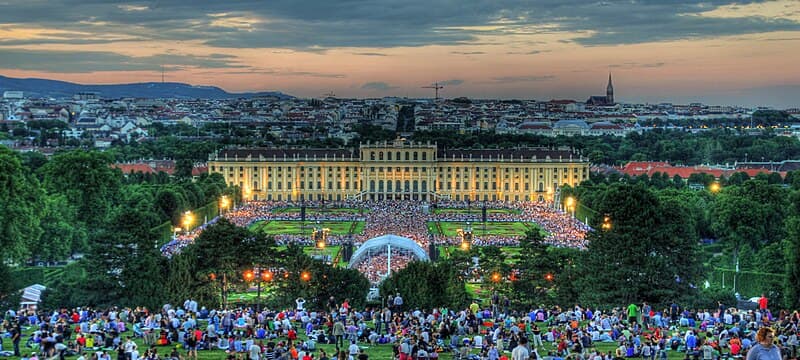
The Habsburgs' summer residence with 1,040 rooms, given its present form under Maria Theresa. Two routes are open to visitors: twenty-two rooms on the Imperial Tour and forty on the Grand Tour, including the Hall of Mirrors where six-year-old Mozart once performed. Behind the palace, a Baroque garden climbs to the Gloriette, with views over the whole city.

Tip: The ticket is valid for a specific time slot and in season is often sold out several hours ahead — buy it online the evening before. The gardens, the path around the maze, and the way up to the Gloriette are free and open from six in the morning; arrive at seven and you'll have them to yourself. The grounds include the oldest zoo in the world, dating from 1752, and a Christmas market in December.

Admission:
from €26, Imperial Tour
Time needed:
half a day
Hofburg

Hofburg

Innere Stadt

The winter imperial residence in the middle of the city, expanding since the thirteenth century into a complex that today also houses the Austrian president. The visitor route links Franz Joseph's imperial apartments, the Sisi Museum devoted to Empress Elisabeth, and the Silver Collection with court tableware for a thousand guests.

Tip: The Spanish Riding School is in the same complex: the morning training sessions of the Lipizzaner horses, held Tuesday to Friday, cost a fraction of a full performance and offer just as good a view. The Treasury, with the imperial crown dating from 962, is a separate ticket and is usually queue-free, even though it's the most valuable collection in the palace.

Admission:
from €21
Time needed:
2–3 h
St. Stephen's Cathedral

St. Stephen's Cathedral

Innere Stadt

A Gothic cathedral with a 136-metre south tower and a roof covered in a quarter of a million coloured tiles. Inside is Anton Pilgram's pulpit, featuring the sculptor's self-portrait in a window beneath the stairs, and the catacombs hold the remains of more than eleven thousand people, including the Habsburgs' internal organs.

Tip: Free entry to the main nave only extends as far as the railing behind the pews; beyond that, admission is charged. The south tower is climbed on foot up 343 steps, while an elevator takes you to the Pummerin bell on the north tower — the north is easier and cheaper, the south has the better view. You can look inside for free during morning mass; evening organ concerts are ticketed.

Admission:
free entry, tours from €6
Time needed:
1 h
Belvedere

Belvedere

Landstraße

A pair of Baroque palaces built for Prince Eugene of Savoy, joined by a garden. The Upper Belvedere holds the world's largest collection of Gustav Klimt, including The Kiss, plus works by Schiele and Kokoschka; the lower palace hosts temporary exhibitions and retains an original Hall of Mirrors and a marble gallery.

Tip: The Kiss hangs in a small room where a crowd gathers around midday — go right at ten or an hour before closing instead. The garden between the two palaces is freely accessible and offers the classic view of the upper palace with the city behind it. A ticket for just the Upper Belvedere is enough; the lower palace is worth it mainly if there's an exhibition on.

Admission:
from €17.50, Upper Belvedere
Time needed:
2–3 h
Kunsthistorisches Museum

Kunsthistorisches Museum

Innere Stadt

A collection the Habsburgs assembled over four centuries: the world's largest holding of paintings by Pieter Bruegel the Elder, plus Vermeer, Rembrandt, Caravaggio and Raphael, along with Egyptian and classical antiquities departments. The 1891 building itself has a staircase decorated with lunettes painted by a young Gustav Klimt.

Tip: The café beneath the dome in the middle of the museum is one of the loveliest in Vienna, and you can visit it without a ticket to the collections. Across the street stands a mirror-image building housing the natural history museum. On Thursdays it's open until nine in the evening, and after six it's largely empty.

Admission:
€21
Time needed:
3 h
Prater and the Ferris Wheel

Prater and the Ferris Wheel

Leopoldstadt

A former imperial hunting ground that Joseph II opened to the public in 1766. The northern section holds an amusement park with two hundred rides, including the Riesenrad — a sixty-five-metre Ferris wheel from 1897 that survived wartime bombing and has become a symbol of the city. The rest of the Prater is a five-kilometre avenue and woodland.

Tip: Entry to the park is free, and you pay for individual rides rather than at a gate. The Ferris wheel takes fifteen minutes to turn, and each gondola has a bench; the best time is half an hour before sunset. The amusement area is noisy, but right behind it starts the Hauptallee, a five-kilometre car-free avenue for running or cycling.

Admission:
free, Ferris wheel €14
Time needed:
2–3 h
Naschmarkt

Naschmarkt

Wieden / Mariahilf

A kilometre-long market built over the culverted Wienfluss river, documented since 1780. The first half has stalls selling vegetables, cheese, olives and spices; the second half restaurants serving Turkish, Middle Eastern and Asian food. On Saturdays it's also lined by the city's largest flea market.

Tip: Fruit and nut stall prices near Karlsplatz, where samples are offered, are pitched at tourists and are negotiable; locals shop in the back section closer to Kettenbrückengasse. For the Saturday flea market, arrive before nine — after that, the best pieces are gone. Above the market stand two Art Nouveau buildings by Otto Wagner with gilded medallions.

Admission:
free
Time needed:
1–2 h
State Opera

State Opera

Innere Stadt

The first building erected on the Ringstraße, opened in 1869 with Mozart's Don Giovanni. It stages a performance nearly every evening for ten months of the year, with a different title each time — the largest repertory ensemble in the world. Daytime tours lead onto the stage, into the boxes, and backstage.

Tip: Standing-room tickets go on sale eighty minutes before the performance right at the side entrance and cost thirteen to fifteen euros. The queue starts forming two hours ahead, but with a bit of patience you can get into a world-class opera house more cheaply than a cinema. In April and May, performances are also streamed free onto a screen in the square in front of the building.

Admission:
standing room from €13, tour €13
Time needed:
1–3 h
Hundertwasserhaus

Hundertwasserhaus

Landstraße

A municipal apartment building from 1985, designed by the painter Friedensreich Hundertwasser as a protest against the right angle: uneven floors, crooked window frames in twenty-five colours, and trees growing straight out of the windows. People still live there today, so the interior is off-limits, but it's the most photographed piece of modern architecture in the city.

Tip: The building is viewed from outside and is free; next to it stands the commercial Hundertwasser Village with shops aimed squarely at tourists. Anyone wanting more can walk ten minutes further to Kunst Haus Wien, a gallery in the same style with a permanent Hundertwasser exhibition. Tram number one runs here.

Admission:
free from outside
Time needed:
30–45 min

Photos: Schönbrunn Palace — C.Stadler/Bwag (CC BY-SA 4.0) · Hofburg — C.Stadler/Bwag (CC BY-SA 3.0 at) · St. Stephen's Cathedral — C.Stadler/Bwag (CC BY-SA 4.0) · Belvedere — Diego Delso (CC BY-SA 4.0) · Kunsthistorisches Museum — Manfred Werner - Tsui (CC BY-SA 3.0) · Prater and the Ferris Wheel — Gugerell (CC0) · Naschmarkt — C.Stadler/Bwag (CC BY-SA 4.0) · State Opera — Wiener Staatsoper GmbH (CC BY-SA 4.0) · Hundertwasserhaus — C.Stadler/Bwag (CC BY-SA 4.0)

Where to stay

Areas and districts, matched to the kind of trip you are taking

Innere Stadt

Best for: first-time visitors and sightseeing

The historic core inside the Ringstraße, with the cathedral, the Hofburg, the opera, and the Graben and Kärntner Straße pedestrian streets. Everything essential can be covered on foot in half a day, and it has the highest concentration of marble-tabled cafés. Housing is the most expensive in the city, and evenings inside the ring are quiet since few people actually live here. Three metro lines pass through.

Leopoldstadt

Best for: quiet stays, the Prater, and value for location

A district across the Danube Canal, historically Jewish, today home to the Prater, the Augarten, and the fastest-changing food scene in the city. It's one metro stop or a fifteen-minute walk across the bridge from the centre, yet accommodation is roughly a quarter cheaper. The Karmelitermarkt is a smaller, more authentic market than the Naschmarkt.

Mariahilf and Neubau

Best for: shopping, cafés and nightlife

Two neighbouring districts around the shopping street Mariahilfer Straße, between which lies the MuseumsQuartier and a district of small shops and bars around Neubaugasse. It's the liveliest part of Vienna for anyone who wants more than sightseeing. The Naschmarkt sits on the southern edge, a ten-minute walk or a U3 ride from the centre.

Landstraße and Belvedere

Best for: galleries and proximity to the main station

A district southeast of the centre with the Belvedere, the Hundertwasserhaus, and Wien Mitte station, from which trains run to the airport. It's quiet, green, and has lower hotel prices. Wien Hauptbahnhof, the main station with trains to Prague and Budapest, sits on the southern edge of the district.

Getting around

From the airport

From Czechia, Vienna is most often reached by train or bus rather than by air — direct express trains from Prague run every two hours and take four hours to Wien Hauptbahnhof. A ticket bought in advance costs around eighteen euros, last-minute up to three times that. The bus takes five hours from Prague and four from Brno. Schwechat Airport lies eighteen kilometres southeast of the city, with an S7 train to the centre taking twenty-five minutes and costing under five euros, or the CAT express, which is twice as expensive and saves only eight minutes — the regular train is clearly the better choice. By car it's three and a half hours from Prague on the motorway, and a motorway vignette is required.

Wien Schwechat (VIE) · 18 km

  • S7 train to Wien Mitte· 25 min· €4.60
  • City Airport Train (CAT)· 16 min· €14.90
  • ÖBB Railjet train to Hauptbahnhof· 15 min· €4.60
  • Taxi· 25–35 min· €36

Bratislava (alternative for low-cost flights) (BTS) · 55 km

  • Flixbus / RegioJet bus to Vienna· 1 h 15 min· €9

Around town

Vienna's transport is the cheapest thing in the city: five metro lines, twenty-nine tram lines and over a hundred bus routes under a single fare, where one ticket covers a journey of any length in one direction with all transfers. Visitors typically buy a 24-hour or 72-hour pass, which pays off from the third ride of the day. Tickets must be validated in the blue machine before the first ride — an unvalidated ticket counts as invalid, and inspectors travel in plain clothes, with a hundred-euro fine. The metro runs from five in the morning to midnight, and around the clock on weekends. The city centre, though, is best explored on foot, and tram lines 1 and 2 circle the entire Ringstraße for the price of an ordinary ticket — the cheapest sightseeing ride in the city.

Metro (U-Bahn)Five lines, running every two to five minutes, all night on weekends. A single ticket covers the whole journey in one direction, including transfers to trams and buses. · €2.40 single ride
TramsThe densest network in central Europe. Lines 1 and 2 circle the Ringstraße past the opera, parliament and city hall — a sightseeing ride for the price of a ticket. · €2.40
Tourist travel passes24-hour for €8, 48-hour for €14.10, 72-hour for €17.10, weekly for €17.10 (valid Monday to Monday). Pays off from the third ride of the day. · €8 / 24 h
WienMobil Rad bike shareDocked shared bikes around the city, with the first thirty minutes free after registration. Vienna has dense cycle lanes and flat terrain, making it easy to ride. · from €0 for the first 30 min
Fiaker (horse carriage)A two-horse carriage that waits by the cathedral and the Hofburg. A twenty-minute loop costs around eighty euros per carriage, not per person — confirm the price beforehand. · €80 per carriage

Useful apps: WienMobil, Google Maps, ÖBB Scotty, Qando Wien

When to go

Vienna is a year-round city, since the main draws are indoors. The most pleasant months are May, June and September, when outdoor café seating is comfortable and the Schönbrunn gardens are in bloom. July and August are hot — the Pannonian climate pushes temperatures past thirty degrees, and the metro has no air conditioning — but the opera is closed and hotel prices drop. Autumn belongs to wine: in September and October, Heurigers pour Sturm (young fermenting wine) and Grinzing gets packed. From mid-November to Christmas, fifteen Christmas markets run at once — it's the busiest and priciest time of year, but also the prettiest. January and February are the cheapest, with frost and the best conditions for museums and the ball season.

Best time

May, June and September, plus Advent for anyone wanting the Christmas markets

What to avoid

the first half of August, because of the heat and the closed opera

MonthJanFebMarAprMayJunJulAugSepOctNovDec
Day3°5°11°16°21°24°27°26°21°15°8°4°
Night-2°-1°2°6°11°14°16°16°12°7°3°0°
Rainy days878789876688

Food & drink

Viennese cuisine is the only one in the world named after a city rather than a country, and it shows: the schnitzel is Milanese, the goulash Hungarian, the dumpling Bohemian, the pancake French. It's eaten in three types of establishment, and the difference matters. A Beisl is a pub with home-style cooking and the best value for money, a Kaffeehaus is a café where people sit for hours over a single coffee reading newspapers mounted on a wooden rod, and a Heuriger is a wine tavern on the edge of the city where food is sold by weight at the counter. Prices are mid-range: lunch at a Beisl runs twelve to eighteen euros, coffee with water about five. The cheapest food is at a Würstelstand or in the market hall, the priciest at places on Kärntner Straße built around one-time visitors.

What to try

Wiener Schnitzel

A veal cutlet pounded thin, breaded and fried in clarified butter so the breadcrumbs puff up away from the meat. The pork version must be labelled 'Schnitzel vom Schwein' and costs a third less; it's served with a potato salad dressed with vinegar, not mayonnaise.

Tafelspitz

Boiled beef tip cooked in beef broth, served with grated horseradish, apple-horseradish relish, and a creamy chive sauce. The broth is eaten first as a soup, then the meat — that's part of the ritual, not just a tip.

Wiener Gulasch

A beef goulash with a heavy proportion of onion, no flour and no vegetables, generously paprika-spiced. Served with a bread dumpling or a roll; the breakfast version with sausage and egg is called Fiakergulasch.

Sachertorte

A chocolate cake with a thin layer of apricot jam and a hard glaze, always served with unsweetened whipped cream. The original is sold only at Hotel Sacher and Café Sacher; Demel's rival version has the jam under the glaze instead.

Apfelstrudel

An apple strudel made from stretched pastry so thin you can see a newspaper through it. Served warm with vanilla sauce; at Schönbrunn, the pastry-stretching is demonstrated every hour in the underground kitchen.

Kaiserschmarrn

A shredded pancake with raisins, dusted with powdered sugar and served with plum compote. It's a full lunch, not a dessert — a portion is usually meant for two, and in mountain huts it's ordered as a main course.

Würstelstand

A street sausage stand, often open late into the night. Käsekrainer is a sausage with cheese inside, Bosna a spicy sausage in a roll with onion and curry powder. Ordered 'mit süß oder scharf' depending on the type of mustard.

Wiener Melange

Espresso with hot milk and milk foam, the Viennese take on a cappuccino, always served with a glass of water on the tray. Anyone who orders just 'einen Kaffee' will be asked which kind — a classic café offers more than ten.

What it costs

Melange at a café

€4.50–6

Half-litre of beer at a pub

€4.50–5.50

Lunch at a Beisl

€12–18

Wiener Schnitzel in the centre

€22–28

Day pass on public transport

€8

Schönbrunn admission

from €26

Standing room at the State Opera

€13–15

Night in a 3-star hotel for two

€90–140

Indicative prices that change over time — treat them as a guide, not a price list.

Practical information

SocketsCEuroplug, two round pinsFSchuko
Voltage230V / 50Hz
Tap waterTap water is drinkable — Vienna, like most of Austria, drinks water from mountain springs that flows to the tap by gravity without chemical treatment — it's one of the best tap waters in Europe, and buying bottled water is pointless. In a restaurant, though, a glass of tap water is usually charged around a euro, since it's served as a drink; with coffee, on the other hand, it's brought automatically and for free. Public fountains marked 'Trinkwasser' are found around the city.
TippingTipping in Austria is expected: five to ten percent, rounded up for coffee. It isn't left on the table, though — you state the total including the tip to the server when paying ('twenty-two, please'), and they hand back the change. You pay at the table, not at a till, and each person typically pays for themselves; the server will ask 'zusammen oder getrennt?' (together or separate). At hotels, housekeeping gets a euro or two per night, porters a euro per bag.
Driving on theright
SafetyAustria is among the safest countries in Europe, and city streets are calm even at night. The real risk is pickpocketing in crowded trams, at Christmas markets, and outside major sights, where organised groups operate. In the evening, Wien Hauptbahnhof and Praterstern stations attract a crowd best avoided; otherwise it's fine to walk almost anywhere. Cycle lanes are often marked on the pavement in a different paving colour, and stepping into one is the most common way to collide with a bike. The emergency number is 112, ambulance 144.
Opening hoursOpening hours in Austria are strictly regulated: shops are open roughly from nine to seven in the evening, and until six on Saturdays; on Sundays almost everything is closed except restaurants, museums, and shops at the main station and airport. Anyone arriving on a Sunday can only shop at the main station. Museums mostly close on Mondays, though the big Viennese galleries don't. Cafés open at eight and close between eight in the evening and midnight; a classic café never rushes you out, and you can sit over a single coffee for hours.
Customs & etiquetteTitles are taken seriously in Austria, and being addressed as 'Herr Doktor' is no joke. People greet with 'Grüß Gott' on entering a shop or a train compartment, and say goodbye with 'Wiederschauen'. In a café, you wait to be seated by the server and order through them; bringing your own food or joining a stranger's table isn't done. Punctuality is taken for granted — arriving ten minutes late for a reservation means losing the table. Shorts aren't worn into churches or the opera. Waste sorting is strict, with colour-coded bins.
A few local wordsHello — Grüß GottThank you — Danke schönPlease — BitteThe bill, please — Zahlen, bitteCheers — Prost

How to plan your days

1 day

One day in Vienna

  1. 1Morning at St. Stephen's Cathedral and the Graben pedestrian street.
  2. 2The Hofburg, with the imperial apartments and treasury.
  3. 3Lunch at a Beisl in the lanes behind Hoher Markt.
  4. 4Afternoon at the Belvedere for the Klimt collection.
  5. 5Evening loop on tram number one around the Ringstraße, then dinner.

2 days

Two days including Schönbrunn

  1. 1Follow the one-day plan above.
  2. 2Morning: take the U4 metro to Schönbrunn for your booked time slot.
  3. 3Walk up through the garden to the Gloriette and back, or visit the zoo.
  4. 4Lunch, then an afternoon at the Naschmarkt.
  5. 5Evening: standing room at the State Opera, or a concert.

3 days

Three days including galleries and wine

  1. 1Follow the two-day plan above.
  2. 2Morning at the Kunsthistorisches Museum for the Bruegel collection.
  3. 3Lunch at the MuseumsQuartier, then an afternoon at the Leopold Museum for Schiele.
  4. 4Early evening at the Hundertwasserhaus and a walk along the Danube Canal.
  5. 5Evening: tram out to Grinzing for young wine at a Heuriger.

Day trips

Bratislava

80 km · 1 h by train

The nearest capital of a neighbouring country, reached from Hauptbahnhof by a train that runs every hour and takes under an hour, with a return ticket costing around sixteen euros. The old town can be covered on foot in two hours, a white castle stands above it, and the SNP Bridge's observation tower offers views all the way into Austria. Food and beer prices are roughly half those in Vienna. In summer, a fast boat also runs along the Danube.

Wachau, Melk and Dürnstein

80 km · 1 h 20 min by train to Melk

The Danube valley between Melk and Krems, a UNESCO site with terraced vineyards on both banks. Melk has a huge Baroque Benedictine monastery with a library and fresco hall; Dürnstein has a ruined castle where Richard the Lionheart was once imprisoned. The classic route is by train to Melk, then by boat or bicycle along the river to Krems, and back by train from there.

Baden bei Wien

26 km · 1 h by Badner Bahn tram

A spa town with thermal sulphur springs that once drew Vienna's high society, and where Beethoven spent fifteen summers. It has a sprawling spa park, a casino, a rose garden with eight hundred varieties, and a modern thermal spa. It's reached by the blue Badner Bahn tram directly from the opera, and a standard Vienna transport ticket covers it up to the tariff boundary.

Frequently asked questions

What's the best way to get to Vienna?+

By direct train from the main railway station, running every two hours, with a four-hour journey to Wien Hauptbahnhof. A ticket bought a month ahead costs around eighteen euros, last-minute up to fifty. The bus takes roughly five hours and is somewhat cheaper. Flying isn't worth it — once you add the trip to the airport and check-in, it takes just as long.

How much does public transport in Vienna cost?+

A single ticket costs €2.40 and covers a journey of any length in one direction, including all transfers. A 24-hour pass costs €8, a 72-hour pass €17.10. Tickets must be validated in the blue machine before the first ride, otherwise they're invalid; inspectors travel in plain clothes and the fine is one hundred euros.

Do I need to book Schönbrunn tickets in advance?+

Yes, if you want to go inside. Tickets are valid for a specific time slot and in high season are often sold out several hours or even a day ahead. Buy them online the evening before. The gardens, the path up to the Gloriette, and the maze at the edge of the grounds don't require a ticket and are open from six in the morning.

How many days are enough for Vienna?+

Two days cover the Hofburg, the cathedral, Schönbrunn, and one gallery. Three days are more comfortable and leave room for the Kunsthistorisches Museum or an evening at the opera. For four days or more, it's worth adding a day trip to Bratislava or the Wachau valley — both an hour away by train.

Can you get into the Vienna Opera cheaply?+

Yes. Standing-room tickets go on sale eighty minutes before the performance at the side entrance and cost thirteen to fifteen euros. The queue starts forming about two hours ahead, and standing spots have a rail to lean on plus a subtitle display. In April and May, performances are also shown for free on a large screen outside the building.

Is the Vienna Pass or Vienna City Card worth it?+

The Vienna City Card is mainly a transport pass with small museum discounts and rarely pays off — a regular travel pass is cheaper. The Vienna Pass, which includes admission to attractions, only pays off for someone who manages three paid sights a day; for a two-day visit covering Schönbrunn and Belvedere, separate tickets work out cheaper.

Is Vienna dead on Sundays?+

Shops, yes — on Sundays almost all retail is closed except for shops at the main station, the airport, and Praterstern. Restaurants, cafés, museums, and public transport run as usual, and Sunday is actually the best day for galleries and a stroll along the Ringstraße without crowds. Plan your shopping for Saturday before six.

Is Vienna's tap water good?+

It's among the best in Europe: it flows down by gravity from Alpine mountain springs and isn't chemically treated. It's safe to drink, and bottled water is unnecessary. In a restaurant, though, a glass of tap water is usually charged around a euro because it's billed as a drink; with coffee, on the other hand, it's brought automatically and for free.
Conditions de visa

Vérifiez les conditions de visa actuelles pour entrer dans ce pays.

Vérifier les conditions de visa

Langue

German

Devise

EUR

Fuseau

GMT+1

Indicatif

+43

Population

9.1M

Superficie

83,879 km²

Tension

230V / 50Hz

Côté de conduite

Droite

Meilleurs hôtels à Vienna

Prix en direct de 500+ hébergements

Chargement des hôtels...

More destinations in Austria

Vous planifiez un voyage à Vienna?

Comparez des centaines d'hôtels, trouvez le meilleur prix et réservez avec annulation gratuite.