Hotels in Sanya

China's tropics at the southern tip of Hainan Island

Sanya

LanguageEnglish
CurrencyCNY
TimezoneGMT+8
Temperature5-30 °C
Dial Code+86
Population1.41B
Area9,596,960 km²
SocketsType A / Type C / Type I
Tap waterNot drinkable

Discover Sanya

Sanya sits at the southern tip of Hainan Island, on the eighteenth parallel — further south than Havana — making it China's only truly tropical city, and Chinese visitors call it the 'Hawaii of the East'. As recently as the 1990s this was fishing towns and a military base; today it's the country's most luxurious beach resort, where branded resorts in Yalong Bay stand alongside duty-free malls the size of airports and fishing harbours unloading the morning catch. The island has three major bays: Dadonghai, closest to the centre and the busiest; Yalong Bay, with a twenty-kilometre beach and five-star resorts; and Haitang Bay to the east, with the newest developments and the largest duty-free mall in the world. The island's interior is mountainous, covered in rainforest, and home to the indigenous Li and Miao peoples, whose villages can be visited. Sanya is a Chinese destination for Chinese visitors — English gets you by inside the resorts, elsewhere only with a translation app, and in many places you can't get around without mobile payment via WeChat Pay or Alipay.

What to see

The places worth your time in Sanya, and what to expect at each

Yalong Bay

Yalong Bay

Yalong Bay

A seven-kilometre beach of fine white sand and clear water, ringed by the largest concentration of luxury resorts in China. The water is calm, sheltered by the bay, and it's the finest beach around Sanya. A promenade with a park runs behind the resorts.

Tip: The beach is public by law and accessible outside the hotels too — entrances between resorts are marked, even if hotel staff don't mention them. The eastern end of the bay is the calmest. In January and February, Yalong Bay sees the most Chinese visitors and hotel prices double.

Admission:
free
Time needed:
full day
Nanshan Temple and the Guanyin statue

Nanshan Temple and the Guanyin statue

Nanshan

A Buddhist complex forty kilometres west of the city, with an eighty-three-metre statue of the goddess Guanyin standing on an artificial islet in the sea — one of the tallest statues in the world, with three faces looking in three directions. The complex covers fifty hectares of temples and gardens.

Tip: The site is huge, and electric carts run between the entrance and the statue that aren't included in basic admission — pay extra for them, since it's a forty-minute walk in the heat otherwise. Going up inside the statue's base costs extra. The light is best in late afternoon, with the statue set against the setting sun.

Admission:
admission, cart and statue base separate
Time needed:
4 h
Wuzhizhou Island

Wuzhizhou Island

Wuzhizhou

A small island northeast of Sanya with the best coral and clearest water in the area, reached by a twenty-minute boat ride. It's the main spot for snorkelling, diving and water sports, and its single resort allows an overnight stay.

Tip: Take the first morning boat — after 10am the island fills with tour groups and queues for diving programmes run an hour long. Entry, the boat and individual activities are all charged separately, and the total ends up higher than the initial price suggests. The best coral is on the island's north side, where most visitors never reach.

Admission:
entry and boat, activities separate
Time needed:
full day
Tianya Haijiao

Tianya Haijiao

Tianya

A coastal park with giant granite boulders carved with characters meaning 'edge of the sky, corner of the sea' — for Chinese visitors, a symbol of the empire's furthest reach, historically where exiles were sent. It's the most photographed site in Hainan and a symbol of eternal love.

Tip: For Chinese visitors this is an emotionally loaded pilgrimage site; for foreigners it's rocks on a beach — knowing that in advance helps set expectations. The site is long and hot, with a shuttle train running through it. Go right at opening in the morning; afternoons bring the most tour groups and a queue to photograph at the rocks.

Admission:
admission fee
Time needed:
2.5 h
Dadonghai

Dadonghai

Dadonghai

Sanya's oldest and busiest beach, right by the city, ringed with hotels, restaurants and bars. Smaller than Yalong Bay, but walkable from the centre, open late into the night, and home to the only real nightlife in town.

Tip: This is the only beach in Sanya where people swim after dark and where the beach itself is lit up. Prices at beachfront restaurants run triple those at eateries two blocks inland. On high-wave days a red flag goes up, and lifeguards take it seriously.

Admission:
free
Time needed:
half a day
Yanoda Rainforest

Yanoda Rainforest

Yanoda

A protected tropical reserve forty kilometres northeast of the city, with a glass skywalk over a valley, suspension bridges, waterfalls, and a canyon that can be waded along the riverbed in rented water shoes.

Tip: The site has two sections, and most visitors only do the upper one with the glass skywalk; the canyon below, waded along the riverbed, is more interesting and quieter. It rains in the forest at any moment — a rain poncho is essential and is sold on-site for several times its usual price. Admission includes internal shuttle transport.

Admission:
admission includes internal transport
Time needed:
5 h
Luhuitou Park

Luhuitou Park

Luhuitou

A hill above the city with a statue of a deer that, according to Li ethnic legend, turned into a young woman, offering the best view over Sanya, its harbour and bays. Free-roaming parrots live in the park, and in the evening it's the spot to watch the illuminated city.

Tip: A road leads to the top, with an electric cart running from the gate; on foot it's a steep forty-minute climb, not worth it in the tropical heat. Best arrival is an hour before sunset, staying until the city lights up — that's the only real reason to come.

Admission:
admission fee
Time needed:
2 h
Fish market and seafood by weight

Fish market and seafood by weight

downtown

A market where you select a live catch from tanks — shrimp, crab, shellfish, fish — pay by weight, and a neighbouring kitchen cooks it to your specification for a fee. The best known are the First Market and the modern Sanya Seafood Square.

Tip: This is the single most common site of tourist disputes in Sanya. Insist on having your catch weighed on the market's own certified scale at the entrance, never the vendor's, and get the price per kilo and the cooking fee written down before agreeing to anything. With that precaution, it's the best food in the city.

Admission:
paid by weight
Time needed:
2 h
Haitang Bay and its duty-free shopping

Haitang Bay and its duty-free shopping

Haitang Bay

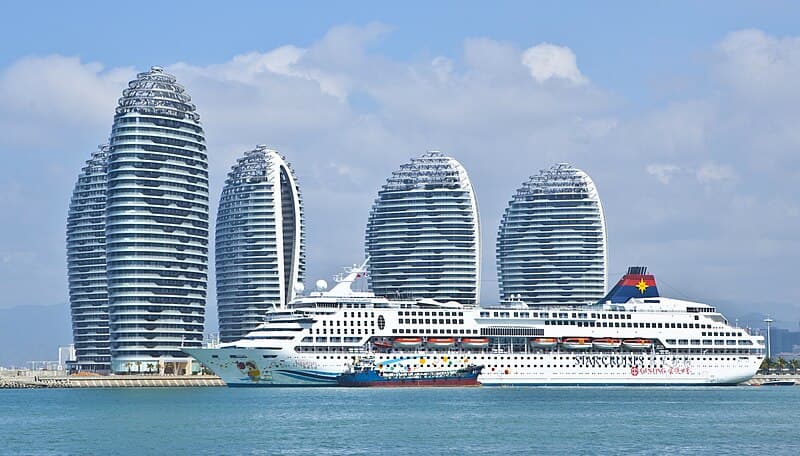
The easternmost and newest bay, with a twenty-two-kilometre beach, the most modern resorts, and the CDF Mall — the largest duty-free complex in the world. Hainan has a special duty-free scheme, and Chinese travellers fly here specifically to shop for cosmetics and luxury goods.

Tip: The duty-free scheme is designed for Chinese residents with a domestic ID, and foreigners mostly get little out of it — come to look, not to shop. Haitang Bay's beach is the widest in the area and, outside the resorts, virtually empty, which is the real reason to visit.

Admission:
free
Time needed:
half a day

Photos: Yalong Bay — Anna Frodesiak (Public domain) · Nanshan Temple and the Guanyin statue — Hostage820 (CC BY-SA 3.0) · Wuzhizhou Island — liuzusai刘祖赛 (CC BY 3.0) · Tianya Haijiao — Anna Frodesiak (CC0) · Dadonghai — Huangdan2060 (CC BY 3.0) · Yanoda Rainforest — Hanno Böck (CC0) · Luhuitou Park — lienyuan lee (CC BY 3.0) · Fish market and seafood by weight — N509FZ (CC BY-SA 4.0) · Haitang Bay and its duty-free shopping — Charlie fong (CC BY-SA 4.0)

Where to stay

Areas and districts, matched to the kind of trip you are taking

Yalong Bay

Best for: luxury resorts and the finest beach

A seven-kilometre beach of white sand with the highest concentration of five-star resorts in China. Calm, with the best beach in the area, and hotels with their own gardens and pools. The downside is isolation — there's almost nothing outside the resorts, and it's a half-hour taxi ride to the centre.

Dadonghai

Best for: a first stay and the lowest prices

The oldest resort district, right by the city, with hotels of every category, restaurants and Sanya's only real nightlife. The beach is smaller and busier than Yalong Bay's, but everything is walkable and food costs a fraction of resort prices. The most practical choice for a first visit.

Haitang Bay

Best for: new resorts and quiet

The eastern bay with the newest developments, a twenty-two-kilometre beach, and the largest duty-free mall in the world. It has the most space and the fewest people per metre of beach. It's also the furthest from everywhere else — expect a taxi for every trip.

Downtown Sanya and the river

Best for: food and everyday Chinese life

The actual city along the river, with markets, eateries, shops and the fish market. There's no beach here and hotels are basic, but it's the cheapest accommodation and the only place to see how Sanya lives outside the tourist bubble. The beach is a fifteen-minute ride away.

Getting around

From the airport

Sanya Phoenix Airport lies ten kilometres west of the centre and connects to a dense network of domestic routes to every major Chinese city, plus direct flights from Hong Kong, Seoul, Bangkok and Singapore. There's no direct flight from Europe; you connect via Beijing, Shanghai, Hong Kong or Doha, with total travel time of fifteen to twenty hours. A high-speed railway circles the whole island — from Haikou in the north it's an hour and a half to Sanya, the most comfortable connection.

Sanya Phoenix International Airport (SYX) · 10 km

  • Metro/light rail to the centre· 15 min· 10 CNY
  • Taxi to Dadonghai· 20 min· 40 CNY
  • Taxi to Yalong Bay· 45 min· 120 CNY
  • Hotel transfer· 20–50 min· included in stay

Haikou Meilan (north of the island) (HAK) · 300 km

  • High-speed train to Sanya· 1 h 30 min· 98 CNY

Around town

Sanya is spread out and its bays are far apart, so travel is by taxi or the Didi app, which is cheaper and needs no haggling. A coastal light rail runs with stops at the airport, downtown and Yalong Bay. City buses run frequently for a few yuan, but announcements are Chinese-only. Payment is the key issue: taxis, buses and most restaurants expect WeChat Pay or Alipay, and cash is increasingly rare — link both to a foreign card before you fly. Without a VPN, neither Google Maps nor most foreign apps work.

Didi (ride-hailing app)The most common transport; has an English interface and shows the price upfront, but requires mobile payment. · 15 CNY
Coastal light railStops at the airport, downtown and Yalong Bay; the fastest link between the bays. · 10 CNY
City busA dense network for a few yuan, announcements Chinese-only; line 25 connects the main bays. · 2 CNY
Rented scooter or e-bikeCommon among locals, complicated for foreigners due to registration; traffic is heavy and pedestrians have no right of way. · 50 CNY / day

Useful apps: Didi, Alipay, WeChat, Baidu Maps

When to go

The best period runs from November to April: dry, around 28°C, the sea at 25°C, and no typhoons. It's also mainland China's peak travel season — around Lunar New Year and the week around May 1st, hotel prices double or triple and the beaches fill up. From May to October it's hot, muggy and humid, with afternoon downpours, and from July to September typhoons are a risk, capable of shutting the airport for a couple of days. Sea temperature stays above 24°C even in January.

Best time

November to April

What to avoid

August and September, for typhoons and humidity

MonthJanFebMarAprMayJunJulAugSepOctNovDec
Day27°27°29°31°32°32°32°32°31°30°29°27°
Night19°20°22°24°25°26°26°25°25°24°22°20°
Rainy days444611141416151274
Sea24°25°26°28°29°30°30°30°29°28°27°25°

Food & drink

Hainanese cuisine is mild and not spicy, which surprises anyone expecting typically fiery Chinese food — it's steamed, braised, and uses coconut. The most famous dish is Wenchang chicken, known worldwide in its Singaporean form as Hainanese chicken rice. But the main experience in Sanya is seafood sold by weight: you pick a live catch, pay for the weight, and a neighbouring kitchen cooks it. This is exactly where you should get the price per kilo and the cooking fee written down beforehand, and insist on a certified scale — it's the most common dispute in the city. Coconuts are sold everywhere for ten yuan and are cheaper than bottled water.

What to try

Wenchang chicken

Poached chicken served lukewarm with a ginger, garlic and lime sauce, alongside rice cooked in the chicken fat. The original Hainanese version of the dish the world knows as Singaporean chicken rice — here the skin is firmer and the meat chewier.

Seafood by weight

In Sanya you go to a seafood market, pick a live catch, pay for its weight, and a neighbouring kitchen cooks it for a fee. Get the price per kilo and the cooking method written down beforehand — the most common tourist dispute in the whole city.

Coconut rice and coconuts

Rice steamed right inside a coconut shell, a Hainanese classic. Green drinking coconuts are sold everywhere for ten yuan, cheaper than bottled water — in Sanya you'll go through several a day.

Hainanese noodles

Rice noodles with dried shrimp, peanuts and pickled vegetables, served almost dry with a bowl of broth on the side. A ten-yuan breakfast you won't find at a hotel buffet.

Dim sum and bao

Morning steamer baskets with shrimp, pork or sweet paste filling. Cantonese influence runs strong in Sanya, and a dim sum breakfast with tea from 7am is common even at simple eateries.

Hot pot

A boiling broth at the table where you cook your own meat, vegetables and noodles. Order a split pot — spicy and mild halves. In the south, a mild coconut-and-chicken broth is also made, the local variant of hot pot.

Tropical fruit

Hainan is China's tropical garden: mango, mangosteen, lychee, dragon fruit and durian are sold at markets for a fraction of mainland prices. Fruit is sold by weight — insist on your own scale, not the vendor's.

Tea and rice wine

Tea is drunk unsweetened and is often free in restaurants. Hainanese rice wine and palm wine are sold at rural markets; 'shan lan jiu' is a mountain spirit of the Li ethnic group and is stronger than it looks.

What it costs

Bowl of noodles at an eatery

15–25 CNY

Lunch at a local restaurant

40–70 CNY

Seafood by weight (per person)

150–300 CNY

Green coconut from a stall

10 CNY

Entry to Nanshan Temple

from 108 CNY

Wuzhizhou Island (entry and boat)

from 148 CNY

Didi from the airport to Yalong Bay

100–140 CNY

Night in a 4-star hotel

500–1,200 CNY

Indicative prices that change over time — treat them as a guide, not a price list.

Practical information

SocketsAtwo flat pins (US/JP)CEuroplug, two round pinsIAustralian, angled pins
Voltage220V / 50Hz
Tap waterDo not drink tap water — Tap water is never drunk anywhere in China. Every hotel, train station and even aircraft provides boiling water — Chinese travellers drink hot water, and a thermos flask is standard gear. Bottled water costs two to three yuan in a shop, ten times more inside a resort complex. Ice traditionally isn't added to drinks in China and you won't get it at local restaurants; beer is served at room temperature unless you specifically ask for chilled ('bing de').
TippingTipping isn't customary in China, and offering one is often refused as inappropriate — the exceptions are tour guides and international-chain hotels. Payment method is the crucial issue: cash and foreign cards work at the margins of everyday commerce, while payment runs through a phone via WeChat Pay or Alipay, both of which can now be linked to a foreign card — set this up before you fly, since it's often hard to do on the ground without a Chinese phone number. Without mobile payment, in many places you can't eat or get a ride. Bank of China ATMs accept foreign cards.
Driving on theright
SafetyChina is a safe country, violent crime against foreigners is rare, and walking around cities at night poses no problem. The real risks lie elsewhere: traffic, where pedestrians have no right of way even at crossings; crushing crowds during national holidays; and overcharging in tourist zones. The 'invitation to tea' or bar scam ending in a fantastical bill still operates in big cities today. The internet is filtered — Google, WhatsApp, Facebook, Instagram and most foreign maps don't work without a VPN, and a VPN must be installed before you fly. The emergency number is 110 (police), 120 (ambulance).
Opening hoursShops and malls are open from ten to ten including weekends, street eateries from 6am. Restaurants cook for lunch from eleven to two and for dinner from five to nine — the kitchen shuts between those windows. Sights and parks open early, around 8am, and last admission is usually an hour before closing. During holidays, especially Chinese New Year and the first week of October, hundreds of millions of people travel across the country and everything is crowded and pricier.
Customs & etiquetteBusiness cards and money are handed over with both hands. Loud conversation and pushing in queues aren't rudeness here, just the local norm. Food is ordered to share in the middle of the table, and everyone helps themselves from the shared dishes; chopsticks are never stuck upright into rice, since that resembles an offering to the dead. Bills aren't split — one person pays, and the other treats next time. Declining the first offer of something is a politeness ritual, and it's meant to be offered three times. Avoid political topics, Taiwan and Tibet.
A few local wordsHello — Ni haoThank you — Xie xieHow much does it cost? — Duo shao qian?The bill, please — Mai danI don't understand — Wo bu dongI don't want it spicy — Bu yao la

How to plan your days

1 day

One day in Sanya

  1. 1Morning on the beach at Yalong Bay, while it's still cool.
  2. 2Lunch at an eatery outside the resort strip.
  3. 3Afternoon at Tianya Haijiao park with its carved rocks.
  4. 4Before sunset, the viewpoint at Luhuitou.
  5. 5Dinner with seafood by weight, then an evening at Dadonghai.

2 days

Two days with the temple and an island

  1. 1Day one as above.
  2. 2Morning at Nanshan Temple and the Guanyin statue.
  3. 3Lunch on-site or on the way back.
  4. 4Afternoon swimming at Haitang Bay.
  5. 5Evening at the duty-free mall and a riverside walk.

3 days

Three days with the rainforest

  1. 1First two days as above.
  2. 2First boat of the morning to Wuzhizhou Island for snorkelling.
  3. 3Return in the afternoon and rest on the beach.
  4. 4Next day, a full day at Yanoda Rainforest including the canyon.
  5. 5Last evening, the fish market and buying tropical fruit.

Day trips

Wuzhi Mountain and Li ethnic villages

100 km · 2 h by car

The island's highest mountain, with five peaks rising out of tropical rainforest, and villages of the indigenous Li and Miao peoples in the surrounding area. Visitors come for hikes, views from the mountain roads, and the Li weaving tradition, whose textiles are UNESCO-listed. It's a different Hainan from the coast — cooler, greener, and resort-free.

Qixianling Hot Springs and Lingshui Peninsula

80 km · 1 h 30 min by car

Hot springs in the mountains north of Sanya, with pools at various temperatures set in a tropical garden — worth a whole afternoon. On the way lies the Lingshui peninsula and Monkey Island (Nanwan), home to over two thousand free-roaming macaques, reached by a cable car over the sea.

Boao and Qionghai

180 km · 1 h 30 min by train

A coastal town on the east coast, host to the annual Boao Forum for Asia, where three rivers meet the sea and long empty beaches stretch out. It's calmer and cheaper than Sanya and gives the best sense of what Hainan looked like before the resorts arrived. The high-speed train takes an hour and a half.

Frequently asked questions

Do I need a visa for China?+

Since 2024, Czech (and most EU) citizens can visit mainland China visa-free for tourist stays up to thirty days; the policy changes regularly, so check it shortly before travel. Hainan additionally has its own visa-free scheme for tour groups and individual tourists of up to thirty days. Your passport must be valid for six months.

How do you pay in China without a Chinese card?+

The standard is mobile payment via WeChat Pay and Alipay, and both can now be linked to a foreign card — set this up at home, since it's often difficult to do on the ground without a Chinese phone number. Cash is still legal, but many businesses struggle to handle it. Bank of China ATMs accept foreign cards.

Which bay in Sanya should I choose?+

Yalong Bay has the nicest beach and luxury resorts but is isolated. Dadonghai is the cheapest, walkable from the centre, and has the only real nightlife. Haitang Bay is the newest, widest and calmest, but the farthest from everything. For a first visit without a car, Dadonghai is the most practical.

When is the weather best in Sanya?+

From November to April, when it's dry, around 28°C, and typhoon-free. This is also mainland China's peak season — around Lunar New Year and the first week of May, hotel prices double or triple. From July to September typhoons are a risk and can shut the airport.

Can I get by in English in Sanya?+

Within the resorts and at the airport, yes; outside them, only occasionally. Menus are in Chinese, bus announcements are in Chinese, and restaurant staff usually don't speak English. A translation app with photo mode is practically essential, and it's worth downloading an offline dictionary, since Google doesn't work without a VPN.

How do I avoid getting overcharged for seafood?+

Always weigh your catch on the certified scale at the market entrance, never the vendor's own scale, and get the price per kilo and the cooking fee written down before agreeing to anything. The First Market and Sanya Seafood Square both keep control scales for exactly this reason. With that precaution, it's the best food in the city.

Are Hainan's duty-free shops worth it?+

Usually not, for foreigners. The duty-free scheme with its high allowances is designed for Chinese residents with a domestic ID, and goods are picked up on departure to mainland China. The CDF Mall in Haitang Bay is the largest of its kind in the world and worth seeing as a spectacle, not as a shopping trip.

Does the internet and mapping work in Sanya?+

Without a VPN, Google, WhatsApp, Facebook, Instagram and Google Maps don't work. You need to install and test a VPN before you fly, since it can't be downloaded once you've arrived. Local alternatives — Baidu Maps and Amap — work well but are in Chinese. A local SIM or an eSIM roaming through a foreign carrier gets around some of the restrictions.

Arrival Card

Fill in the required arrival card before your trip to avoid delays at immigration.

Complete Arrival Card

Visa Requirements

Check the latest visa requirements for entering this country. Some nationalities may need to apply for a visa or e-visa before travel.

Check visa requirements

Language

Mandarin

Currency

CNY

Timezone

GMT+8

Dial Code

+86

Population

1.41B

Area

9,596,960 km²

Voltage

220V / 50Hz

Driving Side

Right

Top Hotels in Sanya

Live prices from 500+ properties

Loading hotels...

More destinations in China

Planning a trip to Sanya?

Compare hundreds of hotels, find the best price, and book with free cancellation on TravelManiac.