Hotels in Honolulu

Hawaii's capital beneath the Diamond Head crater

Honolulu

IdiomaEnglish
MonedaUSD
Huso horarioGMT-10
Temperatura5-30 °C
Prefijo+1
Población335M
Área9,833,520 km²
EnchufesTipo A / Tipo B
Agua del grifoPotable

Descubra Honolulu

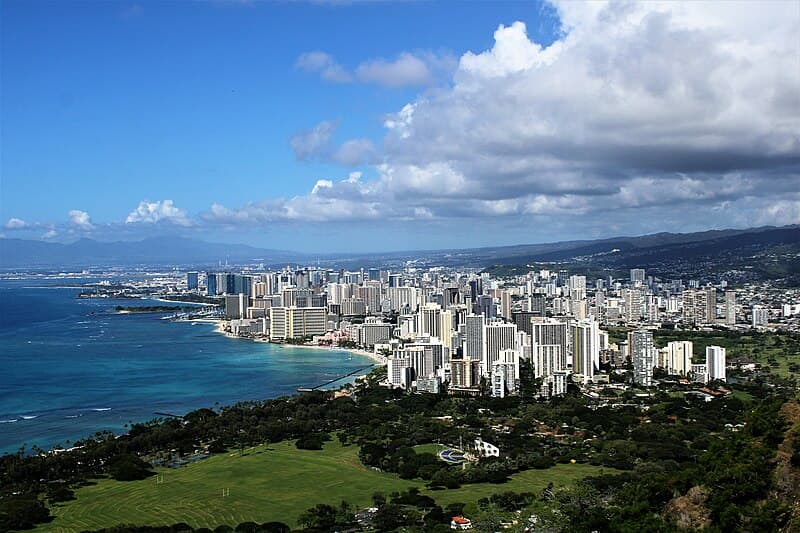
Honolulu is the capital of Hawaii, on the south coast of the island of Oʻahu, and it's the most isolated major city in the world — the nearest continental landmass is 4,000 kilometres away. Most visitors know it mainly for Waikiki, 3 kilometres of beach and hotel towers beneath the Diamond Head crater, but the city is much more: it has a financial district, the largest Chinatown in the islands, and the only royal palace on US soil. The Hawaiian Kingdom remained independent until 1893, when it was overthrown by American plantation owners, and the tension around that history is still very much alive in the islands. The second historic turning point was 7 December 1941, when the Japanese attack on Pearl Harbor drew America into the war; the sunken USS Arizona still lies on the bottom of the harbour, marked by a memorial. Oʻahu is also an island where an hour's drive takes you from a city beach to pineapple plantations, the Nuʻuanu Pali cliffs and the giant waves of the North Shore. The climate is remarkably steady: the average temperature varies by only 4 degrees between January and August, and the sea stays around 25 degrees year-round.

What to see

The places worth your time in Honolulu, and what to expect at each

Waikiki

Waikiki

Waikiki

3 kilometres of sandy beach on the south coast lined with hotels, with the calmest water in the area thanks to an offshore reef, and views of the Diamond Head crater. This is where modern surfing was born, and board rental shops and instructors work right on the sand.

Tip: The whole beach is public, including the stretches in front of hotels — access lanes between buildings are marked. The calmest water and the best spot for a first surf lesson is by Kūhiō Beach, where a breakwater keeps the waves small. Parking in Waikiki runs over $30 a day, which is the main reason not to bother with a car here.

Admission:
free
Time needed:
all day
Diamond Head (Lēʻahi)

Diamond Head (Lēʻahi)

Diamond Head

An extinct volcanic crater at the eastern end of Waikiki, with a military observation post from 1908 on its rim. The trail up is short but steep, running through a tunnel and up a staircase, and from the summit you can see the whole coast from Koko Head to Pearl Harbor.

Tip: Since 2022, entry is by advance reservation through the park's website only, and you won't be let in without one — book your slot as soon as you know your date, as morning slots go first. Go up at 6am, or the shadeless trail becomes unbearable. Bring water, as none is sold at the top.

Admission:
advance reservation required
Time needed:
2 h
Pearl Harbor and the USS Arizona

Pearl Harbor and the USS Arizona

Pearl Harbor

A national memorial at the site of the Japanese attack of 7 December 1941. A white pavilion stands over the sunken battleship USS Arizona, in which 1,177 men died and whose hull still rests on the seabed; drops of oil still rise to the surface.

Tip: Entry to the memorial is free, but requires a timed ticket reservation, released 8 weeks ahead and again 24 hours ahead, and it sells out within minutes. No bags or backpacks are allowed inside the site; paid lockers are available. Bring only a wallet and phone, and set aside half a day.

Admission:
free, reservation required
Time needed:
4 h
ʻIolani Palace

ʻIolani Palace

Downtown

The only royal palace on US soil, built by King Kalākaua in 1882 — it had electricity and a telephone before the White House did. In 1893, after the monarchy's overthrow, Queen Liliʻuokalani was held here, and the room where she spent 9 months can be seen upstairs.

Tip: An audio-guided tour is cheaper and more flexible in timing than a guided one, but the guides are often descendants of Hawaiian families, and their perspective on 1893 is the most valuable thing you'll take from the visit. Shoe covers are required to enter the palace. It's closed on Sundays and Mondays.

Admission:
admission fee
Time needed:
2 h
Hanauma Bay

Hanauma Bay

Hawaiʻi Kai

A flooded volcanic crater east of the city with a coral reef right off the shore — the best snorkelling on Oʻahu. The bay is a protected reserve with a visitor cap, and a short film on reef conservation is mandatory viewing before you go in.

Tip: Entry is by reservation only, released 2 days ahead at 7am Hawaii time, and it's gone within minutes — you won't get in without one. It's closed on Tuesdays. Sunscreen containing oxybenzone is banned by Hawaiian law, so bring a mineral one.

Admission:
admission fee, reservation required
Time needed:
half a day
Bishop Museum

Bishop Museum

Kalihi

The world's largest museum of Polynesian culture and natural history, founded in 1889. A 3-storey Hawaiian hall with royal feather cloaks, a hall with a mounted orca, and a planetarium explaining Polynesian star navigation.

Tip: This is the best place on Oʻahu to understand that Hawaii has its own thousand-year history, not just an American one. The planetarium runs shows at fixed times — check them at the ticket desk right away and plan the rest of your visit around them. The museum is off the tourist trail; get there by bus or car.

Admission:
admission fee
Time needed:
3 h
Mānoa Falls and Mānoa Valley

Mānoa Falls and Mānoa Valley

Mānoa

A 50-metre waterfall in a rainforest above the city, reached by a 2.5-kilometre trail through muddy jungle with giant bamboo and ferns. Mānoa Valley gets the highest rainfall around Honolulu and stays green all year.

Tip: The trail is almost always muddy and slippery — sandals and white trainers are a bad idea; boot rental is available by the car park. Swimming under the falls is banned because of leptospirosis in the standing water, and it's not just a formality. Parking on site is paid; the bus from Waikiki takes one transfer.

Admission:
parking fee
Time needed:
2.5 h
Chinatown and Downtown

Chinatown and Downtown

Chinatown

The oldest Chinatown in the United States, founded in the 1850s by immigrants from the plantations. The Oʻahu Market, shops selling fresh-flower lei, Vietnamese and Filipino eateries, and historic buildings from the kingdom era nearby.

Tip: Visit in the morning, when the market and eateries are running; by evening the district turns partly unwelcoming and some streets empty out. The cheapest and best food in Honolulu is right here — Vietnamese phở costs a fraction of anything in Waikiki. Fresh flower lei here cost a third of airport prices.

Admission:
free
Time needed:
2.5 h
Nuʻuanu Pali and Punchbowl

Nuʻuanu Pali and Punchbowl

Nuʻuanu

The Nuʻuanu Pali lookout sits on a ridge above the city, where in 1795 Kamehameha I conquered Oʻahu and drove the defenders over the cliff; the wind here is strong enough to lean into. Nearby is Punchbowl, a cemetery in a volcanic crater holding the graves of those who fell in the Pacific.

Tip: The wind at Pali blows constantly and it often rains — a jacket is worth having even when it's 25 degrees down in the city. Parking is paid. Punchbowl is a working military cemetery, not a tourist attraction; visit quietly and photograph respectfully. Both fit into one afternoon on the way to the windward coast.

Admission:
parking fee
Time needed:
3 h

Photos: Waikiki — Pickle the cool (CC BY-SA 4.0) · Diamond Head (Lēʻahi) — mar1865 (CC BY-SA 3.0) · Pearl Harbor and the USS Arizona — DoD photo by: PH3(AW/SW) JAYME PASTORIC, USN (Public domain) · ʻIolani Palace — Gage Skidmore from Surprise, AZ, United States of America (CC BY-SA 2.0) · Hanauma Bay — ErgoSum88 (Public domain) · Bishop Museum — Mark Miller (CC BY-SA 4.0) · Mānoa Falls and Mānoa Valley — Danieljaycho (CC BY-SA 3.0) · Chinatown and Downtown — Joel Bradshaw (Public domain) · Nuʻuanu Pali and Punchbowl — Lukas from Tokyo, Japan (CC BY 2.0)

Where to stay

Areas and districts, matched to the kind of trip you are taking

Waikiki

Best for: first-time visitors and the beach

The hotel district, with the beach, restaurants and shops, home to the vast majority of visitors. Everything is walkable, and buses from here reach the whole island. The cost is noise, crowds and parking fees over $30 a day — most people staying here skip the car altogether.

Ala Moana and Kakaʻako

Best for: shopping and modern accommodation

A district between Waikiki and downtown with the largest open-air shopping centre in the world, the Ala Moana city beach, quieter than Waikiki, and the mural-covered Kakaʻako area full of cafes and breweries. Accommodation is newer and a little cheaper, and Waikiki is a 20-minute walk away.

Downtown and Chinatown

Best for: history and the cheapest food

The administrative and historic centre, with ʻIolani Palace, courts and banks, adjoining Chinatown with its market and eateries. It's the most interesting part of Honolulu by day, but empties out at night and some streets stay unwelcoming. There are few hotels here; most people visit for the day.

Kailua and the Windward Coast

Best for: the prettiest beaches and quiet

The windward coast beyond the mountain ridge, with the beaches of Kailua and Lanikai, prettier than Waikiki, with turquoise water. Accommodation is in houses and apartments rather than hotels, and it's quiet. A tunnel through the mountains gets you there in half an hour, and beach parking is limited and monitored.

Getting around

From the airport

Daniel K. Inouye Airport lies 6 kilometres west of downtown and is the main hub for the whole archipelago — flights land here from the US mainland, Japan, Korea and Australia, and onward flights leave for the other Hawaiian islands. There are no direct flights from Europe; travellers connect via the US west coast, typically Los Angeles, San Francisco or Seattle, with the whole journey taking 20-24 hours, and an ESTA authorisation or visa is required. From the airport, an airport shuttle, taxi or city bus runs to Waikiki, though the bus doesn't take large luggage.

Daniel K. Inouye International Airport (HNL) · 13 km

  • Airport shuttle to Waikiki· 30–45 min· $20
  • Uber or Lyft· 25 min· $35
  • Taxi· 25 min· $45
  • TheBus route 20· 1 h· $3

Around town

Honolulu has the best public transport in Hawaii — the TheBus network covers the whole island, the fare is $3, and the daily cap on a HOLO card means you'll never pay more than $7.50 a day. It can even get you to the North Shore, though it takes 2 hours. A rental car is worth it for a day or 2 to circle the island, but not for the whole trip: parking in Waikiki costs over $30 a day and is limited and quick to fill near popular trails and beaches. Uber and Lyft work reliably. The new elevated Skyline rail currently runs only in the western part of the island.

TheBus with a HOLO cardCovers the whole island including the North Shore; the daily cap means you'll never pay more than $7.50 a day. · $3
Uber and LyftReliable across the city; from the airport to Waikiki, significantly cheaper than a taxi. · $12
Rental carWorth it for a day or 2 to circle the island; expect over $30 a day for parking in Waikiki. · $55 / day
Biki (bike share)Stations across Honolulu and Waikiki, ideal for short hops along the coast. · $4.50 / 30 min

Useful apps: DaBus2, Uber, Lyft, Biki, Recreation.gov

When to go

Honolulu has the most stable climate of any destination in this guide — only 4 degrees separate the coolest and warmest months, and the sea stays between 25 and 27 degrees all year. Price and swell matter more than weather here. From April to June and September to mid-December offers the best balance of weather and price: dry, quieter, cheaper hotels. December to March is rainier and also the most expensive, thanks to American visitors escaping winter; but that's also when giant waves hit the North Shore and whales pass by. Summer is the driest and warmest.

Best time

April to June and September to November

What to avoid

the turn of December into January, because of prices and crowds

MonthJanFebMarAprMayJunJulAugSepOctNovDec
Day27°27°27°28°29°30°31°31°31°30°29°27°
Night19°19°20°21°22°23°24°24°24°23°22°20°
Rainy days109997677791111
Sea25°25°25°25°26°27°27°27°27°27°26°26°

Food & drink

Hawaiian cuisine blends a Polynesian base with waves of immigrants from Japan, China, Portugal and the Philippines who came to work the plantations. The everyday staple is the plate lunch — rice, macaroni salad and meat — and poke, cubes of raw tuna sold by weight at a supermarket counter rather than in a restaurant. Prices in Waikiki are geared to tourists; the same dish in Chinatown or from a North Shore food truck costs a third as much. Remember that sales tax is added to every price, and a tip of 18-20 percent is expected at a table-service restaurant, so the final bill runs roughly a quarter higher than what's printed on the menu.

What to try

Poke

Cubes of raw tuna marinated in soy sauce, sesame and seaweed. The Hawaiian original is sold by weight at a Foodland supermarket counter or a poke shop, not a restaurant — it's fresher there and costs a third as much.

Plate lunch

2 scoops of rice, macaroni salad and meat — kalua pork, chicken teriyaki or loco moco. A plantation-era working lunch that fills you up for the whole day and costs around $15 from a food truck.

Kalua pua'a

Pork slow-roasted all day in an underground imu oven, shredded and salted with sea salt. The centrepiece of a lūʻau feast; on an everyday plate, it's the best value for money in Hawaiian food.

Poi and laulau

Poi is a greyish paste made from pounded taro root, the staple of the traditional Hawaiian diet and very neutral in flavour. Laulau is pork and fish wrapped in taro leaves and steamed — the most approachable dish from the traditional cuisine.

Shave ice

Hawaiian shaved ice drenched in syrups, finer than a European ice cone — the ice is shaved, not crushed. The classic version has a scoop of ice cream at the bottom and condensed milk on top; Matsumoto's on the North Shore is the best known.

Spam musubi

A slice of fried luncheon meat on a block of rice, wrapped in nori. It sounds unpromising, but it's the best-selling snack on the islands and costs a couple of dollars at an ABC Store — a legacy of World War II military rations.

Malasada

A Portuguese doughnut with no hole, coated in sugar, brought to Hawaii by workers from Madeira. Leonard's bakery is the best known; buy it warm for breakfast, since a cold one isn't worth eating.

Mai tai and Kona coffee

A rum cocktail with lime and orgeat syrup, an obligatory order in Waikiki at sunset. Kona, from the Big Island, is the only coffee grown in the US; watch out for '10% Kona blend' mixes, which are 90 percent something else.

What it costs

Poke bowl from a supermarket counter

$12–18

Plate lunch from a food truck

$14–20

Dinner at a Waikiki restaurant

$45–90 per person

Mai tai at a beach bar

$16–22

Diamond Head entry (reservation)

$5 + parking

Surf lesson in Waikiki

from $80

TheBus daily fare cap

$7.50

Night at a 4* hotel in Waikiki

$280–500 + resort fee

Indicative prices that change over time — treat them as a guide, not a price list.

Practical information

SocketsAtwo flat pins (US/JP)Btwo flat pins plus ground (US)
Voltage120V / 60Hz
Tap waterTap water is drinkable — Tap water is safe to drink in the United States, and restaurants will give it to you free with ice — just ask for 'tap water'. Buying bottled water is unnecessary and pricey — a bottle costs $2-3 in a shop and $5 at an attraction. It's worth carrying a reusable bottle, as refill stations are available at airports and in parks. Ice is everywhere, and drinks are served noticeably colder than is typical in Europe.
TippingTipping isn't optional — it's part of the server's wage. At a table-service restaurant, tip 18-20 percent of the pre-tax total; at a bar, a dollar per drink; taxi and rideshare drivers, 15 percent; housekeeping, $3-5 per night; porters, $2 per bag. The card reader usually offers preset percentage buttons — watch out, as these sometimes calculate from the total including tax. On top of the menu or shelf price, sales tax is also added, around 5 percent in Hawaii, so the final total is always higher than the listed price.
Driving on theright
SafetyThe tourist districts of major American cities are safe by day and police presence is visible, but the line between a good and a bad neighbourhood is sharp and often just a few blocks. Check your accommodation's address on a map beforehand. Never leave visible belongings in a parked car. Health insurance is an essential budget item: an ER visit without insurance costs thousands of dollars, an ambulance ride over 1,000, and American hospitals expect payment upfront — travel insurance with a high coverage limit is an absolute must. The emergency number is 911.
Opening hoursShops open from 10am to 9pm, including Sundays, and supermarkets and pharmacies such as CVS or Walgreens are often open around the clock. Restaurants serve breakfast from 6am, lunch from 11am, and dinner early — many kitchens close by 9pm. Bars check ID for anyone who looks under 40 and won't serve you without a passport; a copy isn't enough. Drinking alcohol in public, on the beach or in a car is prohibited.
Customs & etiquetteThe friendly small talk from staff is a professional norm, not an invitation to friendship. Queuing is respected, and personal space is larger than in Europe. Haggling only happens over cars and at flea markets, never elsewhere. Smoking is banned in practically all indoor spaces and on many beaches. Questions about salary or politics aren't raised with strangers. Hawaii also has its own local customs: the aloha spirit means not pushing or rushing, shoes come off before entering a home, and sacred sites and stones are never moved, not even as a souvenir.
A few local wordsHello — Hi / Good morningThank you — Thank youThe bill, please — Check, pleaseJust looking, thanks — Just looking, thanksHow much is that with tax? — How much is it with tax?Tap water, please — Tap water, please

How to plan your days

1 day

A day in Honolulu

  1. 16am hike up Diamond Head with a reservation.
  2. 2Malasada or poke breakfast on the way down.
  3. 3Morning at the beach and a first surf lesson in Waikiki.
  4. 4Afternoon at ʻIolani Palace and Chinatown.
  5. 5Sunset at Ala Moana beach and dinner outside Waikiki.

2 days

2 days including Pearl Harbor

  1. 1Day 1 as above.
  2. 2Morning at Pearl Harbor and the USS Arizona with a booked ticket.
  3. 3Lunch, then the afternoon at Bishop Museum and its planetarium.
  4. 4Early evening at the Nuʻuanu Pali lookout.
  5. 5Dinner in Kakaʻako, among the murals.

3 days

3 days covering the whole island

  1. 1The first 2 days as above.
  2. 2Morning snorkelling at Hanauma Bay, booked 2 days ahead.
  3. 3Drive over to the windward coast and Lanikai beach.
  4. 4The next day, a full loop of the island by car via the North Shore.
  5. 5Last afternoon at Mānoa Falls and buying Kona coffee.

Day trips

North Shore

55 km · 1 h by car

Oʻahu's north coast, with Waimea Bay, Sunset Beach and the Banzai Pipeline, where winter waves break over 7 metres high and the world surfing tour holds competitions. In summer the same coast is calm and swimmable. In the town of Haleʻiwa, stop for shave ice at Matsumoto's and shrimp from the food trucks.

Kualoa Ranch

40 km · 45 min by car

A private 2,000-hectare ranch in a dramatic valley on the windward side, where Jurassic Park, Godzilla and dozens of other films were shot. Visits are by off-road vehicle, horseback or ATV; entry is only with a booked tour, and you can't go into the valley independently.

Polynesian Cultural Center

60 km · 1 h 15 min by car

A complex in Lāʻie where 6 Polynesian cultures — Hawaiian, Samoan, Maori, Tahitian, Fijian and Tongan — showcase their traditions, dances and crafts in their own villages. It's a commercial venture run by a Mormon university, but the performers are genuine students from those islands. The programme, including dinner and a show, fills a whole day.

Frequently asked questions

Do I need a visa for Hawaii?+

Hawaii is a US state, so the same rules apply as for the mainland. Visitors from Visa Waiver Program countries, including most of the EU, the UK and Australia, travel on an electronic ESTA authorisation, which must be arranged online at least 2 days before departure and is valid for 2 years; a biometric passport is required. Travellers from other countries need a US visa. Travel insurance with a high coverage limit is essential — without it, American healthcare can be ruinous.

Which attractions require advance reservations?+

Diamond Head, Hanauma Bay and Pearl Harbor — you can't get into any of them without a reservation. Pearl Harbor tickets are released 8 weeks ahead, and again 24 hours ahead, and sell out within minutes. Hanauma Bay opens reservations 2 days ahead at 7am local time. Plan this as soon as you know your dates.

Do I need a car on Oʻahu?+

Not necessarily. Honolulu has the best public transport in Hawaii — the TheBus network covers the whole island, and the daily fare cap is $7.50. A car is worth it for a day or 2 to circle the island and visit the North Shore, but not for the whole stay, since parking in Waikiki costs over $30 a day and is limited near the beaches.

When is the best time to visit?+

April to June and September to November — dry, fewer crowds and lower prices. The climate is steady year-round, with only a 4-degree difference between January and August. Winter is rainier and pricier, but it brings huge waves to the North Shore and whales offshore. Summer is the driest and the sea is warmest.

How expensive is Honolulu?+

Hawaii is among the most expensive US destinations because almost everything is shipped in. Budget $50-70 per person per day on food alone if you eat at restaurants. It's cheaper to shop at Foodland and eat plate lunches from food trucks. On top of the price you'll also pay sales tax and a tip, adding roughly another quarter.

Is Waikiki the best beach on Oʻahu?+

No, it's the most accessible. The water is calm and it's a great spot for your first surfing lesson, but the beach is narrow and crowded. Lanikai and Kailua on the windward coast are prettier, Waimea Bay on the North Shore is lovely in summer, and Hanauma Bay is best for snorkelling. All of them are within an hour by bus or car.

What is a resort fee?+

A mandatory daily charge that Hawaiian hotels add on top of the room rate — typically $30-50 a day for wifi, beach towels and the gym, whether you use them or not. It's often hidden from the price shown on a booking site and only added at check-in, so the actual nightly rate ends up that much higher.

What should I watch out for in the sea?+

Watch for currents and waves, which change dramatically between seasons — the North Shore is calm in summer and deadly in winter. Only swim at beaches with lifeguards and follow the warning flags. Hawaiian law bans sunscreens containing oxybenzone to protect the coral, so buy mineral sunscreen instead. Swimming in freshwater below waterfalls is prohibited because of leptospirosis.

Requisitos de visa

Verifique los requisitos de visa actuales para ingresar a este país.

Verificar requisitos de visa

Números de emergencia

Idioma

English

Moneda

USD

Huso horario

GMT-10

Prefijo

+1

Población

335M

Área

9,833,520 km²

Voltaje

120V / 60Hz

Lado de conducción

Derecha

Mejores hoteles en Honolulu

Precios en vivo de 500+ propiedades

Cargando hoteles...

Planea un viaje a Honolulu?

Compare cientos de hoteles, encuentre el mejor precio y reserve con cancelación gratuita.