Hotels in Protaras

The family side of the cape, where the lights go out by eleven

Protaras

LangueGreek / Turkish
DeviseEUR
FuseauAsia/Nicosia
Température14-34 °C
Indicatif+357
Population1.3M
Superficie9,251 km²
PrisesType G
Eau du robinetPotable

Découvrez Protaras

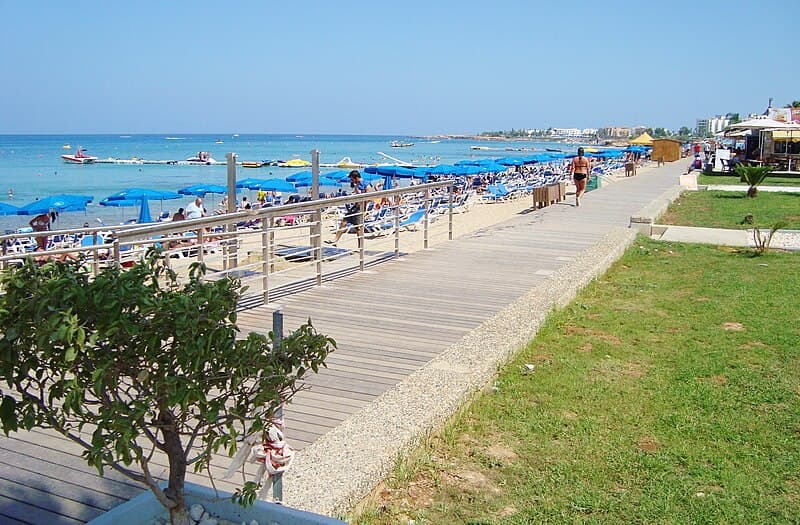
Protaras grew out of farmland belonging to the municipality of Paralimni, where people displaced from occupied Famagusta after 1974 settled and began building hotels on what had been potato fields. That's why the resort looks different from Ayia Napa: it has no historic core or town square, but instead a continuous stretch of beaches and a four-kilometer promenade. Fig Tree Bay at its center is named after the fig tree that has stood on the shore since the sixteenth century and survived every redevelopment around it. The beaches here are wider and the sea shallower than at the western end of the cape, which is why Protaras has become Cyprus's go-to choice for families with small children — restaurants have kids' menus, the promenade is fully accessible, and noise dies down by midnight. Above the resort rises a rock topped by the church of Profitis Ilias, reached by a hundred fifty steps, from which the whole Cavo Greco cape is visible. Ayia Napa is ten kilometers away along the coast road, Larnaca fifty-five kilometers and about fifty minutes.

What to see

The places worth your time in Protaras, and what to expect at each

Fig Tree Bay

Fig Tree Bay

Center

A sandy bay at the center of the resort with a small islet just offshore, reachable by a five-minute swim, and a fig tree on the shore it's named after — recorded as standing here since the sixteenth century. The water stays shallow for over thirty meters from shore, and the beach repeatedly holds a Blue Flag.

Tip: The calmest spot is the southern end of the bay beneath the rocky headland, which most people never reach since it's two hundred meters from the main steps. Sunbeds are rented for the whole day regardless of arrival time — after three in the afternoon it's worth asking the lifeguard about a reduced rate.

Admission:
free, sunbeds from 12.50 €
Time needed:
full day
Profitis Ilias Church

Profitis Ilias Church

1 km northwest

A white chapel built in 1984 atop a rocky hill above the resort, reached by a stone staircase of a hundred fifty steps. From the terrace, all of Protaras is visible, along with Cape Cavo Greco and, on a clear day, the occupied coast of Famagusta to the north.

Tip: People come here for sunset, but the steps have no shade and get scorching in summer — bring water and go after seven. A car can be parked right at the base of the steps rather than down in town, saving half a kilometer uphill. Covered shoulders are required to enter the chapel.

Admission:
free
Time needed:
1 h
Konnos Bay

Konnos Bay

5 km south

A horseshoe-shaped bay on the edge of Cavo Greco National Park, enclosed by wooded cliffs, with sand sloping gently into the water. Rocks shelter it on both sides, so it stays calm even when the rest of the coast is choppy, and pine trees grow right up to the cliff edge above the beach.

Tip: The parking area above the bay has about forty spaces and fills up after nine; the rest of the visitors park on the road and walk two hundred meters down. A water taxi also runs to the bay from Fig Tree Bay, an easier option in season than hunting for a spot. Shade from the pines doesn't reach the beach until late afternoon.

Admission:
free, sunbeds from 12.50 €
Time needed:
half a day
Kamara tou Koraka

Kamara tou Koraka

7 km south

A natural rock arch on the Cavo Greco coast, carved by the sea out of a limestone headland and about six meters tall. In Greek it's called the Raven's Arch, known to tourists as Love Bridge. A coastal path runs along the cliff edge around it, with sea views shifting in color with the depth of the seabed.

Tip: Walking across the arch itself is not allowed — the rock is cracked, and the village banned it after part of it broke off. Photos are taken from the mainland on the north side. The best light is an hour after sunrise, when the path is also empty and it isn't yet hot.

Admission:
free
Time needed:
1.5 h
Singing fountains

Singing fountains

2 km north

A water show on a pond beside the main road, where two hundred jets move to music and colored lighting, accompanied by live dancers. The program runs roughly an hour and a half and plays six times a week after dark in the main season.

Tip: It's the cheapest evening entertainment for a family in the whole resort, and children enjoy it longer than adults do. Tickets are bought on site, but arrive at least twenty minutes early — the back rows are far from the water and hard to see over people's heads. It doesn't run at all outside the season.

Admission:
from 12 €
Time needed:
1.5 h
Ocean Aquarium

Ocean Aquarium

1.5 km north

An aquarium with around a thousand marine and freshwater creatures divided into themed sections from the Nile to the coral reef, with a shark tunnel and an outdoor garden where flamingos, peacocks, and crocodiles roam behind glass. It also holds a sea turtle collection.

Tip: Go at eleven, when the sharks are fed; the schedule isn't posted in advance, but staff will tell you the time if you ask. Along with the fountains, it's the only indoor entertainment in Protaras, and every family heads here in the midday heat — after four it's half empty.

Admission:
from 16 €
Time needed:
2 h
Green Bay and the underwater statues

Green Bay and the underwater statues

1.5 km south

A rocky bay at the south end of the promenade, where the seabed at three to six meters is fitted with plaster statues and amphorae. They were created as a diver training site, but are visible with just a snorkel too, since the water here is unusually clear and current-free.

Tip: Bring your own snorkel — there's no rental right on the beach. Entry into the water is via steps cut into the rock, and water shoes help against sea urchins. Mornings have the calmest water and best visibility; after two the wind picks up and sand clouds the water.

Admission:
free
Time needed:
2 h
Paralimni

Paralimni

5 km north

The municipality Protaras administratively belongs to, which became the capital of the free part of the Famagusta district after 1974. It's a genuine Cypriot town, with a main square, three churches standing side by side, a Saturday market, and taverns cooking for locals, not hotels.

Tip: The Saturday morning market is the best place for halloumi, dried fruit, and glyko tou koutaliou preserves straight from the producers — prices run roughly half those on the resort promenade. Parking in town is free, unlike in the resort.

Admission:
free
Time needed:
2 h
Deryneia and the Famagusta viewpoint

Deryneia and the Famagusta viewpoint

12 km north

A village right against the buffer zone, from which several viewing terraces look out over the sealed-off district of Varosha — a once-luxurious resort abandoned in 1974 and left decaying behind fences ever since. The village has a museum devoted to the island's division, and a border crossing operates nearby.

Tip: The viewing terraces sit on cafe rooftops, and entry costs a few euros, coffee included; a telescope is on site. Photography is allowed toward Varosha, but not toward the military post below it, and it's a rule the soldiers enforce. Late afternoon is best, when the sun shines from behind you.

Admission:
from 3 €
Time needed:
2 h

Photos: Fig Tree Bay — Catauggie (CC BY-SA 4.0) · Profitis Ilias Church — Ssu (CC BY-SA 4.0) · Konnos Bay — dronepicr (CC BY 2.0) · Kamara tou Koraka — Knowledge2need (CC BY-SA 4.0) · Singing fountains — Kogeela (CC0) · Ocean Aquarium — AyianapaProtaras (CC BY-SA 3.0) · Green Bay and the underwater statues — Ethan from Scottsdale (CC BY 2.0) · Paralimni — AyianapaProtaras (CC BY-SA 3.0) · Deryneia and the Famagusta viewpoint — Alex Ostrovski (CC BY-SA 4.0)

Where to stay

Areas and districts, matched to the kind of trip you are taking

Fig Tree Bay and the promenade

Best for: first visit and families

The heart of the resort around its most famous bay, with hotels right above the beach and restaurants at ground level. Everything is walkable along the fully accessible promenade, and a car isn't needed. It's also the most expensive part of Protaras, and accommodation books up well in advance for August.

Pernera

Best for: a quieter stay with young children

The northern part of the resort, with a series of smaller coves, apartment complexes, and a fishing harbor. The beaches are smaller and separated by rocks, but there are noticeably fewer people and lower prices. It's two to four kilometers to central Protaras along the promenade or by bus.

Kapparis

Best for: cheaper accommodation and northern views

The northernmost part, right against the buffer zone, with clifftop hotels and steps down into the water. The occupied coast of Famagusta is visible from here, and it tends to be windier. Prices are the lowest in the area, but without a car you're dependent on the hotel restaurant and a bus that runs every half hour.

Paralimni and the inland area

Best for: apartments with a car and life away from tourism

A town five kilometers from the sea, where locals live and accommodation and food prices are noticeably lower. Evenings are cooler and quieter here. Getting to the sea requires a car or bus, which isn't practical for a beach holiday with children, but makes sense for a longer stay built around day trips.

Getting around

From the airport

The nearest airport is Larnaca, fifty-five kilometers west; the transfer along the A3 motorway takes about fifty minutes. A direct airport bus runs to Ayia Napa, connecting there with line 101 to Protaras, so public transport takes around an hour and a half — with kids and luggage, a shared transfer or taxi is the better choice. Paphos airport is a hundred sixty kilometers away and takes over two hours, worth it only for a significantly cheaper flight. Car rental agencies have branches at both airports and in the resort itself.

Larnaca (LCA) · 55 km

  • Hotel transfer· 50–70 min· included in package
  • Airport bus via Ayia Napa· 1 h 30 min· 11 €
  • Taxi from the airport· 50 min· 75 €
  • Rental car· 50 min· 35 € / day

Paphos (PFO) · 160 km

  • Rental car· 2 h 10 min· 35 € / day
  • Shared transfer· 2 h 40 min· 38 €

Around town

The promenade links the whole resort from Kapparis to Green Bay and runs about four kilometers, so most of a stay is covered on foot. Bus 101 runs between Protaras, Ayia Napa, and Paralimni every fifteen to twenty minutes and is the cheapest connection in the area. Konnos Bay and Cavo Greco are reached by car, water taxi from Fig Tree Bay, or tourist train. A car is needed only for trips off the cape; in town, parking is in paid zones that fill up from the morning in August.

Bus 101Protaras–Ayia Napa–Paralimni every 15–20 minutes, running until midnight in season. · 1.50 € / ride, 5 € / day
Water taxiFrom Fig Tree Bay to Konnos Bay and Ayia Napa, several times a day in season. · 15 € return
Tourist trainA loop along the promenade and up to Profitis Ilias church, running continuously through the day. · 5 €
Rental carNeeded for Cavo Greco and trips to Larnaca or Troodos; drive on the left. · 35 € / day

Useful apps: Google Maps, Bolt, Cyprus By Bus, Nextbike Cyprus

When to go

The eastern tip of Cyprus has the longest swimming season on the island — the sea stays above twenty-two degrees from May to early November and is warmest in September. For families with children, June and September are best, when the air is around thirty and the beaches are bearable at noon. July and August bring thirty-two in the shade, packed sunbeds, and the highest prices. From November to March most hotels close and the resort empties out, though the coastal paths are pleasant to walk without the heat.

Best time

June and September

What to avoid

August, due to heat and prices; December to February, due to closed hotels

MonthJanFebMarAprMayJunJulAugSepOctNovDec
Day17°17°19°22°26°30°32°32°30°27°23°19°
Night9°9°10°12°16°20°22°23°21°18°14°11°
Rainy days1086321001469
Sea18°17°17°19°21°24°26°27°27°25°22°20°

Food & drink

Restaurants along the Protaras promenade are geared toward British and family guests: children's menus, English breakfasts, and Greek classics in a milder form. The cooking is decent, but you'll find Cypriot cuisine at full strength only in Paralimni and Deryneia, where taverns serve locals and meze is ordered for the whole table. The fish taverns by the harbor in Pernera are worth it, selling the day's catch. Prices on the promenade run about a third higher than in Paralimni five kilometers away — a difference worth one bus ride a day over a week's stay.

What to try

Meze

Not a starter, but a way of eating: staff bring fifteen to thirty small dishes in succession for as long as you keep saying more. It's ordered for the whole table, a minimum of two people, and expect a three-hour dinner — pace yourself, since the meat always comes last.

Halloumi

A Cypriot cheese made from sheep's and goat's milk that doesn't melt and grills up crisp. It's had protected status since 2021, and you'll recognize it by its saltiness and slight squeak between your teeth. Eaten with melon at breakfast, grilled with lemon alongside beer.

Kleftiko

A lamb shoulder slow-roasted overnight in a clay oven sealed with dough, so it cooks in its own steam. The meat falls off the bone by itself. It's made to order, and at good taverns you should reserve it a day ahead, or you'll get a version reheated from that morning.

Koupepia

Vine leaves stuffed with rice, ground meat, tomato, and cinnamon. The Cypriot version is more heavily spiced than the Greek one and is eaten warm with yogurt. In a meze it arrives right after the dips and is usually homemade.

Afelia

Pork braised in red wine with crushed coriander seeds, a flavor you won't find elsewhere in the Mediterranean. Served with pourgouri, a wheat pilaf. The most typical dish of inland Cyprus.

Grilled fish and octopus

Barbounia (red mullet), tsipoura (sea bream), and grilled octopus are charged by weight — ask for the price per kilogram beforehand; it's usually between sixty and eighty euros. Cheaper and just as good is maridha, small fried fish eaten whole.

Tahini and talattouri

Tahini is a sesame paste thinned with lemon and garlic, talattouri the Cypriot version of tzatziki made with mint instead of dill. They arrive at the table with warm pita as the first thing, and are free only in taverns, not in tourist restaurants along the promenade.

Glyko tou koutaliou

'Spoon sweet': fruit or nuts preserved in thick syrup, served with a glass of cold water as a welcome to guests. In mountain villages you'll get it in nearly every other house, and it's sold in jars as the best souvenir.

What it costs

Coffee on the promenade

3–4.50 €

Lunch at a beachfront restaurant

15–22 €

Lunch at a tavern in Paralimni

10–15 €

Meze for two

48–62 €

Beer, 0.5 l

4.50–6 €

Two sunbeds and an umbrella

12.50–17 €

Singing fountains show

from 12 €

Night at a 4-star hotel in August

170–260 €

Indicative prices that change over time — treat them as a guide, not a price list.

Practical information

SocketsGBritish, three rectangular pins
Voltage240V / 50Hz
Tap waterTap water is drinkable — Tap water in Cyprus is drinkable and hygienically safe, but very hard, and in the south largely comes from desalination plants, giving it a flat, chalky taste. Most people filter it or buy bottled water instead — a half-liter costs around thirty cents at the supermarket, over a euro at a beach bar. In mountain villages the water comes from springs and tastes excellent.
TippingRestaurants in Cyprus commonly add a ten percent service charge to the bill — before leaving a tip, check whether a 'service' line is already there. If it is, just round up with small change. If not, ten percent is standard. In taxis you round up, and one to two euros a day is left for housekeeping.
Driving on theleft
SafetyCyprus is among the safest countries in the European Union, and crime is minimal even in the resorts. The most realistic risk is traffic: driving is on the left, roundabouts go clockwise, and most accidents involve tourists in their first two days with a rental car. A flag system operates on the beaches, and rip currents can form near the headlands in the afternoon wind. The sun is strong from June to September even under an umbrella — factor fifty sunscreen and a hat aren't excessive. The emergency line 112 works, and operators speak English.
Opening hoursIn the resorts, shops are open in season from nine in the morning until ten at night, seven days a week, with supermarkets open until around nine and until seven on Sundays. Outside the season, from November to March, a large part of the shops and restaurants in tourist zones close entirely and reopen only in April. Pharmacies keep an on-call rota, posted on each one's door.
Customs & etiquetteCyprus is Orthodox, and covered shoulders and knees are expected in churches and monasteries; at monasteries like Kykkos you'll be lent a scarf at the entrance. Swimwear belongs on the beach — not in a shop or a tavern. Lunch is eaten between one and three, dinner after eight, and people linger long at taverns — the waiter won't bring the bill unprompted, you have to ask for it. Cypriots aren't Greeks and dislike being mistaken for them; the island's 1974 division is a sensitive topic best not raised first.
A few local wordsHello — Yassas (Γεια σας)Thank you — EfcharistoPlease — ParakaloThe bill, please — To logariasmo, parakaloCheers — YamasGoodbye — Andio

How to plan your days

1 day

A day in Protaras

  1. 1Morning at Fig Tree Bay and a swim out to the islet.
  2. 2Lunch at a promenade tavern set back from the front row.
  3. 3Afternoon snorkeling over the statues at Green Bay.
  4. 4Before sunset, the climb up to Profitis Ilias church.
  5. 5Evening at the singing fountains or dinner in Pernera.

2 days

Two days with Cavo Greco

  1. 1Day one as outlined above.
  2. 2Morning by car or water taxi to Konnos Bay.
  3. 3The coastal path to the Kamara tou Koraka rock arch.
  4. 4Afternoon return and rest on the beach in Pernera.
  5. 5Dinner in Paralimni, where the cooking is for locals.

3 days

Three days with a view across the border

  1. 1The first two days as outlined above.
  2. 2Morning at the aquarium, while it's hot outside.
  3. 3Afternoon in Deryneia, looking out over abandoned Varosha.
  4. 4The island-division museum right next to the viewing terraces.
  5. 5A final evening of meze at a tavern off the promenade.

Frequently asked questions

How is Protaras different from Ayia Napa?+

Protaras is a family resort without a bar strip — noise dies down by midnight, the promenade is fully accessible, and restaurants have children's menus. Ayia Napa has a historic core, lighter sand, and nightlife until dawn. They're ten kilometers apart and connected by bus, so you can stay in one and pop over to the other in the evening.

Is Fig Tree Bay suitable for young children?+

Yes, it's one of the shallowest beaches in Cyprus: the water is still waist-deep for an adult thirty meters from shore, and the seabed is sandy with no rocks. The beach is Blue Flag rated with lifeguards. The calmest spot is the southern end of the bay beneath the rocky headland, which most people never reach.

Do I need a car in Protaras?+

No. The promenade links the whole resort, and bus 101 runs every fifteen minutes to both Ayia Napa and Paralimni. A car is worth having for Cavo Greco, Deryneia, and full-day trips to Larnaca or the Troodos Mountains. Remember that driving in Cyprus is on the left, and police strictly fine phone use behind the wheel.

How do I get to Konnos Bay?+

By car along the road to Cavo Greco, where there's a parking area above the bay for roughly forty cars — it fills up after nine. In season, a water taxi runs from Fig Tree Bay and drops you right in the bay, costing around fifteen euros return. On foot it's five kilometers from the center along the coastal path.

What is Varosha, and can you visit it?+

Varosha is a district of Famagusta that residents abandoned within hours in 1974 and which has stood empty behind fences ever since. Since 2020, part of its streets has been opened to visitors via the crossing at Deryneia. From the Cypriot side it's visible from the viewing terraces in Deryneia, which also have a telescope and a museum on the island's division.

When can you swim in Protaras?+

Comfortably from May to early November, when the sea stays above twenty-two degrees. It's warmest in September, around twenty-seven, because the shallow coastal seabed warms up all summer long. In April and November the water is around nineteen degrees — fine for hardy swimmers, not for kids.

Are the singing fountains worth it?+

For a family with children, yes — it's the cheapest evening entertainment in the resort and lasts an hour and a half. Arrive at least twenty minutes early, since the back rows are far from the water and hard to see over people's heads. Outside the main season the show doesn't run at all, which is worth checking in advance.

How many days are enough for Protaras?+

For the resort and its beaches alone, three days. A week makes sense with day trips: Cavo Greco, Ayia Napa, Deryneia, and Larnaca are all within an hour's drive, and with a car you can even fit in the Troodos Mountains. Anyone who just wants to lie on the beach with kids could spend two weeks here without feeling like it repeats itself.

Conditions de visa

Vérifiez les conditions de visa actuelles pour entrer dans ce pays.

Vérifier les conditions de visa

Langue

Greek / Turkish

Devise

EUR

Fuseau

Asia/Nicosia

Indicatif

+357

Population

1.3M

Superficie

9,251 km²

Tension

240V / 50Hz

Côté de conduite

Gauche

Meilleurs hôtels à Protaras

Prix en direct de 500+ hébergements

Chargement des hôtels...

More destinations in Cyprus

Vous planifiez un voyage à Protaras?

Comparez des centaines d'hôtels, trouvez le meilleur prix et réservez avec annulation gratuite.