Hotels in Hvar

The sunniest island in the Adriatic, with lavender and wine

Hvar

LanguageCroatian
CurrencyEUR
TimezoneEurope/Zagreb
Temperature8-28 °C
Dial Code+385
Population3.9M
Area56,594 km²
SocketsType C / Type F
Tap waterDrinkable

Discover Hvar

Hvar has, by measurement, more hours of sunshine than anywhere else in Croatia — over 2,700 a year — and hotels on the island still trade on the old guarantee of a free stay if it snows. The island is 80 km long and different in every direction: in the west, the harbour town of Hvar with its Venetian square, yachts and late-night bars; in the middle, vineyards and terraced lavender fields; in the east, empty villages and coves with no road access. At Stari Grad lies an ancient plain, parcelled out by Greek settlers in the 4th century BC, whose stone walls still hold their original layout and are UNESCO-listed. Hvar is also Croatia's most expensive island and its liveliest in high season — anyone seeking quiet stays in Jelsa or Zavala. Ferries and catamarans run from Split and from Drvenik on the mainland.

What to see

The places worth your time in Hvar, and what to expect at each

Fortica Fortress

Fortica Fortress

Above the town

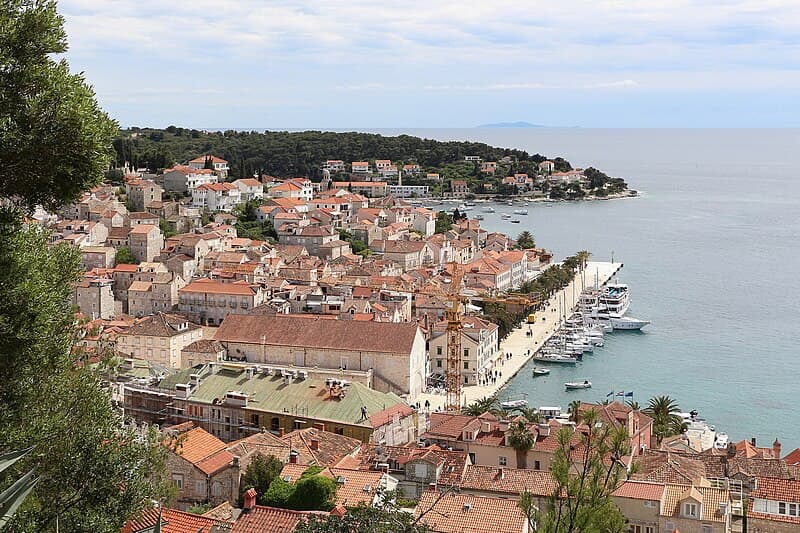
A hilltop fortress 100 m above the town, built by the Venetians in the 16th century. It served as a refuge for residents during Ottoman attacks, and its cistern and prison are still visible today. The ramparts give the best view over Hvar's harbour and the scattered Pakleni Islands.

Tip: A steep path through agaves leads up in 20 minutes, or you can drive up via the bypass road. Go 1 hour before sunset; the fortress stays open after dark, and the illuminated town below is reason enough to linger.

Admission:
from €10
Time needed:
1.5 h
St Stephen's Square and Cathedral

St Stephen's Square and Cathedral

Hvar Town

The largest square in Dalmatia, 4,500 square metres of limestone paving, opening straight onto the harbour. At its far end stands a Renaissance cathedral with a bell tower whose windows multiply with each storey, making the building look lighter the higher you look.

Tip: The square is the only one in Dalmatia with no shade — you can't cross it at midday. Cafés on the north side sit in the arcade's shade from 11am, those on the south side not until evening.

Admission:
cathedral free
Time needed:
1 h
Arsenal and Theatre

Arsenal and Theatre

Hvar Town

A 13th-century Venetian shipyard, with a theatre built into its upper floor in 1612 — one of the oldest communal theatres in Europe, open to nobility and commoners alike. Galleys were repaired on the ground floor, sailing in beneath the arch.

Tip: The theatre was closed for a long refurbishment and its opening hours keep changing — check with the tourist office on the square before heading over. The arsenal's archway is open to walk through even outside visiting hours.

Admission:
from €6
Time needed:
45 min
Pakleni Islands

Pakleni Islands

2 km from the harbour

An archipelago of 21 uninhabited islets 10 minutes by boat from Hvar's harbour, with pines reaching down to the water and coves of crystal-clear sea. Palmižana has a marina and restaurants; Jerolim and Stipanska are more laid-back and partly nudist.

Tip: Water taxis run continuously from the harbour, and the last return trip is usually around 7pm — confirm the time with the boatman, or you'll be stuck on the island overnight. Palmižana has drinking water; the other islets have none.

Admission:
boat from €10 return
Time needed:
half a day
Stari Grad Plain

Stari Grad Plain

Stari Grad, 20 km

Farmland parcelled out by Greek colonists from Sicily in the 4th century BC into rectangular plots divided by stone walls. The layout hasn't changed in 23 centuries, and the fields are still farmed today — it's the best-preserved ancient land division in the Mediterranean and a UNESCO World Heritage Site.

Tip: A signposted cycle path crosses the plain, and cycling it is the only way to grasp its scale — from the main road by car it just looks like vineyards. Bikes can be hired near the harbour in Stari Grad.

Admission:
free
Time needed:
2–3 h
Stari Grad

Stari Grad

20 km north-east

Croatia's oldest town, founded by the Greeks in 384 BC as Pharos. It's a quiet harbour with stone lanes, the Renaissance estate of the poet Petar Hektorović, and his fish pond at the centre of a walled garden.

Tip: Ferries from Split dock at Stari Grad, not Hvar Town — it's another 2 km from the ferry port into town, and 20 km on to Hvar. A connecting bus meets the ferries, but only the main sailings.

Admission:
Hektorović's estate from €6
Time needed:
half a day
The lavender fields and Velo Grablje

The lavender fields and Velo Grablje

10 km east

In the 1960s Hvar was Europe's largest producer of lavender oil, and the terraced inland fields remain today. The village of Velo Grablje, from which the lavender was once exported, now has just a handful of permanent residents and hosts a lavender festival every June.

Tip: Lavender blooms from mid-June to mid-July; outside that window the fields are just grey-green shrubs. Buy the oil from growers in the villages, not from stalls at the harbour, which is often diluted.

Admission:
free
Time needed:
2 h
Sveta Nedjelja vineyards

Sveta Nedjelja vineyards

25 km south-east

Croatia's steepest vineyard, on a southern slope beneath a cliff where Plavac Mali is grown on terraces above the sea at a gradient of more than 40 degrees. Above the village is a cave with prehistoric finds, once home to Augustinian hermits.

Tip: The village is reached through the Pitve–Zavala tunnel, a single-lane, unlit passage carved into the rock — you wait at the entrance for oncoming traffic. There's no bus; you'll need a car or a boat.

Admission:
tasting from €15
Time needed:
half a day
Dubovica Beach

Dubovica Beach

8 km east

A pebble cove 8 km east of the town beneath a steep slope, with a stone house right on the shore and exceptionally clear water. It's one of the island's most photographed beaches and visible from the old road above it.

Tip: A stony path leads down from the road in about 10 minutes, and the roadside parking fills up by 10am. Arrive before 9am or after 5pm, when the beach empties out.

Admission:
free
Time needed:
half a day

Photos: Fortica Fortress — Quahadi Añtó 17:13, 26 November 2015 (UTC) (CC BY-SA 3.0) · St Stephen's Square and Cathedral — Tomeq183 (CC BY-SA 3.0) · Arsenal and Theatre — Schorle (CC BY-SA 3.0) · Pakleni Islands — User: Stop_The_Lies (Public domain) · Stari Grad Plain — Carsten Steger (CC BY-SA 4.0) · Stari Grad — Rplevak (CC BY-SA 4.0) · The lavender fields and Velo Grablje — Martin Brož (CC BY 3.0) · Sveta Nedjelja vineyards — Falk2 (CC BY-SA 4.0) · Dubovica Beach — Falk2 (CC BY-SA 3.0 de)

Where to stay

Areas and districts, matched to the kind of trip you are taking

Hvar Town

Best for: a first visit, nightlife and boats

The harbour, with the main square, the fortress and the island's best choice of restaurants and bars. Water taxis to the Pakleni Islands and catamarans to Split leave from here. Accommodation is the most expensive in Croatia, and in season the noise from the harbourside bars runs until 2am.

Stari Grad

Best for: peace and quiet, and ferries

The island's oldest town, in a deep sheltered bay where the car ferries dock. Prices here are about half those in Hvar, evenings are quiet, and the ancient plain lies just outside town. It's 20 km to Hvar over the ridge, with several buses a day.

Jelsa and Vrboska

Best for: families and natural beaches

2 neighbouring resorts on the island's north side, with pines down to the water and shallower coves than elsewhere on Hvar. Vrboska has a church converted into a fortress and a canal that earns it the nickname "Little Venice". Quieter and cheaper than Hvar Town.

Zavala and the south slope

Best for: vineyards and getting away from it all

The southern side of the island beneath the ridge, reached through a single-lane tunnel cut into the rock. There are vineyards, a handful of apartments, and coves with no one around. It's unworkable without a car, and there's nowhere to go in the evening, but for peace and sea it has no rival on the island.

Getting around

From the airport

Hvar has no airport; flights go to Split, and the journey continues by sea. The Krilo and Jadrolinija catamarans sail from Split direct to Hvar Town in 1 hour, but take foot passengers only, and they sell out in high season. Car ferries run from Split to Stari Grad in 2 hours, and from Drvenik on the Makarska Riviera to Sućuraj on the island's eastern tip in 25 minutes. From Stari Grad it's another 20 km to Hvar, with a connecting bus for the main sailings.

Split (Resnik, Kaštela) + boat (SPU) · 24 km

  • Airport bus to Split harbour, then catamaran· 2 h total· €20
  • Split–Stari Grad car ferry· 2 h crossing· €7 per person, €40 per car
  • Drvenik–Sućuraj ferry· 25 min crossing· €5
  • Water taxi from Split· 1 h 30 min· €300

Around town

Hvar Town is pedestrian, and cars aren't allowed into the centre — park in the paid car park above the town. Buses run around the island between Hvar, Stari Grad, Jelsa and Sućuraj, but only a few times a day and barely at all on Sundays — touring the island by bus is hard going. A car or scooter is therefore the sensible choice for day trips around the island. Water taxis to the Pakleni Islands run continuously from the harbour, morning until evening.

Island busHvar – Stari Grad – Jelsa – Sućuraj, only a few services a day, almost none on Sundays. · €4
Water taxi to the Pakleni IslandsRuns continuously from Hvar's harbour; confirm the last return trip with the boatman. · €10 return
Scooter or quad bike hireThe most practical option for the island's roads; permitted through the Pitve–Zavala tunnel. · €35/day
Car hireNeeded for the southern slope and the eastern part of the island; parking in Hvar Town is paid and limited. · €50/day

Useful apps: Google Maps, Jadrolinija, Bolt, Arriva Croatia

When to go

Hvar has the mildest climate of the Croatian islands, and the season starts earlier here than on the mainland — swimming is possible from mid-June right through to mid-October. June is best, when the lavender is in bloom and prices haven't yet spiked, along with September, when the sea is warmest and the grape harvest is under way. July and August bring packed catamarans, accommodation prices doubling, and a harbour crowded with yachts. In winter most hotels close and the island falls quiet.

Best time

June for the lavender and September for the sea

What to avoid

August, for the prices and fully booked crossings

MonthJanFebMarAprMayJunJulAugSepOctNovDec
Day12°12°14°18°22°27°30°30°26°21°17°13°
Night7°7°8°11°15°19°22°22°19°15°12°9°
Rainy days98887523681010
Sea15°14°14°16°19°23°25°26°24°22°19°17°

Food & drink

Hvar's cuisine is built on fish, olive oil and wine. The local speciality, gregada, is the oldest way of preparing fish in the Adriatic: white fish simmered with potato and onion, without tomatoes. The island is also a wine region — Plavac Mali from the southern slopes of Sveta Nedjelja and Ivan Dolac ranks among Croatia's best reds. Restaurants in the harbour are expensive and aimed at yachters; the konobas in the inland villages of Velo Grablje, Vrisnik and Dol cook just as well for half the price.

What to try

Gregada

The oldest way of preparing fish in the Adriatic: white fish simmered with potatoes, onion and white wine, without tomatoes. Made on Hvar and the surrounding islands.

Peka

Meat and potatoes slow-cooked for 3 hours under a cast-iron bell covered in hot embers. Arguably the best Croatian dish there is, but it's ordered a day ahead and for at least 2 people.

Plavac Mali

A robust red wine from southern Dalmatia, related to Zinfandel. The best sites are Dingač and Postup on the Pelješac peninsula and Sveta Nedjelja on Hvar; it often exceeds 15% alcohol.

Crni rižot

Risotto with octopus or cuttlefish, coloured black with cuttlefish ink. It tastes of the sea and reliably stains your teeth — skip the white T-shirt.

Škampi na buzaru

Prawns cooked in white wine, garlic and breadcrumbs, eaten with your hands. Order it where they put a bowl for the shells and a wet wipe on the table — a sign they do it properly.

Pršut and Pag cheese

Dry-cured ham from Dalmatia or Istria, and a hard sheep's cheese from the island of Pag, where the sheep graze on grass salted by the bura wind. A standard cold starter with a glass of wine.

Brudet

A thick fish stew made from several kinds of fish with tomatoes, served with polenta. A fisherman's dish made from whatever didn't sell that day, so it's a little different each time.

Fritule

Small fried doughnuts with raisins and lemon zest, dusted with sugar. Sold in paper cones along the promenade and the cheapest dessert on the coast.

What it costs

Coffee on the square

€4–5

Lunch at an inland konoba

€15–20

Dinner in the harbour

€40–55 per person

Beer, 0.5 l

€5–6

Water taxi to the Pakleni Islands

from €10 return

Fortica fortress

from €10

Wine tasting at a winery

from €15

Night in a 4-star hotel

€160–260

Indicative prices that change over time — treat them as a guide, not a price list.

Practical information

SocketsCEuroplug, two round pinsFSchuko
Voltage230V / 50Hz
Tap waterTap water is drinkable — Tap water is safe to drink throughout Croatia and tastes good; on the coast it comes from karst springs. There's no point buying bottled water — just fill a bottle at your apartment in the morning. Restaurants, however, don't normally offer tap water and charge for bottled.
TippingTipping is customary but modest: round up in a café, and give around 10% in a restaurant for good service. Card machines usually have no tip option, so it's worth carrying a little cash. In taxis, just round up.
Driving on theright
SafetyThe Croatian coast is among the safest in Europe, and pickpocketing is rare even in high season. The real risks lie elsewhere: beaches are made of sharp limestone pebbles, and sea urchins live in the shallows, so water shoes aren't a luxury. The bura wind can pick up within the hour and sweep swimmers and inflatables off course, while the afternoon maestral carries sunloungers off the shore. Jumping into the water from cliffs without checking the depth is the most common cause of injuries here needing an ambulance. The single European emergency number 112 works, and operators speak English.
Opening hoursIn season, shops in the resorts open from 8am to 10pm, including Saturdays. On Sundays the law requires most shops to close — they may open on only 16 Sundays a year, chosen by the retailer, so bakeries, newsagents and petrol-station kiosks stay open while supermarkets don't. Sunday shopping needs to be done on Saturday instead. Restaurants and cafés aren't affected by the rule.
Customs & etiquetteSwimwear belongs on the beach — walking around in swimwear or without a shirt in town centres is finable under municipal bylaws in Croatia, and Dubrovnik, Split and Hvar do actually issue fines, starting at €100. Cover shoulders and knees in churches. Croatians are proud to be Croatian, not "former Yugoslavia"; don't be the one to bring up the 1990s war. Breakfast is light, lunch is around 2pm and dinner after 8pm.
A few local wordsHello — Dobar danThank you — HvalaPlease — MolimThe bill, please — Račun, molimCheers — Živjeli

How to plan your days

1 day

A day in Hvar

  1. 1Morning at St Stephen's Square, the cathedral and the arsenal.
  2. 2Lunch in a lane above the harbour, not on the square.
  3. 3Afternoon water taxi to the Pakleni Islands for a swim.
  4. 4Climb up to Fortica Fortress before sunset.
  5. 5Dinner and an evening at the bars by the harbour.

2 days

2 days with the ancient plain

  1. 1Day 1 as above.
  2. 2Morning bus or drive to Stari Grad.
  3. 3Hektorović's estate and a walk through the stone lanes.
  4. 4Afternoon cycling across Stari Grad Plain among the Greek walls.
  5. 5Return via Jelsa, dinner at an inland konoba.

3 days

3 days with wine and southern coves

  1. 1First 2 days as above.
  2. 2Morning drive through the Pitve–Zavala tunnel to the island's south side.
  3. 3Plavac Mali tasting in Sveta Nedjelja above the terraced vineyards.
  4. 4Afternoon swim at Dubovica cove on the way back.
  5. 5If time allows, a boat trip the next day to Vis and the Blue Cave.

Day trips

Vis and the Blue Cave

40 km · 2 h by boat

An island that was a Yugoslav military base closed to tourists until 1989, which kept it undeveloped. Next to it lies the islet of Biševo with the Blue Cave, where sunlight reflecting off the seabed makes the water glow around midday. Entry to the cave is regulated by the authorities, and trips don't run when the sea is rough.

Brač and Zlatni Rat

25 km · 1 h by boat to Bol

A neighbouring island with a pebble spit near Bol, whose tip changes shape with the wind and currents. In summer a direct catamaran runs between Jelsa and Bol, so it can be done in a day. Above Bol rises Vidova Gora, the highest peak on the Adriatic islands.

Korčula

45 km · 1 h 30 min by catamaran

A fortified town built on a fishbone street plan designed to break the bura wind while still letting in the summer breeze. The reputed birthplace of Marco Polo has its own museum. The island is a wine region, and its white Pošip and Grk varieties aren't found elsewhere.

Frequently asked questions

How do I get to Hvar from Split?+

The Krilo or Jadrolinija catamaran sails direct to Hvar Town in 1 hour, but foot passengers only — they don't take cars, and in high season they sell out a day ahead. With a car, take the ferry to Stari Grad; the crossing takes 2 hours, and it's then another 20 km to Hvar.

Do I need a car on Hvar?+

If you're staying in Hvar Town and only want the beaches and the Pakleni Islands, no. For Stari Grad Plain, the southern vineyards and the eastern part of the island, yes — buses run only a few times a day and almost not at all on Sundays. A scooter or quad bike is an alternative.

When does the lavender bloom on Hvar?+

From mid-June to mid-July, peaking around the end of June. The lavender festival takes place in Velo Grablje at that time. Outside this period the fields are just grey-green shrubs, so anyone travelling for the lavender needs to time it right.

Is Hvar expensive?+

It's the most expensive Croatian island, especially Hvar Town, where prices match the yachting crowd. Dinner in the harbour costs €40–50 per person. In Stari Grad, Jelsa and the inland villages, prices are roughly half for the same quality.

What are the beaches like on Hvar?+

Pebbly and rocky — there's practically no sand. The prettiest are Dubovica in the south and the coves on the Pakleni Islands, reached by boat. Shallower, more child-friendly beaches lie around Jelsa and Vrboska on the island's northern side.

Is a trip to the Pakleni Islands worth it?+

Yes, it's the main reason to stay in Hvar Town. Water taxis run continuously from the harbour, the crossing takes 10–20 minutes, and the pine-fringed coves are cleaner than the town beaches. Always confirm the last return trip with the boatman.

Is it true that Hvar refunds guests if it snows?+

It was a marketing guarantee from hotels of the last century, and some accommodation still references it today; it rests on Hvar getting more than 2,700 hours of sunshine a year. Snow falls here once in many years and never settles.

How many days are enough for Hvar?+

2 days for the town, its fortress and the Pakleni Islands. Anyone wanting to see Stari Grad Plain, the southern vineyards and Jelsa needs 4–5 days, ideally with a car. For a week's beach holiday the island is big enough not to feel repetitive.

Visa Requirements

Check the latest visa requirements for entering this country. Some nationalities may need to apply for a visa or e-visa before travel.

Check visa requirements

Language

Croatian

Currency

EUR

Timezone

Europe/Zagreb

Dial Code

+385

Population

3.9M

Area

56,594 km²

Voltage

230V / 50Hz

Driving Side

Right

Top Hotels in Hvar

Live prices from 500+ properties

Loading hotels...

Planning a trip to Hvar?

Compare hundreds of hotels, find the best price, and book with free cancellation on TravelManiac.