Hotels in Poreč

Byzantine mosaics and pine-shaded lagoons

Poreč

LanguageCroatian
CurrencyEUR
TimezoneEurope/Zagreb
Temperature8-28 °C
Dial Code+385
Population3.9M
Area56,594 km²
SocketsType C / Type F
Tap waterDrinkable

Discover Poreč

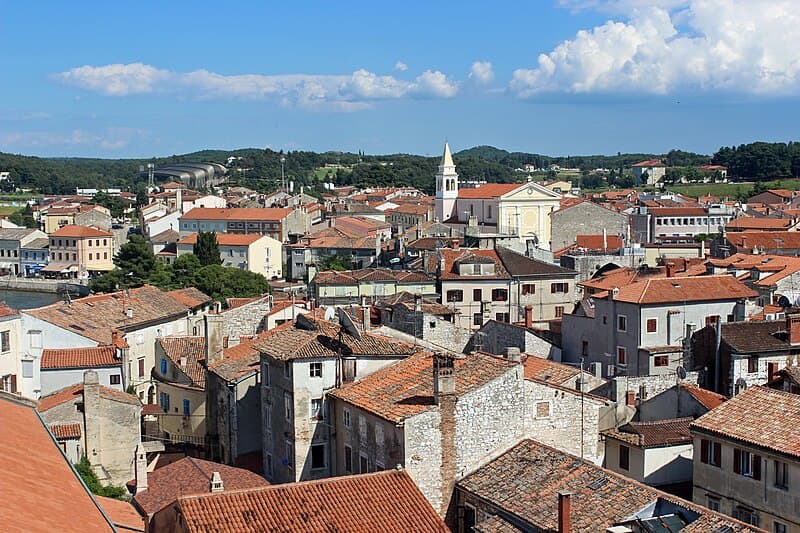
Poreč is Istria's most visited resort town and also home to the peninsula's most valuable monument — the sixth-century Euphrasian Basilica, whose apse is lined with Byzantine mosaics of gold and glass and is listed as a UNESCO World Heritage Site. The old town sits on a narrow peninsula that still follows its Roman layout, with a main axis (decumanus) and a cross street (cardo), so you walk streets that are two thousand years old. But the tourist activity happens outside it: south of town stretches a band of lagoons — Zelena, Plava, and Bijela — with hotel complexes, pools, cycling paths, and pine trees reaching down to the water. The beaches are rocky and concrete, not sandy, but the sea is clean and the entry points are fitted with steps. Pula airport is fifty-six kilometers away, Trieste two hours by car.

What to see

The places worth your time in Poreč, and what to expect at each

Euphrasian Basilica

Euphrasian Basilica

Old town

An early Christian complex from the sixth century with a baptistery, bishop's palace, and atrium, whose apse is covered in Byzantine mosaics of gilded glass. Beneath the floor you can see mosaics from an even older, fourth-century basilica. It's the best-preserved complex of its kind in the Mediterranean after Ravenna.

Tip: The ticket also includes the climb up the bell tower, from which you can see the whole peninsula and Sveti Nikola island — most visitors leave after the mosaics and skip the climb. The mosaics photograph best in the morning, when light enters the apse from the east.

Admission:
from 10 €
Time needed:
1.5 h
Marafor and the Roman temples

Marafor and the Roman temples

Old town

The former Roman forum at the tip of the peninsula, today a quiet square with the remains of the Temple of Neptune and the foundations of the Temple of Mars at its edge. It's the only place in town where the ancient layer sits directly on the surface, not buried under later buildings.

Tip: Around Marafor are the best places in the old town, since the crowds from the main street rarely make it here. In the evening, summer films are projected onto the stone walls, with the schedule posted on the board at the square's entrance.

Admission:
free
Time needed:
45 min
Decumanus and the old town

Decumanus and the old town

Old town

The peninsula's main street, tracing the axis of a first-century Roman military camp and running from the land gate all the way to Marafor. It's lined with Venetian palaces with balconies, Romanesque houses, and passages down to the sea, including the Romanesque House with its thirteenth-century wooden balcony.

Tip: The peninsula is four hundred meters long and can be walked in twenty minutes, so it's worth taking the side lanes down to the sea and returning along the waterfront. The main street is busiest at noon and empty before nine in the morning.

Admission:
free
Time needed:
1.5 h
Zelena Laguna

Zelena Laguna

5 km south

The largest of the hotel lagoons, five kilometers south of town: a continuous stretch of pine forest with concrete and pebble beaches, pools, a marina, and a path running along the sea. The coastal promenade runs through it, connecting all the way to Poreč's center.

Tip: A tourist train runs into town along the promenade, and during the day a boat line also runs from the marina, which is more pleasant than the bus. Entry into the water is via steps from concrete platforms — water shoes help against sea urchins at the edges.

Admission:
free
Time needed:
full day
Sveti Nikola Island

Sveti Nikola Island

1 km from the waterfront

A wooded islet less than a kilometer from the waterfront, home to a hotel, a lighthouse, and a pine park. The beaches are rocky and concrete, but the water is cleaner than in town, and it offers the best view back at the Poreč peninsula with its basilica.

Tip: A boat leaves from the waterfront every half hour, and the crossing takes ten minutes. The island has only two establishments with prices to match; bringing your own food saves money, and you can find your own patch of rock on the north side.

Admission:
boat from 8 € return
Time needed:
half a day
Baredine Cave

Baredine Cave

8 km northeast

A karst cave eight kilometers northeast of town with five chambers reaching down sixty meters, flowstone formations, and an underground lake. It's home to the olm, a blind cave-dwelling amphibian that can live over a hundred years and survive years without food.

Tip: Down below it's a constant fourteen degrees and damp, so a sweater and grippy footwear aren't overkill even in August. Tours are guided and leave at fixed times; the last one is usually around six — check in advance.

Admission:
from 15 €
Time needed:
1.5 h
Lim Bay

Lim Bay

20 km south

A ten-kilometer-long narrow bay cutting inland between hundred-meter slopes, formed by the flooding of a river canyon. Oysters and mussels are farmed here and sold at konobas right on the shore; swimming is banned throughout the bay because of the farms.

Tip: The viewpoint from the road above the bay is free, and you can see the whole canyon from there; you only descend to the water at the restaurants near the end. Oysters are best in the winter months, while in summer mostly mussels are sold.

Admission:
free
Time needed:
2–3 h
Parenzana

Parenzana

from the center

A former narrow-gauge railway from Poreč through Grožnjan to Trieste, decommissioned in 1935 and now converted into a hundred-twenty-three-kilometer cycling trail running over viaducts and through tunnels into the inland hills. From Poreč it reaches both Vižinada and Motovun.

Tip: The first ten kilometers from Poreč are flat and easy, then the trail climbs into the hills — with kids, ride just the initial stretch and turn back. Bikes are rented in the lagoons and in town, and it's rideable even on a standard trekking bike.

Admission:
free
Time needed:
half a day
Vrsar

Vrsar

10 km south

A fishing town ten kilometers south, perched on a hill above its marina, with the church of St. Martin at the top and a maze of lanes below. According to his memoirs, Casanova visited twice, and the town still marks it with a festival. Eighteen small islands lie offshore.

Tip: Park down by the marina and walk up on foot — parking at the top is minimal. The Dušan Džamonja sculpture park, with its large-format works, sits right above town and is freely accessible at no charge.

Admission:
free
Time needed:
half a day

Photos: Euphrasian Basilica — Aquamunda (CC BY 4.0) · Marafor and the Roman temples — Maesi64 (CC0) · Decumanus and the old town — Disdero (CC BY-SA 3.0) · Zelena Laguna — istra1977 (CC BY 3.0) · Sveti Nikola Island — Marko Maras (CC BY 2.0) · Baredine Cave — Marcin Grochowski (CC BY-SA 3.0 pl) · Lim Bay — Aconcagua (talk) (CC BY-SA 3.0) · Parenzana — Herbert Ortner, Vienna, Austria (CC BY 2.5) · Vrsar — Ekaterina Polischuk (CC BY-SA 4.0)

Where to stay

Areas and districts, matched to the kind of trip you are taking

Old town on the peninsula

Best for: first visit and sightseeing

A four-hundred-meter-long peninsula with the basilica, the Roman street grid, and a waterfront on three sides. Accommodation is in apartments in old houses — there are almost no hotels here. Everything is walkable, evenings are lively around Marafor, cars are barred, and parking is at the entrance.

Zelena and Plava Laguna

Best for: hotels with pools and families

A band of pine forest five kilometers south of town with large hotel complexes, water parks, tennis courts, and a marina. A tourist train or boat runs into the center. The best choice for a week's holiday with kids, since all services are within the complex.

Špadići and Materada

Best for: campsites and cheaper apartments

The northern coast beyond town, with campsites, apartments, and quieter rocky beaches shaded by pines. It's a twenty-minute walk into the center along the coastal promenade. Prices are lower than in the lagoons, and it's closer to town than the southern side.

Vrsar and Funtana

Best for: calm and a smaller scale

Two smaller resorts ten kilometers south, with a marina, stone lanes on a hill, and fewer tourists than Poreč. The beaches are rocky, but it's a short hop to the Lim Bay from here. Without a car or bus, you can't reach Poreč from here.

Getting around

From the airport

The nearest airport is Pula, fifty-six kilometers south, served in season by charter and low-cost flights; the transfer takes just under an hour. An alternative is Trieste on the Italian side, two hours by car, with year-round service. By car from Prague it's roughly nine hundred kilometers via Vienna and Ljubljana, about ten hours — Istria is the quickest part of Croatia to reach. The Istrian Y-junction highway to Poreč splits off near Baderna.

Pula (PUY) · 56 km

  • Hotel transfer· 55 min· included in package
  • Scheduled bus via Pula· 1 h 45 min· 11 €
  • Taxi from the airport· 55 min· 90 €
  • Rental car from the airport· 55 min· 40 € / day

Trieste (Italy) (TRS) · 130 km

  • Rental car· 2 h· 45 € / day
  • Bus via Koper· 3 h· 20 €

Around town

The old town takes twenty minutes to walk and is pedestrian-only. From the hotel lagoons south of town, a tourist train runs into the center along the promenade, and in season a boat line also runs from the marina, which is the most pleasant connection. Poreč also happens to be Croatia's best town for cycling: bike paths run along the whole coast, and the Parenzana trail climbs inland from town. A car is needed only for trips to Motovun, Baredine Cave, and Pula.

Tourist trainFrom the lagoons to the waterfront along the coastal promenade, running continuously through the day in season. · 4 €
Boat line to the lagoonsFrom the Poreč waterfront to Zelena Laguna and Sveti Nikola island, every half hour. · 8 € return
BicycleCoastal paths and the Parenzana trail inland; rentals are available at every hotel complex. · 12 € / day
Rental carNeeded for Motovun, Grožnjan, and Pula; parking near the old town is paid. · 40 € / day

Useful apps: Google Maps, Jadrolinija, Bolt, Arriva Croatia

When to go

Istria's sea is cooler than Dalmatia's, and the season here is shorter — comfortable swimming runs from late June to mid-September, when the water is twenty-two to twenty-five degrees. June and September are best: warm, everything open, and the lagoons aren't packed. May and October belong to cyclists and inland sightseeing — the sea is too cold for swimming. Truffle season starts in September and peaks in October and November, when the inland konobas are at their most interesting.

Best time

June and September

What to avoid

August, due to crowded lagoons and high prices

MonthJanFebMarAprMayJunJulAugSepOctNovDec
Day9°10°13°17°22°26°29°29°24°19°14°10°
Night3°3°5°9°13°17°19°19°16°12°8°4°
Rainy days8778885578109
Sea11°11°12°14°18°22°24°25°23°19°16°13°

Food & drink

Istria cooks differently from the Dalmatian coast — closer to Italian cuisine, with an emphasis on the inland region. Truffles come from the Motovun forest, Istrian boškarin beef from the farms, and malvazija and teran wine from the vineyards. Homemade fuži and pljukanci pasta appear on every konoba's menu, usually with truffles or wild-game stew. Restaurants on the waterfront are pricier and aimed at tourists; konobas in the inland villages a few kilometers from town cook better and cheaper.

What to try

Istrian truffles

White truffles from the Motovun forest are foraged from September to January, black ones year-round. Grated over homemade fuži pasta, this is the most typical Istrian dish — watch out for cheap versions that rely on truffle oil instead.

Fuži and pljukanci

Homemade Istrian pasta: fuži are rolled diamond shapes, pljukanci are rolled strips. Served with wild-game stew, boškarin beef, or truffles.

Boškarin

Istrian grey cattle, a breed saved from extinction. The meat is slow-braised and full-flavored; on a menu it's a sign the kitchen is sourcing from the peninsula.

Malvazija and teran

Istrian white malvazija is dry, mineral, and ideal with fish; red teran is tart and pairs with cured ham (pršut). Both are also sold at wineries' self-service refill stations, by the demijohn.

Ston oysters

Oysters from the Bay of Mali Ston, farmed there since Roman times. Bought directly from the growers at the pier, cheaper than anywhere else in the Mediterranean.

Maneštra

A thick Istrian soup of beans, corn, and smoked meat, close to minestrone. In winter it's a main dish; in summer only a few konobas make it.

Škampi na buzaru

Prawns braised in white wine, garlic, and breadcrumbs, eaten with your hands. Order it where they bring a shell bowl and a wet napkin to the table — a sign it's made properly.

Kroštule

Fried ribbons of dough dusted with sugar, the Istrian version of angel wings. Made for weddings and pilgrimage feasts, and only fresh in bakeries in the morning.

What it costs

Coffee on the waterfront

2.50–3.50 €

Lunch at a bistro

10–15 €

Dinner at a konoba with truffles

30–45 € per person

Beer, 0.5 l

3.50–4.50 €

Sunbed and umbrella

12–18 € for two sunbeds

Euphrasian Basilica with bell tower

from 10 €

Baredine Cave

from 15 €

Night at a 4-star hotel

110–170 €

Indicative prices that change over time — treat them as a guide, not a price list.

Practical information

SocketsCEuroplug, two round pinsFSchuko
Voltage230V / 50Hz
Tap waterTap water is drinkable — Tap water is drinkable throughout Croatia and tastes good; on the coast it comes from karst springs. There's no point buying bottled water — just fill a bottle at your apartment in the morning. In restaurants, though, tap water isn't normally offered, and bottled water is charged for.
TippingTipping is customary but modest: at a cafe you round up, at a restaurant around ten percent is given for good service. Card terminals usually don't have a tip option, so it helps to have a bit of cash on hand. In taxis, you just round up.
Driving on theright
SafetyThe Croatian coast is among the safest in Europe, and pickpocketing is rare even in season. The real risks lie elsewhere: beaches are made of sharp limestone pebbles, and sea urchins live in the shallows, so water shoes aren't a luxury. The bura wind can pick up within an hour and knock even experienced swimmers off inflatables; the afternoon mistral carries sunbeds off the shore. Diving into water from cliffs without checking the bottom is the most common cause of injuries that call for an ambulance here. The single European emergency number 112 works, and operators speak English.
Opening hoursShops in the resorts are open in season from eight in the morning until ten at night, including Saturdays. On Sundays, a law requires most shops to stay closed — they may open only sixteen Sundays a year, chosen by the retailer, so bakeries, newsstands, and gas station kiosks operate while supermarkets don't. Sunday shopping should therefore be done on Saturday. Restaurants and cafes aren't affected by the closure law.
Customs & etiquetteSwimwear belongs on the beach — walking around town centers in a swimsuit or without a shirt is fined under municipal bylaws in Croatia, and in Dubrovnik, Split, and Hvar these fines are genuinely collected, starting at one hundred euros. Cover shoulders and knees when visiting churches. Croatians take pride in being Croatian, not 'former Yugoslavia'; don't be the one to bring up the war of the 1990s. Breakfast is light, lunch is around two in the afternoon, and dinner after eight.
A few local wordsHello — Dobar danThank you — HvalaPlease — MolimThe bill, please — Račun, molimCheers — ŽivjeliGoodbye — Doviđenja

How to plan your days

1 day

A day in Poreč

  1. 1Morning at the Euphrasian Basilica, with a climb up the bell tower.
  2. 2A walk along the decumanus and side lanes down to the sea.
  3. 3Lunch near Marafor at the tip of the peninsula.
  4. 4Afternoon boat trip to Sveti Nikola island for a swim.
  5. 5Evening on the waterfront and dinner at a konoba off the main street.

2 days

Two days with caves and the bay

  1. 1Day one as outlined above.
  2. 2Morning at Baredine Cave and its underground lake.
  3. 3Lunch at an inland konoba with homemade fuži.
  4. 4Afternoon at the Lim Bay viewpoint, with mussels on the shore.
  5. 5Return via Vrsar and its sculpture park.

3 days

Three days with the interior

  1. 1The first two days as outlined above.
  2. 2Morning cycling the Parenzana trail into the inland hills.
  3. 3Or drive to Motovun above the truffle forest and on to Grožnjan.
  4. 4Malvazija wine tasting at a winery on the way back.
  5. 5If time remains, the amphitheater in Pula on an extra day.

Day trips

Rovinj

38 km · 40 min by car

Istria's most photogenic town: houses rising straight out of the sea, topped by the bell tower of St. Euphemia. The old town is a peninsula of cobbled lanes lined with painters' studios. In season, an excursion boat also runs there along the coast from Poreč.

Motovun and Grožnjan

35 km · 40 min by car

Two fortified hilltop towns above the Mirna valley. Motovun sits above the forest where white truffles are hunted, and its walls offer views over the whole interior. Grožnjan is a village of artists, with galleries in nearly every other house and a summer music school.

Pula

56 km · 55 min by car

A Roman amphitheater seating twenty thousand spectators, the sixth-largest in the world and the only one with all four towers surviving intact. It hosts summer concerts and a film festival. The city also has the Temple of Augustus and the Arch of the Sergii, both from the first century.

Frequently asked questions

Does Poreč have sandy beaches?+

No. The beaches are rocky, with concrete slabs and steps into the water, and in places pebbly. Entry points have ladders and showers, so swimming is comfortable, but don't expect sand. The best swimming is in the lagoons south of town, in the shade of pine trees.

What is the Euphrasian Basilica, and is it worth the entry fee?+

An early Christian complex from the sixth century whose apse is lined with Byzantine mosaics of gilded glass, listed as a UNESCO World Heritage Site. After Ravenna, it's the best-preserved complex of its kind in the Mediterranean. The ticket also includes the bell tower, with a view over the peninsula.

How do I get from the hotel lagoons into town?+

On foot along the coastal promenade in forty-five minutes, by the tourist train that runs continuously, or by boat from the marina in Zelena Laguna every half hour. The boat is the most pleasant option and also the fastest. You can't drive into the center — the old town is pedestrian-only.

Is Poreč suitable for families with children?+

Yes, the lagoons are built for exactly that: hotel complexes with pools, water parks, kids' activity programs, and shallow entry points into the sea. The downside is the rocky beaches, so water shoes are practically essential for children. You get into town by tourist train or boat.

When is truffle season in Istria?+

White truffles from the Motovun forest are foraged from September to January, peaking in October and November; black truffles are foraged year-round. In the main summer season, most restaurants therefore work with frozen or preserved truffles, which shows in both flavor and price.

Can you swim in the Lim Bay?+

No, swimming is banned throughout the bay because of the oyster and mussel farms. People come here for the viewpoint from the road above the canyon and for lunch at the konobas on the shore, where seafood is sold directly by the farmers. The ban is enforced and fined.

Do I need a car in Poreč?+

Not for staying in the lagoons — the tourist train and boat run into town, and cycling paths run along the coast. A car pays off for trips to Motovun, Grožnjan, Baredine Cave, and Pula, which buses reach only a few times a day and with a transfer.

How many days are enough for Poreč?+

The old town alone can be seen in half a day. It makes sense to treat Poreč as a base for a week: the lagoons for swimming, the Parenzana trail for cycling, and inland towns for wine and truffles as day trips. Istria is small, and everything is within an hour's drive.

Visa Requirements

Check the latest visa requirements for entering this country. Some nationalities may need to apply for a visa or e-visa before travel.

Check visa requirements

Language

Croatian

Currency

EUR

Timezone

Europe/Zagreb

Dial Code

+385

Population

3.9M

Area

56,594 km²

Voltage

230V / 50Hz

Driving Side

Right

Top Hotels in Poreč

Live prices from 500+ properties

Loading hotels...

Planning a trip to Poreč?

Compare hundreds of hotels, find the best price, and book with free cancellation on TravelManiac.