Hotels in Rovinj

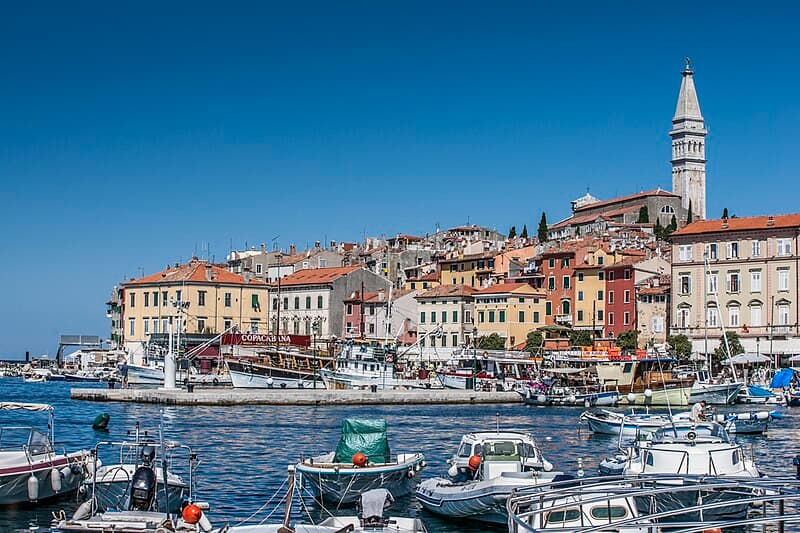
Houses rising straight out of the sea

Rovinj

LanguageCroatian
CurrencyEUR
TimezoneEurope/Zagreb
Temperature8-28 °C
Dial Code+385
Population3.9M
Area56,594 km²
SocketsType C / Type F
Tap waterDrinkable

Discover Rovinj

Rovinj is the most photogenic town on the Croatian coast, and the reason is specific: until 1763 the old town was an island, and its buildings had to grow upward because there was nowhere to expand outward. As a result, houses stand right in the water with no proper quay, the lanes are narrow because of the bora wind, and above it all rises the 62-metre bell tower of St. Euphemia, modelled on Venice's San Marco. Rovinj was Venetian for five centuries, Italian is spoken here as a second official language, and signs are bilingual. Around the town lies Zlatni rt park with pines and oak forest, and off the coast are fourteen islets reachable by a ten-minute boat ride. The beaches are rocky and concrete, but the water is clear and pine shade reaches right to the water's edge. Pula airport is forty kilometres away.

What to see

The places worth your time in Rovinj, and what to expect at each

Church of St. Euphemia

Church of St. Euphemia

Old town

A baroque church at the highest point of the old town, with a 62-metre bell tower topped by a copper statue of the saint that turns with the wind and serves fishermen as a weathervane. Inside is the sarcophagus of St. Euphemia, which legend says floated to Rovinj across the sea by itself.

Tip: The bell tower is climbed via a wooden staircase open on the sides and visibly old — not for anyone afraid of heights. From the top you can see the whole Istrian coast and, on a clear day, even the Alps.

Admission:
bell tower from 5 €
Time needed:
1 h
Grisia

Grisia

Old town

The old town's main lane climbs from the square to the church, and along its whole length painters hang their works directly on the house walls. On the second Sunday of August an open-air exhibition fills the lane with canvases as several hundred artists arrive.

Tip: The paving is polished stone and gets slippery as ice after rain or in smooth-soled sandals — walk carefully, preferably along the edges. Before 9am the lane is empty and photographs best.

Admission:
free
Time needed:
1 h
Balbi's Arch and the main square

Balbi's Arch and the main square

Old town

A baroque gate from 1680 on the site of the original town gate, decorated with the Venetian winged lion and, on the outer and inner faces, the heads of a Turk and a Venetian. It leads from the main square into the old town and is the only surviving entrance of the original seven gates.

Tip: Next to the arch stands the town clock tower, and every morning a market spreads out beneath it selling fruit, olive oil and lavender. Vendors serve locals until about 10am, then switch over to souvenirs.

Admission:
free
Time needed:
45 min
Zlatni rt park

Zlatni rt park

1.5 km south

A forest park on the peninsula south of the old town, planted in the nineteenth century by Austrian industrialist Georg Hütterott: cedars, cypresses and pines across ninety hectares, interspersed with rocky coves and a seafront promenade. There's also a climbing area on the rock face.

Tip: Cars aren't allowed into the park; it's reached on foot or by bike, twenty minutes from the centre. The coves on the south side stay shaded all afternoon and are less crowded than the beaches near the entrance.

Admission:
free
Time needed:
half a day
Crveni otok (Red Island)

Crveni otok (Red Island)

3 km from the harbour

A pair of connected islets — Sveti Andrija and Maškin — fifteen minutes by boat from the harbour, with a hotel, pine forest and a loop trail around the perimeter. On Sveti Andrija stands a Benedictine monastery converted into a mansion, set in a park of exotic trees.

Tip: Boats leave Rovinj's harbour every hour and the last return crossing is usually around 7pm — miss it and you're stuck on the island. Maškin island is wilder, with no hotel and calmer rocky entry points into the water.

Admission:
boat from 8 € return
Time needed:
full day
Batana Eco-Museum

Batana Eco-Museum

Waterfront

A small museum dedicated to the batana — the flat-bottomed wooden boat used for fishing in Rovinj for centuries, inscribed on the UNESCO list of intangible heritage. On display are boats, tools and recordings of bitinada, the local unaccompanied multi-part singing tradition.

Tip: In summer the museum runs evening batana boat cruises with dinner at the Spacio quay and bitinada singing — only two or three outings a week with limited capacity, so book ahead.

Admission:
from 5 €
Time needed:
1 h
Mulini and Lone beaches

Mulini and Lone beaches

1 km south

Two developed beaches at the start of Zlatni rt park, a ten-minute walk from the old town: concrete platforms and pebbles with steps into the water, showers and beach bars. From Mulini you can see the old town and bell tower — the best view in Rovinj at sunset.

Tip: Both fill up by 10am. For more calm, continue further into the park to rocky entry points with no facilities but pine shade all day. Sea urchins are everywhere, so water shoes are a must.

Admission:
free, sunbeds from 15 €
Time needed:
full day
Palud Reserve

Palud Reserve

8 km south

Istria's only ornithological reserve, eight kilometres south of town: a shallow freshwater lagoon separated from the sea by a dune strip that Austrians dug as a drainage canal. Over two hundred and twenty migratory bird species stop here.

Tip: The reserve has two wooden observation towers and free entry. Best visited March to May and in September during bird migration; in summer the lagoon is largely dried out and mosquitoes are a nuisance, so repellent is essential.

Admission:
free
Time needed:
2 h
Harbour and fish market

Harbour and fish market

Waterfront

The waterfront between the old town and the marina, where fishing boats dock in the morning and the day's catch is sold in the hall at the old town's entrance. Boats to the islands and Lim Bay depart from here, and in the evening it becomes the town's main promenade.

Tip: The fish market winds down around 11am and the best catch is gone by nine. If you're cooking in your apartment, buy fish here for a third of restaurant prices; vendors will gut it for free on request.

Admission:
free
Time needed:
1 h

Photos: Church of St. Euphemia — Berthold Werner (CC BY-SA 3.0) · Grisia — This Photo was taken by Miha Peče. Feel free to use my photos, but please mention me as the author. I would much appre (CC BY-SA 4.0) · Balbi's Arch and the main square — David Orlovic (CC BY-SA 3.0) · Zlatni rt park — Ivana (CC BY-SA 3.0) · Crveni otok (Red Island) — Branko Radovanović (CC BY-SA 4.0) · Batana Eco-Museum — Roberta F. (CC BY-SA 3.0) · Mulini and Lone beaches — Silverije (CC BY-SA 4.0) · Palud Reserve — Miljenko 1960 (CC BY-SA 4.0) · Harbour and fish market — Roberta F. (CC BY-SA 3.0)

Where to stay

Areas and districts, matched to the kind of trip you are taking

Old town

Best for: a first visit and the atmosphere

A former island with narrow lanes climbing toward the bell tower, where houses stand right in the water. Accommodation is in apartments in old houses, often without air conditioning and with luggage carried up stairs. No cars allowed. In return, you step out your door onto Grisia with the sea beneath your windows.

Zlatni rt and the southern coast

Best for: swimming and shade

The strip between town and the park, with hotels, the Mulini and Lone beaches, and a promenade under the pines. Ten to twenty minutes on foot to the centre along the sea. The best combination of beaches and proximity to the old town, though accommodation here is the most expensive in Rovinj.

Monsena and Valdaliso

Best for: resorts and campsites to the north

The northern coast, three kilometres from town, with large hotel complexes, campsites and naturist zones. The beaches are rocky and less crowded than near the park. A bus and tourist train run into town, or you can cycle the coastal path.

Rovinjsko Selo and the inland

Best for: cheaper apartments if you have a car

Villages and apartments a few kilometres from the sea, with noticeably cheaper accommodation and cooler nights. Without a car it doesn't make much sense, since the coast is five to ten kilometres away. In exchange, you'll find taverns that cook for locals.

Getting around

From the airport

The nearest airport is Pula, forty kilometres south, served by charter and low-cost flights in season; the transfer takes about forty minutes. The alternative is Trieste in Italy, two hours by car, with year-round service. Driving from Prague it's roughly nine hundred kilometres via Vienna and Ljubljana, about ten hours, making Rovinj and Istria as a whole the fastest-reached part of Croatia by road. Coming off the Istrian Y-motorway, you exit at Kanfanar.

Pula (PUY) · 40 km

  • Hotel transfer· 40 min· included in stay
  • Scheduled bus via Pula· 1 h 20 min· 9 €
  • Taxi from the airport· 40 min· 70 €
  • Rental car from the airport· 40 min· 40 € / day

Trieste (Italy) (TRS) · 135 km

  • Rental car· 2 h· 45 € / day
  • Bus via Koper· 3 h· 20 €

Around town

The old town is pedestrian-only; cars aren't allowed in, and parking is in paid zones on the edge, full by morning in August. Zlatni rt park and the beaches are reached on foot or by bike along the coastal path. Boats to Crveni otok and Sveta Katarina islands leave the harbour every hour. A car is only needed for trips to Pula, Motovun and the Palud reserve; otherwise buses around Istria run just a few times a day.

Boat to the islandsFrom the harbour to Crveni otok and Sveta Katarina every hour; the last boat back is usually around 7pm. · 8 € return
BicycleCoastal paths to the park and north to the resorts; rentals are available in the centre and at the resorts. · 12 € / day
Tourist trainFrom the centre to the northern resorts and the park, running throughout the day in season. · 4 €
Rental carNeeded for Pula, Brijuni and the inland towns; parking near the old town is paid. · 40 € / day

Useful apps: Google Maps, Jadrolinija, Bolt, Arriva Croatia

When to go

The Istrian sea is cooler than the Dalmatian one and the season shorter: comfortable swimming runs from late June to mid-September, when the water reaches 22–25°C. June and September are best, warm enough but without the old town's lanes becoming impassable. August means packed beaches, the highest prices, and parking as the main daily problem. May and October belong to cycling, the inland, and, from September, truffles.

Best time

June and September

What to avoid

August, because of crowds and parking

MonthJanFebMarAprMayJunJulAugSepOctNovDec
Day9°10°13°17°22°26°29°29°24°19°14°10°
Night3°3°5°9°13°17°19°19°16°12°8°4°
Rainy days8778885578109
Sea11°11°12°14°18°22°24°25°23°19°16°13°

Food & drink

Rovinj's cuisine is Istrian with Venetian influence: plenty of seafood, homemade pasta and truffles from the Motovun forest an hour away. Classics include scampi buzara-style, truffle risotto and white Malvazija from the surrounding vineyards. Restaurants on the waterfront and in the main lanes are expensive; taverns (konobas) in inland villages and in Rovinjsko Selo cook just as well for half the price. Always have fish priced by the kilogram beforehand, since it's charged by weight.

What to try

Scampi buzara-style

Prawns stewed in white wine, garlic and breadcrumbs, eaten with your hands. Order where they bring a bowl for the shells and a wet napkin to the table — a sign it's done properly.

Istrian truffles

White truffle from the Motovun forest is harvested from September to January, black truffle year-round. Grated over homemade fuži pasta, it's the most typical Istrian dish — watch out for cheap versions that rely on truffle oil instead.

Fuži and pljukanci

Homemade Istrian pasta: fuži are rolled diamond shapes, pljukanci are hand-rolled strips. Served with wild-game stew, with boškarin beef, or with truffles.

Malvazija and Teran

Istrian white Malvazija is dry, mineral and ideal with fish; red Teran is acidic and pairs with cured ham (pršut). Both are also sold on tap at winery filling stations, by the demijohn.

Crni rižot (black risotto)

Risotto with octopus or cuttlefish, coloured black with cuttlefish ink. It tastes of the sea and reliably stains your teeth — best not worn with a white shirt.

Boškarin

The Istrian grey ox, a breed saved from extinction. The meat is slow-cooked and full-flavoured; on a menu it signals that the kitchen sources from the peninsula.

Maneštra

A thick Istrian soup of beans, corn and smoked meat, close to minestrone. In winter it's a main course; in summer only a few taverns still make it.

Kroštule

Fried, sugared strips of dough, an Istrian cousin of angel wings pastries. Baked for weddings and church feasts, and only fresh in the morning at bakeries.

What it costs

Coffee on the waterfront

3–4 €

Lunch at a bistro

12–16 €

Dinner at a seaside restaurant

35–50 € per person

Beer, 0.5 l

4–5 €

Sunbed and umbrella

15–20 € for two sunbeds

St. Euphemia bell tower

from 5 €

Boat to Crveni otok

from 8 € return

Night in a 4-star hotel

140–220 €

Indicative prices that change over time — treat them as a guide, not a price list.

Practical information

SocketsCEuroplug, two round pinsFSchuko
Voltage230V / 50Hz
Tap waterTap water is drinkable — Tap water is safe to drink throughout Croatia and tastes good; on the coast it comes from karst springs. There's no need to buy bottled water — just fill a bottle at your apartment in the morning. Restaurants, however, don't usually offer tap water and will charge for bottled.
TippingTipping is customary but modest: in a café you round up, in a restaurant around ten percent for good service. Card terminals usually don't have a tip option, so it's worth carrying a little cash. In taxis, just round up.
Driving on theright
SafetyThe Croatian coast is among the safest in Europe, and pickpocketing is rare even in high season. The real risks are different: beaches are made of sharp limestone pebbles, and sea urchins live in the shallows, so water shoes aren't a luxury. The bora wind can rise within an hour and knock even experienced swimmers off inflatables, while the afternoon maestral carries sunbeds away from the shore. Jumping into the water from cliffs without checking the depth is the most common cause of injury for ambulance callouts here. The European emergency number 112 works and operators speak English.
Opening hoursShops in the resorts are open in season from 8am to 10pm, including Saturdays. On Sundays, a law requires most shops to close — they're only allowed to open sixteen Sundays a year, chosen by the retailer, so bakeries, newsstands and petrol-station kiosks operate but supermarkets don't. Plan Sunday shopping for Saturday instead. Restaurants and cafés aren't affected by the rule.
Customs & etiquetteSwimwear belongs on the beach — walking around town centres in swimwear or without a shirt is fined by municipal bylaw in Croatia, and in Dubrovnik, Split and Hvar fines are actually issued, starting around a hundred euros. Cover shoulders and knees when entering churches. Croatians are proud to be Croatian, not "former Yugoslavia" — don't be the one to bring up the 1990s war. Breakfast is light, lunch is around 2pm, and dinner after 8pm.
A few local wordsGood day — Dobar danThank you — HvalaPlease — MolimThe bill, please — Račun, molimCheers — ŽivjeliGoodbye — Doviđenja

How to plan your days

1 day

One day in Rovinj

  1. 1Before 9am, up Grisia lane to the Church of St. Euphemia.
  2. 2Climb the bell tower for the coastal view.
  3. 3Fish market, then lunch at a tavern off the waterfront.
  4. 4Afternoon at Zlatni rt park, swimming in the shaded coves.
  5. 5Sunset from Mulini beach, then dinner at the harbour.

2 days

Two days with an island

  1. 1Day one as above.
  2. 2Morning boat to Crveni otok and a loop around the island.
  3. 3Swim at the wilder Maškin, lunch at the jetty.
  4. 4Afternoon back in town, visit the Batana Eco-Museum.
  5. 5Evening batana boat cruise with bitinada singing, if scheduled.

3 days

Three days with Istria

  1. 1First two days as above.
  2. 2Morning drive to Pula for the Roman amphitheatre.
  3. 3Or a boat to the Brijuni archipelago with its ancient villa and safari park.
  4. 4Afternoon Malvazija tasting at a winery on the way back.
  5. 5If time remains, a further day for Motovun and inland truffles.

Day trips

Pula

40 km · 40 min by car

A first-century amphitheatre for twenty thousand spectators, the sixth-largest in the world and the only one to have preserved all four side towers. Underground there's an exhibition on olive and wine growing, and in summer the arena hosts concerts and a film festival. The town also has the Temple of Augustus.

Brijuni

30 km · 45 min by car and boat from Fažana

A national-park archipelago that served as Tito's summer residence and hosted statesmen from around the world. It still has a safari park with animals given to him as gifts, a Roman villa in Verige Bay, and dinosaur footprints in the rock. Entry is only with an organised tour from Fažana.

Motovun and Grožnjan

50 km · 50 min by car

Fortified hilltop towns above the Mirna valley. Below Motovun lies the forest where white truffles are hunted, and the walls offer a view over the whole inland region. Grožnjan is an artists' village with a gallery in nearly every house and a summer music school.

Frequently asked questions

Why do Rovinj's houses stand right in the sea?+

Until 1763 the old town was an island separated from the mainland by a channel. There was nowhere to expand, so building went upward and right to the very edge of the rock. The channel was eventually filled in, but the buildings remained — which is why there's no proper quay here and houses rise straight out of the water.

Are there sandy beaches in Rovinj?+

No, the beaches are rocky and concrete, with platforms and ladders into the water, and pebbles in places. The best equipped are Mulini and Lone at the entrance to Zlatni rt park. Water shoes are practically essential because of sea urchins. The upside is clear water and pine shade reaching almost to the waterline.

Is it worth climbing the St. Euphemia bell tower?+

Yes, from the top you can see the whole Istrian coast, the islets off the town and, on a clear day, even the Alps. You climb a wooden staircase that's open on the sides, visibly old, and unpleasant for anyone afraid of heights. Admission costs around five euros.

Do I need a car in Rovinj?+

Not for staying in town — the old town is pedestrian-only, you walk to the park and beaches, and boats go to the islands. A car is useful for trips to Pula, Brijuni and the inland. Keep in mind that parking on the edge of the old town is paid and in August takes a while to find.

Is Italian spoken in Rovinj?+

Yes, Italian is the second official language here and signs, including street names, are bilingual. Rovinj was Venetian for five centuries and an Italian community still lives here today. In restaurants and shops you'll get by fine in Italian or English.

How do I get to Crveni otok (Red Island)?+

By boat from Rovinj's harbour; the crossing takes fifteen minutes and boats run roughly every hour. A return ticket costs around eight euros. The last boat back is usually around 7pm — check the time, since the island only has a hotel and there's nowhere else to stay overnight.

When is Rovinj least crowded?+

In June and the second half of September, when the sea is already or still warm and the old town's lanes aren't jammed. August means packed beaches, the highest prices and parking as the main daily headache. May and October belong to cycling, the inland and, from September, truffles.

How many days are enough for Rovinj?+

The old town alone can be covered in half a day, with Zlatni rt park and the beaches in two. For a week-long stay Rovinj makes a good base: Pula, Brijuni, Poreč and the inland towns with wine and truffles are all within an hour's drive.

Visa Requirements

Check the latest visa requirements for entering this country. Some nationalities may need to apply for a visa or e-visa before travel.

Check visa requirements

Language

Croatian

Currency

EUR

Timezone

Europe/Zagreb

Dial Code

+385

Population

3.9M

Area

56,594 km²

Voltage

230V / 50Hz

Driving Side

Right

Top Hotels in Rovinj

Live prices from 500+ properties

Loading hotels...

Planning a trip to Rovinj?

Compare hundreds of hotels, find the best price, and book with free cancellation on TravelManiac.