Hotels in Split

A Roman palace that's still lived in today

Split

LanguageEnglish
CurrencyEUR
TimezoneGMT+1
Temperature8-28 °C
Dial Code+385
Population3.9M
Area56,594 km²
SocketsType C / Type F
Tap waterDrinkable

Discover Split

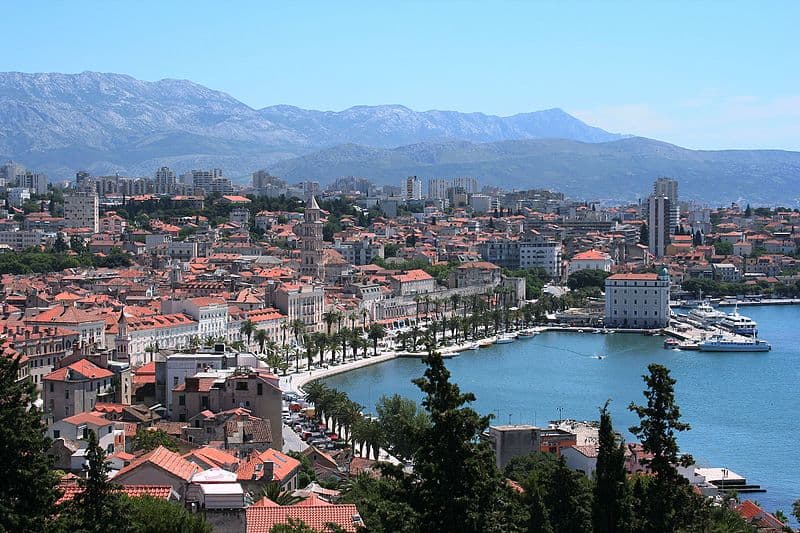
Split is the only city in the world that grew up inside a Roman palace and never grew out of it. Diocletian's fourth-century residence isn't a fenced-off excavation site — it has flats, cafés, washing lines strung between ancient columns, and every morning people walk through it on their way to work. Around the palace lies Croatia's second-largest city, with two hundred thousand residents, a university and a harbour from which ferries leave for Brač, Hvar, Vis and Korčula. Split isn't a classic resort town, then: its beaches are more urban than holiday-styled, and its main asset is that you can head somewhere new every day. Above the centre rises the forested Marjan peninsula, at Bačvice people play picigin in ten centimetres of water, and from six in the evening the whole town strolls along the Riva. The airport is twenty-five kilometres away, with charter flights from Prague running from May to October.

What to see

The places worth your time in Split, and what to expect at each

Diocletian's Palace

Diocletian's Palace

Old Town

An imperial residence from 305 AD, whose walls locals moved into after the fall of Rome and never left. Today around three thousand people live inside, across two hundred buildings, along with shops and bars — all standing on Roman walls that in places are five metres thick.

Tip: There's no single ticket for the palace — it's a public neighbourhood. You only pay for the cellars, the bell tower and the temple; the rest is free to walk through, best at seven in the morning before the cruise groups arrive.

Admission:
freely accessible
Time needed:
2–3 h
Cathedral of Saint Domnius

Cathedral of Saint Domnius

Peristyle

Originally Diocletian's mausoleum, converted into a cathedral dedicated to a bishop the same emperor had executed. The oldest cathedral in the world still using its original structure, with Andrija Buvina's wooden doors from 1214 and a sixty-metre bell tower.

Tip: Entry to the bell tower is a separate ticket, and the stairway is open on the sides with no full wall — anyone afraid of heights should skip the climb entirely. Go up in the morning; by afternoon it gets stuffy inside.

Admission:
from €10 combined
Time needed:
1 h
Peristyle and the Palace Cellars

Peristyle and the Palace Cellars

Old Town

The colonnaded courtyard at the heart of the palace, where the emperor once appeared before his subjects and where people now sit on the steps with coffee. Beneath it stretches an extensive underground level that exactly mirrors the vanished imperial halls above, preserved only because centuries of rubbish were dumped into it.

Tip: The cellars hold a constant sixteen degrees and are the one place in the centre bearable at noon in August. The entrance hall leading from the cellars to the Peristyle is open to all, lined with market stalls.

Admission:
cellars from €8
Time needed:
1 h
The Riva

The Riva

Waterfront

A white promenade between the palace and the harbour, lined the whole way with palm trees and café terraces. It's the city's main social space: locals come here for morning coffee, an evening stroll, and celebrations of everything from New Year's Eve to a win by local football club Hajduk.

Tip: Have coffee on the Riva, but walk two streets back into the palace for lunch — the same dish costs a third more on the promenade. Prices must be posted; at places with a street tout, get the price per kilo of fish confirmed first.

Admission:
free
Time needed:
1 h
Marjan Hill

Marjan Hill

Marjan

A forested, pine-covered peninsula that begins five minutes' walk from the palace and rises to 178 metres. It has viewpoints over the whole city, hermit chapels carved into the rock, and running trails used year-round by locals.

Tip: A stone stairway climbs up from the Varoš neighbourhood, but it's more pleasant to go up the paved road from Meje and come back down the steps. Bring water — there's no spring or stall along the ridge.

Admission:
free
Time needed:
2–3 h
Ivan Meštrović Gallery

Ivan Meštrović Gallery

Meje

A villa Croatia's greatest 20th-century sculptor built as his home, studio and exhibition hall in one. Inside are dozens of his marble and bronze sculptures; outside, a garden with cypress trees and sea views.

Tip: The ticket also covers Kaštelet, two hundred metres further on, where Meštrović's wooden cycle of reliefs sits in a Renaissance chapel — most visitors don't know about it and only see the villa.

Admission:
from €11
Time needed:
1.5 h
Bačvice and Picigin

Bačvice and Picigin

Bačvice

A city sand beach with water so shallow you can walk waist-deep fifty metres from shore. That's exactly why picigin was invented here — a game where players dive for a small ball and must never let it hit the water. It's played year-round, including on New Year's Day.

Tip: During the day Bačvice is packed, but after nine in the evening the beach empties out and the water stays warm. On the pebbly section wear water shoes — sea urchins lurk just past the sand.

Admission:
free
Time needed:
half a day
Klis Fortress

Klis Fortress

12 km northeast

A fortress on a rocky saddle above Split, sitting on the only route from the coast into the interior — which is why it was fought over from Roman times through the Ottoman era. The walls run along the ridge, and from the highest point you can see the whole Split bay and its islands.

Tip: Bus 22 from the bus station stops right below the walls and runs roughly every hour. The paths are uneven stone without railings, so sandals are a bad idea here.

Admission:
from €10
Time needed:
2 h
Salona

Salona

Solin, 6 km north

The capital of Roman Dalmatia, once home to sixty thousand people, until the Avars burned it down in the seventh century — its residents fled into Diocletian's Palace, which is how Split came to exist. What remains is an amphitheatre for seventeen thousand spectators, city walls, a basilica and a necropolis.

Tip: The site is large and kept as a park rather than a manicured museum, so you'll walk through grass among grazing sheep. Go early morning or early evening, as there's almost no shade.

Admission:
from €6
Time needed:
2 h

Photos: Diocletian's Palace — Dennis G. Jarvis (CC BY-SA 2.0) · Cathedral of Saint Domnius — Berthold Werner (CC BY-SA 4.0) · Peristyle and the Palace Cellars — Berthold Werner (CC BY-SA 4.0) · The Riva — Silverije (CC BY-SA 3.0) · Marjan Hill — dronepicr (CC BY 2.0) · Ivan Meštrović Gallery — SchiDD (CC BY-SA 4.0) · Bačvice and Picigin — dronepicr (CC BY 2.0) · Klis Fortress — Općina Klis (CC BY-SA 4.0) · Salona — Bernard Gagnon (CC BY-SA 4.0)

Where to stay

Areas and districts, matched to the kind of trip you are taking

Diocletian's Palace and Pjaca

Best for: a first visit and sightseeing

Living inside ancient walls, everything on foot, and bar noise until two in the morning. Apartments here tend to be small, without lifts, and dragging a suitcase over cobblestones is a chore — but you step outside your door straight onto the Peristyle. The best choice for two or three nights.

Varoš and Meje

Best for: quiet a few minutes from the centre

An old fishing quarter of narrow lanes climbing the slope toward Marjan. Five minutes' walk to the Riva, but quiet after ten at night, and home to the city's best konobas. From here it's an easy walk up Marjan or to the Meštrović Gallery, and parking is noticeably easier than in the centre.

Bačvice, Firule and Žnjan

Best for: swimming and families

A coastal strip east of the harbour with city beaches, a promenade and hotels. Fifteen to thirty minutes' walk to the centre along the water. The water is shallow and ideal for children, and evenings are lively without the noise levels of the palace.

Podstrana, Stobreč and Kaštela

Best for: pool hotels and having a car

Resort areas ten to twenty kilometres from the centre, home to most of the large hotels with pools and private beaches. Prices are lower than in the city, but without a car or bus you can't get anywhere from here. Kaštela has the advantage of being ten minutes from the airport.

Getting around

From the airport

Split Airport sits in Kaštela, twenty-five kilometres northwest of the centre, with both charter and scheduled flights from Prague in season. An airport bus runs to the Riva, along with regular bus 37, and a taxi costs around forty euros. Split is also Croatia's largest ferry port — Jadrolinija and Krilo sail from here to Brač, Hvar, Vis, Šolta and Korčula, with the terminal right next to the bus and train stations. By car from Prague it's roughly a thousand kilometres and twelve hours on the motorway via Vienna and Zagreb.

Split (Resnik, Kaštela) (SPU) · 25 km

  • Airport bus to the Riva· 40 min· €8
  • Regular bus 37 (Trogir–Split)· 50 min· €4
  • Taxi to the centre· 30 min· €40
  • Hotel transfer· 30–50 min· included in package

Around town

Split's centre is pedestrian, and a car there is purely a burden — the palace is closed to traffic and the surrounding paid zones cost over two euros an hour. City buses run by Promet cover every district plus Podstrana and Kaštela; tickets are cheaper bought at a newsstand than from the driver. Ferries to the islands leave from the harbour; the catamaran is twice as fast but doesn't take cars and sells out in season. A rental car only makes sense for trips inland.

Promet city busCovers Žnjan, Podstrana, Solin and Kaštela; tickets are cheaper at a newsstand than from the driver. · €1.60
Jadrolinija ferryTakes cars, sailing to Brač, Hvar, Šolta, Vis and Korčula from the main harbour. · €7
Krilo catamaranFaster, foot passengers only; sells out a day ahead in summer, so buy online. · €12
Taxi and BoltBolt is reliable and cheaper than a standard taxi from a rank. · €5

Useful apps: Google Maps, Jadrolinija, Bolt, Arriva Croatia

When to go

The main season runs from June to September, with the sea above 24°C from July to early October. June and September are the most pleasant: warm, the sea already or still warm, and the palace walkable without crowds. July and August bring temperatures over thirty degrees, packed ferries, and double the accommodation prices. May and October are great for sightseeing and day trips, but swimming feels cold to most people. In winter the city carries on as usual, only island ferry schedules run reduced.

Best time

June and September

What to avoid

late July and August, for the heat and the prices

MonthJanFebMarAprMayJunJulAugSepOctNovDec
Day11°12°15°19°24°28°31°31°26°21°16°12°
Night5°5°7°10°14°18°21°21°17°14°10°6°
Rainy days1110101097447101212
Sea14°13°14°16°19°23°25°26°24°21°18°16°

Food & drink

Split's cuisine is Dalmatian: grilled fish, olive oil, chard with potatoes on the side, and wine cut with water. The best value is found in konobas in Varoš and the streets behind the fish market, not the places with picture menus on the Riva. The Peškarija fish market runs every morning except Sunday and is the only one in the Mediterranean without flies — thanks to a sulphur spring right next to it. The Pazar produce market by the palace's eastern gate has fruit, cheese and cured ham straight from growers. For a quick lunch there are bakeries selling burek and stalls selling ćevapi.

What to try

Pašticada

Beef marinated in vinegar and wine and stewed for two days, served with homemade gnocchi. A festive Dalmatian dish, so at the restaurant give yourself time and an appetite.

Crni rižot (black risotto)

Risotto with octopus or cuttlefish, coloured black with cuttlefish ink. It tastes of the sea and reliably stains your teeth — sit down to it without a white shirt on.

Peka

Meat and potatoes cooked slowly for three hours under an iron bell covered with hot coals. The single best Croatian dish there is, but it's ordered a day ahead and for at least two people.

Soparnik

A thin savoury pie filled with chard, baked over an open hearth, a speciality of the Poljica region near Omiš. Sold by weight, and the one Dalmatian dish that's vegan.

Škampi na buzaru

Shrimp stewed in white wine, garlic and breadcrumbs, eaten with your hands. Order it where they bring a bowl for the shells and a wet napkin — a sign it's done properly.

Pršut and Pag cheese

Dry-cured ham from Dalmatia or Istria, and a hard sheep's cheese from the island of Pag, where the sheep graze on grass salted by the bura wind. The standard cold starter with a glass of wine.

Ćevapi

Grilled minced-meat rolls in somun flatbread with onion and creamy kajmak. The cheapest filling lunch in the country, and the only thing you'll get in a resort after midnight.

Fritule

Small fried doughnuts with raisins and lemon zest, dusted with sugar. Sold in paper cones along the promenade, the cheapest dessert on the coast.

What it costs

Coffee on the Riva

€3–4

Burek or ćevapi

€5–8

Dinner at a konoba

€25–35 per person

Beer, 0.5 l

€4–5

Sunlounger at Bačvice

€10–15 for two

Entry to the palace cellars

from €8

Catamaran to Hvar

from €12

Night in a 4-star hotel

€120–200

Indicative prices that change over time — treat them as a guide, not a price list.

Practical information

SocketsCEuroplug, two round pinsFSchuko
Voltage230V / 50Hz
Tap waterTap water is drinkable — Tap water is drinkable everywhere in Croatia and tastes good, drawn from karst springs along the coast. There's no need to buy bottled water — just fill a bottle in your apartment each morning. Restaurants, though, typically don't offer tap water and will charge for bottled instead.
TippingTips are left, but in small amounts: round up at a café, and leave around ten percent at a restaurant for good service. Card terminals usually have no tip option, so it helps to carry a few coins. In taxis, just round up.
Driving on theright
SafetyViolent crime is rare and cities are safe even at night. The only real risk is pickpocketing in crowds on the main street and around cruise-ship disembarkation points. Watch out for bills at restaurants with a street tout — overpriced items with no listed price are the most common tourist annoyance in coastal towns, so confirm the price before ordering. Don't park in city centres without a paid zone; tow trucks operate reliably.
Opening hoursShops are open roughly from eight to eight, shopping centres until nine. By law, most shops close on Sundays, with exceptions for bakeries, newsstands and shops at stations and petrol stations. Museums close on Mondays, and many extend their hours into the evening during peak season. Cafés on the squares open at seven a.m. and close around midnight.
Customs & etiquetteSwimwear belongs on the beach — walking through the centre in a swimsuit or without a shirt is punishable under Croatian municipal bylaws, and Dubrovnik, Split and Hvar do actually issue fines, starting around a hundred euros. Shoulders and knees should be covered in churches. Croatians are proud to be Croatian, not "former Yugoslavia" — don't be the one to bring up the 1990s war. Breakfast is light, lunch is around two, and dinner after eight.
A few local wordsGood day — Dobar danThank you — HvalaPlease — MolimThe bill, please — Račun, molimCheers — Živjeli

How to plan your days

1 day

A day inside the palace

  1. 1Seven a.m.: the Peristyle and cathedral, before the groups arrive.
  2. 2The palace cellars and the passage out to the Riva.
  3. 3Lunch at a konoba in Varoš, not on the promenade.
  4. 4Afternoon climb up Marjan for the view over the city.
  5. 5Evening stroll on the Riva, then a swim at Bačvice after dark.

2 days

Two days with the Roman surroundings

  1. 1Day one as above.
  2. 2Morning: bus 22 to Klis Fortress.
  3. 3Afternoon: the Salona ruins in Solin.
  4. 4Back to Bačvice, dinner in the streets behind the fish market.

3 days

Three days including an island

  1. 1The first two days as above.
  2. 2Morning catamaran or ferry to Brač.
  3. 3Zlatni Rat beach in Bol, lunch at the harbour.
  4. 4Return on the early-evening service, dinner in the Meštrović quarter of Meje.
  5. 5If there's time left, a day trip to Trogir.

Day trips

Trogir

27 km · 50 min by bus

An island town and UNESCO World Heritage Site, with the Cathedral of St Lawrence and Master Radovan's portal from 1240. The whole old town can be walked in an hour, but people still live there and it's far calmer than Split. Bus 37 runs there from both the airport and the centre.

Krka National Park

80 km · 1 h 30 min by car

The Skradinski Buk cascades, where water spills over seventeen limestone steps. Swimming below the falls has been banned since 2021, so visitors now walk the wooden boardwalks instead. Smaller and much closer than Plitvice Lakes.

Brač and Zlatni Rat

40 km · 50 min by ferry to Supetar

The nearest large island and Croatia's most photographed beach: a shifting pebble spit near Bol whose tip changes shape with the wind and currents. The island quarries the white stone used to build both Diocletian's Palace and Washington's White House.

Frequently asked questions

Do you have to pay to enter Diocletian's Palace?+

No. The palace is an ordinary city district where people live and run businesses, and you can walk through it for free at any time. You only pay for individual sights inside: the cellars, the cathedral, the bell tower, the Temple of Jupiter and the treasury. A combined cathedral-and-bell-tower ticket costs around ten euros.

Is Split suited to a beach holiday?+

Only partly. The city beaches of Bačvice, Firule and Žnjan are good, but they're busy city beaches, not a quiet resort. Split works best as a base for sightseeing and island trips — anyone wanting to lie on a beach for seven days will be happier in Makarska or on Hvar.

How long should I stay in Split?+

Two days is enough for the city itself, the palace, Marjan, Klis and Salona. Add trips to Brač, Hvar, Trogir and Krka and you can easily fill a week, since Split is Dalmatia's best ferry hub and everything is reachable in a day.

Do I need a car in Split?+

In town a car is more of a hindrance — the palace is closed to traffic and blue-zone parking costs over two euros an hour. A car is useful only if you're staying in Podstrana or Kaštela and want to explore inland. For the islands it's more convenient to go without one, by catamaran.

When is the sea warmest?+

In August and September, when the water is 25–26°C. Comfortable swimming runs from mid-June to early October. In May the sea is at 19°C, still too cool for most people even though the air is over twenty.

What is picigin?+

A Split game born on the shallows of Bačvice: players stand knee-deep in water, dive for a small ball, and must never let it touch the water. It's played year-round, and dozens gather in swimwear on New Year's Day. It's listed as Croatian intangible cultural heritage.

Can you visit the islands from Split as a day trip?+

Yes, and it's the main reason to stay here. The catamaran to Hvar takes an hour, the ferry to Brač fifty minutes, and to Vis two and a half hours. In season, buy your ticket online a day ahead, since catamarans sell out and cars queue for the ferry from early morning.

Where can you eat well in Split for reasonable money?+

In the konobas of Varoš and the lanes behind the fish market, where food is cooked for locals. Places on the Riva and in the palace's main passages charge a third more for the same dishes. The cheapest filling lunch is ćevapi or burek from a bakery, around eight euros.

Visa Requirements

Check the latest visa requirements for entering this country. Some nationalities may need to apply for a visa or e-visa before travel.

Check visa requirements

Language

Croatian

Currency

EUR

Timezone

GMT+1

Dial Code

+385

Population

3.9M

Area

56,594 km²

Voltage

230V / 50Hz

Driving Side

Right

Top Hotels in Split

Live prices from 500+ properties

Loading hotels...

Planning a trip to Split?

Compare hundreds of hotels, find the best price, and book with free cancellation on TravelManiac.