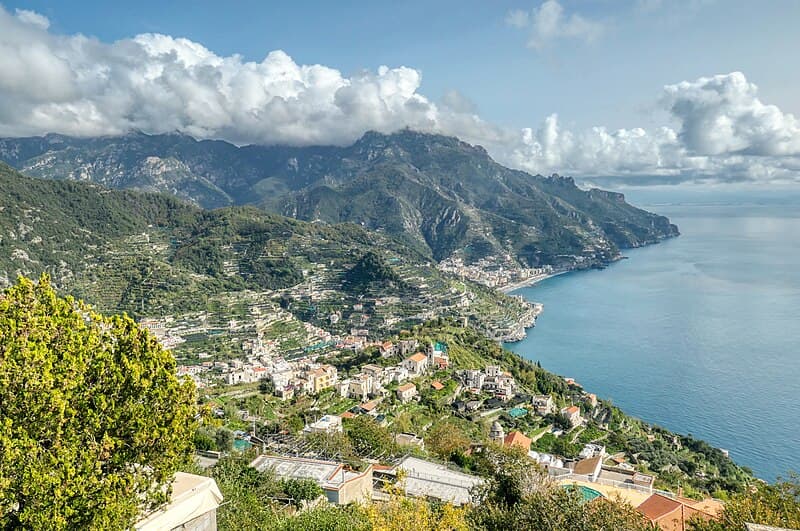
50 kilometres of road carved into the cliffs above the Tyrrhenian Sea
Amalfi Coast
LanguageEnglish
CurrencyEUR
TimezoneGMT+1
Temperature10-30 °C
Dial Code+39
Population59M
Area301,340 km²
SocketsType C / Type F / Type L
Tap waterDrinkable
Discover Amalfi Coast
The Amalfi Coast is the southern flank of the Sorrentine Peninsula, where the Lattari Mountains plunge into the sea so steeply that the villages had to grow vertically up the rock instead of spreading outward. A single road runs through it, the SS163, 52 km long with 130 bends and no crash barriers above the drop — and it's UNESCO-listed together with the whole coast as a cultural landscape. Amalfi was a maritime republic in the 10th century that rivalled Venice and had its own maritime code. Today the strip of 13 villages is a luxury destination where the 50 km drive can take 4 hours in August and a hotel room with a view costs more than the flight there. The differences between the villages are considerable: Positano is the most photogenic and most expensive, Amalfi has the most history and the most buses, Ravello sits 300 m above the sea and is quiet, and Atrani is a village of 500 residents right next to Amalfi.
What to see
The places worth your time in Amalfi Coast, and what to expect at each
Positano
western end of the coast
A village stacked up the hillside like an amphitheatre, its houses in shades of ochre and pink, with the majolica dome of the Santa Maria Assunta church at its centre. 90 per cent of the streets are steps, and the only through road runs one-way from top to bottom. Below lies the pebble beach of Spiaggia Grande, lined with restaurants.
Tip: Positano is a place you descend into and climb back out of, so reckon on 400 steps between the beach and the upper car park. You don't want a car here: parking costs €6–8 an hour and there are only a few dozen spaces. Arrive by boat from Sorrento or Amalfi, which lands right on the beach.
Admission:
free
Time needed:
half a day
Amalfi Cathedral
Amalfi, centrum
The Cathedral of St Andrew sits atop 62 steps above the main square, with a striped Arab-Norman façade and bronze doors cast in Constantinople around 1060. The crypt holds the relics of the apostle Andrew, brought from Constantinople in 1208. Beside it stands the Cloister of Paradise, with 22 pairs of interlaced columns.
Tip: The entrance to the cathedral is via the Cloister of Paradise, and the ticket is paid at the top of the 17 steps, not the bottom — there's no point queuing earlier. Before 8am and after 7pm, entry to the church itself for prayer is free. Shoulders and knees must be covered, and this is checked at the door.
Admission:
€5
Time needed:
1 h
Ravello and Villa Rufolo
7 km above Amalfi
A town 350 m above the sea, reached by 7 km of hairpin bends up from the coast. The 13th-century Villa Rufolo has a Moorish courtyard and a terraced garden with a celebrated view over the Gulf of Salerno; Richard Wagner found here, in 1880, his model for Klingsor's garden in Parsifal.
Tip: From June to September the garden hosts a festival, with the stage built on a terrace above the drop — the orchestra plays with its back to the sea. Tickets sell out months ahead. By day, Ravello is 5°C cooler than the coast below, reason enough on its own in August.
Admission:
€8
Time needed:
half a day
Villa Cimbrone and the Terrace of Infinity
Ravello
A garden on the very edge of Ravello's headland, built in 1904 by the English Lord Grimthorpe on the remains of a medieval estate. Its Terrace of Infinity is lined with a row of marble busts and ends 100 m above nothing, with a view over the whole gulf from Maiori to Cilento.
Tip: From the centre of Ravello it's a 10-minute walk to the villa along a flat paved lane between walls, but no car or bus reaches it. The best light is before 10am; in the afternoon a queue forms on the terrace for photos. There's a hotel within the grounds, which the standard ticket doesn't admit you to.
Admission:
€10
Time needed:
1–2 h
Path of the Gods
above Positano
A ridge path from Bomerano above Agerola to Nocelle above Positano, 7.5 km along an old mule track at around 600 m altitude. It runs along the edge above the bay with a view of Capri the whole way, and ends at a staircase that descends into Positano. The descent makes up most of the elevation change.
Tip: Walk from Bomerano towards Positano, not the other way — the reverse direction climbs 500 m. A bus runs to Bomerano from Amalfi via Agerola in under an hour. The route has no water or shade, so allow 4 hours and avoid the midday heat in July and August.
Admission:
free
Time needed:
4–5 h
Emerald Grotto
4 km west of Amalfi
A flooded limestone cave near Conca dei Marini, where seawater flowed in after the roof collapsed. Light enters through an underwater opening and turns the water green; on the floor sits a concrete nativity scene, lowered there since the 1960s. Inside, visitors are rowed among the stalactites.
Tip: Unlike the Blue Grotto on Capri, this one can be reached by car or bus and descended by lift straight from the road, so you can get in even when the sea is rough. The colour is best around midday, when the sun is highest. The visit lasts a quarter of an hour and costs a fraction of a trip to Capri.
Admission:
€5
Time needed:
1 h
Furore Fjord
7 km west of Amalfi
A narrow ravine cut by a stream into the cliff, spanned by the 30 m bridge of the SS163. Below lie a few dozen metres of pebbles and several fishermen's cottages built into the rock. In July, a cliff-diving championship is held from the bridge, from 25 metres up.
Tip: The bus stops here, and 200 steps lead down from the stop to the water. Parking on the bridge is banned and police enforce it. The beach is tiny and gets no sun in the afternoon, since the ravine wall blocks it — visit in the morning.
Admission:
free
Time needed:
1–2 h
Atrani
1 km from Amalfi
The smallest town in southern Italy, squeezed into a ravine barely 100 metres wide next to Amalfi. A tiny square with a church, a few lanes running through passages under houses, and a beach used by locals rather than day-trippers. It's separated from Amalfi by 700 m of tunnel and cliffside footpath.
Tip: This is the cheapest place on the coast for both accommodation and food, yet it's a 10-minute walk from Amalfi. Anyone after reasonably priced lodging within reach of everything should look here. Buses don't enter the square, stopping instead on the road above the village.
Admission:
free
Time needed:
2 h
Vietri sul Mare and its ceramics
eastern end of the coast
The eastern gateway to the coast, a town that has lived off painted ceramics for 400 years — tiles, plates and donkey figurines in blue, yellow and green. The dome of the church of St John the Baptist is made of the same tiles, and the ceramics museum in the Villa Guariglia tower traces how the craft has changed.
Tip: Ceramics here cost a third less than in the shops of Positano and Amalfi, which stock up from here in the first place. Workshops will wrap fragile pieces for air travel. Vietri sits by Salerno, making it a natural stop on the way to or from the coast rather than a trip in its own right.
Areas and districts, matched to the kind of trip you are taking
Amalfi and Atrani
Best for: a first stay and getting around without a car
The centre of the coast and its transport hub: buses run both ways from here, and boats go to Positano, Salerno and Capri. Amalfi has the cathedral, the shops and the most restaurants; neighbouring Atrani is half the price and a 10-minute walk away. Without a car, it's the most practical base on the whole coast.
Positano
Best for: the postcard backdrop and shopping, not for tired legs
The most photogenic and most expensive village, entirely made of steps, with boutiques selling linen dresses and made-to-measure sandals. Staying here means paying a premium for the view and climbing up and down several times a day. Buses arrive packed, and in season riding one means standing.
Ravello
Best for: quiet, views and escaping the August heat
350 m above the sea, quiet and crowd-free, with 2 famous villas and a summer music festival. It's several degrees cooler here than below, but reaching the sea means 7 km of hairpin bends by bus. Good for a few restful days, not for swimming.
Maiori and Minori
Best for: families and lower prices
2 neighbouring villages east of Amalfi with the coast's longest sandy beach and a flat, step-free centre. Accommodation is a third cheaper than in Positano, and buses to Amalfi run often. They lack the postcard backdrop, which is exactly what keeps prices down.
Flights reach the coast via Naples, from where it's 60 km to Amalfi but a 2-hour journey. The simplest connection without a car is the train from Naples to Salerno in 35 minutes, then a boat to Amalfi and Positano, which runs several times a day from April to October and bypasses the road traffic entirely. The other option is the Circumvesuviana train to Sorrento and a SITA bus over the pass. Airport buses run direct to Sorrento and Positano, but only in season. In July and August the SS163 clogs up in the afternoon, and the 50 km can take 4 hours.
Naples Capodichino (NAP) · 60 km
Train to Salerno and boat to Amalfi· 2 h· €25
Curreri bus to Sorrento and SITA· 2 h 30 min· €15
Private transfer· 1 h 30 – 3 h· €130 per car
Salerno Costa d'Amalfi (SUF) · 30 km
Taxi to Amalfi· 50 min· €70
Bus to Salerno and boat· 1 h 20 min· €12
Around town
The key decision is not to bring a car. The SS163 is narrow, full of bends and jams up in season; parking in Positano and Amalfi costs €6–8 an hour, if you find a space at all. SITA buses run the whole coast roughly every half hour, are cheap and their drivers handle the bends well, but around midday they're often too full to take more passengers — travel in the morning. The most pleasant way to get around is by boat: from April to October it links Salerno, Amalfi, Positano, Sorrento and Capri, is faster than the bus and gives you a sea-level view of the cliffs. Anyone who arrives by car leaves it in a garage at the hotel and doesn't touch it for a week.
SITA Sud busesThe backbone route along the SS163 between Sorrento, Positano, Amalfi and Salerno. Tickets are bought in advance at a tobacconist's; the driver doesn't sell them. Often full and non-stopping around midday. · €2–3.40 depending on distance
Boats and fast ferriesFrom April to October, between Salerno, Amalfi, Positano, Sorrento and Capri. The fastest and most comfortable option, but cancelled in rough seas. · €10–18 one way
Bus to RavelloFrom the stop by the harbour in Amalfi, every 30 minutes, taking 25 minutes. Sit on the right for the view. · €1.50
Scooter and mopedSlips past traffic jams and parks anywhere, a major advantage on the SS163. Requires experience, though — the road is narrow and buses take up both lanes on the bends. · €45 per day
Taxi and private driverFixed fares between villages, around €80 from Amalfi to Positano. Worthwhile for 3 or 4 people, especially in the evening once buses stop running around 10pm. · €60–100 between villages
Useful apps: Google Maps, SITA Sud, Travelmar, Unico Campania
When to go
May, June and September are best: the sea is warm, everything is open and transport still works. July and especially August bring gridlock on the single road, packed buses and the year's highest prices; Italians take their holidays around 15 August, when the coast is at its fullest. April and October are pleasant for walking the trails, but the sea is 18°C and some beach services aren't running. From November to March, half the hotels and restaurants close, the boat lines stop entirely and the coast lives on locals alone. Afternoon rain mostly arrives in November.
Best time
May, June and September
What to avoid
August for traffic and prices, November to March for closed businesses
Month
Jan
Feb
Mar
Apr
May
Jun
Jul
Aug
Sep
Oct
Nov
Dec
Day
14°
14°
16°
18°
22°
26°
29°
29°
26°
22°
18°
15°
Night
9°
9°
10°
12°
15°
19°
22°
22°
19°
16°
13°
10°
Rainy days
9
8
8
8
5
3
2
2
5
8
11
10
Sea
16°
15°
15°
16°
19°
23°
26°
27°
25°
23°
20°
18°
Food & drink
The coast's cuisine rests on fish, sfusato lemons and scialatielli pasta, invented in Amalfi in the 1970s. Restaurants right on the seafront in Positano and Amalfi charge for the view; 2 streets up, the same dish costs a third less and is often cooked by the same family. In Atrani, Minori and Vietri prices are normal. Fish is often billed per 100g, so ask how much a whole portion will weigh. The lemons here are the size of a fist and are even eaten raw, as a salad with olive oil and mint.
What to try
Scialatielli ai frutti di mare
Short, thick noodles made from a dough with milk and basil, served with mussels and prawns. Created in Amalfi in 1978, it's the most typical pasta of the whole coast.
Delizia al limone
A dome of sponge cake soaked in lemon cream and coated in white icing. A dessert invented in Sorrento in the 1980s, now on every menu from Positano to Vietri.
Ndunderi from Minori
Curd-cheese dumplings said by local tradition to be 2,000 years old, now protected as one of the world's oldest pasta shapes. Made mainly in Minori and hard to find elsewhere.
Alici di Cetara and colatura
Anchovies from Cetara and colatura fish sauce, used to season spaghetti with garlic and parsley. A direct descendant of ancient garum and the strongest flavour in the region.
Sfusato amalfitano
The local lemon variety, with a strongly fragrant peel and low-acid flesh. Eaten sliced as a salad with oil and mint, and the base of limoncello and most local desserts.
Mozzarella and fiordilatte
Buffalo mozzarella from the plains of Campania and cow's-milk fiordilatte from the Lattari mountains right above the coast. Both are bought from the dairy on the day they're made, not from a supermarket.
Campanian pizza
Naples is an hour away and pizza here follows the same rules: soft crust edge, short baking time, few toppings. The cheapest main course on the coast, around €8.
Limoncello and concerto
A lemon liqueur made from sfusato peel and concerto, a herbal liqueur from Tramonti made to a monastery recipe using 14 herbs. Both are drunk ice-cold after a meal.
What it costs
Espresso at the counter
€1.20
Lunch at a trattoria in Atrani
€20–28
Dinner on the promenade in Positano
€55–90 per person
SITA bus between villages
€2–3.40
Boat Amalfi–Positano
€10–15
Sunbed on the beach in Positano
€30–50 per day
Parking in the centre
€6–8 per hour
Night in a 3-star hotel for 2
€150–320
Indicative prices that change over time — treat them as a guide, not a price list.
Practical information
SocketsCEuroplug, two round pinsFSchukoLItalian
Voltage230V / 50Hz
Tap waterTap water is drinkable — Tap water in Italy is drinkable and monitored more strictly than bottled water, including the public drinking fountains found on squares — in Rome they're called nasoni, and every larger town has hundreds. A sign reading "acqua non potabile" means the opposite and usually appears only at fountains in old parks. Restaurants don't offer tap water; the waiter automatically brings bottled and asks "naturale, o frizzante?" — still or sparkling.
TippingTipping in Italy isn't done by percentage as in the US. Restaurant bills usually include coperto, a cover charge for the table setting and bread, typically €2–3 per person — that stands in for a tip. When service is excellent, people round up or leave a few euros on the table. Nothing is tipped in a café. Card terminals usually have no tip option.
Driving on theright
SafetyItaly is a safe country and violent crime rarely touches tourists. The real risks are pickpocketing in crowds, at metro exits and around busy sights, and theft from cars — nothing visible should be left in a car parked on the street, not even an empty bag. In the south and in tourist centres, watch bills for items you didn't order; the price list must be displayed visibly. The emergency number 112 works and operators speak English.
Opening hoursIn the resorts, shops open in season from 9am until late evening, many on Sundays too, and often skip the midday break. Out of season, though, the resorts largely shut down: from November to March only a fraction of businesses operate. Restaurants serve dinner from 7.30pm, busiest around 9pm. Beach services run from May to mid-September; outside that window beaches are free and without sunbeds.
Customs & etiquetteCappuccino is drunk only in the morning — ordering one after lunch is the clearest sign of a tourist; espresso follows a meal. Coffee at the counter costs a fraction of the price at a table, and price lists usually show 2 columns. Churches don't admit visitors in shorts above the knee or with bare shoulders, and the big basilicas check at the door. Walking through town in swimwear isn't done, and seaside resorts often fine it. Keep your receipt — Italian law fines even the customer who leaves without one.
A few local wordsGood day — BuongiornoThank you — GraziePlease — Per favoreThe bill, please — Il conto, per favoreCheers — SaluteGoodbye — Arrivederci
How to plan your days
1 day
1 day on the coast
1Morning boat from Salerno or Sorrento to Amalfi.
2St Andrew's Cathedral and the Cloister of Paradise.
3Bus up to Ravello for Villa Rufolo.
4Lunch in Ravello, 5°C cooler than below.
5Afternoon boat to Positano and back in the evening.
2 days
2 days with the Emerald Grotto
1Day 1 as above, staying in Amalfi or Atrani.
2Morning bus west to the Emerald Grotto.
3Stop at Furore Fjord and the steps down to the water.
4Afternoon swim in Positano or Praiano.
5Dinner in Atrani, away from tourist prices.
3 days
3 days with the Path of the Gods
1The first 2 days as above.
2Morning bus from Amalfi to Bomerano above Agerola.
3Path of the Gods to Nocelle, 7.5 km along the ridge.
4Descend the steps into Positano and swim at Spiaggia Grande.
5With a fourth day, take a boat to Capri or a train to Pompeii.
Day trips
Pompeii and Vesuvius
50 km · 1 h 30 min by bus and train
A city buried by the eruption of AD 79, its 60 hectares of streets, houses and frescoes uncovered to their present state. A basic walk-through takes 3 hours and shade is scarce. Vesuvius continues by bus to a car park at 1,000 m, then a half-hour walk up gravel to the crater.
Capri
30 km · 1 h by boat from Positano
From April to October, boats run direct from Positano and Amalfi to Capri with no transfer. A day is enough for Monte Solaro, the Piazzetta and the Faraglioni viewpoint; the Blue Grotto needs calm seas and extra time. The last boat back leaves around 5pm, which shapes the whole day's plan.
Paestum
70 km · 1 h 30 min by car or train via Salerno
3 Doric temples from the 5th century BC, among the best-preserved Greek buildings in the world — better preserved than most of what stands in Greece. The site is flat, walkable in 2 hours, and the museum holds the Tomb of the Diver, with a unique Greek wall painting.
Frequently asked questions
Is it worth having a car on the Amalfi Coast?+
Usually not. The SS163 road is narrow and jams up in season, parking in Positano and Amalfi costs €6–8 an hour and spaces are scarce. SITA buses run every half hour and the boats between towns are faster and more pleasant. A car only makes sense out of season or if you're staying inland.
Where's the best base on the coast?+
Without a car, Amalfi or neighbouring Atrani, which has buses in both directions and boats to Positano and Salerno. Positano is the most expensive and entirely made of steps, Ravello is quiet but 7 km from the sea. Maiori and Minori are a third cheaper and have the longest beach.
How do I get from Naples to the coast?+
Most reliably by train to Salerno in 35 minutes, then by boat to Amalfi or Positano, since the boat avoids the traffic jam entirely. The other route is the Circumvesuviana train to Sorrento and a SITA bus. Direct buses from the airport run only in season. Allow 2–3 hours.
When are there fewest people on the coast?+
In May and the second half of September, when everything is open, the sea is over 20°C and traffic still moves. The worst period is 15 July to the end of August, when Italian holidaymakers join the foreign tourists and the 50 km road can take 4 hours.
Are there sandy beaches here?+
Most beaches are dark pebbles or coarse grey sand and are small, hemmed in between cliffs. Maiori has the longest sandy beach, Positano the largest pebble one. A sunbed costs €30–50 a day; free public strips exist even on the best-known beaches.
Can you walk the coast on foot?+
Old mule paths and staircases run between the villages, such as the Path of the Gods from Bomerano to Nocelle or the Valley of the Mills above Amalfi. These are genuine hikes with several hundred metres of ascent, not strolls. Within the villages you're on steps constantly, which in Positano means hundreds of steps a day.
How much does food cost on the coast?+
On the seafront promenades in Positano and Amalfi, dinner runs €55–90 per person; 2 streets up, the same meal costs around €30. In Atrani, Minori and Vietri, prices are normal Italian levels. Fish is often charged by weight, so ask in advance how much a portion will weigh.
Is it worth coming out of season?+
From November to March the coast is empty and accommodation costs a third of the price, but around half the hotels and restaurants are closed and the boat lines don't run at all. Buses, sights and the landscape itself remain. If you want peace and don't need the sea, go in April or October.
Visa Requirements
Check the latest visa requirements for entering this country. Some nationalities may need to apply for a visa or e-visa before travel.