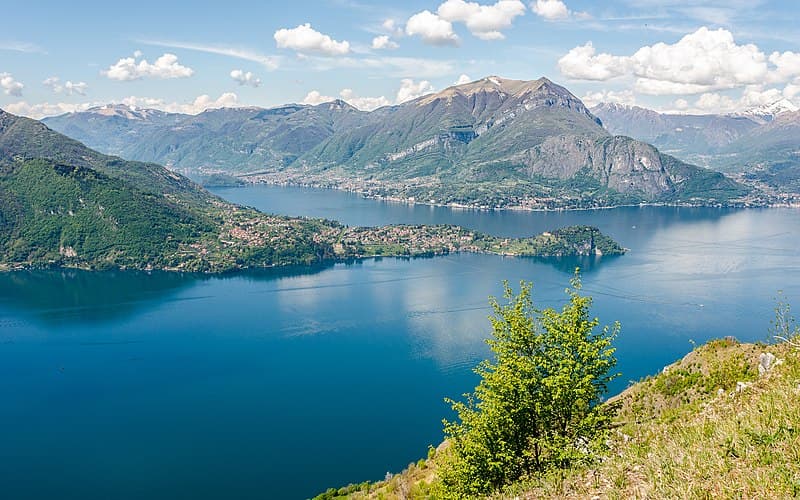
An inverted Y among the mountains, ringed by 400 villas
Lake Como
LanguageEnglish
CurrencyEUR
TimezoneGMT+1
Temperature10-30 °C
Dial Code+39
Population59M
Area301,340 km²
SocketsType C / Type F / Type L
Tap waterDrinkable
Discover Lake Como
Lake Como is Italy's deepest lake — 410 metres — shaped like an inverted Y, with 3 arms meeting at Bellagio. It formed in a glacial valley, so the shores are steep and the roads run through tunnels and above sheer drops, while the villages cling to a narrow strip beside the water. People have come here for the summer since Roman times: Pliny the Younger had 2 villas here, and since the 18th century several hundred more have been added, with gardens that are now the main reason to visit. The lake has 3 distinct sections — the southern arm with the town of Como and its industrial silk-making past, the western arm with most of the famous villas, and the northern end near Colico, where the wind blows and windsurfers gather. Distances look small on the map, but the road is narrow and the only sensible way to get around is by boat. The season is short and clearly defined: the villas open in mid-March and close in early November, and the boat timetable changes along with them. Come outside that window and you'll still see the lake, the mountains and Como, but the gardens will stay behind their walls.
What to see
The places worth your time in Lake Como, and what to expect at each
Bellagio
middle of the lake
A small town at the tip of the peninsula where the lake splits into 2 arms, with stepped cobbled lanes between the houses and a promenade beneath plane trees. From here you can see both arms at once, and across the water to the mountains above Varenna. Villa Melzi's lakeside gardens hold century-old azaleas and a Japanese pavilion.
Tip: During the day this is the busiest spot on the whole lake, since every boat and bus heads here. Arrive on the first boat before 10am, or after 5pm. Bellagio has 3 car parks, and they're full by 9am in season — don't come by car.
Admission:
Villa Melzi €8
Time needed:
half a day
Villa del Balbianello
Lenno, western arm
A villa on a headland near Lenno, built by Cardinal Durini in 1787 on the site of a Franciscan monastery. Its loggia with 2 towers stands on a rock surrounded by water on 3 sides, and the garden is clipped into geometric shapes. Star Wars and Casino Royale were both filmed here.
Tip: You can't drive to the villa at all: either walk the 1km from Lenno along the forest track, or take a water taxi for €10. The villa is closed on Mondays and Wednesdays; the garden stays open longer than the interior. A garden-only ticket costs half the combined price.
Admission:
garden €12, with villa €25
Time needed:
half a day
Villa Carlotta
Tremezzo
A baroque residence in Tremezzo set in 7 hectares of gardens, where over 150 varieties of azaleas and rhododendrons bloom from mid-April to May. Inside is Canova's marble Cupid and Psyche and a collection of Empire furniture. From the terrace the view crosses the water straight to Bellagio.
Tip: Come in the second half of April, when the garden is in full bloom — outside that window it's a pleasant park, but nothing more. The bamboo garden and the Japanese corner sit right at the top, and most visitors never reach them. A ferry runs to Tremezzo from Bellagio every half hour.
Admission:
€12
Time needed:
2–3 h
Varenna and Villa Monastero
eastern shore
A village on the eastern shore that the crowds from Milan skip, with colourful houses above the water and the Passeggiata degli Innamorati, a promenade built on stilts right over the surface. Villa Monastero is a former Cistercian monastery with 2km of gardens along the shore, full of agave, palms and lemon trees.
Tip: Varenna has its own train station on the line from Milan, so you can reach it from the airport in an hour and a half without a car — Bellagio has no such option. Above the village stands Vezio Castle, with views over both arms; it's a 20-minute climb up.
Admission:
Villa Monastero €10
Time needed:
half a day
Brunate funicular
Como
A funicular railway from Como to the village of Brunate at 720m, running since 1894. It climbs at a gradient of over 55% and takes just 7 minutes to reach a viewpoint over the whole southern arm. At the top are Art Nouveau villas, and a path leads on to the Voltiano lighthouse.
Tip: Go up in the late afternoon and stay for sunset — the southern arm faces exactly that direction from here, and the last car down runs around midnight. From the upper station it's a half-hour uphill walk to the lighthouse, with views as far as Monte Rosa.
Admission:
€6.60 return
Time needed:
2–3 h
Como Cathedral
Como, city centre
The Cathedral of Santa Maria Assunta, built continuously from 1396 to 1770, so it's Gothic at the base and Baroque at the top, with a dome designed by Juvarra. Statues of 2 pagan authors, both named Pliny, stand on the façade — a striking exception for a Catholic church.
Tip: Admission is free, and it's the best shelter from rain or heat in Como. Next door is the Broletto, the medieval town hall in white, grey and pink marble. Covered shoulders and trousers or a skirt below the knee are required inside the cathedral.
Admission:
free
Time needed:
1 h
Isola Comacina
western arm
The lake's only island, once home to a fortified town that Como razed to the ground in 1169 for siding with Milan. What remains are the foundations of 5 churches, a small church of St John, and 3 modernist artists' houses from 1940. The island is an archaeological reserve.
Tip: A boat leaves from Sala Comacina several times a day, and the ticket covers the return trip too; the last one usually runs around 6pm. The island has a single restaurant that has served the same menu since 1947, ending with a fire ritual against the bishop's curse — booking is essential, and it costs around €70.
Admission:
boat €6, island €5
Time needed:
half a day
Piona Abbey
northern end of the lake
A 13th-century Cistercian abbey on a peninsula near Colico, with a cloister where every column is decorated differently. Monks still live here today, making herbal liqueurs, honey and teas sold in the abbey shop. It's surrounded by a pine grove and a quiet bay.
Tip: This is the quietest spot on the whole lake, up in the north where the usual circuits don't reach. The abbey closes at midday, from noon to 2:30pm. It combines well with Colico and a walk around Piano di Spagna, a wetland with a bird reserve.
Admission:
free, donations welcome
Time needed:
1–2 h
Villa Olmo and the Como promenade
Como
A neoclassical villa from the late 18th century on Como's western edge, now an exhibition hall with a public park and a lakeside pool. A promenade runs to it from the centre along the shore, past the monument to Alessandro Volta, the inventor of the battery, who was born in Como.
Tip: The park is free and open until evening; entry to the villa is charged only during exhibitions. The Lido Villa Olmo pool next door is the cheapest place to swim near Como, with a lake view. It's a flat, 20-minute walk from the centre along the promenade.
Areas and districts, matched to the kind of trip you are taking
Como
Best for: a first arrival point and getting around without a car
A real town of 85,000 people, with 2 train stations and the best connections to Milan and the airport. Accommodation costs a third less than by the lake, and there's evening life here even out of season. The drawback is its southern position: reaching the prettiest villas takes over an hour by boat.
Bellagio and the middle of the lake
Best for: views into both arms
The best-known and most expensive part of the lake, with ferries running both directions and the shortest hop to all the main villas. It's busiest by day and empties out in the evening. No train runs here; it's reached by boat or by car along the narrow road from Como.
Varenna and the eastern shore
Best for: arriving by train and a quieter stay
The eastern side has the rail line from Milan, so you can reach Varenna in an hour without changing trains. The village is smaller than Bellagio, noticeably cheaper, and gets the morning sun. Ferries to Bellagio and Menaggio run every half hour, and a car isn't needed here.
Tremezzo, Menaggio and the western arm
Best for: villas, gardens and families
A stretch of shore with Villa Carlotta, Villa del Balbianello, and Menaggio, which has a flat promenade, a lido, and the start of a cycle path into Switzerland. Accommodation is mid-range, and ferries link both shores. Anyone visiting for the gardens should stay here.
Milan is closest: a direct bus runs from Malpensa airport to Como in 1 hour, and from Bergamo it's an hour and a half. Trains from Milan's Centrale station either terminate in Como or continue along the eastern shore to Varenna and Colico — the only spot on the lake reachable directly by train. No train runs to Bellagio; it's reached by boat from Como, Varenna or Menaggio. By car, the lake is easiest reached via Milan, or from hub cities such as Zurich and Munich across Switzerland or Austria; a motorway vignette is required for the Swiss stretch.
Milan Malpensa (MXP) · 55 km
Airport bus to Como· 1 h· €14
Train via Saronno to Como· 1h 20min· €13
Rental car· 55 min
Bergamo Orio al Serio (BGY) · 90 km
Bus to Milan and train to Varenna· 2h 30min· €18
Rental car· 1h 30min
Milan Linate (LIN) · 70 km
Metro to Centrale and train to Varenna· 2 h· €12
Private transfer· 1h 10min· €140 per car
Around town
The boat is the basic mode of transport here, not an attraction. Navigazione Laghi runs slow boats, fast boats and car ferries; in the middle of the lake, between Bellagio, Varenna, Menaggio and Cadenabbia, a ferry runs every 20 minutes and links the 4 main towns for a few euros. A day ticket for the whole lake pays off from 3 crossings. The lakeside road is narrow, running through tunnels with oncoming buses, so 20km takes 40 minutes, and parking in both Bellagio and Como is expensive and full. The eastern shore has a railway to Varenna and Colico; the western shore doesn't.
Navigazione Laghi boatsSlow boats, fast boats with a surcharge, and car ferries. A day ticket for the middle stretch pays off from 3 trips. The timetable changes between seasons and is sparse in winter. · €3–15 depending on the stretch
Milan–Varenna–Colico trainThe only railway on the lake, along the eastern shore. From Milan to Varenna is a direct 1-hour ride, and it's the cheapest way to get here. · €7 from Milan
ASF busesRoutes along both shores from Como to Bellagio and Menaggio. Cheap, but slow and crowded on the bends; for a tour of the villas, the boat is faster. · €3–5
CarPractical only for the northern part and villages off the boat routes. The road is narrow, parking in Bellagio and Como costs €3 an hour, and it's usually full by 9am in season. · parking from €2 per hour
Water taxiA private boat between any 2 points, including villa stops that the public ferry skips. For a group of 4 it costs about the same per person as a scheduled cruise. · from €100 per hour
Useful apps: Google Maps, Navigazione Laghi, Trenord, Google Translate
When to go
The finest period is from mid-April to early June, when the azaleas and rhododendrons bloom in the villa gardens — the single reason to come at exactly that time, since outside it Villa Carlotta is just a park. July and August are warm and good for swimming, but crowded and stuffy, as the lake sits in an enclosed valley. September and early October are calm, the water is still 22°C, and the light is the best of the year. From November to March some hotels, villas and boat lines close, it rains, and the mountains hold mist over the valley; Como itself runs year-round.
Best time
mid-April to June and September
What to avoid
November to March, when the villas are closed and boats run only a fraction of the schedule
Month
Jan
Feb
Mar
Apr
May
Jun
Jul
Aug
Sep
Oct
Nov
Dec
Day
7°
9°
14°
17°
22°
26°
29°
28°
24°
18°
11°
7°
Night
0°
1°
4°
8°
12°
16°
18°
18°
14°
10°
5°
1°
Rainy days
7
6
8
11
12
10
8
9
7
8
9
7
Sea
7°
7°
8°
11°
16°
21°
24°
25°
22°
17°
12°
9°
Food & drink
Around the lake the cooking is Lombard and built on freshwater fish: perch, whitefish, and above all the dried fish missoltino, salted and dried here since the 16th century. Alongside it come risotto, polenta, and buttery ravioli. Restaurants right on the promenade in Bellagio charge for the view; 2 streets up, or in the villages along the shore, the same dish costs a third less. Local wines come from Valtellina, just beyond the lake's northern end — light mountain reds made from the nebbiolo grape. Anyone wanting to eat cheaply buys a michetta roll from the bakery and cheese from the dairy, and sits by the shore.
What to try
Missoltino
Whitefish salted, sun-dried and pressed into a tin with bay leaves. It's grilled and served with polenta and vinegar; the flavour is very strong and not everyone takes to it, but it's the lake's oldest dish.
Risotto con pesce persico
Risotto with perch fillets fried in butter and sage. The most typical main course of Como cuisine, and a mark of a good restaurant: a poor one makes it with frozen fillets.
Polenta uncia
Cornmeal porridge baked with cheese, butter and garlic, a dish from the mountains above the lake. It's rich, and large portions are ordered to share around the whole table.
Pizzoccheri
Buckwheat noodles from Valtellina with cabbage, potatoes and casera cheese, topped with melted butter. A winter dish served on the lake during the colder months.
Bresaola from Valtellina
Beef cured in mountain air, sliced thin and served with rocket, parmesan and lemon. A lighter starter than ham, and a protected-origin product in the region.
Miascia
A cake made from stale bread, milk, apples and pears, born out of whatever was left in the pantry. Sold by weight in patisseries around the lake and keeps for days.
Nebbiolo from Valtellina
A mountain red wine from terraced vineyards above Sondrio — lighter and more acidic than the Piedmont wine made from the same grape. Ordered by the glass, and pairs surprisingly well with fish, better than white does.
Ice cream and espresso on the promenade
A genuine gelateria has a sign reading "produzione propria" and keeps its ice cream in flat metal tubs, not piled into colourful mounds. Have your coffee at the counter — at a table on the promenade it costs 4 times as much.
What it costs
Espresso at the counter
€1.30
Lunch at a trattoria off the promenade
€18–25
Dinner with a view in Bellagio
€45–70 per person
Bellagio–Varenna ferry
€5
Day ticket for the middle stretch
from €15
Entry to Villa del Balbianello
€12–25
Brunate funicular
€6.60 return
Night in a 3* hotel for 2
€130–260
Indicative prices that change over time — treat them as a guide, not a price list.
Practical information
SocketsCEuroplug, two round pinsFSchukoLItalian
Voltage230V / 50Hz
Tap waterTap water is drinkable — Tap water is safe to drink in Italy and monitored more strictly than bottled water, including the public drinking fountains in town squares — in Rome they're called nasoni, and every larger town has hundreds of them. A sign reading "acqua non potabile" means the opposite, and usually appears only on fountains in old parks. Restaurants don't offer tap water; the waiter automatically brings bottled and asks "naturale, o frizzante?" — still or sparkling.
TippingTipping in Italy isn't done as a percentage the way it is in America. Restaurant bills usually include a coperto, a cover charge for the table setting and bread, typically €2–3 per person — that stands in for a tip. When service is excellent, the bill gets rounded up or a few euros are left on the table. Nothing is expected at a café. Card machines usually don't have a tip option.
Driving on theright
SafetyItaly is a safe country, and violent crime barely touches tourists. The real risks are pickpocketing in crowds, at metro exits and around crowded monuments, and theft from cars — nothing should be left visible in a car parked on the street, not even an empty bag. In the south and in tourist centres, watch for bills padded with items you didn't order; the price list must be clearly displayed. The emergency number 112 works, and operators speak English.
Opening hoursShops open around 9am, and many smaller ones take a midday break from 1:30 to 3:30pm, later still in the south, until 5pm. Supermarkets and chains in tourist centres stay open all day. Most shops close on Sundays, but restaurants and cafés don't. Museums typically close on Mondays. Restaurants open for lunch from 12:30 to 2:30pm and for dinner not until 7:30pm — arrive at 6pm and you'll find the kitchen closed.
Customs & etiquetteCappuccino is drunk only in the morning — ordering one after lunch is the surest sign of a tourist; espresso is what follows a meal. Coffee at the counter in a café costs a fraction of what it does at a table, and the price list usually has 2 columns. Churches don't admit people in shorts above the knee or with bare shoulders; the larger basilicas enforce this at the door. Walking through town in swimwear isn't done, and seaside resorts often fine it. Keep your receipt — Italian law fines even the customer who leaves without one.
A few local wordsHello — BuongiornoThank you — GraziePlease — Per favoreThe bill, please — Il conto, per favoreCheers — SaluteGoodbye — Arrivederci
How to plan your days
1 day
1 day by the lake
1Morning train from Milan to Varenna, a 1-hour journey.
2Villa Monastero and a walk along the lakeside promenade.
3Ferry to Bellagio and lunch in a lane above the promenade.
4Afternoon at the gardens of Villa Melzi.
5Ferry to Tremezzo for Villa Carlotta, then back by train.
2 days
2 days with Balbianello
1Day 1 as above, staying overnight in Varenna or Menaggio.
2Morning boat to Lenno, then on foot or by water taxi to Villa del Balbianello.
3Lunch in Lenno and a swim in Ossuccio bay.
4Afternoon boat trip to Isola Comacina.
5Dinner in Menaggio, where prices are lower than in Bellagio.
3 days
3 days with Como and the north
1The first 2 days as above.
2Morning at the cathedral and along the promenade to Villa Olmo in Como.
3Funicular up to Brunate and a walk to the Voltiano lighthouse.
4Those who prefer quiet can take the train north to Piona Abbey instead.
5Evening back to Milan, or the last boat to wherever you're staying.
Day trips
Lugano and Switzerland
32 km · 40 min by train from Como
Italian-speaking Switzerland begins 10km beyond Como. Lugano has a lakeside promenade, the LAC museum, and a cable car up Monte Brè with views over the Alpine ridge. Prices are in francs, but most shops accept euros at a worse exchange rate; an ID card is enough, and the border usually isn't checked.
Bergamo Alta
85 km · 1h 30min by train via Milan
An upper town ringed by Venetian walls listed as UNESCO heritage, reached by funicular from lower Bergamo. Piazza Vecchia with its library, and the Colleoni Chapel with its marble façade, rank among the finest sights in Lombardy. Most people fly into the local airport and skip the town, which is a mistake.
Milan
50 km · 1h by train from Como or Varenna
A cathedral with 150 statues on its roof, which you can walk across; The Last Supper at Santa Maria delle Grazie, booked months ahead; and the Vittorio Emanuele arcade. Trains run every half hour and a ticket costs around €7, so it's worth it even for half a day.
Frequently asked questions
Where's the best place to stay on Lake Como?+
Without a car, in Varenna or Como, since both have a train station with a direct connection to Milan. Bellagio is the prettiest and most expensive, but the train doesn't go there. Menaggio and Tremezzo are a good compromise if you want to be close to the villas while paying less than in Bellagio.
Do I need a car by the lake?+
Not really. The lakeside road is narrow, with tunnels and oncoming buses, and parking in both Bellagio and Como is expensive and full in season. Ferries in the middle of the lake run every 20 minutes and connect the 4 main towns. A car is only useful for the north and for villages off the boat routes.
When do the villa gardens bloom?+
Azaleas and rhododendrons at Villa Carlotta and Villa Melzi bloom from mid-April to the end of May, which is the only time the gardens are at their best. Outside that period they're pleasant parks, but without the colour. Villa del Balbianello, by contrast, has an evergreen clipped garden that looks the same all year.
Can you swim in Lake Como?+
Yes, from June to September the water is 21–25°C and clear. The shores are steep, though, and there are few accessible beaches; the best are the lidos in Menaggio, at Villa Olmo in Como, and in Domaso to the north. Entry to a lido costs €5–10 and usually includes a pool and showers.
How long does it take to get here from Milan?+
By train from Centrale station it's 1 hour to Varenna, or 35 minutes to Como on a fast train. A direct bus runs from Malpensa airport to Como in 1 hour. From Varenna it's then a 20-minute ferry ride to Bellagio. Driving takes about as long, but you'll end up hunting for parking.
How much do the lake boats cost?+
Single trips cost €3–15 depending on distance and boat type, and the ferry between Bellagio and Varenna is €5. A day ticket for the middle stretch costs from €15 and pays off from 3 crossings. Fast boats carry a surcharge, and the winter timetable is much sparser than in summer.
Is it worth visiting out of season?+
Como as a town works year-round and the lake is photogenic in the mist, but from November to March the villas are closed, boats run only a fraction of the summer schedule, and some hotels close. Anyone who wants to see the gardens and ride the boats should come between April and October.
Is Lake Como expensive?+
More expensive than the Italian average, but not like Capri. The differences are internal: dinner with a view in Bellagio costs twice what it does at a trattoria in Como or Menaggio. A night's stay starts from €130, cheaper in Como. Transport by boat and train, on the other hand, is cheap.
Visa Requirements
Check the latest visa requirements for entering this country. Some nationalities may need to apply for a visa or e-visa before travel.