Hotels in Milan

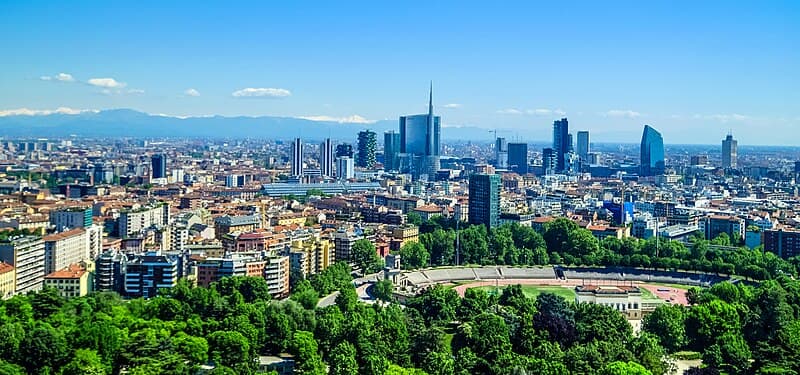
Italy's working city, where a Gothic roof looks out on skyscrapers

Milan

LanguageEnglish
CurrencyEUR
TimezoneGMT+1
Temperature10-30 °C
Dial Code+39
Population59M
Area301,340 km²
SocketsType C / Type F / Type L
Tap waterDrinkable

Discover Milan

Milan is the one Italian city that doesn't live off its past — it's the country's financial and fashion capital, a place of work, business and hurry, where a glass-and-steel district stands right next to a Gothic cathedral. Tourists traditionally passed through for a single night before flying onward, leaving with the impression there was nothing to do here; that hasn't been true for a long time. The cathedral is the largest Gothic cathedral in Italy, and you can climb onto its roof to walk among the marble pinnacles. Leonardo's Last Supper is a fifteen-minute walk away, admitting groups of twenty-five at a time. Add to that Sforza Castle with Michelangelo's final, unfinished sculpture, La Scala, Brera, and an evening aperitivo along the Navigli canals, where a ten-euro drink turns into dinner. Milan is also the best base for day trips: Como, Bergamo and Lake Maggiore are all within an hour by train. Anyone who gives the city two days won't be bored for a single hour.

What to see

The places worth your time in Milan, and what to expect at each

Duomo

Duomo

centro

The largest Gothic cathedral in Italy, built over nearly six hundred years, from 1386 into the twentieth century. Its facade of pink Candoglia marble carries thirty-three hundred statues and one hundred thirty-five spires, the tallest topped by the gilded Madonnina. Inside are fifty-five columns, the longest sundial in Europe set into the floor, and a statue of Saint Bartholomew carrying his own flayed skin.

Tip: The best part is the roof, where you walk among the flying buttresses, and on a clear day you can see the Alps from up there. Get the ticket with elevator access rather than the stairs — it costs a few euros more and saves two hundred fifty steps, which you'll still climb down on foot regardless. Buy the ticket online, since on-site there are two separate lines: one for tickets, one for security. Shoulders and knees must be covered.

Admission:
from 10 € for the church, from 20 € with roof access
Time needed:
2 h
Galleria Vittorio Emanuele II

Galleria Vittorio Emanuele II

centro

A covered arcade from 1877 with a glass vault over a crossing of two streets, linking the cathedral square with La Scala. It's the oldest still-functioning shopping arcade in the world, and Prada has had a store here since its founding. The mosaic floor beneath the central dome carries the emblems of four Italian cities, including a bull symbolizing Turin.

Tip: According to legend, grinding your heel into the bull's testicles in the mosaic floor and spinning around three times brings good luck — the hole left by the ritual is several centimeters deep and gets repaired every year. Cafés in the arcade charge a seating surcharge that can surprise you on the bill; espresso at the counter costs a fraction. The arcade is loveliest after nine at night, once it empties out and only the shop windows are lit.

Admission:
free
Time needed:
30 min
The Last Supper

The Last Supper

Santa Maria delle Grazie

Leonardo's mural in the refectory of the Santa Maria delle Grazie convent, painted between 1495 and 1498. Leonardo used an experimental technique instead of true fresco, and the painting began deteriorating within his own lifetime; what's visible today is the result of a twenty-year restoration. It captures the moment right after Christ announces the betrayal, and it's the first depiction where the apostles react as real individuals rather than a row of saints.

Tip: Tickets are booked online three months in advance and sell out within days of release during the season. Anyone who misses out can try a guided tour, which sometimes still has spots, or ask about cancellations an hour before opening. Visitors get exactly fifteen minutes inside, admitted in groups of twenty-five through two climate-controlled chambers — it's brief, so plan for it.

Admission:
from 15 € + booking fee
Time needed:
15 min visit
Teatro alla Scala

Teatro alla Scala

centro

The most famous opera house in the world, opened in 1778 on the site of a demolished church from which it takes its name. From outside it's an unassuming neoclassical building; inside are six tiers of boxes in red and gold and seating for two thousand people. The season always opens on December 7, the feast of Saint Ambrose, and it's the country's biggest social event.

Tip: The top-tier gallery, known as the loggione, holds the most demanding audience in the world, with tickets starting around thirteen euros — the view is poor but the sound is excellent. A hundred forty standing tickets go on sale on performance day from noon at a side entrance. The theater museum is open daily and includes a view into the auditorium from a box, when rehearsals aren't underway.

Admission:
museum 12 €, performances from 13 €
Time needed:
1 h museum
Sforza Castle

Sforza Castle

Castello

A brick fortress with a tower and moat, seat of the Dukes of Milan, whose decoration Leonardo and Bramante both contributed to. Today it houses seven museums on a single ticket: a furniture collection, a picture gallery, Egyptian collections and, above all, Michelangelo's Rondanini Pietà, on which he worked until six days before his death, leaving it unfinished. Sempione Park opens up behind the castle.

Tip: The courtyard and passage through the castle are free, and it's the shortest route from the center into the park. Museum admission is free or symbolically priced during the last two hours on Wednesday afternoons and after two p.m. on Tuesdays, which almost nobody knows. The Pietà stands in a separate building, the former Spanish hospital, and it stays quiet there even when the rest of the castle is packed.

Admission:
museums from 10 €, grounds free
Time needed:
2 h
Navigli

Navigli

Navigli

A system of navigable canals partly designed by Leonardo, once used to ferry marble into the city for building the cathedral. Most were covered over in the 1930s; two remain: Naviglio Grande and Naviglio Pavese. Bars, workshops and restaurants line both banks today, making this Milan's main neighborhood for an evening out.

Tip: This is where people come for aperitivo between six and nine: a drink costing eight to twelve euros comes with a free buffet, which at many places fully replaces dinner. On the last Sunday of the month, a large antiques market with several hundred stalls runs along the canal. Prices on Naviglio Grande are lower than on the main waterfront near Porta Ticinese — just walk two hundred meters past the bridge.

Admission:
free
Time needed:
whole evening
Pinacoteca di Brera

Pinacoteca di Brera

Brera

Milan's main picture gallery, housed in a baroque palace that's also home to the fine arts academy and botanical garden. On display are Mantegna's Dead Christ, with its dramatic foreshortening from the feet, Raphael's Marriage of the Virgin, works by Piero della Francesca, and Caravaggio's Supper at Emmaus. The tour also includes a restoration workshop visible through a glass wall.

Tip: This is the least crowded major gallery in Milan and an ideal choice for a rainy day. The botanical garden on the grounds is free and is the quietest spot in the center — at midday it's populated by academy students and no one else. On the first Thursday of the month, the gallery stays open until ten at night for three euros. The surrounding Brera district has the prettiest lanes in the city, filled with outdoor seating in the evening.

Admission:
from 15 €
Time needed:
2 h
Quadrilatero della moda

Quadrilatero della moda

Montenapoleone

Four streets — Via Montenapoleone, Via della Spiga, Via Sant'Andrea and Corso Venezia — where practically every major fashion house in the world has a store. Measured by rent per square meter, it's the most expensive shopping district in Europe. Besides the shop windows, several eighteenth-century palazzi stand here, along with the Bagatti Valsecchi museum, a former residence furnished as a Renaissance dwelling.

Tip: You don't have to buy anything to make it worth a walk, especially in January and July, when the legally mandated saldi sale season drops prices by a third to a half. Anyone after year-round bargains on brands should head to the Serravalle or Foxtown outlets, both an hour away by bus. Non-EU visitors can claim a VAT refund on purchases over seventy euros — ask the shop for the form.

Admission:
free
Time needed:
1–2 h
Monumental Cemetery

Monumental Cemetery

Monumentale

A cemetery dating to 1866 that functions essentially as an open-air gallery of Italian sculpture — families of Milanese industrialists once competed over who could commission the grandest tomb. It holds miniature temples, a Greek colonnade, a life-sized bronze Last Supper and modernist abstract monuments from the 1950s. Manzoni and the conductor Toscanini are both buried here.

Tip: Admission is free, and a map marking the most notable tombs is available at the gate; the whole site can be seen in an hour and a half. Few visitors come here, making it one of the truly quiet spots in Milan. It closes at six in the evening and stays shut all day Monday. By metro, it's the Monumentale stop on the purple line.

Admission:
free
Time needed:
1.5 h

Photos: Duomo — Jiuguang Wang (CC BY-SA 3.0) · Galleria Vittorio Emanuele II — Marco Pagani (CC BY 3.0) · The Last Supper — Marcin Białek (CC BY-SA 3.0) · Teatro alla Scala — John Picken (CC BY 2.0) · Sforza Castle — Jakub Hałun (CC BY-SA 4.0) · Navigli — Flavmi (CC BY-SA 4.0) · Pinacoteca di Brera — Jean-Christophe BENOIST (CC BY 3.0) · Quadrilatero della moda — Geobia (CC BY-SA 4.0) · Monumental Cemetery — Paolobon140 (CC BY-SA 4.0)

Where to stay

Areas and districts, matched to the kind of trip you are taking

Centro and Duomo

Best for: a first visit and sightseeing

The loop around the cathedral, the Galleria and La Scala, where most of what draws people to Milan sits within a ten-minute walk. Accommodation here is the priciest, and once the shops close in the evening the area feels fairly dead, since almost no one actually lives here. In exchange, it offers the best access to the main train station and airport, and all three metro lines cross here.

Brera

Best for: dinner and atmosphere

Lanes north of the center around the picture gallery of the same name, with galleries, small shops and restaurants with tables set out on the cobblestones. It's the prettiest part of Milan for a walk, and it's lively in the evening, but prices match the setting — dinner here costs a third more than a quarter-mile away.

Navigli and Porta Genova

Best for: aperitivo and nightlife

The neighborhood along the two remaining canals, with the highest concentration of bars in the city, where people sit outside from six in the evening onward. Accommodation is cheaper than in the center, and it's a ten-minute ride on the green metro line to the cathedral. On weekends it stays loud until two in the morning, which is worth knowing when picking a hotel; streets two blocks from the water are quiet.

Porta Nuova and Isola

Best for: modern Milan

A new district of skyscrapers around Gae Aulenti square, with the Unicredit tower and the Vertical Forest, two towers covered in eight hundred trees. Next to it is Isola, a former working-class neighborhood that's become the city's most interesting food scene. It's the only place in Italy where you can see contemporary architecture on this scale.

Getting around

From the airport

Milan is the most accessible Italian city from the Czech Republic: several flights a day leave Prague, the journey takes an hour and a half, and cheap fares often run under a thousand crowns. Pay attention to which airport your ticket uses — Malpensa lies fifty kilometers northwest, served by the Malpensa Express train to Cadorna or Centrale station in fifty minutes for thirteen euros. Linate is just seven kilometers from the center, and since 2022 the blue M4 metro line runs straight downtown in fifteen minutes for two euros, the best airport connection anywhere in Italy. Bergamo Orio al Serio, served by low-cost carriers, is fifty kilometers away, with a bus to Centrale taking an hour. Driving into the center isn't worth it: there's a congestion charge zone, Area C, and parking costs over thirty euros a day.

Milan Malpensa (MXP) · 50 km

  • Malpensa Express train to Cadorna or Centrale· 50 min· 13 €
  • Bus to Milano Centrale· 55 min· 10 €
  • Taxi to the center (flat rate)· 50 min· 110 €

Milan Linate (LIN) · 7 km

  • M4 metro to the center· 15 min· 2.20 €
  • Taxi to the center· 20 min· 25 €

Bergamo Orio al Serio (BGY) · 50 km

  • Bus to Milano Centrale· 1 h· 10 €

Around town

Milan has the best public transport of any Italian city: four metro lines, trams including historic 1920s cars still in regular service, and buses under a single fare system. A single ticket costs 2.20 € and is valid ninety minutes with all transfers; a day pass costs 7.60 €. The simplest option is to tap a contactless card or phone at the turnstile: the system tallies rides automatically and never charges more than the day-pass fare. The metro runs from six a.m. to midnight, later on Fridays and Saturdays. The center can be covered on foot in half a day, but the Last Supper, Navigli and the cemetery are far enough from the cathedral that the metro is worth using. Don't drive into the center — there's a congestion charge zone, Area C, and parking is color-coded: blue for paid spots, yellow for residents only.

MetroFour color-coded lines, running every two to five minutes, from 6:00 to 0:30. Line M4 connects Linate airport to the center; M1 and M3 cross near the cathedral. The fastest way to get around the city. · 2.20 €
TramsAn extensive network including wooden cars from 1928 still in regular service. Line 1 crosses the center past the castle and La Scala for the price of a standard ticket. Board through any door. · 2.20 €
Day pass7.60 € for twenty-four hours covering everything in the city zone. It pays off from the fourth ride onward; anyone tapping a contactless card at the turnstile gets the daily cap applied automatically, with nothing to work out. · 7.60 € / 24 h
Trains from Centrale and CadornaThirty-eight minutes to Como, fifty to Bergamo, two and a half hours to Venice by high-speed train. Regional trains don't require reservations; high-speed ones do, and booking early means cheaper fares. · from 5 € to Como
Bike and scooter shareBikeMi and several private services across the center. Milan is flat with extensive bike lanes, making cycling easy, though traffic is heavy and drivers impatient. · from 1 € to unlock
TaxiCan't be hailed on the street — call one or wait at a taxi stand. A ride across the center runs twelve to twenty euros; from Malpensa it's a flat rate of 110 €. Uber operates only in its pricier Black tier. · from 12 €

When to go

April, May, September and October are best. Milan sits in the windless Po Valley, so summer is muggy, and in August much of the city shuts down as Milanese head to the coast, leaving many restaurants and shops closed for three weeks. Winter is foggy and gray, with smog that lingers in the basin, but it's the cheapest time and museums are empty. Watch out for trade fair dates: April brings Salone del Mobile design week, February and September bring fashion weeks, and on those dates hotel prices triple with rooms nearly impossible to find. Anyone flexible on dates should check the Fiera Milano trade fair calendar beforehand.

Best time

April to June and September to October, outside trade fair weeks

What to avoid

August for the mugginess and closed businesses, trade fair weeks for the prices

MonthJanFebMarAprMayJunJulAugSepOctNovDec
Day6°9°14°18°23°27°30°29°25°18°11°7°
Night-1°0°4°8°12°16°19°18°15°10°4°0°
Rainy days6679108676887

Food & drink

Milanese cuisine is northern and rich: butter instead of olive oil, rice and saffron instead of pasta, and the city's most typical dish is veal shank braised for three hours. Milan's specialty is aperitivo, which originated here and takes a different form than anywhere else in Italy: between six and nine in the evening, a drink costing eight to twelve euros comes with a buffet substantial enough for a full meal. On weekdays, lunch is quick and cheap at bars, with set midday menus around twelve euros. Milan is Italy's most expensive city for food, but the gap between the center and the outer neighborhoods is enormous — dinner in Navigli or Isola costs half what the same meal costs two hundred meters from the cathedral. Cafés on the main squares and in the Galleria charge a cover fee for sitting down, usually posted in small print.

What to try

Risotto alla milanese

Rice cooked in butter and beef stock, colored deep yellow with saffron and finished with parmesan. It's served either on its own as a first course or as a side to osso buco. At a good trattoria it's creamy and spreads across the plate rather than clumping together.

Cotoletta alla milanese

A bone-in veal cutlet breaded and fried in butter, thick and juicy — unlike a Viennese schnitzel, it isn't pounded thin. A cheaper boneless version is called orecchia d'elefante, and by contrast it's paper-thin and hangs over the edge of the plate.

Osso buco

Veal shank braised for three hours in white wine and stock, served with gremolata made from lemon zest, garlic and parsley. The marrow inside the bone is scooped out with a narrow spoon provided for the purpose — it's the best part and is saved for last.

Aperitivo

A Milanese invention: between six and nine, food is served alongside your drink at no extra charge, ranging from small dishes to a full buffet. Negroni and Campari both originated here. Ten euros for a drink with a buffet is a typical price, and it can replace dinner entirely; Navigli has the most generous spreads.

Panettone

A tall, leavened Christmas cake with candied fruit that originated in Milan, its dough left to rise for thirty-six hours. Artisan bakeries make it from November to January, and it costs around twenty-five euros; the industrial supermarket version is a different thing entirely.

Mondeghili

Fried meatballs made from leftover boiled beef, breadcrumbs and parmesan, a Milanese home-cooking classic now served as a cicchetto with aperitivo. A buffet often has a bowl of them, and they're best eaten while still warm.

Caffè

An espresso drunk standing at the counter for about one euro twenty, ready in seconds. Ordering "un caffè" means espresso; anyone wanting something else has to say so. Never order a cappuccino after a meal.

Gelato

You can spot an honest gelateria by the fact that the ice cream isn't piled into pointy peaks and the pistachio is a dull brownish-green, not bright green. A sign reading "produzione propria" means it's made in-house.

What it costs

Espresso at the counter

1.20–1.60 €

Aperitivo with buffet

8–12 €

Midday menu at a bar

10–14 €

Dinner for two at a trattoria

60–90 €

Day pass for public transport

7.60 €

Cathedral with roof access

from 20 €

The Last Supper

from 15 € + booking fee

Night in a 3-star hotel for two

110–180 €

Indicative prices that change over time — treat them as a guide, not a price list.

Practical information

SocketsCEuroplug, two round pinsFSchukoLItalian
Voltage230V / 50Hz
Tap waterTap water is drinkable — Tap water in Italy is safe to drink and monitored more strictly than bottled water, including at the public drinking fountains found on squares — in Rome they're called nasoni, and every larger city has hundreds of them. A sign reading "acqua non potabile" means the opposite and appears only on fountains in old parks. At restaurants, tap water isn't offered; the server automatically brings bottled water and asks "naturale, o frizzante?" — still or sparkling.
TippingTipping in Italy isn't done as a percentage the way it is in America. Restaurant bills usually include a coperto, a cover charge for the table setting and bread, typically two to three euros per person — this stands in for a tip. When service is excellent, round up the bill or leave a few euros on the table. At a café, nothing is expected. Payment terminals usually don't have a tip prompt.
Driving on theright
SafetyItaly is a safe country, and violent crime practically never affects tourists. The real risks are pickpocketing in crowds, at metro exits and in the crush around monuments, plus theft from cars — nothing visible, not even an empty bag, should be left in a car parked on the street. In the south and in tourist centers, watch for bills padded with items you didn't order; a price list must be posted visibly. The emergency line 112 works and operators speak English.
Opening hoursShops open around nine, and many smaller ones close for a midday break from half past one to half past three, or as late as five in the south. Supermarkets and chains in tourist centers run continuously. Most shops close on Sundays, but restaurants and cafés stay open. Museums typically close on Mondays. Restaurants serve lunch from half past twelve to half past two and dinner not before half past seven — arrive at six and you'll find the kitchen closed.
Customs & etiquetteCappuccino is drunk only in the morning — ordering one after lunch is the clearest sign of a tourist; espresso follows a meal instead. Coffee at the counter costs a fraction of the price at a table, and price lists usually show both columns. Churches don't admit visitors in shorts above the knee or with bare shoulders, and major basilicas enforce this at the entrance. Walking around town in swimwear isn't done, and seaside resort towns can fine for it. Keep your receipt — Italian law fines even the customer who leaves without one.
A few local wordsGood day — BuongiornoThank you — GraziePlease — Per favoreThe bill, please — Il conto, per favoreCheers — SaluteGoodbye — Arrivederci

How to plan your days

1 day

A day in Milan

  1. 1Morning: the cathedral right after opening, then the elevator up to the roof.
  2. 2Galleria Vittorio Emanuele and the facade of La Scala.
  3. 3Lunch at a bar behind Brera, not on the square by the cathedral.
  4. 4Afternoon: Sforza Castle and the Rondanini Pietà, then Sempione Park.
  5. 5Evening: aperitivo in Navigli instead of a sit-down dinner.

2 days

Two days with Leonardo

  1. 1Day one as above.
  2. 2The Last Supper, booked for a morning slot.
  3. 3A walk through the Quadrilatero della moda and its shop windows.
  4. 4Afternoon: the Pinacoteca di Brera and its botanical garden.
  5. 5Evening: a performance or a tour of the La Scala museum.

3 days

Three days with a lake trip

  1. 1Days one and two as above.
  2. 2Morning: train from Cadorna to Como, thirty-eight minutes.
  3. 3Boat across the lake to Bellagio and back, lunch by the water.
  4. 4Return to Milan in the evening.
  5. 5Last evening in Isola or at Gae Aulenti among the skyscrapers.

Day trips

Lake Como

50 km · 38 min by train from Cadorna

A glacial lake shaped like an inverted Y, hemmed in by mountains rising two thousand meters above the water. Boats run across the whole lake from Como, and the classic loop covers Bellagio, Varenna and Menaggio, three towns where the lake's arms meet, connected by a ferry every half hour. Trains run directly from Cadorna station to Como Nord Lago, a stop right at the shore next to the ferry dock. A one-day ticket for boats on the central part of the lake costs around fifteen euros and is the best way to see it.

Bergamo

50 km · 50 min by train

A city on two levels: the modern Città Bassa below, and on the hill above, the Città Alta, ringed by Venetian walls listed as a UNESCO site and reached by funicular. Up top is Piazza Vecchia, a Romanesque basilica with baroque decoration, and the Colleoni Chapel in pink and white marble. The walls can be walked in a full loop, with views over the plain and the Alps. Trains run from Milano Centrale every half hour and cost under six euros; Bergamo also has a low-cost airport, so it can be a stopover on the way in or out.

Lake Maggiore and the Borromean Islands

75 km · 1 h 20 min by train to Stresa

Italy's second-largest lake, whose northern end lies in Switzerland. From Stresa, boats reach the three Borromean Islands: Isola Bella, with its baroque palace and terraced garden full of white peacocks; Isola dei Pescatori, a fishing village with alleys a meter wide; and Isola Madre, with its botanical garden. A train from Milano Centrale reaches Stresa in an hour and twenty minutes, and a combined boat ticket between the islands costs around sixteen euros. A cable car above Stresa climbs to Mottarone, with a view over seven lakes at once.

Frequently asked questions

How do I see Leonardo's Last Supper?+

Only with a reservation in advance. Tickets are released roughly three months ahead on the official website and sell out within days during the season. Groups of twenty-five people at a time pass through climate-controlled chambers and get exactly fifteen minutes inside. Anyone who missed the window can try a guided tour, which sometimes still has spots, or ask about cancellations an hour before opening.

Which Milan airport is best?+

Linate, because it's seven kilometers from the center and the M4 metro line runs straight downtown in fifteen minutes for 2.20 €. Malpensa is fifty kilometers away, and the Malpensa Express train costs thirteen euros and takes fifty minutes. Bergamo is also fifty kilometers away, reached by an hour-long bus ride. The transfer cost often eats up any savings on the airfare, so factor it in.

How many days are enough for Milan?+

Two days cover the cathedral roof, the Last Supper, the castle, Brera and an evening in Navigli. One day is enough only for the cathedral and the Galleria, and it'll feel rushed. Anyone staying three days or more has an ideal base for day trips: Como, Bergamo and Lake Maggiore are all within an hour and a half by train.

How much does transport in Milan cost?+

A single ticket costs 2.20 € and is valid ninety minutes with all transfers; a day pass costs 7.60 €. The simplest option is to tap a contactless card or phone at the turnstile — the system tallies your rides itself and never charges more than the day-pass fare, so there's nothing to calculate. The metro runs from six a.m. to half past midnight.

Is Milan expensive?+

It's the most expensive Italian city, but the difference between neighborhoods is huge. Dinner two hundred meters from the cathedral costs double the same meal in Navigli or Isola. The best value is aperitivo: for a drink costing eight to twelve euros, you get a buffet between six and nine that can replace dinner. Drink your coffee standing at the counter — sitting at a table has its own price list.

When should I avoid Milan?+

In August, when the Po Valley turns muggy and many restaurants and shops close for three weeks as locals head to the coast. And during major trade fair weeks — Salone del Mobile design week in April, fashion weeks in February and September — when hotel prices triple and rooms are nearly impossible to find. Check the dates against the Fiera Milano trade fair calendar in advance.

Is it worth going up to the cathedral roof?+

It's the best part of the whole visit: you walk among marble pinnacles and flying buttresses, and on a clear day you can see the Alps. Get the ticket with the elevator — it costs a few euros more and saves two hundred fifty steps up; you still walk down on your own. Buy the ticket online, since on-site there are two separate lines to wait in.

Can I fit a lake into a single day from Milan?+

Yes, and it's one of the main reasons to spend the night in Milan. A train from Cadorna station reaches Como in thirty-eight minutes, arriving right at the lakefront and the ferry dock, from where boats run to Bellagio and Varenna. Lake Maggiore and Stresa are an hour and twenty minutes from Centrale. Either works as a single day, just watch the last boat departures — in the off-season they can end as early as six o'clock.

Visa Requirements

Check the latest visa requirements for entering this country. Some nationalities may need to apply for a visa or e-visa before travel.

Check visa requirements

Language

Italian

Currency

EUR

Timezone

GMT+1

Dial Code

+39

Population

59M

Area

301,340 km²

Voltage

230V / 50Hz

Driving Side

Right

Top Hotels in Milan

Live prices from 500+ properties

Loading hotels...

Planning a trip to Milan?

Compare hundreds of hotels, find the best price, and book with free cancellation on TravelManiac.