Hotels in Cortina d'Ampezzo

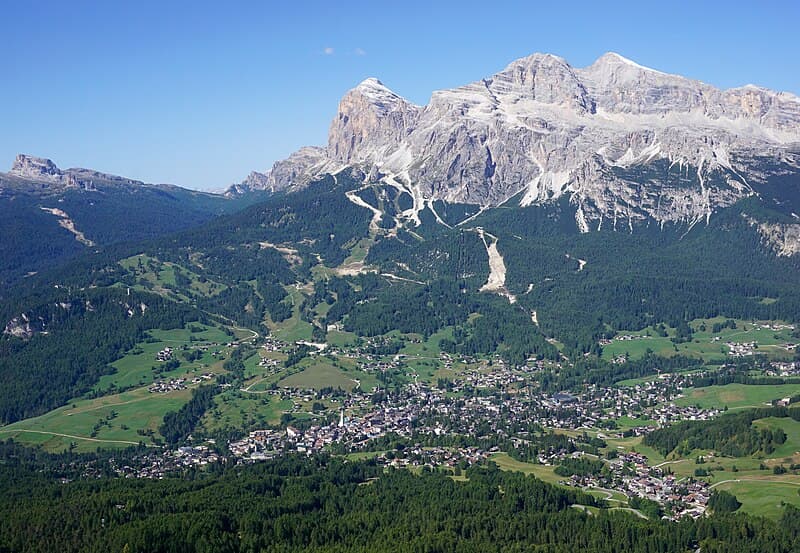
A basin ringed by the sheer walls of the Dolomites

Cortina d'Ampezzo

LanguageItalian
CurrencyEUR
TimezoneEurope/Rome
Temperature10-30 °C
Dial Code+39
Population59M
Area301,340 km²
SocketsType C / Type F / Type L
Tap waterDrinkable

Discover Cortina d'Ampezzo

Cortina d'Ampezzo sits in a flat basin at 1,200 metres, ringed on all sides by sheer limestone walls that turn pink at sunset — a phenomenon called enrosadira, and the reason the Dolomites are UNESCO-listed. Until 1918 this was Austrian Ampezzo, only becoming part of Italy after the First World War, and the older generation here still speaks Ladin rather than Italian. Cortina hosted the Winter Olympics in 1956 and again in 2026 alongside Milan, which brought a new cable car and a rebuilt bobsled track. In winter it's Italy's most expensive ski resort, and part of the Dolomiti Superski circuit, with 1,200 kilometres of pistes on a single pass. In summer, visitors come for via ferratas, mountain biking and the loop of Dolomite mountain passes. The main street, Corso Italia, is pedestrianised, and the evening passeggiata along it is as much a part of Cortina as the mountains above it.

What to see

The places worth your time in Cortina d'Ampezzo, and what to expect at each

Tofana and the Freccia nel Cielo cable car

Tofana and the Freccia nel Cielo cable car

western edge of town

A 3-stage cable car runs from the edge of town up to 3,244 metres on Tofana di Mezzo — the highest point reachable in Cortina without climbing. From the summit you can see across the whole of the Dolomites as far as the Marmolada, and on a clear day even the Alps in Austria. The middle station, Ra Valles, is the starting point for several via ferratas.

Tip: At the top it's around 5°C even in August, with strong wind — a jacket is essential, not optional. The last cable car down leaves around 4:30pm, and staff won't wait for latecomers; miss it and it's a 3-hour walk down. Go first thing in the morning, as the peaks often cloud over after 11am.

Admission:
from €45 return
Time needed:
half a day
Tre Cime di Lavaredo

Tre Cime di Lavaredo

35 km northeast

3 sheer towers that are the symbol of the Dolomites and among the most photographed mountains in Europe. The loop around them is 10 kilometres long, with 300 metres of ascent, and passes Rifugio Locatelli, which gives the classic view of all 3 north faces at once.

Tip: A toll road leads to the starting point at Rifugio Auronzo — €30 per car, and in season it closes between 9am and 5pm once the car park fills. Arrive before 8am, or take the bus from Dobbiaco. The loop is walked anticlockwise, for both the light and the climb.

Admission:
road toll €30 per car
Time needed:
a full day
Lago di Braies

Lago di Braies

50 km north

An emerald glacial lake below the Croda del Becco cliff, with a wooden boathouse that's the most photographed spot in South Tyrol. The loop around the shore is 3.5 kilometres, flat and manageable even with a pram. Wooden rowing boats can be rented on the lake.

Tip: Since 2023, driving in between 10am and 4pm in season has only been possible with a booking paid online in advance — without one, you'll be turned back at the barrier below the lake. Anyone who'd rather not book can arrive before 10am or take the bus. Boats are only rented out in good weather, and the queue for one can run to an hour.

Admission:
parking from €8, boat from €25 per hour
Time needed:
half a day
Cinque Torri

Cinque Torri

12 km west

A group of 5 limestone towers at 2,300 metres, standing alone in the middle of a meadow and serving as one of the Dolomites' best-known climbing areas. Around them is an open-air First World War museum — trenches, caverns and observation posts from the Italian front, all open to walk through.

Tip: A chairlift runs up from Bai de Dones on the road to Passo Falzarego, and from there it's a flat 20-minute walk to the towers. The trenches are freely accessible and free to visit; allow 1.5 hours for the loop around them. Rifugio Scoiattoli is the best spot for lunch with a view anywhere around Cortina.

Admission:
chairlift from €16 return
Time needed:
half a day
Lago di Misurina

Lago di Misurina

15 km northeast

A lake at 1,750 metres with a hotel on the shore, where the Sorapiss group and Tre Cime are reflected in the water. The air here is so dry and clean that the village is home to Italy's only children's sanatorium for asthma sufferers. The loop around the shore is 2 kilometres and flat.

Tip: The toll road to Tre Cime continues from here, so it makes a good stop along the way — park by the lake and carry on up by bus, which runs every half hour and costs less than the toll for a car. The best reflection of the mountains on the water is early in the morning, before the wind picks up.

Admission:
parking from €3 per hour
Time needed:
1–2 h
Passo Giau

Passo Giau

18 km southwest

A pass at 2,236 metres carrying one of the most dramatic roads in the Dolomites — 29 hairpin bends and the jagged peak of Ra Gusela right above the saddle. In season it draws long lines of cyclists, as it's a classic stage of the Giro d'Italia.

Tip: The road is narrow, without barriers and unpleasant in fog; it's usually closed for snow from November to May. Anyone who wants the mountains without walking has to come here — the car park sits right at the pass, and the view starts at the car. The hut at the pass serves a good lunch and stays open even outside the main season.

Admission:
free
Time needed:
2 h
Lagazuoi and the war tunnels

Lagazuoi and the war tunnels

17 km west

A mountain above the Falzarego Pass where Italians and Austrians dug kilometres of tunnels into the rock during the First World War, trying to blow each other up with mined galleries. The cable car runs from the pass up to 2,750 metres, where a hut sits with one of the finest views in the Alps.

Tip: Descending through the war tunnel back down to the pass takes 1.5 hours and requires a head torch and gloves — inside it's dark and wet, and you walk down steps cut into the rock. Both can be rented at the lower station. Anyone who'd rather skip the tunnel can ride the cable car back down.

Admission:
cable car from €22 return
Time needed:
half a day
Corso Italia and the bell tower

Corso Italia and the bell tower

centre

Cortina's pedestrianised main street, with shops, pastry shops and the 76-metre bell tower by the Church of Saints Philip and James, visible from either end of the valley. The evening passeggiata between 6pm and 8pm is a social institution that locals dress up for.

Tip: Shop prices on the Corso are Milan prices, not mountain-town prices. A supermarket with normal prices can be found 2 streets down by the river. People sit outside at the pastry shops even at −5°C, since the chairs come with blankets and there are gas heaters.

Admission:
free
Time needed:
2 h
The 1956 Olympic venues

The 1956 Olympic venues

centre and Zuel

Remnants of the first Winter Olympics broadcast on television: the Trampolino Italia ski jump in Zuel, now unused and crumbling, and the Olympic stadium in the centre, still used today for skating and ice hockey. The Eugenio Monti bobsled track was rebuilt on the site of the original for the 2026 Games.

Tip: The Stadio Olimpico is open for public skating both winter and summer, for a few euros including skate hire, and it's the best plan when it rains. The ski jump in Zuel can be viewed from outside, but you can't go in — it's more of a 10-minute stop on the way out of town.

Admission:
skating from €10
Time needed:
1–2 h

Photos: Tofana and the Freccia nel Cielo cable car — 2015 Michael 2015 (CC BY-SA 4.0) · Tre Cime di Lavaredo — Tiia Monto (CC BY-SA 3.0) · Lago di Braies — STirol (CC BY-SA 3.0) · Cinque Torri — Luca Sartoni from Vienna, Austria (CC BY-SA 2.0) · Lago di Misurina — User Giampaolo.Trapasso on it.wikipedia; Improved Version: User ThomasKloiber (CC BY-SA 3.0) · Passo Giau — Frisia Orientalis (CC BY-SA 3.0) · Lagazuoi and the war tunnels — kallerna (CC BY-SA 4.0) · Corso Italia and the bell tower — Tiia Monto (CC BY-SA 3.0) · The 1956 Olympic venues — User:Globetrotter51 (CC BY 3.0)

Where to stay

Areas and districts, matched to the kind of trip you are taking

Centre and Corso Italia

Best for: first-time stays and evening life

The heart of Cortina around the pedestrian street, with the bell tower, shops and pastry shops. Both the Freccia nel Cielo cable car and the bus station are within walking distance, so there's no need to travel anywhere in the evening. Accommodation here is the priciest in the whole valley, and books up months ahead in season.

Zuel and the southern valley

Best for: skiing on Tofana and lower prices

The southern part of the basin, near the Olympia delle Tofane piste and the bobsled track, 2 kilometres from the centre. Guesthouses and apartments here cost a quarter less than in the centre, and a bus runs into town every 15 minutes. In the morning it's a walk straight to the lift from here.

Pocol and Falzarego

Best for: views and hiking access

The slope above town towards the Falzarego Pass, with hotels overlooking the whole basin and the Pocol viewpoint, where people come for sunset. It's awkward without a car, as the bus runs only a few times a day. In return, it's the closest base to Cinque Torri and Lagazuoi.

Fiames and the north

Best for: peace and quiet, campsites and the cycle path

The northern end of the valley at the entrance to the Dolomiti d'Ampezzo Nature Park, 4 kilometres from the centre. The former railway line converted into a cycle path to Dobbiaco starts here. The cheapest and quietest accommodation around Cortina, but you won't get anywhere in the evening without a car.

Getting around

From the airport

Cortina has no airport or train station of its own — the nearest railway station is in Calalzo, 40 kilometres south, connected by bus. Most visitors fly into Venice or Treviso and continue by the Cortina Express bus, which runs from the airport directly to the centre in 2 hours. By car, the resort is most easily reached from the north via Austria and Toblach (Dobbiaco), or from the south via Venice. In winter, winter tyres and snow chains are mandatory on mountain roads from mid-November to mid-April, and checks are carried out. The roads over the Falzarego and Giau passes are sometimes temporarily closed after snowfall.

Venezia Marco Polo (VCE) · 160 km

  • Cortina Express bus· 2 h· €28
  • Rental car· 2 h
  • Private transfer· 1 h 50 min· €200 per vehicle

Treviso (TSF) · 140 km

  • Cortina Express bus· 2 h· €25
  • Rental car· 1 h 50 min

Innsbruck (INN) · 170 km

  • Rental car via the Brenner Pass and Toblach· 2 h 20 min
  • Train to Dobbiaco and bus· 3 h 30 min· €30

Around town

Cortina itself can be walked end to end in 20 minutes. City buses run along the valley and to the cable cars, and in winter ski buses run free for lift pass holders. For trips to the passes, Tre Cime and Lago di Braies, a car is far more practical, though in season the long-distance Dolomitibus buses also run there. Parking in the centre is paid and limited by snow in winter; most hotels have their own parking. In summer, an alternative is the former Dolomiti railway line converted into a cycle path, which runs flat all the way to Dobbiaco.

City buses and ski busRoutes along the valley to the cable cars and surrounding villages. The ski bus is free with a lift pass; otherwise tickets are bought in advance at a tobacconist. · €2 ticket
DolomitibusLong-distance routes to Dobbiaco, Belluno and over the passes. In summer they also run to Tre Cime and Lago di Braies; out of season, services are sparse. · €5–12
CarThe most practical option for day trips, but winter tyres and snow chains are mandatory in winter. The mountain passes are sometimes closed after snowfall. · parking from €2 per hour
Cable carsThe Freccia nel Cielo up Tofana, the Faloria from the centre, and chairlifts to Cinque Torri and Lagazuoi. A summer multi-lift pass is cheaper than buying individual rides. · €16–45 return
Lunga Via delle Dolomiti cycle pathA former railway line from Calalzo through Cortina to Dobbiaco, gravel-surfaced and without steep climbs. Bikes and e-bikes can be rented in the centre. · €25 bike per day

Useful apps: Google Maps, Dolomiti Superski, Dolomitibus, Meteo Trentino

When to go

Cortina has 2 seasons with a dead period in between. Winter runs from early December to Easter, with Christmas, New Year and February the most expensive times. Summer runs from late June to mid-September, when huts and cable cars are open and the high routes are walkable — in June, snow still lies above 2,000 metres. April, May, November and early December are shoulder seasons, when most hotels, huts and cable cars are closed, and there's little point visiting. Mountain weather changes within the hour, and afternoon storms in July and August are the rule rather than the exception — plan hikes for the morning.

Best time

late June to mid-September for hiking, January and March for skiing

What to avoid

April to mid-June and November, when most facilities are closed

MonthJanFebMarAprMayJunJulAugSepOctNovDec
Day3°5°9°13°18°21°24°23°19°14°8°4°
Night-8°-7°-4°0°4°8°10°10°6°2°-2°-6°
Rainy days5568101010107676

Food & drink

Cortina cooks Ladin and Tyrolean, not the Italian food of the coast: dumplings, polenta, mushrooms, venison and cheeses from mountain dairies. Restaurants in the centre charge Milan prices; good food for reasonable money is found at mountain huts, where lunch costs half what it does down in town. Huts close early in the afternoon, though, and most are shut in the shoulder seasons from April to June and October to December. Meals are washed down with a white wine from Alto Adige, finished with a pine-cone spirit.

What to try

Casunziei

Crescent-shaped ravioli filled with beetroot, topped with butter, poppy seeds and grated cheese. An Ampezzo speciality you won't find elsewhere in Italy, and the single most typical dish in Cortina.

Canederli

Dumplings made from stale bread with speck or cheese, served in beef broth or buttered with a sprinkling of cheese. A Tyrolean classic; at a mountain hut they make a whole lunch for €10.

Polenta with mushrooms or venison

A coarse cornmeal porridge that has been a staple here for centuries. It's served with stewed meat, mushrooms or melted cheese, and at mountain huts it's brought out on a wooden board for the whole table.

Speck from Alto Adige

A smoked, cured ham with protected designation of origin, sliced thicker than Italian prosciutto. It's sold by weight at delicatessens, and with cheese and bread it makes the cheapest snack for a hike.

Gulasch and Schlutzkrapfen

Tyrolean-style goulash with polenta, and pasta parcels filled with spinach and curd cheese — dishes on the menu that are a reminder this was Austria until 1918.

Strauben and Kaiserschmarrn

Fried batter poured into a spiral and dusted with sugar, and a shredded pancake bake served with cranberries. Desserts the size of a main course; at huts, one is typically ordered for 2 to share.

Mountain-dairy cheeses

Malga cheeses made from the milk of cows grazing above the treeline in summer. They're sold directly at the dairies along the trails, and the taste varies from one to the next depending on what the cows have been grazing on.

Grappa and Bombardino

Bombardino is a hot egg-yolk liqueur topped with whipped cream, drunk on the slopes over a lunch break, and stronger than it looks. Grappa is drunk after meals, and in the mountains often comes flavoured with blueberries or pine cones.

What it costs

Espresso at the counter

€1.50

Lunch at a mountain hut

€18–25

Dinner at a restaurant in the centre

€45–70 per person

Dolomiti Superski day pass

€75–85

Freccia nel Cielo cable car

from €45 return

Road toll to Tre Cime

€30 per car

Ski hire per day

€30–45

Night in a 3-star hotel with half board

€160–280 for a double room

Indicative prices that change over time — treat them as a guide, not a price list.

Practical information

SocketsCEuroplug, two round pinsFSchukoLItalian
Voltage230V / 50Hz
Tap waterTap water is drinkable — Tap water in Italy is safe to drink and monitored more strictly than bottled water, including at public drinking fountains in town squares — in Rome they're called nasoni, and every larger town has hundreds. A sign reading "acqua non potabile" means the opposite, and is usually only found at fountains in old parks. Restaurants don't offer tap water; the waiter automatically brings bottled and asks "naturale, o frizzante?" — still or sparkling.
TippingTipping in Italy isn't done as a percentage the way it is in America. Restaurant bills usually carry a coperto, a cover charge for the table setting and bread, typically €2–3 per person — this stands in for a tip. When service is excellent, people round up or leave a few euros on the table. Nothing is given at a café. Card terminals mostly don't have a tip field.
Driving on theright
SafetyItaly is a safe country, and violent crime barely affects tourists. The real risk is pickpocketing in crowds, at metro exits and in the crush around sights, and theft from cars — nothing should be left visible in a car parked on the street, not even an empty bag. In the south and in tourist centres, watch for bills that include items you didn't order; a price list must be clearly displayed. The emergency number 112 works, and operators speak English.
Opening hoursIn the resort, shops are open in season from 9am until late evening, many on Sundays too, and often skip the midday break. Out of season, though, the resort closes down almost entirely: from November to March only a handful of businesses stay open. Restaurants serve dinner from 7:30pm, and get busy around 9pm. Beach services run from May to mid-September; outside that period, beaches are free and without sunbeds.
Customs & etiquetteCappuccino is drunk only in the morning — ordering one after lunch is the clearest sign of a tourist; espresso follows a meal instead. Coffee at the counter in a café costs a fraction of the price at a table, and the price list usually has 2 columns. Churches shouldn't be entered in shorts above the knee or with bare shoulders, and major basilicas check this at the door. Walking around town in swimwear isn't done, and seaside resorts can fine you for it. Keep your receipt — Italian law fines even the customer who leaves without one.
A few local wordsHello — BuongiornoThank you — GraziePlease — Per favoreThe bill, please — Il conto, per favoreCheers — SaluteGoodbye — Arrivederci

How to plan your days

1 day

A Day in Cortina

  1. 1Morning cable car up Tofana on the Freccia nel Cielo, while it's still clear.
  2. 2Descend to the middle station at Ra Valles and back down.
  3. 3Lunch in the centre or at the hut by the lower station.
  4. 4Afternoon chairlift to Cinque Torri and a loop around the war trenches.
  5. 5Evening passeggiata along Corso Italia, then dinner.

2 days

2 Days with Tre Cime

  1. 1Day 1 as above.
  2. 2Set off before 7am for Rifugio Auronzo, before the road closes.
  3. 3Loop around Tre Cime anticlockwise, lunch at Rifugio Locatelli.
  4. 4Stop at Lago di Misurina on the way back.
  5. 5Evening skating at the Olympic stadium, or a pastry shop on the Corso.

3 days

3 Days with the Mountain Passes

  1. 1Days 1–2 as above.
  2. 2Morning at Passo Falzarego and up the cable car to Lagazuoi.
  3. 3Descend through the war tunnel with a head torch back to the pass.
  4. 4Afternoon loop over Passo Giau, with views from the car.
  5. 5Anyone with a fourth day heads to Lago di Braies with a booking made in advance.

Day trips

Marmolada

45 km · 1 h 15 min by car

The Dolomites' highest peak, with a glacier, reached by a 3-stage cable car from Malga Ciapela up to 3,260 metres. At the top is Europe's highest-altitude museum, dedicated to the mountain warfare of 1915–1917, fought in tunnels dug directly into the glacier. On a clear day the view reaches as far as Venice.

Bolzano and the Ötzi Museum

135 km · 2 h by car

The capital of South Tyrol, where the archaeological museum displays the mummy of Ötzi — a man 5,300 years old, found in a glacier on the border with Austria, kept in a refrigerated chamber and viewable through a small window. The town itself is Germanic-Italian, with medieval arcades and a market square.

Alta Badia and the Sellaronda circuit

40 km · 1 h by car

A loop of 4 passes around the Sella massif — Gardena, Sella, Pordoi and Campolongo — skied in its entirety in winter, and driven, cycled or ridden by motorbike in summer. The route is 52 kilometres long and takes 3 hours with stops. In the Ladin villages of Corvara and Colfosco, 3 languages are spoken.

Frequently asked questions

How do I get to Cortina without a car?+

By the Cortina Express bus from Venice or Treviso airports, running direct to the centre in 2 hours for around €25. No train runs to Cortina; the nearest station is in Calalzo, 40 kilometres south. Local buses then run along the valley and to the cable cars.

Is a car worth having in Cortina?+

For day trips, yes. Buses to Tre Cime, Lago di Braies and over the Giau and Falzarego passes run only in the main season and infrequently. Anyone who just wants to ski or hike straight from Cortina doesn't need a car — the ski bus is free with a lift pass. In winter, winter tyres and snow chains are mandatory.

When does snow lie in Cortina?+

Naturally from December to April, and thanks to snowmaking the pistes are skiable from early December to Easter. The most reliable snow is in January and February. Above 2,000 metres, patches of snow remain as late as June, which limits some of the higher summer trails.

Is Cortina expensive?+

Yes, it's Italy's most expensive mountain resort, and prices in the centre match Milan. Accommodation in Zuel and Fiames is a quarter cheaper, and lunch at a mountain hut costs half what a restaurant on Corso Italia charges. A Dolomiti Superski lift pass costs €75–85 a day.

Do I need to book to visit Tre Cime?+

Not for Tre Cime, but the road up to Rifugio Auronzo charges a €30 toll per car and closes in season once the car park fills — arrive before 8am. A booking is required for Lago di Braies, where between 10am and 4pm you can't drive in by car without a paid reservation.

What to do in Cortina when it rains?+

Go ice skating at the Olympic stadium, where public sessions including skate hire cost €10, or drive to Bolzano to see Ötzi the Iceman. In town there's the Rinaldo Zardini Museum, with fossils, and a modern art museum. Mountain huts stay open even in the rain, but cable cars stop running during storms.

Can you hike in Cortina without mountain experience?+

Yes. The loop around Tre Cime is a wide track with 300 metres of ascent, and the loops around Lago di Braies and Lago di Misurina are flat. Via ferratas and high routes do require gear and experience, though. Every hike calls for a jacket and water — weather in the Dolomites can change within the hour.

Why don't people in Cortina speak standard Italian?+

The Ampezzo valley belonged to Austria until 1918, and the local language is Ladin, a Romance language older than Italian, spoken today by around 30,000 people across 5 Dolomite valleys. Signs are often bilingual, and mountain names have both an Italian and a Ladin version.
Visa Requirements

Check the latest visa requirements for entering this country. Some nationalities may need to apply for a visa or e-visa before travel.

Check visa requirements

Language

Italian

Currency

EUR

Timezone

Europe/Rome

Dial Code

+39

Population

59M

Area

301,340 km²

Voltage

230V / 50Hz

Driving Side

Right

Top Hotels in Cortina d'Ampezzo

Live prices from 500+ properties

Loading hotels...

Planning a trip to Cortina d'Ampezzo?

Compare hundreds of hotels, find the best price, and book with free cancellation on TravelManiac.