Hotels in Aspen

A silver mining town turned America's priciest ski resort

Aspen

LanguageEnglish
CurrencyUSD
TimezoneGMT-7
Temperature5-30 °C
Dial Code+1
Population335M
Area9,833,520 km²
SocketsType A / Type B
Tap waterDrinkable

Discover Aspen

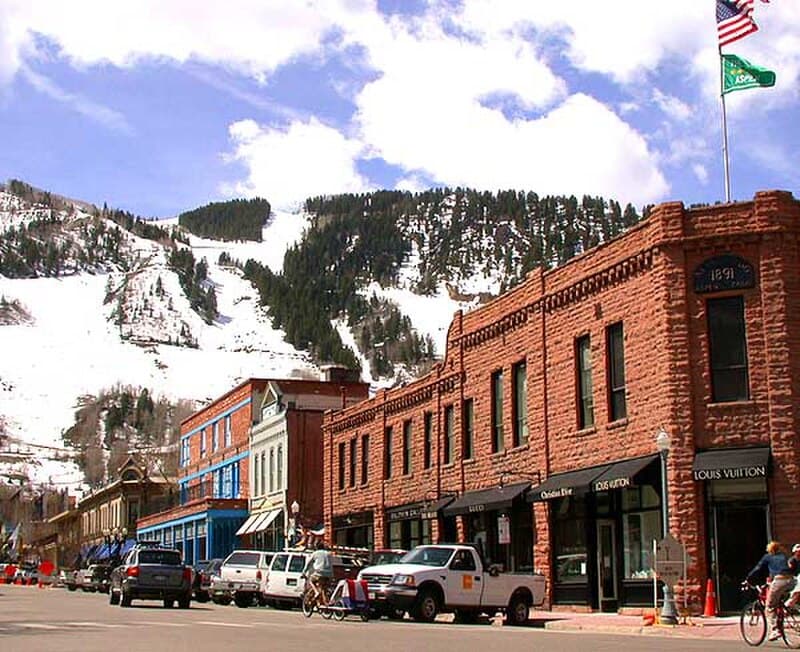
Aspen sits at an elevation of 2,438 metres in the Roaring Fork Valley in the Rocky Mountains and started out as a mining town: in the 1880s it had 12,000 residents and one of the richest silver deposits in America. When the government stopped buying silver in 1893, the town emptied within a few years to a few hundred residents and decayed for 50 years. It was brought back to life after the Second World War by skiing and by the Paepckes, a couple from Chicago who, alongside the ski lifts, also founded a music festival and an institute for debating ideas — which is why people who never set foot on skis come here too. Today there are 4 separate ski mountains on a single ticket, a Victorian brick-built downtown, and some of the highest property prices in the country. Summer is a full second season here, and for many more beautiful than winter: mountain meadows bloom, the gondola runs to the summit, and by late September entire hillsides of the aspen groves the town is named after turn gold.

What to see

The places worth your time in Aspen, and what to expect at each

Aspen Mountain

Aspen Mountain

directly above downtown

The mountain that rises directly above the main street and doesn't have a single beginner run — it's entirely red and black runs. The Silver Queen Gondola carries you from downtown to 3,400 metres in 14 minutes, where the Sundeck restaurant sits with a view over the whole valley and the surrounding 14,000-foot peaks.

Tip: In summer the gondola runs from June to September and is the fastest way up without hiking; at the top there's a short nature trail and live music on weekends. Anyone who flew in from low altitude yesterday shouldn't go up on day 1 — altitude sickness tends to announce itself right here.

Admission:
summer gondola from USD 45
Time needed:
half day
Maroon Bells

Maroon Bells

16 km south-west

2 maroon 14,000-foot peaks above the glacial Maroon Lake, the most photographed spot in Colorado. Their colour comes from hematite-rich rock, and the horizontal bands are visible from a distance. A flat path follows the shore from the lake, with a longer trail on to Crater Lake.

Tip: From May to October you can't get here without a reservation: either a timed car entry slot or a bus from Aspen Highlands, both booked online in advance. The first morning departure is best, when the surface is glassy and the mountains mirror in it. Mornings hover around freezing even in August.

Admission:
bus USD 16, entry USD 10
Time needed:
half day
Snowmass

Snowmass

15 km north-west

The largest of the 4 mountains, 15 kilometres from Aspen, with over 1,300 metres of vertical drop — more than any other resort in North America. Half the runs are blue, making it the best mountain for families and average skiers, with its own village built right on the slope.

Tip: The ski bus from Aspen is free and runs every 15 minutes, so staying in Snowmass and skiing everywhere else is a common and cheaper option — accommodation runs about a third less than in downtown Aspen. In summer there's a bike park, and the Elk Camp chairlift gives the easiest access to high-mountain trails in the area.

Admission:
included with lift pass
Time needed:
full day
Aspen Highlands and Highland Bowl

Aspen Highlands and Highland Bowl

5 km south-west

The steepest of the 4 mountains, whose summit amphitheatre, Highland Bowl, is open terrain with slopes up to 45 degrees. No lift reaches the top at 3,150 metres: it's a roughly 45-minute hike along a narrow ridge with skis on your shoulder.

Tip: A free snowcat carries part of the way up, boarded at the top of the lift, saving 20 minutes of climbing. Even for those who skip the summit, Highlands offers the best view of Maroon Bells of all 4 mountains. Buses to Maroon Lake also depart from here.

Admission:
included with lift pass
Time needed:
full day
Independence Pass

Independence Pass

32 km east

A pass at 3,687 metres on the Continental Divide, carrying one of the highest paved roads in America. The summit sits above the tree line in tundra with a boardwalk, and the ruins of the 1879 mining settlement of Independence stand beside the road.

Tip: The road is closed from early November to the end of May, and during that time the drive into Aspen from the east is an hour and a half longer. Even in August it's around 8 degrees up top and windy. The stretch above town is so narrow that 2 cars can only pass at pull-outs, and vehicles longer than 8 metres are banned.

Admission:
free
Time needed:
half day
Wheeler Opera House

Wheeler Opera House

downtown

A theatre from 1889 built by silver magnate Jerome Wheeler at the height of the town's boom. It burned down twice and stood empty for 50 years; today it's restored to its original form and hosts performances year-round. Across the street stands the Hotel Jerome from the same era, with a bar that has never closed.

Tip: The programme is posted on the building, and tickets for chamber concerts cost a fraction of the summer music festival. It's the best shelter from rain and, in the shoulder season, one of the few places open in town. The bar at the Hotel Jerome is open to the public and is the cheapest way inside.

Admission:
concerts from USD 25
Time needed:
1–2 h
Ashcroft

Ashcroft

18 km south

The remains of a mining town in the Castle Creek valley that had 2,000 residents, 6 hotels and 20 saloons in 1883, and was empty a decade later. 9 wooden buildings survive, including a hotel and saloon, preserved in the state they decayed into.

Tip: In winter no road for cars reaches here, only an 11-kilometre cross-country ski trail — the loveliest cross-country route in the area, ending at a mountain restaurant reachable only by ski or horse-drawn sleigh. In summer you can drive in, and entry is by voluntary donation.

Admission:
voluntary donation
Time needed:
half day
Aspen Art Museum

Aspen Art Museum

downtown

A museum of contemporary art in a 2014 building by Japanese architect Shigeru Ban, its facade formed of a woven wooden lattice. Admission is free thanks to the foundation behind it, and exhibitions change several times a year. The visit starts at the rooftop terrace and works down through the floors.

Tip: The rooftop terrace café is open even without an interest in the exhibitions, and it looks out over the town's roofs to Aspen Mountain; coffee there is the cheapest downtown. It's usually open until 7pm, an exception in a town where shops close at 6pm.

Admission:
free
Time needed:
1–2 h
Buttermilk and Hunter Creek

Buttermilk and Hunter Creek

5 km north-west, and above town

The gentlest of the 4 mountains, where the whole of Aspen learns to ski, and for many years the site of the Winter X Games with its giant superpipe. Facing the town, the Hunter Creek valley opens up, reachable on foot straight from the end of the street, where moose graze and the nearest trails into the mountains begin.

Tip: Buttermilk is accessible on the same lift pass as the other mountains and is the one place in Aspen where a beginner won't feel lost. Hunter Creek can be reached on foot without a car from the end of Red Mountain Road; the first half hour is steep, then it opens into a meadow. Keep at least 50 metres from any moose you see.

Admission:
free / included with lift pass
Time needed:
half day

Photos: Aspen Mountain — Wikimedia Commons (CC BY-SA 3.0) · Maroon Bells — Rhododendrites (CC BY-SA 4.0) · Snowmass — Jeffrey Beall (CC BY 4.0) · Aspen Highlands and Highland Bowl — Chassig at English Wikipedia (CC BY-SA 3.0) · Independence Pass — Mark Donoher from ???. Cropped and color-corrected by Daniel Case prior to upload (CC BY 2.0) · Wheeler Opera House — Daniel Case (CC BY-SA 3.0) · Ashcroft — John Holm from Leadville, CO, USA (CC BY 2.0) · Aspen Art Museum — Bkthomson16 (CC BY-SA 4.0) · Buttermilk and Hunter Creek — Werdna (CC BY-SA 4.0)

Where to stay

Areas and districts, matched to the kind of trip you are taking

Downtown Aspen

Best for: a first visit, restaurants and the gondola on your doorstep

The Victorian core with brick buildings from the mining era, shops, galleries, and the gondola to Aspen Mountain at its edge. Everything is walkable, and it's the only real nightlife in the valley. Accommodation is the priciest in all of Colorado and books out months ahead in season.

Snowmass Village

Best for: families and lower prices

A village on the slope of the largest mountain, 15 kilometres from Aspen, built in the 1960s. Runs lead straight to the accommodation, there's a pool and children's programmes, and prices are about a third lower. The free ski bus to Aspen runs every 15 minutes and, in winter, into the night.

Basalt and Carbondale

Best for: the cheapest stays and normal prices

2 ordinary towns 25 and 40 kilometres down the valley, home to most people who work in Aspen. Accommodation and food cost roughly half as much, and the bus up runs every half hour. Anyone here for a week of skiing saves the most this way of any option.

Woody Creek and the Castle Creek valley

Best for: quiet and nature away from town

Scattered settlements off the main road, once home to writer Hunter S. Thompson, with little more than a tavern, a ranch and mountains around. There's no shop or public transport, and you can't get anywhere from here without a car. In return, it's the closest base for Ashcroft and the mountain trails.

Getting around

From the airport

Aspen has its own airport 4 kilometres from downtown, served by flights from Denver, Dallas and a handful of other American cities; because of the narrow valley location, though, flights get cancelled in low cloud, so a backup plan is essential. Flying into Denver is more reliable, followed by a 4-hour drive on I-70 via Glenwood Springs, or a shared shuttle that runs several times a day. Flights from Europe to Denver typically connect through a major hub such as London, Amsterdam or Frankfurt. Independence Pass is closed from November to the end of May, so winter journeys take the longer route, which is worth planning for.

Aspen Pitkin County (ASE) · 6 km

  • RFTA bus downtown· 15 min· free
  • Taxi· 10 min· USD 25

Denver International (DEN) · 350 km

  • Rental car via I-70· 4 h
  • Shared shuttle· 4 h 30 min· USD 120
  • Connecting flight to Aspen· 1 h 10 min· USD 180

Eagle County (EGE) · 110 km

  • Rental car· 1 h 30 min
  • Shared shuttle· 1 h 45 min· USD 90

Around town

For its size, Aspen has exceptional public transport: RFTA buses run down the valley from Aspen through Basalt and Carbondale to Glenwood Springs, and are free within Aspen and between Aspen and Snowmass. Ski buses to all 4 mountains run every 15 minutes and, in winter, into the night. Downtown is walkable in 10 minutes, and a car there is more of a burden — parking is paid and fills up in season. You can't reach Maroon Bells without a reservation from May to October, whether by car or bus. In winter you need all-wheel drive or winter tyres, or you may be turned back on the mountain road.

RFTA busesFree within Aspen and between Aspen and Snowmass, paid further down the valley to Glenwood Springs. Frequent, and running into the night in winter. · free to USD 8
Ski busesTo all 4 mountains every 15 minutes, free even without a lift pass. Tend to be full between 8am and 9am. · free
Silver Queen GondolaFrom downtown to the summit of Aspen Mountain in 14 minutes, in both winter and summer. In summer it's the fastest way up to 3,400 metres. · from USD 45 in summer
Maroon Bells busFrom Aspen Highlands from May to October; booking online in advance is mandatory. Without it you can't reach the lake even in your own car. · USD 16
Rental carUseful for trips out of the valley, more of a hindrance in town. Downtown parking is paid, and all-wheel drive or winter tyres are required in winter. · USD 60–120 a day

Useful apps: Google Maps, RFTA Bus Tracker, Aspen Snowmass, COtrip

When to go

The winter season runs from late November to early April, and thanks to the elevation the snow is reliable; the priciest periods are Christmas, New Year and the last week of February. Summer, from June to September, is a full second season — gondolas run, mountain meadows bloom, a music festival takes place, and accommodation costs less than in winter. Late September around Aspen is the loveliest time of year, when entire hillsides of aspen groves turn gold. April, May and November are shoulder seasons, when most hotels and restaurants close and little is open. In July and August afternoon thunderstorms roll in almost daily, so mountain outings start in the morning.

Best time

late June to mid-September, with golden aspens in late September

What to avoid

April, May and November, when most businesses are closed

MonthJanFebMarAprMayJunJulAugSepOctNovDec
Day1°3°7°11°17°23°26°25°21°15°7°1°
Night-13°-12°-8°-4°1°4°8°7°3°-2°-8°-12°
Rainy days99989610118779

Food & drink

Aspen eats American with ambition: beef and bison from Colorado ranches, trout from mountain rivers, and a handful of restaurants downtown with prices among the highest in the country. It's crucial to know that menu prices exclude tax and tip, so the real bill runs roughly a quarter higher — on a $100 dinner that's $25 extra. There are 2 ways to save: order lunch instead of dinner, since the same places offer a midday menu at half price, and eat in Basalt or Carbondale down the valley, where prices are ordinary Colorado rates. Even the expensive places run a happy hour between 4pm and 6pm.

What to try

American breakfast

Eggs with toast, pancakes with maple syrup, or a burrito, plus bottomless coffee refilled without asking. The portion lasts into the afternoon, so an eighteen-dollar breakfast can stand in for lunch too.

Burger and fries

Made from local beef in the mountain towns and costs $20–25. Staff will ask how you want it done: medium rare is red in the middle, medium is pink, well done is cooked through.

Green chili

A thick sauce of roasted green chillies and pork, ladled over burritos and eggs alike in Colorado. Ordered as a side, and it's the most distinctive regional flavour on the menu.

Craft beer

Colorado has the highest number of microbreweries per capita in the country, and their beers tend to be stronger than they look. Above 2,000 metres, alcohol hits noticeably faster, especially on the first night after arrival.

Colorado lamb and bison

Lamb and bison from nearby ranches, often listed on menus with the rancher's name. Bison is leaner than beef and it's the most typical local ingredient on menus here.

Rocky Mountain trout

Grilled or almond-crusted, from rivers in the area. Compared with other mains it's on the cheaper side, and it's the only fish on the menu that hasn't been flown in.

Pancakes and bottomless coffee

Breakfast spots open at 7am and refill your coffee again and again without asking. The portion lasts into the afternoon, so an $18 breakfast can replace a lunch that would cost $30.

Happy hour

Between 4pm and 6pm, even the expensive restaurants offer discounted drinks and small plates, often at a third of the usual price. It's the simplest way to eat downtown Aspen for reasonable money.

What it costs

Coffee

5 USD

Breakfast at a bistro

18–25 USD

Lunch on the mountain

25–35 USD

Dinner downtown, before tax and tip

70–150 USD per person

Day lift pass at the window

200–260 USD

Lift pass bought online in advance

from 140 USD

Ski rental for a day

55–90 USD

Night at a 3* hotel for 2

300–600 USD

Indicative prices that change over time — treat them as a guide, not a price list.

Practical information

SocketsAtwo flat pins (US/JP)Btwo flat pins plus ground (US)
Voltage120V / 60Hz
Tap waterTap water is drinkable — Tap water is safe to drink across the United States, and restaurants will bring it free with ice if you ask ("tap water"). Buying bottled water is needless and pricey — a bottle costs $2–3 in a shop, $5 at an attraction. It's worth carrying a refillable bottle, as airports and parks have filling stations. Ice is everywhere, and drinks are served noticeably colder than is typical in Europe.
TippingTipping isn't optional here; it's part of staff wages. At a table-service restaurant, 18–20 percent of the pre-tax total is standard, $1 per drink at a bar, 15 percent for taxi and rideshare drivers, $3–5 a night for housekeeping, $2 a bag for porters. Payment terminals usually offer preset percentage buttons — watch out, as these sometimes calculate from the total including tax. Sales tax is also added on top of listed menu and shelf prices, running roughly 5 percent in Hawaii and 7 in Florida, so the final total is always higher than the price shown.
Driving on theright
SafetyRocky Mountain resort towns rank among the safest places in the country, and crime is negligible. The real risks are medical and natural: above 2,500 metres altitude sickness shows up as headaches and insomnia, sunlight is a third stronger than at sea level, and afternoon thunderstorms roll in almost daily in July and August. Bears live in the area and raid bins for food, so food should never be left in a car or on a terrace. Healthcare is extremely expensive, and travel insurance with a high limit is essential. The emergency number is 911.
Opening hoursIn mountain resort towns, shops open around 10am and close at 6pm, restaurants serve dinner early, and last orders are usually around 9pm. Lifts run roughly from 8.30am to 4pm, and mountain restaurants close shortly after the last run. Alcohol is sold only at licensed stores, not in ordinary supermarkets, and photo ID is required for purchase at a shop or a bar regardless of age. The shoulder season in April, May and November means most hotels and restaurants are closed.
Customs & etiquetteThe friendly chattiness of staff is a professional norm, not an invitation to friendship. Queuing is respected, and personal space is larger than in Europe. Haggling happens only over cars and at flea markets, never elsewhere. Smoking is banned in practically all indoor spaces and on many beaches. Questions about salary and politics aren't raised with strangers. In Hawaii, local customs also apply: the aloha spirit means not pushing or rushing, shoes come off before entering a home, and sacred sites and stones are never removed, even as souvenirs.
A few local wordsGood day — Hi / Good morningThank you — Thank youThe bill, please — Check, pleaseJust looking — Just looking, thanksHow much is it with tax? — How much is it with tax?Tap water, please — Tap water, please

How to plan your days

1 day

1 day in Aspen

  1. 1Breakfast downtown and a stroll through the Victorian streets.
  2. 2The Silver Queen Gondola up to the summit of Aspen Mountain.
  3. 3Lunch on the Sundeck terrace with a view over the valley.
  4. 4Afternoon at the Aspen Art Museum and its rooftop terrace.
  5. 5Dinner down in Basalt, or happy hour downtown.

2 days

2 days with Maroon Bells

  1. 1Day 1 as above.
  2. 2The first morning bus from Aspen Highlands to Maroon Lake, booked ahead.
  3. 3A loop around the lake and the longer trail on to Crater Lake.
  4. 4Return around midday, before the afternoon storms arrive.
  5. 5Afternoon walk into the Hunter Creek valley straight from town.

3 days

3 days with the pass

  1. 1The first 2 days as above.
  2. 2Morning drive over Independence Pass, if it's open.
  3. 3A stop at the ruins of the Independence mining settlement and the tundra above.
  4. 4Afternoon at Ashcroft in the Castle Creek valley.
  5. 5With a 4th day, head to Glenwood Springs for the hot-spring pools.

Day trips

Glenwood Springs

68 km · 1 h by car or RFTA bus

A town at the confluence of 2 rivers, with a hot-spring pool 105 metres long and cave steam baths carved into the rock above it. Above the town is an amusement park reached by gondola, and the grave of Doc Holliday, the gunslinger from the shootout at the O.K. Corral. The RFTA bus runs down the valley and costs a few dollars, making it the cheapest full-day trip.

Marble and Crystal Mill

90 km · 2 h by car plus an off-road stretch

The village that supplied the marble for the Lincoln Memorial and the Tomb of the Unknown Soldier in Washington; the quarry is still active. Above it stands the wooden Crystal Mill from 1893, perched on a rock over a creek, one of the most photographed buildings in Colorado. The final stretch of road needs a 4x4, otherwise it's on foot.

Twin Lakes and Mount Elbert

90 km · 1 h 45 min by car over the pass

Beyond Independence Pass lie 2 glacial lakes below Mount Elbert, Colorado's highest peak at 4,400 metres. A 19th-century settlement sits by the lakes, and it's the starting point for the summit, reached via a marked trail taking 9 hours round trip. The road over the pass is closed from November to the end of May.

Frequently asked questions

How do I get to Aspen?+

Either a connecting flight from Denver to the local airport 4 kilometres from downtown, or by car or shared shuttle from Denver, which takes 4 hours. Flights to Aspen get cancelled in low cloud because of the narrow valley location, so a backup plan by car or shuttle is sensible.

Do I need a car in Aspen?+

No. RFTA buses within Aspen and between Aspen and Snowmass are free, ski buses to all 4 mountains run every 15 minutes, and downtown is walkable in 10 minutes. A car is only useful for trips out of the valley, such as Independence Pass or Marble.

Do I need to book for Maroon Bells?+

Yes. From May to October you can't reach the lake without a reservation, whether by car or by bus from Aspen Highlands; both are booked online in advance, and slots sell out in high season. The first morning departure is best, when the surface is calm and the mountains reflect in the water.

How much does a lift pass cost in Aspen?+

At the ticket window in high season, $200 to $260 a day, the highest in America. Bought online a few weeks ahead it starts from $140, and multi-day passes are markedly cheaper. A single ticket covers all 4 mountains, including Snowmass.

Is Aspen suitable for beginners?+

Yes, but not on Aspen Mountain, which doesn't have a single beginner run. Start on Buttermilk, which is entirely gentle, then move on to Snowmass, where half the runs are blue. Highlands is the steepest and belongs to experienced skiers. A free ski bus runs between the mountains every 15 minutes.

Can you save money in Aspen?+

By staying and eating outside downtown. In Basalt and Carbondale, down the valley, a night's stay and dinner cost roughly half, and the bus up runs every half hour. In Aspen itself, lunch instead of dinner and happy hour between 4pm and 6pm help. Buy your lift pass online weeks ahead.

What is there to do in Aspen in summer?+

Summer is a full second season here: the gondola runs to the summit, people hike to Maroon Bells and Hunter Creek, mountain biking is popular, and a music festival runs in July and August. In late September the aspen groves turn gold, the loveliest time of year. Afternoon thunderstorms are the rule in summer.

How does the altitude affect visitors?+

Aspen sits at 2,400 metres, and anyone arriving from low altitude may sleep poorly and get headaches for the first 2 nights. It helps to drink noticeably more water, avoid high elevations on the first day, and skip alcohol, which hits harder at altitude. The sun is a third stronger here than at sea level, so sunscreen is essential even in winter.

Visa Requirements

Check the latest visa requirements for entering this country. Some nationalities may need to apply for a visa or e-visa before travel.

Check visa requirements

Language

English

Currency

USD

Timezone

GMT-7

Dial Code

+1

Population

335M

Area

9,833,520 km²

Voltage

120V / 60Hz

Driving Side

Right

Top Hotels in Aspen

Live prices from 500+ properties

Loading hotels...

Planning a trip to Aspen?

Compare hundreds of hotels, find the best price, and book with free cancellation on TravelManiac.