Hotels in Grand Canyon

A canyon 1.5 kilometres deep, its walls revealing 2 billion years of Earth's history

Grand Canyon

LanguageEnglish
CurrencyUSD
TimezoneGMT-7
Temperature5-30 °C
Dial Code+1
Population335M
Area9,833,520 km²
SocketsType A / Type B
Tap waterDrinkable

Discover Grand Canyon

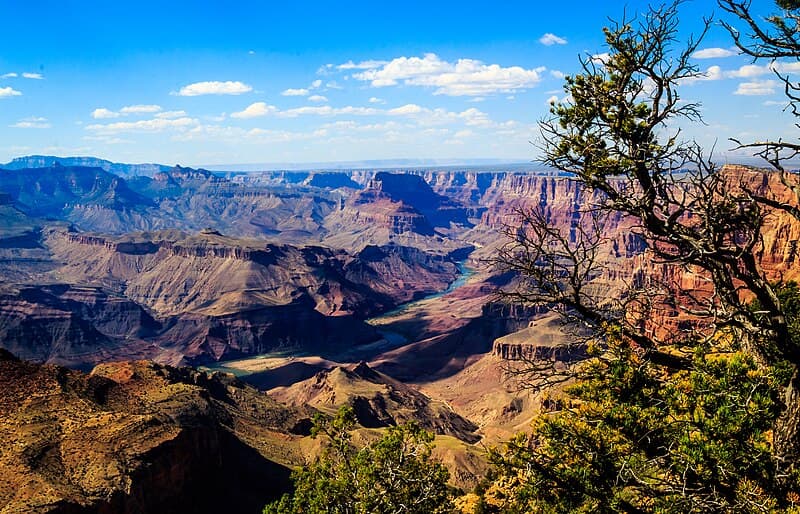
The Grand Canyon is a canyon of the Colorado River in northern Arizona, 446 kilometres long, up to 19 kilometres wide and in places over 1,800 metres deep. The river has been cutting into the plateau for millions of years, and the coloured layers of its walls reveal almost 2 billion years of geological history — from dark rock at the bottom to white limestone at the rim. The national park has two main sections: the South Rim, with a historic village, viewpoints and hotels, open year-round, and the North Rim, 300 metres higher and far quieter, open only in summer. The two are 16 kilometres apart as the crow flies, but over 350 kilometres apart by road. Most visitors arrive on a day trip from Las Vegas or Phoenix, walk along the rim and leave — yet the most memorable moments are sunrise and sunset, when the walls turn red, and a short hike a few kilometres into the canyon. It's worth staying at least 1 night in the park or in nearby Tusayan. Since 2026, foreign visitors pay a surcharge on top of the entrance fee.

What to see

The places worth your time in Grand Canyon, and what to expect at each

Mather Point

Mather Point

South Rim Visitor Center

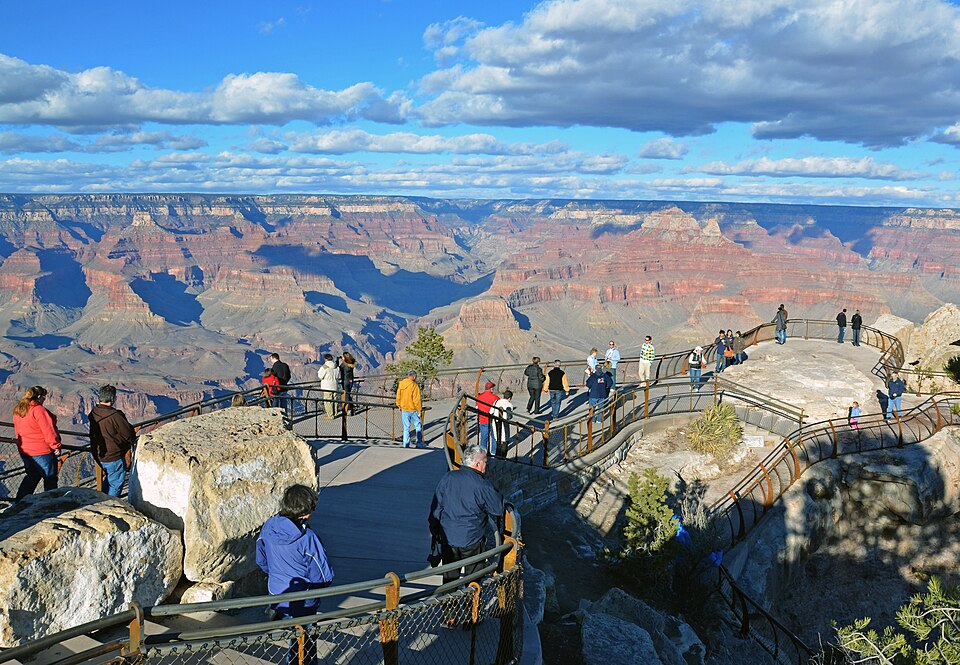
The most-visited viewpoint on the South Rim, a few minutes' walk from the main visitor centre. A rocky promontory juts out over the canyon, and from its tip you can see over 30 kilometres to the east and west, with a stretch of the Colorado River visible far below. Most people see the canyon here for the first time.

Tip: Mather Point is the most striking spot for a first view of the canyon, but also the busiest. Arrive an hour early for sunrise, or better, walk 1 kilometre west along the Rim Trail to Yavapai Point, which has the same view with fewer people. The visitor centre has a short film and trail maps.

Admission:
included in park entry
Time needed:
30 min
Rim Trail and Yavapai

Rim Trail and Yavapai

Between Mather Point and Hermits Rest

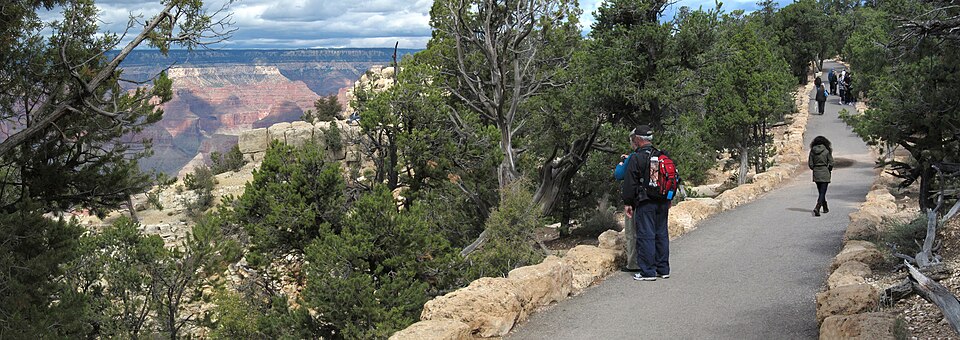
A trail running along the South Rim for 22 kilometres, mostly paved and flat, with viewpoints every few hundred metres. At Yavapai Point stands a geology museum with huge windows over the canyon, explaining how the rock layers formed. The trail passes through Grand Canyon Village and its historic buildings.

Tip: The prettiest stretch is between Yavapai and Grand Canyon Village, 3 kilometres along the so-called Trail of Time, where every metre of path represents a million years, with rock samples from the corresponding depth laid alongside. You can hop on the free shuttle bus at any point and head back. The trail is stroller-friendly.

Admission:
free
Time needed:
1–4 h
Hermit Road and Hopi Point

Hermit Road and Hopi Point

Western South Rim

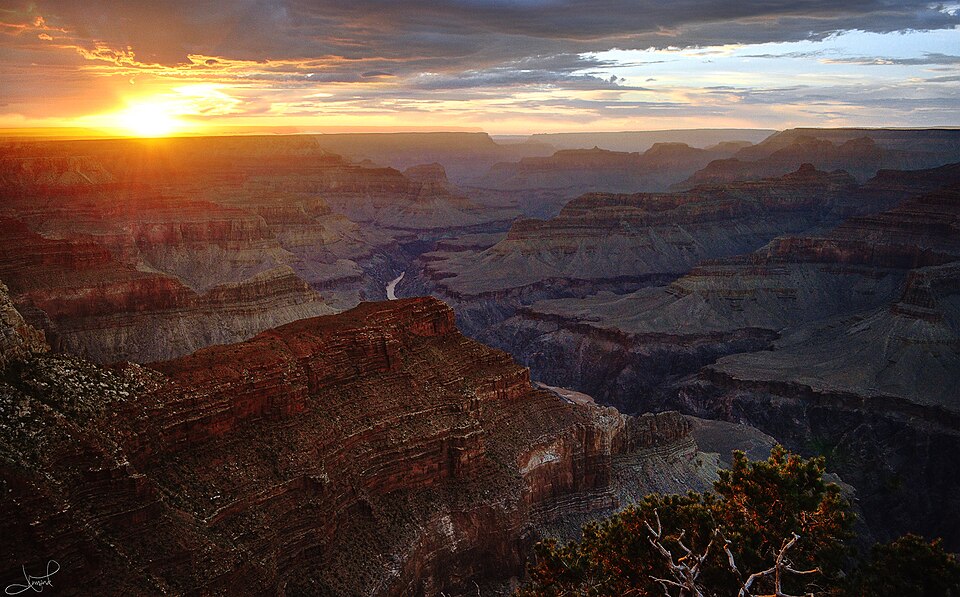
An 11-kilometre road running west from Grand Canyon Village, with nine viewpoints — Powell Point, Mohave Point, Pima Point and, at the end, Hermits Rest, a stone cabin from 1914. Hopi Point has the widest view of the canyon and the most famous sunset on the South Rim.

Tip: From March to November, the road is closed to private cars, and only the free red shuttle bus runs, every 10–15 minutes, until an hour after sunset. Arrive at Hopi Point an hour before sunset. From Mohave Point you can see and hear the rapids of the Colorado River.

Admission:
free, bus free
Time needed:
2–3 h
Bright Angel Trail

Bright Angel Trail

Grand Canyon Village

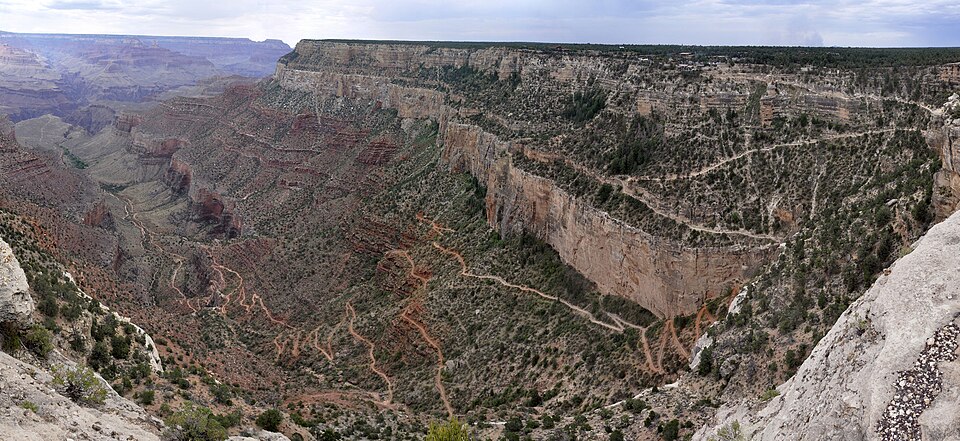
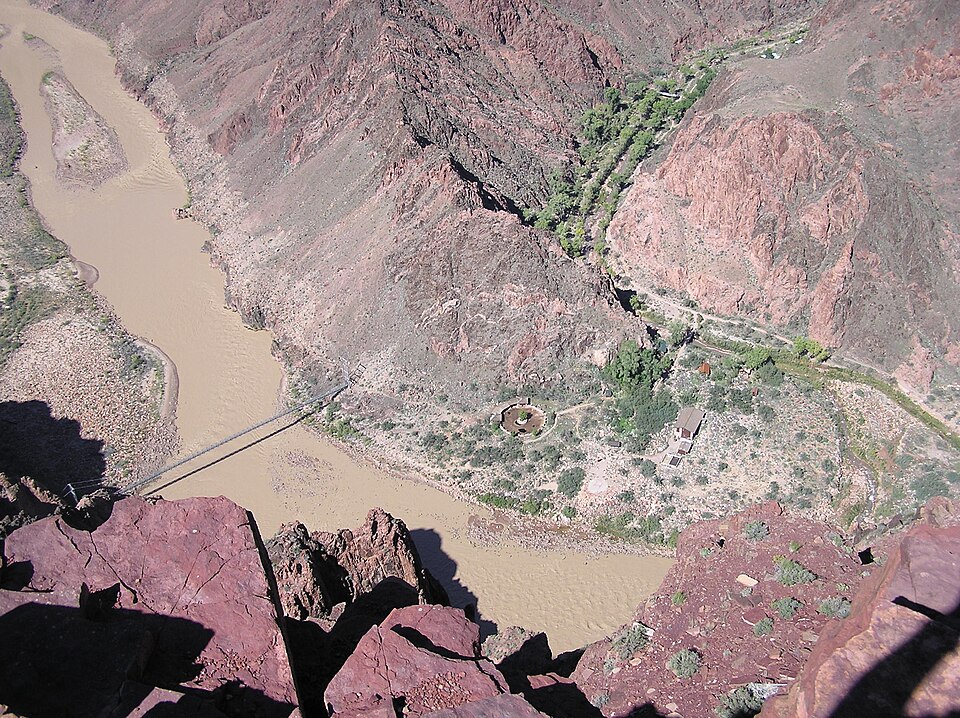
The main trail into the canyon, starting right in Grand Canyon Village and switchbacking down towards the river. Day hikers head to the 1.5 Mile or 3 Mile Resthouse for water and shade, or as far as Havasupai Gardens, with its cottonwoods and stream, 7.5 kilometres and 900 metres below the rim.

Tip: The return trip takes twice as long as the descent — plan on 2 hours up for every hour down. In summer, set off at dawn and be heading back up by 11am. Water at the rest stops only runs from May to September and the pipes often break, so always carry your own.

Admission:
free
Time needed:
3–8 h
South Kaibab Trail and Ooh Aah Point

South Kaibab Trail and Ooh Aah Point

Yaki Point

A steeper ridgeline trail that, unlike Bright Angel, doesn't follow a ravine but runs along a promontory with views to both sides from the first minute. Ooh Aah Point is 1.5 kilometres and 200 metres down; Cedar Ridge is 2.5 kilometres. It starts at Yaki Point, reachable only by shuttle bus.

Tip: For a short hike, this is the best trail in the park — in 2 hours there and back you'll see more than anywhere else. There's no water or shade on the trail, only morning shade in summer. Ooh Aah Point is loveliest at sunrise; the first orange Kaibab shuttle runs an hour before dawn.

Admission:
free
Time needed:
2–4 h
Desert View Watchtower

Desert View Watchtower

Eastern South Rim

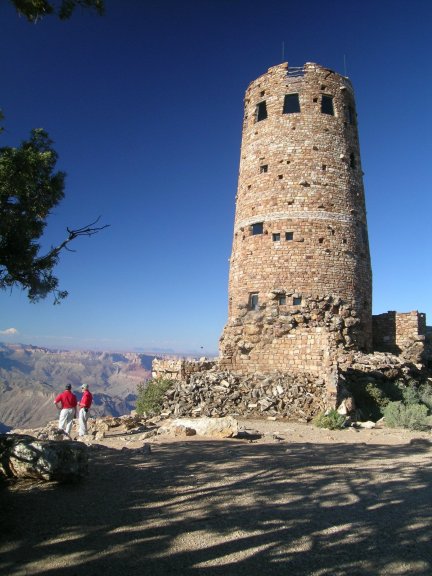
A 20-metre stone tower at the eastern end of the South Rim, built in 1932 by architect Mary Colter in the style of Puebloan structures. Inside are paintings by Hopi artist Fred Kabotie. From the roof you can see the bend of the Colorado River and the Painted Desert.

Tip: The tower is 40 kilometres from the village along Desert View Drive, which has six viewpoints — Grandview, Moran and Lipan are the best. Along the way stands the Tusayan Pueblo ruin with a small museum. If arriving from the east from Page, this is the first place you'll see the canyon.

Admission:
included in park entry
Time needed:
1 h
Grand Canyon Village

Grand Canyon Village

Central South Rim

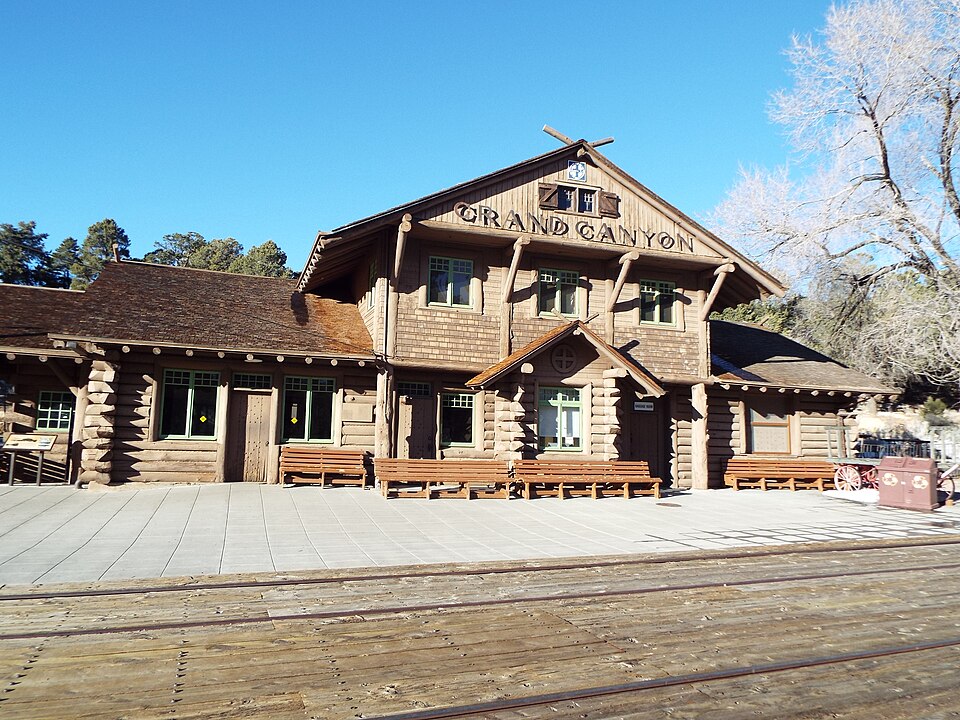
The historic heart of the South Rim, with the 1905 El Tovar hotel, the log Bright Angel Lodge cabins, the Hopi House shop and the railway depot from Williams. Buildings designed by Mary Colter established the style later used throughout America's national parks. Mule rides start from here.

Tip: Breakfast or a drink on the El Tovar terrace with its canyon view costs half of what a night at the hotel does, for a similar experience. Kolb Studio, on the edge of the Bright Angel Trail, houses a gallery from the Kolb brothers, who photographed the canyon from 1904 onward. Parking in the village fills up by 10am in summer, so arrive by bus.

Admission:
free
Time needed:
1–2 h
North Rim and Bright Angel Point

North Rim and Bright Angel Point

North Rim

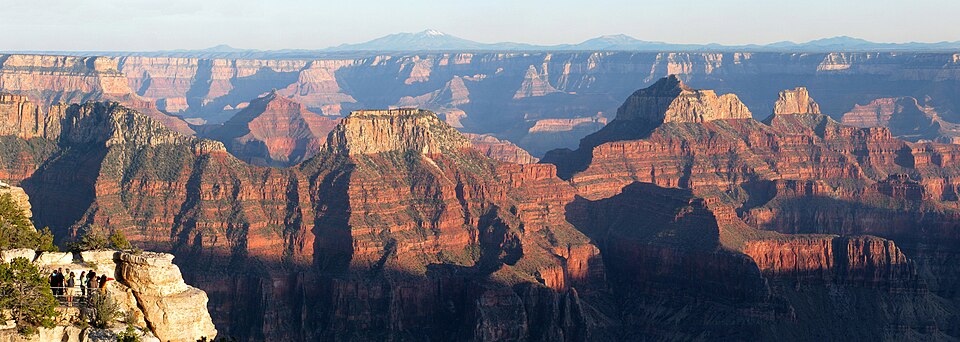
The northern edge of the canyon at 2,400 metres, surrounded by spruce and aspen forest, visited by only a tenth of the park's guests. A short trail leads to the Bright Angel Point promontory, overlooking a side canyon. Cooler and greener than the south, with a season running only from mid-May to mid-October.

Tip: The historic lodge on the North Rim burned down in a wildfire in July 2025, and some services remain closed — check nps.gov for what's open before you go. From the South Rim, it's a 5-hour drive via the bridge at Lees Ferry. The best route to the North Rim is via Utah through Kanab, combined with Zion and Bryce Canyon.

Admission:
included in park entry
Time needed:
half a day
Grand Canyon Skywalk

Grand Canyon Skywalk

Grand Canyon West

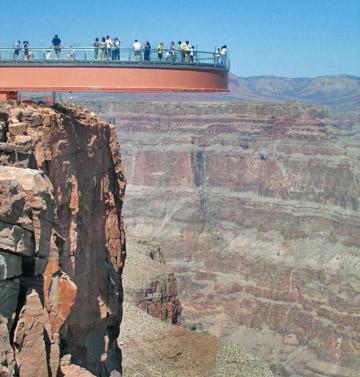
A glass horseshoe platform jutting 20 metres out over the canyon edge, 1,200 metres above the canyon floor, on Hualapai tribal land in the western canyon outside the national park. It's the closest point to Las Vegas, 2.5 hours' drive. The Grand Canyon West complex also has the Eagle Point and Guano Point viewpoints.

Tip: The Skywalk is expensive — admission comes only as part of the whole complex — and phones and cameras aren't allowed on the platform; staff sell photos instead. The canyon here is shallower and less dramatic than on the South Rim. It's really only worth it if you have just 1 day from Las Vegas and don't want to drive 4.5 hours south.

Admission:
$70–100 as part of a package
Time needed:
3 h

Photos: Mather Point — Grand Canyon National Park (CC BY 2.0) · Rim Trail and Yavapai — Grand Canyon National Park (CC BY 2.0) · Hermit Road and Hopi Point — tsaiproject from Canada (CC BY 2.0) · Bright Angel Trail — Jarek Tuszyński (CC BY-SA 4.0) · South Kaibab Trail and Ooh Aah Point — Notary137 at English Wikipedia (Public domain) · Desert View Watchtower — Rossstatham at English Wikipedia (CC BY 2.5) · Grand Canyon Village — Marine 69-71 (CC BY-SA 4.0) · North Rim and Bright Angel Point — Michael Quinn (National Park Service) (Public domain) · Grand Canyon Skywalk — Complexsimplellc at English Wikipedia (CC BY 2.5)

Where to stay

Areas and districts, matched to the kind of trip you are taking

Grand Canyon Village

Best for: first-time visits, sunrise and sunset

Historic hotels and cabins right on the canyon rim — El Tovar, Bright Angel Lodge, Thunderbird and Kachina. For sunrise, you just step outside and leave the car parked. Reservations open 13 months ahead and vanish within weeks for summer.

Tusayan

Best for: convenience, families

A town 11 kilometres south of the entrance, with chain hotels, restaurants, an IMAX cinema and a heliport for scenic flights. A free shuttle runs into the park in summer. The most sensible balance between price and distance.

Williams

Best for: Route 66, the train

A town on the historic Route 66, 95 kilometres south, with motels, diners and neon signs. The Grand Canyon Railway departs from here every morning for the South Rim village, taking 2.25 hours. Cheaper accommodation with atmosphere.

Flagstaff

Best for: city life, trips around Arizona

A university mountain town 130 kilometres south with an airport, breweries and the Lowell Observatory, where Pluto was discovered. A good base for combining with Sedona, Page and Monument Valley. It's 1.5 hours to the canyon.

Getting around

From the airport

Flying in from Europe usually means 1 stopover to Las Vegas (LAS) or Phoenix (PHX), most often via London, Frankfurt or Amsterdam; the journey takes around 15–18 hours. From Las Vegas, it's 450 kilometres (4.5 hours) to the South Rim via Hoover Dam and Kingman; from Phoenix, 370 kilometres (3.5 hours) via Flagstaff. The nearest major airport is Flagstaff (FLG), with flights from Phoenix and Dallas. Public transport to the park is almost non-existent — visitors rely on a rental car or organised tours from Las Vegas. Travellers to the US need an ESTA electronic travel authorisation.

Las Vegas Harry Reid (LAS) · 450 km

  • Rental car· 4 h 30 min· $50/day
  • Organised day trip· 14 h· $200
  • Scenic flight from Las Vegas· 1 h 15 min· $350

Phoenix Sky Harbor (PHX) · 370 km

  • Rental car· 3 h 30 min· $45/day
  • Groome Transportation shuttle via Flagstaff· 5 h· $90

Flagstaff Pulliam (FLG) · 130 km

  • Rental car· 1 h 30 min· $55/day
  • Groome Transportation shuttle· 2 h· $70

Around town

Free national park buses run along the South Rim on four routes: blue through the village, orange to Yaki Point and the start of the South Kaibab Trail, red along Hermit Road, and purple to Tusayan. Buses run every 10–15 minutes from dawn until an hour after sunset. By car, you can drive east along Desert View Drive. Parking in the village and at the visitor centre fills up by 10am in summer, so leave the car at the hotel and take the bus. It's a 5-hour drive between the South and North Rims. Helicopters fly over the canyon from Tusayan.

Free park shuttle busFour routes along the South Rim, every 10–15 minutes.
Rental carNeeded to reach the park and to drive Desert View Drive. · $50/day
Grand Canyon Railway trainFrom Williams to the village on the South Rim, once daily. · $80 round trip
Scenic helicopter flightFrom Tusayan over the canyon, 25–50 minutes. · $300

Useful apps: NPS App, Recreation.gov, Google Maps (offline), GasBuddy

When to go

Spring and autumn are best — April to May and September to October — with temperatures around 20 degrees on the rim and bearable heat for hikes into the canyon. Summer is the busiest and most expensive season, around 30 degrees on the rim, over 40 on the canyon floor, with afternoon lightning storms in July and August. Winter is cold and snowy, with night frosts, but a snow-dusted canyon is beautiful, crowds are thin and hotels are cheaper; trails can ice over, though, so traction devices help. The North Rim is closed from mid-October to mid-May.

Best time

April–May, September–October

What to avoid

July–August for hikes into the canyon

MonthJanFebMarAprMayJunJulAugSepOctNovDec
Day6°8°12°16°21°27°29°27°24°18°11°6°
Night-8°-7°-4°-1°3°7°11°10°7°1°-4°-8°
Rainy days555321894334

Food & drink

In the national park, dining is at hotel restaurants and cafeterias; the food is average and pricey. The best option is the El Tovar restaurant with its view, which requires a reservation. The Canyon Village Market supermarket has everything for a picnic or hiking sandwiches. Northern Arizona cuisine is Southwestern: chilli, beans, beef and dishes from Navajo and Hopi cooking. Navajo fry bread is the base of a Navajo taco. Tusayan and Williams have steakhouses and Route 66-style diners, while Flagstaff has breweries and better restaurants.

What to try

Navajo taco

Fried fry bread topped with beans, ground beef, lettuce, cheese and salsa. A Navajo Nation dish sold at roadside stands on the way to Desert View and Page.

Chilli con carne

A thick stew of beef, beans and chilli, served in a bowl with cheese and onion or in a bread bowl. The most filling meal in the park after a full day of hiking.

Prickly pear

Fruit of the prickly pear cactus with bright pink flesh, used for lemonade, syrup, ice cream and, above all, prickly pear margaritas. A signature Arizona flavour.

Arizona steak

Arizona is cattle country, and steakhouses in Tusayan and Williams serve beef from local ranches grilled over charcoal. Portions are huge.

American breakfast

Eggs with toast, pancakes with maple syrup, or a burrito, plus bottomless coffee refilled without asking. Portions last into the afternoon, so an $18 breakfast can double as lunch.

Burger and fries

Made from local beef in the mountain towns and costs $20–25. Staff will ask how you want it cooked: medium rare is red in the middle, medium is pink, well done is fully cooked through.

Craft beer

Colorado has the highest number of microbreweries per capita in the country, and their beers tend to be stronger than they look. At altitudes above 2,000 metres, alcohol takes effect noticeably faster, especially on the first evening after arrival.

What it costs

Vehicle entry to the park (7 days)

$35

Foreign-visitor surcharge from 2026, per person

$100

Annual America the Beautiful pass for foreign visitors

$250

Sandwich and coffee at Market Plaza

$15–20

Dinner at the El Tovar restaurant

$50–90

Scenic helicopter flight

$300–450

Train from Williams

$80–250

Night at a hotel in the park, for 2

$250–500

Indicative prices that change over time — treat them as a guide, not a price list.

Practical information

SocketsAtwo flat pins (US/JP)Btwo flat pins plus ground (US)
Voltage120V / 60Hz
Tap waterTap water is drinkable — Tap water is safe to drink across the United States, and restaurants will give it to you free with ice — just ask for "tap water". Buying bottled water is unnecessary and expensive — a bottle costs $2–3 in a shop, $5 near an attraction. It's worth carrying a refillable bottle, since airports and parks have filling stations. Ice is everywhere, and drinks are served noticeably colder than is typical in Europe.
TippingTipping isn't optional — it's part of staff wages. At a table-service restaurant, tip 18–20% of the pre-tax total; at a bar, $1 per drink; taxi and rideshare drivers 15%; housekeeping $3–5 a night; porters $2 a bag. Card terminals usually offer percentage buttons — watch out, as these are sometimes calculated on the total including tax. Sales tax is also added on top of the price shown on menus and shelves, running around 5% in Hawaii and 7% in Florida, so the final total is always higher than the sticker price.
Driving on theright
SafetyThe Grand Canyon is safe, but around 12 people die here every year and hundreds more need rescuing — almost always from underestimating the hike back up out of the canyon. Going down is easy, but climbing back up in the heat is not: the canyon floor tops 40 degrees in summer, while the rim sits around 30. Don't try to hike down to the river and back in 1 day — rangers explicitly advise against it. In summer, plan on a litre of water and salty food for every hour of walking. Not all sections of the rim have railings, and people have fallen while taking photos — never step past a barrier. The South Rim sits at 2,100 metres, and altitude fatigue can hit on the first day. Squirrels bite and carry disease — don't feed them.
Opening hoursThe South Rim is open year-round, 24 hours a day; the visitor centre at Mather Point is open from 8am to 5pm. The North Rim only has a season from mid-May to mid-October, and its historic lodge burned down in a 2025 wildfire — check nps.gov before travelling to see what's open on the north side. Restaurants in Grand Canyon Village close at 9pm, and the Canyon Village Market supermarket is open until 8pm.
Customs & etiquetteServers' conversational friendliness is a professional standard, not an invitation to chat. Queuing is respected, and personal space is larger than in Europe. Haggling only happens over cars and at flea markets, never elsewhere. Smoking is banned in practically all indoor spaces and on many beaches. Questions about salary and politics aren't raised with strangers. In Hawaii, local customs also apply: the aloha spirit means not pushing or rushing, shoes come off before entering a home, and sacred sites and stones must never be moved, even as a souvenir.
A few local wordsHello — Hi / Good morningThank you — Thank youThe bill, please — Check, pleaseJust looking, thanks — Just looking, thanksHow much is that with tax? — How much is it with tax?Tap water, please — Tap water, please

How to plan your days

1 day

Grand Canyon in 1 day

  1. 1Morning at Mather Point and the visitor centre.
  2. 2Walk the Rim Trail via Yavapai to Grand Canyon Village.
  3. 3Lunch at Bright Angel Lodge and Kolb Studio.
  4. 4Afternoon on the red shuttle bus along Hermit Road.
  5. 5Sunset at Hopi Point.

2 days

Grand Canyon in 2 days

  1. 1Day 1: Mather Point, the Rim Trail, the village and sunset at Hopi Point.
  2. 2Overnight in the park or in Tusayan.
  3. 3Day 2: at dawn, the South Kaibab Trail to Ooh Aah Point or Cedar Ridge.
  4. 4Afternoon drive along Desert View Drive with its viewpoints and the Tusayan ruin.
  5. 5Sunset at Desert View Watchtower, then head east towards Page.

3 days

Grand Canyon and northern Arizona in 3 days

  1. 1Day 1: the South Rim — viewpoints and sunset.
  2. 2Day 2: morning on the Bright Angel Trail to 3 Mile Resthouse, afternoon at Desert View.
  3. 3Day 3: drive to Page — Horseshoe Bend and Antelope Canyon.
  4. 4Sunset over Lake Powell.
  5. 5Continue on to Monument Valley or back to Las Vegas.

Day trips

Horseshoe Bend and Antelope Canyon

225 km · 2 h 30 min by car

2 icons near the town of Page. Horseshoe Bend is where the Colorado River carves a perfect horseshoe bend 300 metres below the cliff edge, a 1-kilometre walk from the car park. Antelope Canyon is a narrow slot canyon of wavy sandstone where shafts of light fall through; entry is only with a Navajo guide, and booking weeks ahead is essential.

Sedona

180 km · 2 h by car

A town among red sandstone cliffs, one of the prettiest in Arizona, with hikes to rock arches, the Chapel of the Holy Cross built into the rock, and the Airport Mesa viewpoint for sunset. The route runs through Flagstaff and Oak Creek Canyon. Sedona has galleries, spas and good restaurants.

Las Vegas

450 km · 4 h 30 min by car

A casino city in the Nevada desert, where most canyon visitors arrive from and return to after their loop. Along the way lies Hoover Dam on the Arizona–Nevada border and the longest surviving stretch of Route 66, through Seligman. Scenic flights over the canyon also depart from Las Vegas.

Frequently asked questions

How much does entry to the Grand Canyon cost in 2026?+

A vehicle pass for 7 days costs $35. From 1 January 2026, foreign visitors aged 16 and over pay a $100 per-person surcharge at Grand Canyon and 10 other of the most-visited national parks, and the annual America the Beautiful pass for foreign visitors costs $250. If you're visiting several parks, the annual pass pays off. Check current prices at nps.gov.

Is the South Rim or the North Rim better?+

For a first visit, the South Rim — it's open year-round, has the most viewpoints, hotels and buses, and is closer to both Las Vegas and Phoenix. The North Rim is quieter and greener but only open in summer, with limited services after the 2025 fire. Grand Canyon West with the Skywalk is a tourist attraction outside the national park.

Is 1 day enough for the Grand Canyon?+

For the South Rim viewpoints, yes. But the best light is at sunrise and sunset, and anyone arriving on a day trip misses both. Staying 1 night in the park or in Tusayan makes a huge difference. Allow 2 days if you want to hike into the canyon and visit Desert View.

Can I hike down to the river and back in 1 day?+

Rangers strongly advise against it — it's over 20 kilometres with 1,400 metres of elevation change, and summer heat on the canyon floor tops 40 degrees. Hundreds of people need rescuing every year because of it. Reaching the river takes 2 days with an overnight at Phantom Ranch or Bright Angel Campground, both booked through a lottery.

Where should I stay in the park, and when should I book?+

The park has the El Tovar, Bright Angel Lodge, Kachina, Thunderbird, Maswik and Yavapai Lodge hotels. Reservations open 13 months in advance and sell out fast for summer. Alternatives are hotels in Tusayan, 11 kilometres from the entrance, and motels in Williams.

How can I get to the Grand Canyon without a car?+

The easiest way is on an organised trip from Las Vegas or Phoenix, or via the Groome Transportation shuttle from Flagstaff and Phoenix. The Grand Canyon Railway runs from Williams to the village. Free buses operate within the park. Without a car, though, you can't reach Desert View or the surrounding sights.

Is a helicopter flight worth it?+

For a bird's-eye view, yes, but flights above the national park are restricted to marked corridors and can't drop below the rim. A flight from Tusayan lasts 30 to 50 minutes and costs $300–450. From Las Vegas, flights go over the western canyon and sometimes land on the floor on Hualapai land.

What should I pack for a hike into the canyon?+

At least 2–4 litres of water per person, salty snacks, a hat, sunscreen and sturdy shoes. Set off at dawn and be heading back up before noon. In winter and spring the upper sections ice over, so traction devices are useful. Plan for the climb up to take twice as long as the descent.

Visa Requirements

Check the latest visa requirements for entering this country. Some nationalities may need to apply for a visa or e-visa before travel.

Check visa requirements

Language

English

Currency

USD

Timezone

GMT-7

Dial Code

+1

Population

335M

Area

9,833,520 km²

Voltage

120V / 60Hz

Driving Side

Right

Top Hotels in Grand Canyon

Live prices from 500+ properties

Loading hotels...

Planning a trip to Grand Canyon?

Compare hundreds of hotels, find the best price, and book with free cancellation on TravelManiac.