Hotels in Rimini

Fifteen kilometers of sand and a Roman city behind it

Rimini

LanguageItalian
CurrencyEUR
TimezoneEurope/Rome
Temperature10-30 °C
Dial Code+39
Population59M
Area301,340 km²
SocketsType C / Type F / Type L
Tap waterDrinkable

Discover Rimini

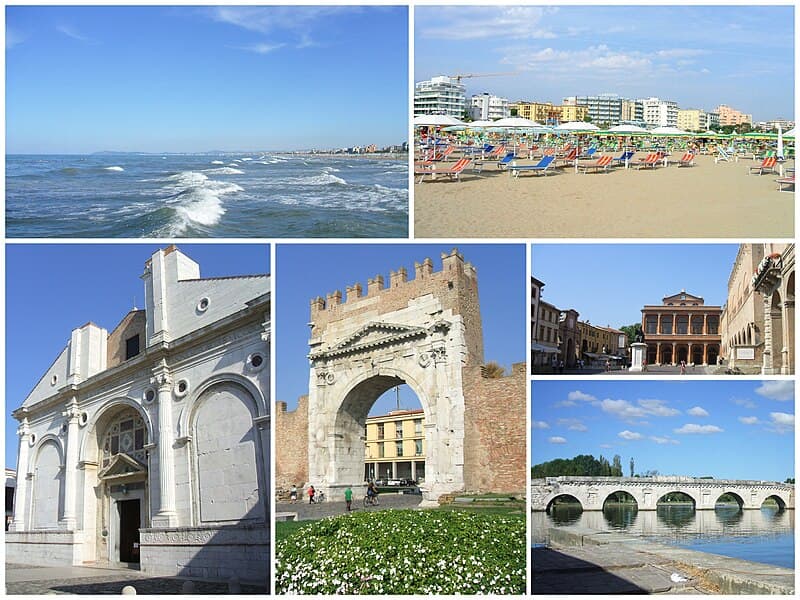
Rimini is Italy's largest seaside resort, and it operates in two layers that barely overlap. The first is the coastline: fifteen kilometers of fine sand divided into two hundred fifty numbered beach sections, where you pay for a sunbed and the staff know regulars by name. The second is the old town, eight hundred meters from the water, founded by the Romans in 268 BC as Ariminum, where the Arch of Augustus and the Bridge of Tiberius still stand — a bridge that's still walked on today and is two thousand years old. Between the two lies the fishing quarter of Borgo San Giuliano with its painted houses, and Rimini still holds its reputation as Italy's dance-music capital, with a club scene that took off here in the 1960s. Federico Fellini was born here, and the city built him a museum. The beach is shallow with a gently sloping seabed, making Rimini a classic family destination, and the airport is just eight kilometers from the center.

What to see

The places worth your time in Rimini, and what to expect at each

Marina Centro beach

Marina Centro beach

Marina Centro

The main stretch of Rimini's beach opposite the center: fine light sand, a seabed sloping so gently that the water is still waist-deep a hundred meters from shore, and numbered beach sections called 'bagni' at each entrance. Each has its own bar, showers, playground and lifeguard, and offers sunbeds by the day or the week.

Tip: Sections with low numbers are closest to the center and priciest; from around number one hundred toward Miramare, prices drop by a third for the same sand. Free beach without sunbeds exists only in narrow strips between sections and near Riminiterme — look for the 'spiaggia libera' sign.

Admission:
sunbed and umbrella from 20 € per day
Time needed:
all day
Bridge of Tiberius

Bridge of Tiberius

Ponte di Tiberio

Borgo San Giuliano

A five-arched bridge of Istrian stone completed in 21 AD under Emperor Tiberius. It has survived two thousand years, the Gothic Wars, and a German attempt to blow it up in 1944, and pedestrians still cross it today — the oldest functioning bridge in Italy.

Tip: In 2017 the area around the bridge was flooded to create a pool in which the bridge now reflects. The best shot is from below, at Marecchia park, an hour before sunset — not from the bridge itself.

Admission:
free
Time needed:
30 min
Arch of Augustus

Arch of Augustus

Arco d'Augusto

Old town

A triumphal arch from 27 BC, the oldest surviving Roman arch of its kind anywhere. It stands where the Via Flaminia from Rome entered the city, and its unusually wide passage meant the town had no defensive gate as such — it was a symbol of peace.

Tip: The Arch and the Bridge of Tiberius are linked by Corso d'Augusto, the roughly kilometer-long main axis of the old town. Walking it end to end from the arch to the bridge takes fifteen minutes and is the easiest way to see all the main sights in sequence.

Admission:
free
Time needed:
20 min
Tempio Malatestiano

Tempio Malatestiano

Old town

A cathedral rebuilt in the fifteenth century by Leon Battista Alberti for Sigismondo Malatesta into a Renaissance temple, its facade shaped like a Roman arch and its interior bearing Sigismondo's initials and portraits of his mistress in place of saints. The Pope declared it a pagan temple and excommunicated Sigismondo.

Tip: In the chapel on the right is a fresco by Piero della Francesca and a crucifix attributed to Giotto — both without a queue and without an entry fee. The church closes for a midday break from half past twelve to half past three, so visit in the morning or early evening.

Admission:
free
Time needed:
45 min
Borgo San Giuliano

Borgo San Giuliano

Borgo San Giuliano

A fishing quarter across the Bridge of Tiberius, with low colorful houses, narrow lanes, and murals referencing Fellini's films and the neighborhood's old way of life. As recently as the 1950s it was the poorest part of the city; today it's the best place in Rimini for dinner.

Tip: The murals are refreshed every two years during the Festa de Borg in September, when the quarter turns into one giant street party. Restaurants here charge about a third less than on the waterfront and cook Romagna dishes rather than a tourist menu.

Admission:
free
Time needed:
2 h
Castel Sismondo

Castel Sismondo

Old town

A fortress built in 1437 by Sigismondo Malatesta, who according to accounts of the time consulted Filippo Brunelleschi during its construction. Only the inner section of the original fortification survives, since the moats were filled in and the outer walls torn down in the nineteenth century. It now houses the Federico Fellini Museum.

Tip: The museum ticket also covers the section in Palazzo Valloni across the square, so plan to visit both buildings. The strongest part is upstairs in the castle, projected into mirrored halls — set aside an extra hour for it.

Admission:
from 12 € (combined ticket)
Time needed:
2 h
Domus del Chirurgo

Domus del Chirurgo

Old town

The remains of a late-second-century Roman house, uncovered in 1989 during the construction of a parking lot. It belonged to a physician of Greek origin and yielded the most complete set of surgical instruments found anywhere in the ancient world — over one hundred fifty pieces, including a tool for extracting arrowheads from wounds.

Tip: The excavation is covered over on Piazza Ferrari, while the instruments themselves are displayed in the city museum a block away, and one ticket covers both. Without the museum, the excavation alone tells you little — plan on it as a single visit spanning two buildings.

Admission:
from 7 €
Time needed:
1.5 h
Italia in Miniatura

Italia in Miniatura

Viserba, 6 km north

A park with two hundred seventy scale models of Italian buildings at 1:25, plus a complete miniature Venice you tour by boat. Besides the models there's a monorail, water rides, and an exhibit on the human body. Open from April to early November.

Tip: It sits six kilometers north near Viserba, reached by city bus number 8. A ticket bought online in advance is noticeably cheaper than at the gate, and in July and August it's worth arriving right at opening — after eleven the queue for the boat ride through 'Venice' can top an hour.

Admission:
from 24 €, children from 18 €
Time needed:
half a day
Federico Fellini Museum

Federico Fellini Museum

Museo Fellini

Old town

A museum opened in 2021 across three connected sites: Castel Sismondo, Palazzo Valloni, and the square between them, which is itself part of the exhibition. It's not a collection of props but a walk through scenes from the films, with sound, projections, and furniture you're invited to sit on.

Tip: Fellini was born in Rimini and portrayed the city of his childhood in the film Amarcord — anyone who's seen it beforehand gets twice as much out of the museum. On Piazza Malatesta hangs a giant veil and a bench with a phone that plays voices from his films; that part is outdoors and free.

Admission:
from 12 €
Time needed:
2–3 h

Photos: Marina Centro beach — Giorgio Galeotti (CC BY 4.0) · Bridge of Tiberius — Heiko Trurnit (CC BY-SA 2.5) · Arch of Augustus — Il Malatestiano (CC BY-SA 4.0) · Tempio Malatestiano — Michele1978rimini (Public domain) · Borgo San Giuliano — SilviaSanchini1983 (CC BY-SA 4.0) · Castel Sismondo — Oleh Kushch (CC BY-SA 4.0) · Domus del Chirurgo — Capvalerio85 (CC BY-SA 4.0) · Italia in Miniatura — Italiainminiatura (CC BY-SA 3.0) · Federico Fellini Museum — Lorenzo Gaudenzi (CC BY-SA 4.0)

Where to stay

Areas and districts, matched to the kind of trip you are taking

Marina Centro

Best for: first-time visitors and reach to everything

The strip of hotels between the beach and the old town, with the most accommodation and the shortest distance to everything. Ten minutes on foot to the center, two minutes to the beach. In exchange, this is Rimini's most expensive area, and noise from the promenade carries into the night in August. Most visitors from abroad head here.

Old town

Best for: sightseeing and dinner without a tourist menu

The Roman core with Corso d'Augusto, the Arch and the Tempio, half an hour on foot from the sea. Accommodation here is in smaller hotels and apartments and tends to be cheaper than on the seafront. Good for anyone who doesn't need the beach right outside and doesn't mind a bus or bike ride to the water.

Rivazzurra, Miramare and the south

Best for: families and lower prices

The southern stretch of coast toward the airport, where the beach sections are quieter, hotels smaller, and prices a fifth to a third lower. Trolleybus 11 runs along the seafront to the center every ten minutes and takes twenty minutes. The airport is just a few minutes away, which means occasional aircraft noise.

Viserba and the north

Best for: a quieter stay and Italia in Miniatura

The northern resorts beyond the harbour, with their own promenades and a family character. The beach is just as wide and sandy, hotels are fewer, and evenings are quiet. Bus and train both reach Rimini, but without a car it feels a bit cut off. Italia in Miniatura and the Riccione aquarium are nearby.

Getting around

From the airport

Rimini has its own international airport, Federico Fellini, eight kilometers south of the center, served by charter flights in summer, including seasonal connections from Prague. Outside the season, options are limited and most journeys route through Bologna, an hour from Rimini by train, or through Venice. Rimini is reachable by train from across Italy, with the station just ten minutes on foot from the beach. By car it's about a thousand kilometers from Prague via Austria and the Brenner Pass, twelve to thirteen hours with stops; Italian motorways charge tolls collected on exit.

Federico Fellini Airport (RMI) · 8 km

  • Trolleybus 9 to the center· 25 min· 1.50 €
  • Taxi· 15 min· 25 €
  • Hotel transfer· 20 min· 15 € per person

Bologna Guglielmo Marconi (BLQ) · 120 km

  • Marconi Express plus train to Rimini· 1 h 45 min· 20 €
  • Direct bus· 2 h· 20 €
  • Rental car via the A14 motorway· 1 h 20 min

Ancona Falconara (AOI) · 95 km

  • Train from Falconara to Rimini· 1 h 15 min· 10 €
  • Rental car· 1 h

Around town

Rimini is walkable if you're staying in Marina Centro: two minutes to the beach, ten to the old town. Trolleybus line 11 runs the full fifteen-kilometer length of the coast, linking the northern and southern resorts to the center and the station, every ten minutes in season. Since 2019 a fast line called Metromare has also run on a dedicated lane between Rimini and Riccione, quicker than driving. A bicycle is actually the best option — the coast is flat and cycle paths run its whole length; rental shops charge from ten euros a day. A car is more hindrance than help in the center, with paid parking that's hard to find in August.

Trolleybus 11 along the coastThe backbone route from Riccione to the northern resorts via the center and the station, running from 6 a.m. to midnight. · 1.50 € per ticket
MetromareA bus on a dedicated lane between Rimini and Riccione, seventeen minutes with no traffic delays. · 1.50 €
BicycleA coastal cycle path runs the full length of the beach and is flat. The fastest way to get around in season. · 10 € per day
Train along the coastRegional trains stop at Riccione, Cattolica and Cesenatico, cheaper and faster than the bus. · 2.50 €
TaxiRanks at the station and on the promenade; otherwise booked by phone. Ride-hailing apps barely function here. · 10 € for a ride in the center

Useful apps: Google Maps, Trenitalia, Start Romagna, moovit

When to go

The season runs from May to September, with the biggest crush in late July and August, when Italians themselves are on holiday and hotel prices double. The sea warms to a pleasant 20°C by late May and stays warm through the end of September. The best balance is June and the first half of September: warm weather, full services, and prices half those of August. In July and August the Adriatic gets muggy, with afternoon thunderstorms several times a month. Out of season, Rimini is effectively a closed town — from November to March most hotels and beach sections shut down.

Best time

June and the first half of September

What to avoid

mid-August around the Ferragosto holiday, when it's busiest and priciest

MonthJanFebMarAprMayJunJulAugSepOctNovDec
Day8°9°13°18°23°27°30°30°25°20°14°9°
Night1°1°4°8°13°17°19°19°16°12°7°3°
Rainy days777876456798
Sea11°10°11°14°19°23°26°26°24°20°16°13°

Food & drink

Romagna cuisine is hearty and meat-forward rather than seafood-focused: the staple is piadina, a thin flatbread cooked on a griddle and filled with squacquerone cheese and rocket or ham, along with homemade pastas like cappelletti and strozzapreti. Rimini certainly has fish, but the best is found in simple places along the harbour canal, not on the promenade. Eating cheaply means a piadineria or a spot in Borgo San Giuliano; restaurants with sea views are the expensive option. Sangiovese from the hills behind the city is the wine to drink with it all.

What to try

Piadina

A flatbread of flour, water and lard cooked on a hot stone, filled with cheese, ham or vegetables. It costs three to five euros at a piadineria and is the cheapest lunch in Rimini. You can tell a good one because it's only griddled after you order.

Strozzapreti al ragù

Hand-twisted pasta with a meat sauce simmered for hours. The name translates as 'priest-choker', and Romagna has several legends about where it comes from; every trattoria serves it, and it's the safest thing to order.

Cappelletti in brodo

Small stuffed pasta parcels in meat broth, a traditional Sunday and Christmas dish. In summer only some places have it on the menu, which is a sign the kitchen cooks home-style rather than for tourists.

Brodetto riminese

A fish soup made from several kinds of fish, added in stages according to how long each needs to cook. Served with toasted bread, it's a dish that comes from the fishermen of the harbour canal, not the promenade restaurants.

Squacquerone

A soft, spreadable cow's-milk cheese with protected origin status, smeared onto piadina with fig jam. Buy it at the market on Piazza Cavour — in a supermarket it's the one thing worth bringing home.

Sardoncini alla griglia

Small grilled sardines with olive oil and lemon, a classic Adriatic starter. Priced per portion, not by weight, at around ten euros — a good test of whether a place knows how to handle fish.

Sangiovese di Romagna

A red wine from the hills behind Rimini, lighter than the Tuscan version. The house carafe wine costs around six euros for half a liter and is perfectly drinkable; a bottle from a winery near Santarcangelo is in a different league.

Ciambella

A dry ring-shaped cake that in Romagna is dunked in wine or coffee. Sold by weight in every bakery, it's the only local dessert worth buying outside a proper pastry shop.

What it costs

Espresso at the counter

1.20–1.50 €

Piadina

3–5 €

Lunch at a trattoria

15–22 €

Dinner with fish

35–50 € per person

Beer, 0.4 l

5–6 €

Sunbed and umbrella per day

20–35 €

Italia in Miniatura

from 24 €

Night in a 3-star hotel, half-board

70–130 € per double

Indicative prices that change over time — treat them as a guide, not a price list.

Practical information

SocketsCEuroplug, two round pinsFSchukoLItalian
Voltage230V / 50Hz
Tap waterTap water is drinkable — Tap water in Italy is drinkable and monitored more strictly than bottled water, including at the public drinking fountains found on squares — in Rome they're called 'nasoni', and every larger city has hundreds. A sign reading 'acqua non potabile' means the opposite and appears only on fountains in old parks. Restaurants don't offer tap water; the server automatically brings bottled and asks 'naturale, o frizzante?' — still or sparkling.
TippingTipping in Italy isn't done as a percentage the way it is in the US. Restaurant bills usually include a 'coperto', a cover charge for the table setting and bread, typically two to three euros per person — this stands in for a tip. When service is excellent, people round up or leave a few euros on the table. Nothing is left at a café. Card terminals usually have no tip prompt.
Driving on theright
SafetyItaly is a safe country and violent crime rarely touches tourists. The real risks are pickpocketing in crowds, at metro exits, and around crowded sights, plus theft from parked cars — nothing visible should be left in a car parked on the street, not even an empty bag. In the south and in tourist hubs, watch for bills padded with items you didn't order; a price list must be clearly posted. The emergency number 112 works and operators speak English.
Opening hoursIn the resorts, shops open from nine until late in the evening during the season, many even on Sundays, often skipping the midday break. Out of season, though, the resort largely shuts down: from November to March only a fraction of businesses stay open. Restaurants serve dinner from half past seven, filling up around nine. Beach services run from May to mid-September; outside that window the beaches are free and without sunbeds.
Customs & etiquetteCappuccino is drunk only in the morning — ordering one after lunch is the clearest tourist tell; espresso follows a meal instead. Coffee at the counter costs a fraction of the price at a table, and price lists usually show both columns. Churches require covered shoulders and knees above the knee, and the larger basilicas enforce this at the door. Walking around town in swimwear isn't done, and seaside resorts can fine you for it. Keep your receipt — Italian law technically fines the customer too for leaving without one.
A few local wordsGood day — BuongiornoThank you — GraziePlease — Per favoreThe bill, please — Il conto, per favoreCheers — SaluteGoodbye — Arrivederci

How to plan your days

1 day

A day in Rimini

  1. 1Morning on Marina Centro beach, before the sun gets strongest.
  2. 2Lunch at a piadineria on the way to the old town.
  3. 3Corso d'Augusto from the Arch of Augustus to the Tempio Malatestiano.
  4. 4The Bridge of Tiberius and a stroll through Borgo San Giuliano.
  5. 5Dinner at one of the trattorias in the quarter, then back to the promenade.

2 days

Two days with Fellini

  1. 1Day one as above.
  2. 2Morning at the Federico Fellini Museum in Castel Sismondo and Palazzo Valloni.
  3. 3Lunch at the market on Piazza Cavour.
  4. 4Afternoon at the Domus del Chirurgo and the city museum's surgical instruments.
  5. 5Late afternoon on the beach and an aperitivo on the promenade before dinner.

3 days

Three days with a day trip

  1. 1First two days as above.
  2. 2Morning by bus or car to San Marino, up to the three towers.
  3. 3Lunch in the old town up top, back to the sea in the afternoon.
  4. 4Or, instead of San Marino, take the train to Ravenna for the Byzantine mosaics.
  5. 5With kids, an alternative is a full day at Italia in Miniatura or the aquarium in Riccione.

Day trips

San Marino

25 km · 50 min by bus

The world's oldest republic, perched atop Mount Titano, half an hour's drive and seven hundred meters of elevation from Rimini. Three fortress towers connected by a ridge path, views out to the Adriatic, and duty-free shops that draw half its visitors. A bus leaves from Rimini's train station every hour.

Ravenna

55 km · 1 h by train

Eight UNESCO-listed buildings with fifth- and sixth-century Byzantine mosaics unmatched anywhere else in Europe. The Mausoleum of Galla Placidia, with its star-studded blue vault, is the most striking, and entry is time-limited. The town also holds Dante's tomb — he died here in exile.

Santarcangelo di Romagna

12 km · 20 min by train

A hilltop town ten minutes by train from Rimini, beneath which lie over two hundred underground caves carved into the sandstone, used for centuries to age wine. Up top stands the Malatesta castle; down below are trattorias serving Romagna cooking at half the coastal prices.

Frequently asked questions

Does Rimini have sandy beaches and shallow water?+

Yes, all fifteen kilometers of coastline are fine sand and the seabed slopes very gently — even a hundred meters from shore the water is often only waist-deep. That's exactly why Rimini is such a typical destination for families with small children. The downside is that the water in the shallows isn't as clear as on a rocky coast.

Do you have to pay for the beach in Rimini?+

Almost everywhere, yes. The coast is divided into numbered sections called 'bagni', and a sunbed with an umbrella costs from twenty euros a day, working out considerably cheaper by the week. Free beach without services exists only in narrow strips between the sections, marked with a 'spiaggia libera' sign.

How far is it from the airport to the center?+

Eight kilometers. Trolleybus number 9 reaches the center in twenty-five minutes and a ticket costs around a euro and a half; a taxi costs around twenty-five euros and takes a quarter of an hour. Hotels in Marina Centro often offer their own transfer, booked in advance.

Is it worth having a car in Rimini?+

Not for a beach stay. A trolleybus, line 11, runs along the coast every ten minutes, and there are trains to Ravenna or Santarcangelo and buses to San Marino for day trips. Parking in the center is paid and hard to find in August. A car only makes sense for a road trip through inland Romagna.

What can you do in Rimini when it rains?+

The Federico Fellini Museum takes half a day and is split across two buildings; the Domus del Chirurgo is covered, and the city museum with Roman finds is right next door. The aquarium in Riccione is fifteen minutes by train. The shopping street Corso d'Augusto runs under covered arcades.

How far is San Marino and how do I get there?+

Twenty-five kilometers. A direct bus leaves from Rimini's train station roughly every hour, the journey takes fifty minutes, and a return ticket costs around ten euros. By car it's half an hour, but you park below the town and take a cable car or walk up.

Is Rimini noisy?+

In Marina Centro in August, yes — the promenade stays lively into the night, and the club scene here dates back to the 1960s. Those wanting quiet stay in the northern resorts near Viserba or the southern stretch near Rivazzurra, which have the same beach but a quiet evening. In the old town it's calm after ten.

When is the sea in Rimini warm enough to swim?+

From late May, when it reaches around 20°C, through the end of September. It's warmest in August, around 26°C. The shallow seabed means the water warms up faster than on a deep coastline, but it also stays cloudy for a while after a storm.

Visa Requirements

Check the latest visa requirements for entering this country. Some nationalities may need to apply for a visa or e-visa before travel.

Check visa requirements

Language

Italian

Currency

EUR

Timezone

Europe/Rome

Dial Code

+39

Population

59M

Area

301,340 km²

Voltage

230V / 50Hz

Driving Side

Right

Top Hotels in Rimini

Live prices from 500+ properties

Loading hotels...

Planning a trip to Rimini?

Compare hundreds of hotels, find the best price, and book with free cancellation on TravelManiac.