Hotels in Sicily

An island layered with three thousand years of conquerors

Sicily

LanguageItalian
CurrencyEUR
TimezoneEurope/Rome
Temperature10-30 °C
Dial Code+39
Population59M
Area301,340 km²
SocketsType C / Type F / Type L
Tap waterDrinkable

Discover Sicily

Sicily is the largest island in the Mediterranean and can't be done in a week — it's two hundred and fifty kilometres and four hours' drive from Palermo to Syracuse. Over three thousand years, Greeks, Carthaginians, Romans, Arabs, Normans, Spaniards and Bourbons swept through the island, and each left something behind: the Greek temples at Agrigento are better preserved than most in Greece, the cathedral at Monreale carries Byzantine mosaics across six thousand square metres, and the baroque towns of the southeast were rebuilt entirely in a single style after the 1693 earthquake. Above it all stands Etna, Europe's tallest active volcano at three thousand three hundred metres, which erupts several times a year. The beaches vary — sandy in the south and around San Vito, pebbly and rocky in the east below Taormina. There are two major airports, in Catania and Palermo, and Sicily is difficult without a car.

What to see

The places worth your time in Sicily, and what to expect at each

Etna

Etna

southern slope, Rifugio Sapienza

Europe's tallest active volcano, three thousand three hundred metres high and constantly active — it goes through several eruptive episodes a year and its height changes by tens of metres each time. A cable car and off-road vehicles run up the southern side to two thousand nine hundred metres, from where the summit craters are reached with a guide.

Tip: Even in August it's around ten degrees up there with wind — a jacket and sturdy shoes aren't overkill, and both can be rented on site. The path to the summit craters is only allowed with a certified guide, and it closes during periods of higher activity even with a ticket already bought; the status is checked each morning.

Admission:
cable car and vehicle from 90 €
Time needed:
full day
Valley of the Temples, Agrigento

Valley of the Temples, Agrigento

Valle dei Templi

Agrigento

Eight Doric temples from the fifth century BC on a ridge above Agrigento, including the best-preserved Greek temple anywhere outside Athens — the Temple of Concordia, which survived only because it was converted into a church in the sixth century. The site covers three kilometres and is UNESCO-listed.

Tip: The site has no shade and can hit thirty-five degrees at midday — go right at opening at half past eight, or take the evening tour with lighting, which in summer runs until eleven at night. There are two entrances with a shuttle running between them; otherwise you climb the hill back up.

Admission:
from 12 €
Time needed:
3–4 h
Taormina and its ancient theatre

Taormina and its ancient theatre

east coast

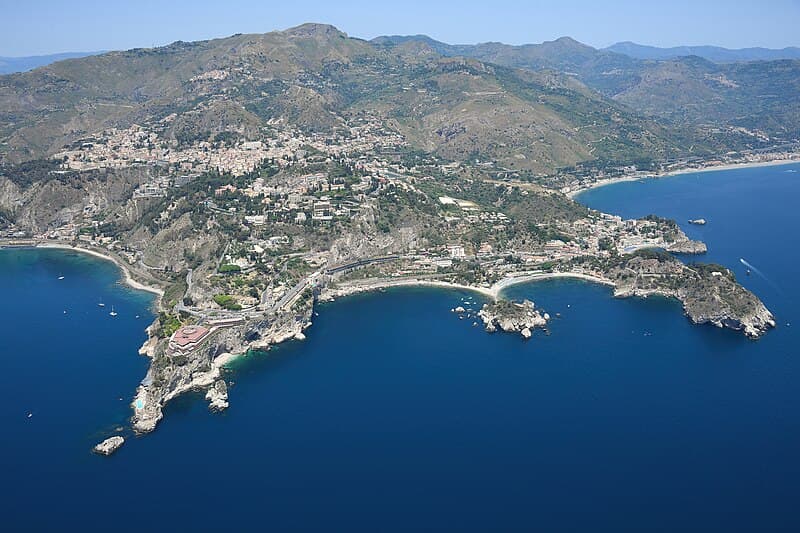
A town on a cliff two hundred metres above the sea, with a Greek theatre from the third century BC whose stage frames Etna and the sea at once. The main street, Corso Umberto, runs three-quarters of a kilometre and is packed with shops; below town lies Isola Bella beach, with an islet joined to shore by a sand spit.

Tip: You can't really reach Taormina by car — the Lumbi car park above town is the only sensible option, with a shuttle bus from there. A cable car runs down to Isola Bella beach for a few euros; on foot it's twenty minutes down and forty steeply back up.

Admission:
theatre from 14 €
Time needed:
full day
Monreale Cathedral

Monreale Cathedral

Monreale, above Palermo

A Norman cathedral from 1174 above Palermo, its interior covered in six thousand four hundred square metres of golden Byzantine mosaics — the second-largest such surface in the world after Hagia Sophia. Next door is a monastic cloister with two hundred and twenty-eight columns, no two decorated alike.

Tip: Eight kilometres above Palermo; city bus 389 runs there from Piazza Indipendenza. The mosaics are lit only at certain hours, and without the light you see a fraction of them — go between nine and half past ten, or after half past two in the afternoon.

Admission:
cathedral free, cloister from 6 €
Time needed:
2–3 h
Ortigia and Syracuse

Ortigia and Syracuse

Syracuse

The island core of Syracuse, joined to the mainland by three bridges: the baroque Piazza Duomo, with a cathedral built directly into the Doric temple of Athena, whose columns still show in the walls; the freshwater spring of Arethusa with its papyrus right by the sea; and a fish market that looks more Arab than Italian in the morning.

Tip: The Neapolis excavations with the Greek theatre and the Ear of Dionysius are on the other side of town and need a separate ticket — treat them as a standalone half-day stop. There's nowhere to park on Ortigia; leave the car at the Talete car park by the bridge.

Admission:
Neapolis from 13 €
Time needed:
full day
Cefalù

Cefalù

north coast

A fishing town seventy kilometres east of Palermo, below the two-hundred-and-seventy-metre La Rocca cliff, with a Norman cathedral from 1131 and a mosaic of Christ Pantocrator in the apse. The sandy beach begins right below the old town, a rarity on the north coast.

Tip: Climbing La Rocca takes an hour on steps that end at the ruins of the Temple of Diana and an Arab fortress; there's an entrance fee, and the last admission is roughly ninety minutes before closing. The best view of town is from the old harbour pier, not from the beach.

Admission:
La Rocca from 5 €
Time needed:
full day
Villa Romana del Casale

Villa Romana del Casale

Piazza Armerina, inland

A fourth-century Roman villa near Piazza Armerina in the middle of the island, buried by a landslide that ended up preserving it. It holds three and a half thousand square metres of mosaic floors, including the famous scene of girls in what looks like bikinis and a forty-metre corridor depicting the hunt for animals destined for Roman arenas.

Tip: It sits in the middle of the island where nothing else is — it makes most sense as a stop on the drive between north and south, not as a trip from the coast. The mosaics are viewed from raised walkways, so a pushchair works, but the roofing traps summer heat, so go in the morning.

Admission:
from 10 €
Time needed:
2 h
Scala dei Turchi

Scala dei Turchi

Realmonte, near Agrigento

A white cliff of soft limestone called marl, sculpted by sea and wind into stepped terraces dropping into turquoise water. It's named after the Saracen raiders said to have landed here. It lies fifteen kilometres from Agrigento near Realmonte.

Tip: Since 2020, walking directly onto the cliff has been banned because of erosion, and it's fenced off — fines are actually issued. Photos and swimming happen from Lido Rossello beach next door, from where the whole cliff is visible, and it looks best at sunset, when it turns pink.

Admission:
beach free
Time needed:
2–3 h
San Vito Lo Capo and the Zingaro reserve

San Vito Lo Capo and the Zingaro reserve

northwest

Sicily's best sandy beach, on the northwestern tip: a wide strip of white sand below the two-hundred-and-seventy-metre Monte Monaco cliff and shallow turquoise water. Just beyond starts the Zingaro nature reserve, seven kilometres of road-free coastline with coves reachable only on foot.

Tip: The reserve is entered from the northern gate at Scopello or the southern gate at San Vito, with no road for cars in between — allow five hours and two litres of water per person for the round trip, as nothing is sold inside. The first coves are twenty minutes from the entrance and tend to be empty before ten.

Admission:
reserve from 5 €
Time needed:
full day

Photos: Etna — BenAveling (CC BY-SA 4.0) · Valley of the Temples, Agrigento — Wolfgang Pehlemann (CC BY-SA 3.0 de) · Taormina and its ancient theatre — Carsten Steger (CC BY-SA 4.0) · Monreale Cathedral — Holger Uwe Schmitt (CC BY-SA 4.0) · Ortigia and Syracuse — Agostino Artnoir Sella (CC BY-SA 2.0) · Cefalù — Ludvig14 (CC BY-SA 4.0) · Villa Romana del Casale — Robur.q (CC BY-SA 3.0) · Scala dei Turchi — Monika Durickova (CC BY 2.0) · San Vito Lo Capo and the Zingaro reserve — Roberto Fontana from Mantova, Italia (CC BY 2.0)

Where to stay

Areas and districts, matched to the kind of trip you are taking

East: Taormina, Catania, Etna

Best for: a first visit and combining the sea with day trips

The most visited part of the island and the best base for a first trip. The Catania airport, Etna an hour's drive away, Taormina with its theatre and Syracuse with Ortigia all within reach. The beaches here, though, tend to be pebbly and black with volcanic sand rather than white. Prices in Taormina are among the highest on the island.

Northwest: Palermo, Cefalù, San Vito

Best for: towns, mosaics and sandy beaches

Palermo is a chaotic Arab-Norman city with the best street food in Italy, Cefalù an hour east combines a landmark with a sandy beach, and San Vito Lo Capo on the tip has the island's best sand. Distances here are bigger than they look — it's an hour and a half from Palermo to San Vito.

Southeast: Syracuse, Noto, Ragusa

Best for: baroque towns and a calmer stay

The Val di Noto, eight towns rebuilt after the 1693 earthquake in a unified baroque style and UNESCO-listed. Quieter and cheaper than the east, with long sandy beaches around Vendicari and Marzamemi. Without a car this part of Sicily is practically inaccessible.

South and interior: Agrigento, Piazza Armerina

Best for: antiquity and stopovers

The Valley of the Temples, Scala dei Turchi and Villa Romana del Casale — the island's most valuable monuments, but the landscape between them is stark and heats up to thirty-five degrees in summer. It's best visited for a night or two on a loop, not as a base for the whole holiday.

Getting around

From the airport

Sicily is served by two major airports: Catania in the east is closer to Etna, Taormina and Syracuse, Palermo in the northwest to Cefalù, San Vito and the western coast. In season there are direct flights from Prague to both; outside season you connect through Rome, Milan or Vienna. A third option is Trapani on the western tip, served by budget airlines. The distance between Catania and Palermo is two hundred and twenty kilometres, two and a half hours by motorway, so the choice of airport really decides where you'll spend your holiday. Ferries run from Naples and from the mainland across the Strait of Messina.

Catania Fontanarossa (CTA) · 7 km

  • Alibus to central Catania· 20 min· 4 €
  • Bus to Taormina· 1 h 20 min· 8 €
  • Rental car· available at the airport

Palermo Falcone Borsellino (PMO) · 35 km

  • Trinacria Express train to Palermo· 50 min· 6 €
  • Prestia e Comandè bus· 50 min· 6.30 €
  • Taxi to the centre· 40 min· 45 €

Trapani Birgi (TPS) · 15 km

  • Bus to Trapani and San Vito· 30 min to 1 h 30 min· 5 €
  • Rental car· available at the airport

Around town

Sicily works without a car, but it shrinks to three or four towns linked by coastal trains. The interior, Villa Romana del Casale, Scala dei Turchi and the Zingaro reserve aren't reasonably reachable by public transport. Trains run along the east coast between Messina, Catania and Syracuse, and along the north to Cefalù and Palermo; they're cheap but slow. Long-distance buses are often faster than the train and link all the major towns. Drivers face narrow signage, an aggressive driving style in cities, and paid parking on blue lines — white lines mean free, yellow means no parking.

Rental carThe only way to see the interior and the remote beaches. Don't drive into the centres of Palermo or Catania, which have camera-enforced restricted zones (ZTL). · 35 € per day in season
Coastal trainMessina — Catania — Syracuse, and Palermo — Cefalù. Cheap and reliable, but slow, and barely anything runs off these routes. · 5–12 €
Long-distance busesSAIS, Interbus and Etna Trasporti connect major towns faster than the train. Tickets are bought from the driver or at a bar near the station. · 10–15 €
Ferries to the islandsFrom Milazzo to the Aeolian Islands, from Trapani to the Egadi Islands. Several times a day in season, once a day outside it. · 20 € return
Taxis and transfersExpensive in the cities, and without a meter the price is negotiated up front. Airport transfers booked online are cheaper than on the spot. · 40 € airport transfer

Useful apps: Google Maps, Trenitalia, AST Sicilia, Liberty Lines

When to go

Sicily has the longest season in Italy — the sea is swimmable from May to the end of October, and it's still twenty-three degrees in October. July and August are hot, routinely over thirty-five degrees inland, and during a sirocco wave from Africa even over forty; sightseeing then only really works in the morning. May, June and all of September and October are best: pleasant temperatures, warm sea and half the prices. Winter is mild and green, around fifteen degrees on the coast, but it rains and some resort hotels close. From December to April, snow settles on Etna, where there's skiing.

Best time

May, June, September and October

What to avoid

the second half of August, when it's hot, crowded and most expensive

MonthJanFebMarAprMayJunJulAugSepOctNovDec
Day15°15°17°20°25°29°32°33°29°25°20°16°
Night8°8°9°11°15°19°22°22°20°16°12°9°
Rainy days876531124788
Sea16°15°15°16°19°23°26°27°26°23°20°18°

Food & drink

Sicilian cuisine is Arab and Greek at once: raisins and pine nuts in fish dishes, marzipan, citrus, and the ice cream the Arabs brought here. Eating cheaply means street stalls and rosticcerie, where an arancina costs two euros and makes a whole lunch; the expensive end is the restaurants in Taormina and on the piazzas. Fish is charged by weight, so ask the price per kilogram up front. The wines are nero d'avola and whites from the vineyards on Etna's slopes, which taste different from the rest of the island thanks to the volcanic soil.

What to try

Arancina

A deep-fried rice ball stuffed with meat ragù and peas, the size of a fist. On the east of the island it's pointed like Etna and called arancino; on the west it's round and arancina — the argument over the word's gender is a serious matter here.

Pasta alla Norma

Pasta with tomatoes, fried aubergine and salted ricotta, Catania's signature dish, named after Bellini's opera. You can tell an honest version by the aubergine being fried, not baked.

Cannolo

A fried tube filled with sheep's-milk ricotta. It has to be filled to order — a pastry shop that keeps them pre-filled in the display case has soft ones, a sign you shouldn't be eating there.

Caponata

A sweet-and-sour salad of fried aubergine, celery, olives and capers with vinegar and sugar. Served cold as a starter, and the one Sicilian dish that's entirely vegan.

Granita with brioche

A slush of lemon, almond, coffee or mulberry that Sicilians eat for breakfast, dipped into a sweet brioche bun. The almond version from Noto is the benchmark; an instant one is snow-white.

Pane e panelle

Fried chickpea-flour fritters stuffed into a bread roll, a Palermo street food for two euros. Sold from stalls at the Ballarò and Capo markets, and the cheapest lunch on the island.

Pesce spada alla ghiotta

Swordfish braised with tomatoes, olives, capers and celery, a specialty of the Strait of Messina, where swordfish is caught from tall boats with a lookout platform. Charged per portion, not by weight.

Nero d'Avola and Etna Rosso

Nero d'Avola is a dark, powerful red from the southeast; Etna Rosso, made from the nerello mascalese grape, is lighter and mineral thanks to the volcanic soil. Wineries on Etna's northern slope offer tastings for around twenty euros.

What it costs

Espresso at the counter

1 €

Arancina from a stall

2–3 €

Lunch at a trattoria

14–20 €

Dinner with fish

35–55 € per person

Granita with brioche

3–4 €

Rental car per day

35–60 €

Trip up Etna by cable car and off-road vehicle

from 90 €

Night in a 3-star hotel

70–140 € per double room

Indicative prices that change over time — treat them as a guide, not a price list.

Practical information

SocketsCEuroplug, two round pinsFSchukoLItalian
Voltage230V / 50Hz
Tap waterTap water is drinkable — Tap water in Italy is drinkable and monitored more strictly than bottled water, including at the public fountains found on piazzas — in Rome they're called nasoni, and every larger town has hundreds. A sign reading 'acqua non potabile' means the opposite and usually appears only at fountains in old parks. Restaurants don't offer tap water; the waiter automatically brings a bottle and asks 'naturale, o frizzante?' — still or sparkling.
TippingTipping in Italy isn't done as a percentage the way it is in America. The bill usually includes a coperto, a cover charge for the table setting and bread, typically two to three euros per person — that stands in for a tip. When service is excellent, round up or leave a few euros on the table. Nothing is expected at a café. Card terminals usually don't have a tip option.
Driving on theright
SafetyItaly is a safe country and violent crime barely touches tourists. The real risks are pickpocketing in crowds, near metro exits and in the crush around monuments, and theft from cars — nothing visible should be left in a car parked on the street, not even an empty bag. In the south and in tourist centres, watch your bill for items you didn't order; the price list must be clearly posted. The emergency line 112 works and operators speak English.
Opening hoursIn resort towns, shops are open from nine until late evening in season, many even on Sundays, often skipping the midday break. Out of season the resort largely shuts down: from November to March only a fraction of businesses stay open. Restaurants serve dinner from half past seven, busiest around nine. Beach clubs operate from May to mid-September; outside that window the beaches are free and loungerless.
Customs & etiquetteCappuccino is drunk only in the morning — ordering one after lunch is the surest sign of a tourist; espresso follows a meal instead. Standing at the counter, coffee costs a fraction of the price at a table, and the price list usually shows both. Don't enter churches in shorts above the knee or with bare shoulders; the big basilicas enforce this at the door. Walking around town in swimwear isn't done and can carry a fine in seaside resorts. Keep your receipt — Italian law fines the customer too if they leave without one.
A few local wordsGood day — BuongiornoThank you — GraziePlease — Per favoreThe bill, please — Il conto, per favoreCheers — SaluteGoodbye — Arrivederci

How to plan your days

1 day

A day in the east

  1. 1Morning by cable car and off-road vehicle up Etna, while it's still clear.
  2. 2Back down to the valley for lunch at a winery on the northern slope.
  3. 3Afternoon in Taormina, the ancient theatre with its view of the volcano.
  4. 4Corso Umberto and a granita at a café on the piazza.
  5. 5Dinner in Taormina or down by Isola Bella beach.

2 days

Two days with antiquity

  1. 1Day one as above.
  2. 2Morning by train or car to Syracuse, Ortigia and Piazza Duomo.
  3. 3Lunch at the fish market on Ortigia.
  4. 4Afternoon at the Neapolis excavations with the Greek theatre and the Ear of Dionysius.
  5. 5Swimming on the way back at the beach below Taormina.

3 days

Three days across the island

  1. 1First two days as above.
  2. 2Drive south to Agrigento, Valley of the Temples right at opening.
  3. 3Lunch in Agrigento, afternoon at Scala dei Turchi from Lido Rossello beach.
  4. 4Villa Romana del Casale near Piazza Armerina on the way back.
  5. 5With more days, continue to Palermo, Monreale and Cefalù.

Day trips

Aeolian Islands

90 km · 2 h by car and boat from Milazzo

Seven volcanic islands north of Sicily: on Vulcano you bathe in sulphur mud and climb the crater, Lipari has a town with a castle and archaeological museum, and Stromboli erupts every half hour, which is exactly why evening boat trips go out to see it. Boats leave from Milazzo, several times a day in season.

Egadi Islands and Favignana

100 km · 1 h 30 min by car and boat from Trapani

Favignana is a flat, butterfly-shaped island with old tuff quarries that turned into coves with pool-coloured water — Cala Rossa and Bue Marino are the most photographed spots on western Sicily. The island can be circled by bike in half a day. The boat from Trapani takes half an hour.

Noto and baroque Val di Noto

40 km · 40 min by car from Syracuse

Eight towns rebuilt after the 1693 earthquake in a unified baroque style of honey-gold limestone. Noto has the finest main street; Modica and Ragusa Ibla sit on slopes and feel more dramatic. Modica is also where chocolate is still made using the cold Aztec method the Spanish brought over.

Frequently asked questions

Do I need a car in Sicily?+

Practically yes, if you want to circle the island. Trains only run along the coast between Messina, Catania and Syracuse, and along the north to Palermo, but the Villa Romana del Casale, Scala dei Turchi and the Zingaro reserve aren't reachable by public transport. If you just want a beach stay in Taormina or Cefalù, you can manage without one.

Which airport should I fly into?+

Catania, if you want Etna, Taormina and Syracuse; Palermo, if you want Cefalù, San Vito Lo Capo and the west. The two are two hundred and twenty kilometres and two and a half hours apart on the motorway, so choosing the airport really decides where your holiday happens. Budget airlines also fly into Trapani on the western tip.

Is it safe to climb Etna?+

Yes, if you stick to marked trails or go with a guide. The summit craters can only be reached with a certified guide, and access closes during periods of higher activity — the status is checked on the ground each morning. Even in summer it's around ten degrees up there with wind, so a jacket and sturdy shoes are essential.

What are the beaches like in Sicily?+

It varies by side of the island. The best sand is in the northwest around San Vito Lo Capo and in the south around Vendicari; the east below Taormina is pebbly and volcanic, so dark. The water is clear almost everywhere and warmest in August and September at around twenty-six degrees.

How many days are enough for Sicily?+

Seven days for one half of the island, at least ten for a loop around the whole thing. Distances are bigger than the map suggests, and inland roads are slow. With a week, pick either the east with Etna and Syracuse, or the west with Palermo and Cefalù — not both.

When should I avoid the heat in Sicily?+

July and August, especially inland and in Agrigento, where it's often over thirty-five degrees and, during a sirocco from Africa, even forty. May, June, September and October are ideal — the sea is warm enough to swim in, sightseeing works all day, and prices are lower.

Is Sicily safe?+

Yes, considerably safer for tourists than the island's reputation suggests. The real risks are pickpocketing in Palermo's markets and break-ins into parked cars — never leave anything visible inside, not even an empty bag. Traffic is the most dangerous thing in Sicily, not crime.

What should I bring back from Sicily?+

Modica's cold-processed chocolate, pistachios from Bronte on Etna's slopes, sun-dried tomatoes and capers from Pantelleria, marzipan fruit, and Nero d'Avola or Etna Rosso wine. It's cheapest to buy at the markets, not in the souvenir shops on the main streets.

Visa Requirements

Check the latest visa requirements for entering this country. Some nationalities may need to apply for a visa or e-visa before travel.

Check visa requirements

Language

Italian

Currency

EUR

Timezone

Europe/Rome

Dial Code

+39

Population

59M

Area

301,340 km²

Voltage

230V / 50Hz

Driving Side

Right

Top Hotels in Sicily

Live prices from 500+ properties

Loading hotels...

Planning a trip to Sicily?

Compare hundreds of hotels, find the best price, and book with free cancellation on TravelManiac.